In the Hometown of Liu Sanjie, There Is a Celestial Mountain Tea Garden Above the Sea of Clouds, Known as the Most Beautiful Tea Garden in Guangxi
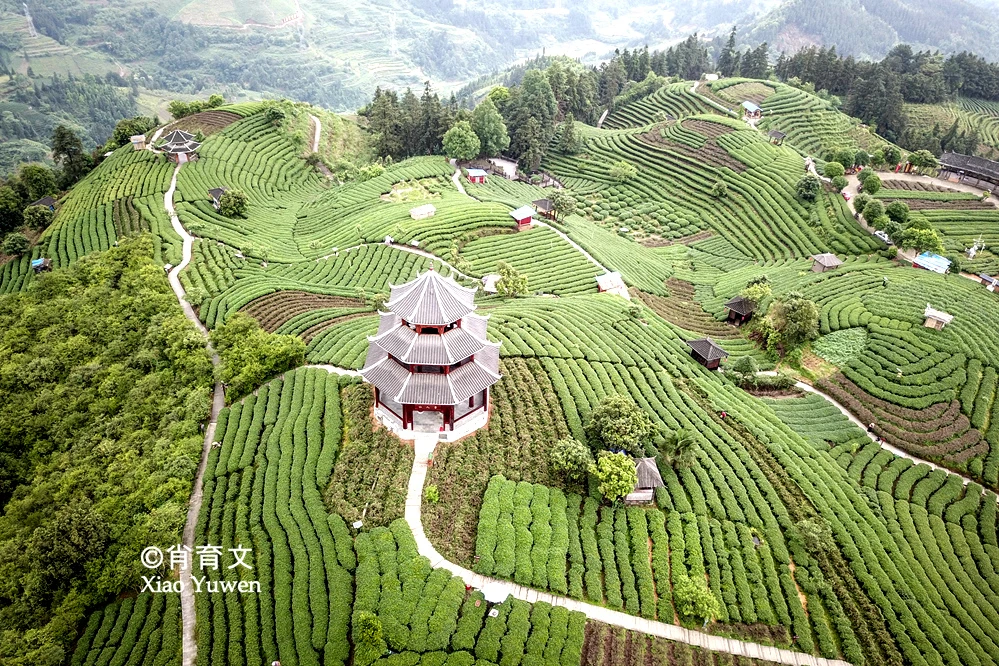
Speaking of Liuzhou, you surely know it is the sacred place where the Zhuang song immortal Liu Sanjie spread her songs. Legend has it that Liu Sanjie sang on Yufeng Mountain, moving the heavens and attaining immortality, and folk songs have echoed at the foot of Yufeng Mountain for generations. However, you probably don't know that Sanjiang tea is also a symbol of Liuzhou and one of China's national geographical indication products. Why is it called Sanjiang tea? Naturally, it is named after the three rivers converging here: the Xun River, the Duliu River, and the Rong River. This area features hilly and mountainous terrain, often described as '90% mountains, half water, and half farmland.' The altitude is not particularly high, generally between 600 and 900 meters, providing a favorable natural ecological environment where 'high mountains produce good tea,' so it is no surprise that high-quality Sanjiang tea is produced here. The Buyang Celestial Mountain Tea Plantation in Sanjiang County is located within Bajiang Township, at the junction of Hunan, Yunnan, and Guangxi provinces, and is a major tea-producing area in the Guangxi Zhuang Autonomous Region. The area is shrouded in clouds and mist all year round, with swarms of butterflies and bees, and a spring-like climate. The plantation boasts beautiful scenery, deep and fertile soil, and vigorous tea plants with plump, bright tea buds. The Celestial Mountain Tea Plantation is 23 kilometers from Sanjiang County town, with convenient transportation. It takes about an hour to drive from the county town, and the road is filled with thick fog. Fortunately, when we arrived at the Celestial Mountain Tea Plantation in Buyang Village, the weather cleared up, and the sun illuminated everything brightly, making the tea leaves appear even greener. It turned out we had been traveling through the clouds and mist, and now that we reached the mountaintop, the clouds were beneath our feet. Buyang Village's Celestial Mountain is a place of beautiful scenery. The entire mountain is covered with tea gardens, and tea is the main source of income. If you climb high and look into the distance, you will see vast expanses of green neatly arranged. The tea plants are planted along the mountain's contours, with smooth, flowing lines—a perfect fusion of human effort and nature, truly admirable! Celestial Mountain is the birthplace of tea, and there is a legendary story about its origin. It is said that two immortals once lived on the mountain, often playing chess on a large rock and discussing celestial matters, living a carefree life. One day, a woodcutter came to the mountain to chop wood and suddenly smelled a fragrance. Following the scent, he eventually found the two immortals playing chess on the rock, and the fragrance came from the teacups beside them. When the immortals saw a mortal approaching, they hurriedly vanished, accidentally knocking over their teacups, and thus the tea plants took root on the mountain. Strolling through the tea garden, the lush greenery refreshes your mind and makes you reluctant to leave. You can't help but bend down to touch the tea plants; the leaves are thick, but the new buds on top are very tender, and a little pressure could squeeze out moisture. Under the scorching sun, workers are picking tea. Tea is not easily produced; after picking, the leaves must go through steps such as withering, pan-firing, de-enzyming, and turning, taking at least half a month to produce a batch of tea. When you drink it, you should cherish it! When tired, sit and rest in the pavilion. The mountain breeze blows, and whether it's psychological or not, I always feel I can smell the faint fragrance of tea leaves. Let this moment last forever—relaxed and at ease. The starry wooden cabins built on the mountaintop! This is the highest ridge nearby; at night, you can almost touch the stars. Around the tea plantation, there are tea trees, oil tea trees, and Chinese fir trees, and the air is filled with the scent of tea. The terraced-like plantings are tea trees, and visitors can apply to experience tea picking. Carrying a small basket and wearing a straw hat, you can join the tea pickers to pluck the three tenderest top buds. Sanjiang County has a long history of tea cultivation and consumption. Sanjiang tea was already produced as early as the Tang Dynasty, with artificial cultivation of tea trees dating back over 2,000 years, and it has developed its own unique tea-drinking culture. Starting in 1988, Sanjiang County designated Buyang Village as a tea cultivation pilot. Over the past 20 years, the tea garden area in Buyang Village has reached over 3,600 mu.