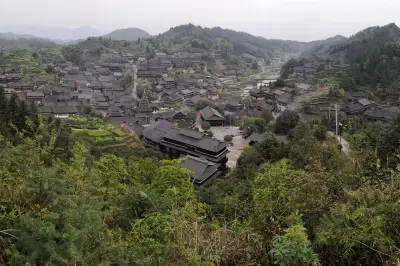
The Largest Dong Village in Guangxi: Eight Villages Connected with Over 10,000 Residents, Bigger Than the Qianhu Miao Village
When it comes to Miao villages, many might think of the Qianhu Miao Village in southeastern Guizhou, not only for its large scale and rich ethnic culture, but also for being the most influential Miao village. So when mentioning Dong villages, which one comes to mind first? If asked, I would recommend Chengyang Eight Villages in Liuzhou, Guangxi.
Like the Qianhu Miao Village, Chengyang Eight Villages is a collective name for a large village made up of multiple ethnic minority villages connected together. However, the Qianhu Miao Village consists of over a dozen villages and, due to early tourism development, is highly commercialized and appears larger. In contrast, Chengyang Eight Villages comprises eight Dong villages, which are more scattered and less concentrated, yet actually larger in scale than the Qianhu Miao Village.
Located in Sanjiang Dong Autonomous County, Liuzhou City, Guangxi Province, Chengyang Eight Villages is composed of eight natural villages: Ma'an, Ping, Yan, Pingtan, Dong, Chengyang Dazhai, Pingpu, and Jichang. It covers an area of 12.55 square kilometers, with over 2,000 households and nearly 10,000 residents—almost twice the population of Qianhu Miao Village.
Due to its strong ethnic atmosphere and numerous festivals, Chengyang Eight Villages is also known as the "Township of a Hundred Festivals." It is said that during festivals, the entire village buzzes with excitement, with songs and celebrations everywhere, creating a joyous and grand atmosphere. Here, visitors can not only enjoy the natural beauty of ethnic villages but also watch folk performances showcasing Dong customs. It is an excellent destination for sightseeing, photography, and experiencing Dong culture.
Dong villages are similar to Miao villages in architecture, often featuring wooden stilted houses. However, Dong villages have their unique characteristics, notably the tall drum towers. "One village, one clan, one drum tower; one look, one listen, one experience" is a saying that captures the essence of Dong villages. The drum tower is the highest point in a Dong village, a landmark building, and a place for rest, entertainment, celebrations, and meetings for the Dong people.
Each of the eight villages in Chengyang has its own drum tower, and some villages have more than one. The towers vary in style, with most dating back to the late Qing Dynasty and early Republic of China period, over a hundred years old.
Besides drum towers, the most distinctive architectural feature of Chengyang Eight Villages is the wind-and-rain covered bridges. Like the drum towers, every village has a wind-and-rain bridge. The most famous is the Yongji Bridge spanning the Linxi River. It is a stone-pier wooden structure with pavilions, consisting of 2 abutments, 3 piers, and 4 spans. Built mainly of wood and stone, it features 5 tower-style bridge pavilions and 19 bridge corridors, with the pavilions and corridors connected. The central pavilion has upturned eaves, and the bridge's wall pillars, eaves, and tiles are adorned with carvings and paintings.
Yongji Bridge of Chengyang Eight Villages is a masterpiece of architecture, combining corridors, pavilions, and towers in one structure, unique in Chinese and international architectural history. It is a representative example of Dong wind-and-rain bridges, the best-preserved and largest of its kind, a testament to the wisdom of the Dong people, and an artistic treasure of Chinese wooden architecture. It is now a key national cultural relic protection unit.
Why is it called Chengyang Eight Villages? "Eight Villages" is straightforward—it consists of eight villages. "Chengyang" refers to two surnames. Legend has it that Chengyang Eight Villages began during the war at the end of the Tang Dynasty. After the Yue people, ancestors of the Dong, were defeated, one branch surnamed Yang migrated northward to this area, where they encountered the surname Cheng, who had moved south due to wars in the Central Plains. The two groups settled and multiplied, giving rise to the later Chengyang Eight Villages.
The eight Dong villages of Chengyang are like pearls scattered among the mountains at the borders of Guangxi, Hunan, and Guizhou. With their unique wind-and-rain bridges, drum towers, stilted wooden houses, and the surrounding mountains, streams, fields, and rich folk customs, they form a distinctive and picturesque landscape, earning Chengyang Eight Villages the reputation of "one of China's most beautiful small towns."
When traveling to Dong villages, the "high mountain flowing water" (a drinking ritual) and the "hundred families banquet" are cultural symbols of Dong hospitality, unity, and harmony. It is said that these welcoming rituals have been practiced in the Sanjiang Dong region for centuries and represent the highest etiquette for receiving guests. The hundred families banquet involves each household preparing food and drink, setting up long tables in a line at the drum tower square. Guests can eat from the first table to the last, with people mingling, toasting, and enjoying the lively atmosphere. A local saying goes: "Eat from a hundred families' meals, unite a hundred families' hearts, drive away a hundred kinds of evil, and accomplish a hundred kinds of things." If you have the chance to travel to Sanjiang, you can experience Chengyang Eight Villages firsthand.