Intoxicating Luosifen: A Stroll through Liuzhou (Part 2)
After tasting the luosifen, it felt as though I had fulfilled a long-cherished wish, and I couldn't help but feel much more relaxed. I returned to my room to get ready briefly, then began my formal stroll through Liuzhou.
Within a 250-kilometer radius centered on Liuzhou, over 80% of Guangxi's 4A-level scenic spots are concentrated, and together with neighboring Guilin they form the world-renowned Greater Guilin Scenic Area. Liuzhou is known as the 'Stone Capital of China' with the saying 'Liuzhou's wondrous stones are second to none under heaven.' Liuzhou is the legendary birthplace of the song immortal Liu Sanjie, who, it is said, sang on Yufeng Mountain and moved heaven itself, achieving enlightenment and becoming an immortal. Folk songs have echoed around the foot of Yufeng Mountain for generations. The songs of the Zhuang, the stilt houses of the Dong, the dances of the Miao, and the festivals of the Yao are considered the four highlights of Liuzhou's ethnic charm.
The Liuzhou Museum is situated on the east side of People’s Square. It is a comprehensive national-level key museum with advanced facilities and modern functions. Its collection includes over 36,000 cultural relics, with main exhibitions such as the Liuzhou History and Culture Exhibition, Liuzhou Ethnic Minority Customs Exhibition, Ancient Bronze Exhibition, Ancient Calligraphy and Painting Fan Exhibition, and Ancient Ceramics Exhibition, presenting the city's ethnic culture and history to visitors.
Visiting the museum does not require a ticket; you only need to make a reservation via their WeChat official account. Outside public holidays, you can even book on the spot. The staff at the entrance are warm and welcoming; they will guide you through the reservation procedure. Then, after putting on a mask and passing the security check, you can thoroughly explore and learn about the history of Liuzhou. An hour and a half to two hours is enough for a visit. From the museum, cross Wenchang Bridge, and not far away is the Liuzhou Industrial Museum, about two kilometers away. As a free spirit who enjoys exploring alone, my first choice is usually to walk. Along the way, you can take in the local streetscape, which is also a great way to understand the customs and culture of the place. After all, as the saying goes, 'the best scenery is always on the road.'
The Liujiang River divides Liuzhou into two parts—north and south—flowing in a U shape. The north bank is mainly the commercial district, while most scenic spots and landscapes lie on the south bank. Walking onto Wenchang Bridge and standing in the middle, looking down at the clear Liujiang River and the scenery on both banks, who could imagine that this beautiful city with its green hills and blue waters, so picturesque today, was once a heavily polluted area where acid rain accounted for up to 70% of the annual precipitation just forty years ago? Reflecting on this, I couldn’t help but be filled with emotion. In this world, only our China dares to 'change the heavens and the earth for a new day.'
The Liuzhou Industrial Museum records this history in detail. Here you can learn about the transformation of this heavy industrial city, its pollution control, and the future prospects and planning of its urban industries.
After the visit, my heart surged with emotion. A feeling of happiness as a Chinese person welled up spontaneously.
Opposite the museum is Yaobu Ancient Town. Initially, I had planned to book a hotel in the ancient town, but while doing my research I learned that today's Yaobu Ancient Town is basically a 'renovated as new' cluster of Republican-era buildings, often jokingly called 'fake antiques.' Its style is similar to Nanjing’s 1912 Republican-era architectural blocks. During the day it’s fairly quiet, but in the evening it becomes a place for locals and tourists to dine and enjoy late-night snacks.
About 90% of the buildings in the ancient town are barbecue joints, restaurants, beer houses, bars, and the like. In short, you can party here till the early hours without a problem. The distance from the Industrial Museum to the next sight, Ma’anshan (Horse Saddle Mountain), is 3.5 kilometers. To save time, I opted for the bus. Bus No. 12 from Wenchang Road West takes only about 20 minutes, roughly seven stops, to reach Liuzhou’s highest point, Ma’anshan.
Ma’anshan stands majestically on the south bank of the Liujiang River, stretching roughly east to west, over 1,500 meters long and 270 meters above sea level. The mountain’s shape features two prominent peaks with a dip in the middle, resembling a horse saddle. Climbing to the summit, you are greeted with a sweeping panorama, evoking the feeling that 'all mountains lie beneath your feet, and clouds drift before your chest.' Since the Tang and Song dynasties, Ma’anshan has been a famous mountain in Liuzhou and a renowned tourist destination. On the western side there is the Ziyi Rock, which resembles folded palms and is a Taoist site. It houses the shrine of Emperor Ziyi and a 'chessboard stone' with dark skin and red veins, where legend says Han Zhongli and Lü Dongbin of the Eight Immortals once played chess, leaving behind immortal footprints at the entrance. The rock is also adorned with numerous inscriptions and carvings, including the seal-script cliff inscription 'Diaotai' (Fishing Platform) by Fang Xinru of the Song dynasty and the cliff carving of 'Xindian Ji' (Record of the New Hall) by Wang Anzhong. Nearby, facing the ancient Lingquan Spring and backed by Ziyi Rock, the Lingquan Ancient Temple was known as the 'foremost temple in Guangyou' during the Song dynasty. Near the summit on the northern side, there is the Xianyi Rock, which resembles a grand mansion, covering about 300 square meters. Its entrance is high and spacious, and inside, stalactites have formed stone pillars, curtains, and flowers that resemble human figures and objects in a myriad of shapes. The Tang dynasty writer Liu Zongyuan once described it in vivid detail.
Like Guilin, Liuzhou is part of the karst landscape, so these small mountains, over 200 meters in altitude, rise abruptly and steeply. Hiking all the way up and down would require some stamina. Fortunately, there is an elevator. A vertical shaft elevator inside the mountain takes just 48 seconds to reach the summit. Entering the horizontal tunnel at the mountain base feels like stepping into a time tunnel. The passage is deep, about 200 meters long, and its walls are pasted with panoramic views of Liuzhou from various eras.
After walking through the 200-meter tunnel, you reach the lobby of the vertical elevator. The buttons inside are simple, just up and down. The elevator entrance is at level -1, and it takes you to level 1. The elevator car is not large, holding up to 13 passengers at a time. Forty-eight seconds later, you arrive at the top of Ma’anshan. Step onto the observation platform and the 'natural grand bonsai' immediately unfolds before your eyes.
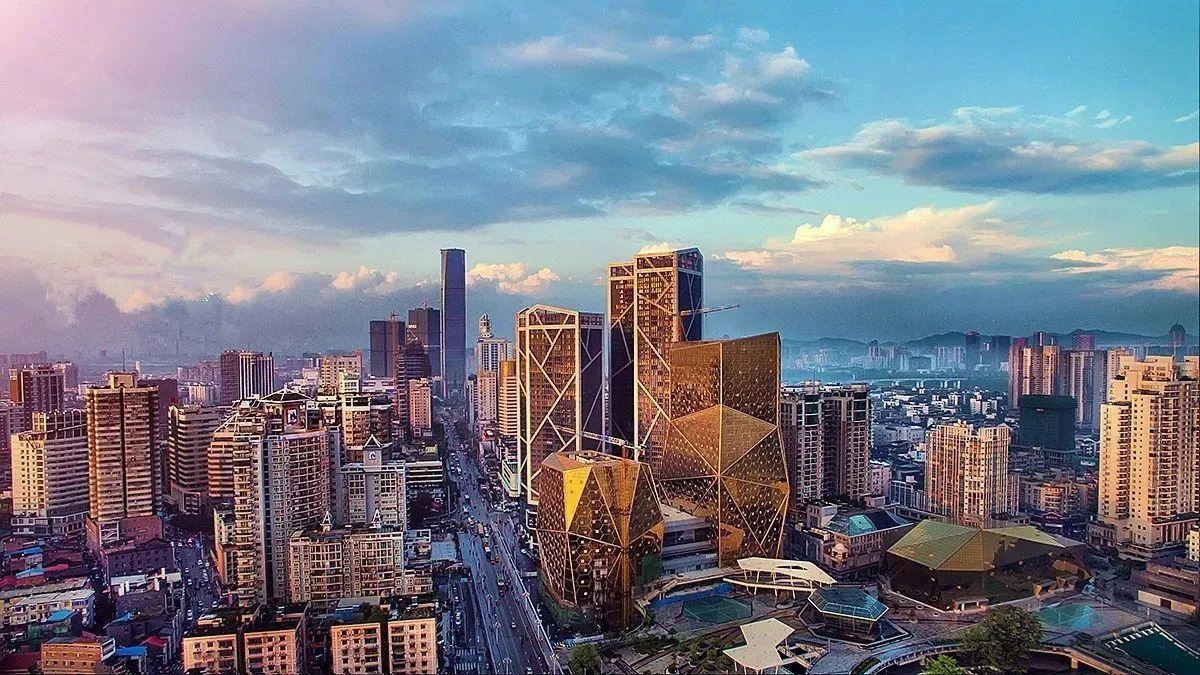
Standing on the summit viewing platform, gazing down at Liuzhou in all directions—south, east, north, west, front, back, left, right—my heart surged with emotion, and I couldn’t stop exclaiming in admiration. This feeling can’t be expressed simply with the word 'beautiful'... Since I can't put it into words clearly, let's just feel it, feel this city with our hearts...
After spending about half an hour on the observation platform, I began my descent. Though the height is only a little over 200 meters, it took me a full forty-plus minutes to go down, giving me a profound understanding of the true meaning of 'easy to go up, hard to come down.' When I finally reached the entrance of the parking lot and the small shop at the foot of the mountain, my legs were shaking so much I couldn’t take another step. I had no choice but to buy a drink, borrow a small stool, and sit down to rest and catch my breath.
At that moment, I was tired, thirsty, and hungry, yet the sense of satisfaction was indescribable. Unknowingly, it was already past 2 p.m., and my stomach began to rumble again. From the distance, a certain distinctive aroma seemed to drift over from this city, tempting me, drawing me to follow it involuntarily, to seek out my 'intoxicating luosifen.' (End of article)