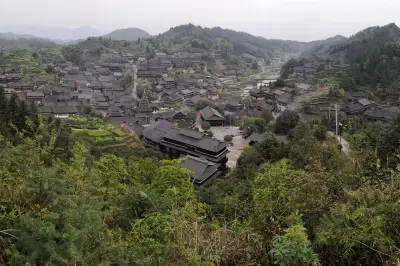
The Only Dong Museum in China, Located in Sanjiang at the Junction of Three Provinces, with Rich Exhibits Not to Be Missed
Sanjiang is the only Dong autonomous county in Guangxi and has the largest Dong population among the five Dong autonomous counties in China, earning the reputation of 'Chinese Dong in Sanjiang' and 'Thousand-year Dong Village, Dreaming of Sanjiang'. It is home to not only the UNESCO intangible cultural heritage Dong Grand Song, the 'World's First Drum Tower' Sanjiang Drum Tower, the 'World's Longest Wind and Rain Bridge' Sanjiang Wind and Rain Bridge, and the world's first wooden structure arena 'Dongxiang Bird's Nest', but also the only Dong museum in China.
This museum is called the Sanjiang Dong Museum. It is located on Hexi Jiangfeng Street, Guyi Town, Sanjiang County, adjacent to the performance venue of 'The Dong's Sanjiang'. Therefore, it is a must-visit spot in Sanjiang. During the day, you can visit the Dong Museum, and in the evening, you can watch the performance 'Dong Listening Sanjiang' next to it, gaining a comprehensive understanding of Sanjiang and Dong culture.
Unlike the modern museums in Beijing, Shanghai, and Guangzhou, the Sanjiang Dong Museum has a strong Dong ethnic architectural style. The entire building is arranged north-south, facing east, with a three-story main structure. The central pavilion is a five-story multi-eaved pyramid roof, while the side pavilions are two-story multi-eaved gable and hip roofs. It is a national-style building integrating elements of Dong drum towers and wind and rain bridges, and it is the only Dong museum in China.
Entering the museum lobby, the first thing you see is a collage painting full of Dong ethnic charm, with prominent elements like drum towers and wind and rain bridges. Above the painting is a banner that reads: 'All ethnic groups are one family, working together to realize the Chinese Dream.'
The Sanjiang Dong Museum was built in 1992, nearly thirty years ago. Although the museum is not large, it houses over 3,000 artifacts reflecting Dong culture, including clothing, musical instruments, food, and tools. The museum has three exhibition halls: Hall 1, Hall 2, and the National Unity and Progress Hall. Despite its small size, it is said to contain earrings and ceramics from the Eastern Han Dynasty, each piece exquisitely crafted.
Wandering through the museum feels like stepping into a river of time, gaining a comprehensive understanding of the history and culture of the Dong people. According to records, the Dong ancestors were referred to as 'Qianshou' in pre-Qin literature, and it is generally believed that the Dong evolved from a branch of the ancient Baiyue. The Dong primarily engage in agriculture, mainly rice cultivation, which has a long history, alongside forestry, achieving a fairly high level of agricultural and forestry production.
According to the sixth national census, there are 2.87 million Dong people in China, mainly distributed in Qiandongnan Miao and Dong Autonomous Prefecture and Tongren area in Guizhou Province; Xinhuang Dong Autonomous County, Huitong County, Tongdao Dong Autonomous County, Zhijiang Dong Autonomous County, Jingzhou Miao and Dong Autonomous County in Hunan Province; Sanjiang Dong Autonomous County, Longsheng Various Nationalities Autonomous County, Rongshui Miao Autonomous County in Guangxi Zhuang Autonomous Region; and Enshi Tujia and Miao Autonomous Prefecture in Hubei Province.
Within this region inhabited by the Dong, Sanjiang in Liuzhou, Guangxi, is a central area, so the Dong culture preserved here is the most complete. Although there are several versions of Dong development, experts generally agree that the Dong evolved from a branch of the ancient Baiyue. During the Spring and Autumn and Warring States periods, this area belonged to the Shangyu (Yue) region of the Chu State; in the Qin Dynasty, it was part of Qianzhong Commandery and Guilin Commandery; in the Han Dynasty, it was part of Wuling Commandery and Yulin Commandery. From the Wei, Jin, Southern and Northern Dynasties to the Sui Dynasty, it was called 'Wuxi Region', and during the Tang and Song Dynasties, it was called 'Xidong'.
The Dong Museum contains many documents about Dong history, recording and displaying the evolution of the Dong, as well as many artifacts showcasing Dong culture, such as clothing, dance, and paintings. The clothing display area is relatively large. From these exhibits, we can see that Dong men's clothing is relatively simple, while women's clothing is much more varied in types and designs, with different styles, decorations, embroidery, and colors. Dong women's clothing roughly falls into three types: tight skirt type, loose skirt type, and pants type. In 2014, Dong clothing was approved by the State Council to be included in the fourth batch of national intangible cultural heritage.
The Dong are an ethnic group skilled in song and dance. A local saying goes: 'Those who can speak can sing, and those who can walk can dance.' Therefore, on important festivals, they sing and dance, playing beautiful music. The museum displays many of their musical instruments, especially the Lusheng, in various sizes, as well as the Niutuiqin (ox-leg fiddle) and Dong pipa, all of which they excel at playing.
In summary, the Sanjiang Dong Museum is one of China's key museums and the only comprehensive museum in the country themed on Dong culture. It comprehensively displays Dong architectural culture, food culture, clothing culture, and ethnic customs. If you travel to Sanjiang, this museum is a must-visit, allowing you to gain the most understanding of Dong culture in the shortest time.