2021: Slurping Authentic Luosifen, Roaming the River City of Liuzhou
D1-5.14: Arrive in Liuzhou, climb Ma'anshan to enjoy panoramic night view of Liuzhou
D2-5.15: Visit Longtan Park, explore Liuzhou Industrial Museum, wander through Yaobu Ancient Town, admire the Liujiang night scenery
D3-5.16: Visit Liuhou Park, explore Liuzhou Museum, and indulge in endless bowls of rice noodles
My superficial knowledge of Liuzhou came entirely from the nationwide craze for luosifen (river snail rice noodles). Truly, a single bowl of noodles has put this city on the map. With its unique flavor, luosifen has broken out of its local bubble to become a 'lifeline' for people across China and a 'source of joy' for today's youth. It carries a magical allure—once you fall for it, there's no turning back. It was my craving for luosifen that led me, alone on a weekend getaway using a flexible flight pass, to head straight to Liuzhou to slurp my fill and, while at it, get to know the city beyond the noodles.
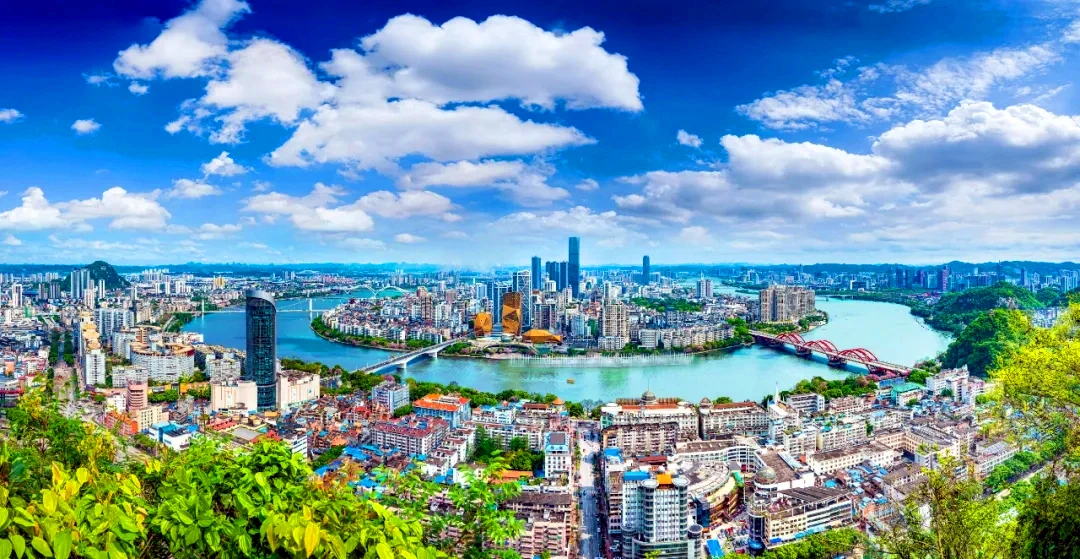
The Liujiang River meanders for hundreds of miles, embracing Liuzhou on three sides like a jade ribbon. With the river's three branches converging and encircling the city like a kettle, Liuzhou forms a pot-shaped peninsula. Founded over 2,100 years ago, it features typical karst topography, creating a landscape where 'towering peaks rise abruptly, unfolding like a scroll painting.' The stone peaks are uniquely beautiful, the ponds deep and emerald-green. The hundred-mile Liujiang is a hundred-mile gallery, its water quality ranked first in the nation. Days with excellent air quality exceed 90% of the year—clear waters, green banks, unhindered water flow, and stunning views. At the same time, Liuzhou is a famous industrial city rich in cultural heritage, leading the nation in new-energy vehicle development.
I arrived at Liuzhou Bailian Airport at dusk. As it's a dual-use military-civilian airport, the flight attendant repeatedly emphasized over the intercom that window shades must stay closed during landing. A bus takes you directly from the airport to Ma'anshan, and my hotel was nearby—very convenient. By the time I checked in, it was already dark, so I hurried up the mountain to catch the night view of Liuzhou.
Since the Tang and Song dynasties, Ma'anshan has been a famous mountain in Liuzhou, one of the old Eight Scenic Spots known as 'Heavenly Horse Soaring.' The Tang-era Liu Zongyuan and Ming-era Xu Xiake both left travel notes here. It has long been the best vantage point for overlooking the city. As the highest peak in the urban center, the mountain features abrupt east and west summits with a saddle-shaped dip in between—hence the name. At only 270 meters above sea level, the paths are steep and straight up and down. Climbing on foot in the sweltering heat was somewhat taxing, but when I finally reached the summit and looked out from the viewing platform, it was all worth it. The nightscape before me couldn't simply be described as 'beautiful.' It was a dazzling feast of colorful lights. Brilliant illumination lit up all the buildings, with lights near and far twinkling like stars in the sky. The whole city was ablaze with neon reflections and bustling traffic. Several bridges straddled the river like long rainbows lying on the waves, majestic and impossible to look away from. No wonder it's said to rank among the top five night views in the world.
As the saying goes, 'true cuisine is found among the people.' The most delicious and authentic luosifen is always in hole-in-the-wall joints tucked in alleyways. Coming down hungry from Ma'anshan, I found 'Guangle Luosifen' in a nearby neighborhood. The highlight to praise was the water spinach garnish—just a quick blanch in boiling water makes it incredibly tender. Coupled with rich, savory snail broth and a spoonful of chili oil to your taste, a single slurp can make you choke if you're too eager. The peanuts were fragrant, the pickled long beans and wood ear mushrooms crispy and refreshing. The rice noodles, also blanched, were smooth and chewy as they slid into your mouth, leaving a tangy aftertaste and lingering fragrance. Sour bamboo shoots are the soul of luosifen; without them, it's incomplete. But not everyone can handle their smell, because both the stink and the aroma of luosifen come from the shoots. Of course, you can add fried duck feet, crispy pork trotters, marinated eggs, sausages, tofu puffs…
Satisfied after my noodle feast, I went back to the hotel only to find the neighboring venue buzzing with excitement. Getting closer, I saw a luosifen speed-eating contest. Whoever finished a giant bowl in the shortest time won cash. People were raring to go, the atmosphere building to a fever pitch, contestants sweating bullets. Sure enough, talent emerges from the streets—one person actually downed a whole bowl in under a minute. Truly impressive!
Taking advantage of the cool morning, I climbed Ma'anshan again. The scenery, like a sash encircling the city, unfolded fully: 'A thousand peaks stand round the wilderness, one river embraces the city.' The natural topography of Liuzhou is laid bare from the summit. Indeed, the views here differ throughout the 24-hour day, but no matter the time, you're treated to breathtaking sights. (Some photos borrowed.)
Liuzhou's public infrastructure is very people-friendly. Most parks and museums offer free admission, including several national 4A-level scenic spots. Everywhere you see two-seat MINI Baojun shared electric cars, resembling Smart cars—cute, easy to drive, and you can hop in and go. Plus, parking is free in the city. Absolutely convenient and comfortable. The bus system is also well-developed; you can check real-time bus arrivals via WeChat. You can even hop on a rare water bus for a leisurely cruise on the Liujiang. (Some photos borrowed.)
Longtan Park is close to downtown, easily accessible. It combines karst natural landscapes, ethnic minority customs, and subtropical karst plant scenery. Surrounded by one lake, two pools, four valleys, and twenty-four peaks, it features deep, emerald pools, a mirror-like lake, green mountain folds, and babbling streams—a secluded paradise amidst the bustling city. Tang dynasty writer and Liuzhou governor Liu Zongyuan once prayed for rain here. Above Jinghu Lake stands a covered bridge modeled after the Chengyang Wind and Rain Bridge in Sanjiang, a reinforced concrete gallery bridge with flying eaves, uniquely stylish.
Liuzhou boasts profound historical and cultural heritage. To understand this city, you must visit the Liuzhou Museum and the Liuzhou Industrial Museum. Built in 2012, the Industrial Museum filled a gap in Guangxi's industrial museums, becoming the first comprehensive urban industrial museum in Guangxi and even the nation. Here you can learn about Liuzhou's transformation as a heavy industrial city and its pollution control, as well as future urban industrial prospects. It was only here that I realized this picturesque city was, four decades ago, a heavily polluted area with acid rain accounting for as much as 70% of annual precipitation. At the museum entrance, a row of low red brick walls first catches your eye, with dark red characters spelling 'Liuzhou Industrial Museum' and metallic English text, evoking an industrial vibe before you even step inside. The museum mainly consists of the Industrial History Hall, Enterprise Elegance Hall, and Eco-Livable Hall. Every restored machine and scene exudes a sense of history, immersing you in the long stream of Liuzhou's industrial development. The 'charcoal-powered car' from the old days and today's Baojun MINI electric vehicle vividly showcase the journey of automobile advancement. On one side, a green train has been converted into a book bar, drawing visitors daily for photo ops—truly the museum's star attraction.
Under the blazing sun, I returned to the hotel area, naturally to try the wildly popular Fei Luo Zhuang. Their signature dish is the snail and duck foot pot. The duck feet are first fried, then braised in a stock pot—the stock is freshly made daily, the broth fragrant and meaty. The aroma alone makes your mouth water. River snails and crispy-then-softened duck feet are stewed together with water spinach, sour bamboo shoots, taro, and peanuts—a heaping potful. The snails are generous, large with crunchy meat. The fried duck feet, golden and long, are each cooked until tender and infused with flavor. A gentle bite easily separates the skin and meat. A sip of the soup is rich and mellow, tofu puffs burst with juices, and bean curd skins are thin yet intact, fully aromatic. In just a decade, Fei Luo Zhuang expanded from one store to six in Liuzhou; it's no exaggeration to say they've nearly taken over the whole street.
Yaobu Ancient Town boasts a prime riverfront location. Its development theme is to 'recreate the quaint charm of the old Yaobu town, revive the past prosperity of the ancient port.' The architecture blends traditional classical and modern styles. As night falls, colorful lanterns twinkle, the moon casts a graceful spell, and the mood climbs into the treetops. Local snack bars light up with warm, romantic glows. The crowd bustles, the scene flows with color, lively and vibrant. Strolling one street lets you savor the city—this is Liuzhou's urban living room, slowing time, feasting on the brilliance of the Liujiang night, a place for leisurely walks and lazy indulgence.
Gazing at the calm river, orange-golden lights began to shimmer, as if the entire surface were paved with gold foil. The hundred-mile Liujiang banks glowed with neon reflections. Eighteen bridges of various designs spanned the river, each a superb viewing spot. The mountains, waterfalls, and musical fountains along the urban riverbank, illuminated by colorful landscape lights, resembled strings of crystal-clear night pearls, reflected in the winding Liujiang like the Milky Way, merging into a dreamy scene in the pot-shaped city's night. The large musical fountain on the water is 315 meters long, surpassing the world's largest in Dubai and the second largest in Las Vegas, making it the biggest floating fountain on any river in the world. It performs punctually at 8 p.m. for 15 minutes. The most unique sight is probably the largest man-made waterfall in Asia, from Yaobu Ancient Town to the Wenmiao Temple area. Cascading down half of Panlong Mountain, the streams turn into silver chains, pouring down as if playing a moving symphony. Pavilions, terraces, and pagodas on the mountain interplay, outlining a dreamlike landscape painting. The artificial waterfall cluster is incredibly realistic, water gushing from crevices among strange rocks, the effect natural and vivid. Especially with the rapid torrent and loud roar, unsuspecting visitors might honestly believe such a spectacular waterfall has always existed by the Liujiang.
Liuzhou Wenmiao Temple was originally built during the Zhenguan reign of the Tang Dynasty, destroyed in a citywide fire in 1928, and rebuilt in 2009, reborn from ashes. Nestled against a hill and the water, it is resplendent in gold and green. The architecture mainly follows the Song Dynasty style with Lingnan local influences, housing the nation's largest cast-bronze, gold-plated seated statue of Confucius. Dongmen Gate Tower, first built during the Hongwu period of the Ming Dynasty, stands 17 meters tall and is Liuzhou's last surviving brick city gate from the Ming and Qing dynasties. After centuries of wind and rain, it still stands majestically on the bank of the Liujiang, exuding unique charm. These ancient buildings glow with a different light under the night's neon.
Liuzhou luosifen is akin to stinky tofu—those who love it adore its rich ingredients and fresh flavor, while those who don't can't stand its pungent smell. Aside from the usual soup noodles, I prefer dry-mixed noodles, especially Dahua Dry Mixed Noodles hidden in a small alley, hailed as 'the best dry mixed noodles in Liuzhou.' Order at least two liang (around 100g). The texture is completely different from soup noodles. The essence lies in the toppings: chopped barbecue pork, crushed peanuts, crispy pork lard bits, minced scallions, minced garlic, and a dark ingredient I think is called niu laba (dried beef jerky). Mix the chewy round noodles evenly with the toppings, letting the minced meat and sauce fully coat the noodles. Then dig in, filling every crevice of your stomach. It's crispy, crunchy, and layered with flavor.
The most iconic historical figure of Liuzhou is Liu Zongyuan, who once served as the governor of Liuzhou. Liu Hou Park was built in his honor, located right in the city center. The park features a typical Jiangnan style, with towering trees, pavilions, terraces, small bridges, and flowing water. Locals fully enjoy their wonderful lives here. I noticed that the people of Liuzhou aren't big fans of square dancing; instead, they love playing instruments and singing. The city often echoes with resonant songs. Looking for the source, I'd find professional-grade setups. Whether the singing quality or the accompaniment, I couldn't help but admire the abundant artistic flair of the folks from the hometown of the songstress Liu Sanjie. A team of hand drummers in the park even held my attention for a long time—all elderly ladies, numerous, well-trained, unified in rhythm, forceful, each face brimming with happiness. Truly enviable!
To truly understand a city, start with its museums. A museum is a city's cultural calling card, a witness to its development, telling stories softly. As the 'flagship' of Liuzhou institutions, the Liuzhou Museum houses over 36,000 artifacts. Each precious exhibit takes you through millennia, letting you feel the flow of time and glimpse the shadows of history. I absolutely loved the hanging oil-paper umbrellas in the first-floor lobby—layer upon layer, with sunlight streaming through, creating a dreamy effect.
When talking about longstanding luosifen shops in Liuzhou, Xihuan Feizai Luosifen is always on the list. Their luosifen is relatively light, blending its signature sour, spicy, fresh, and fragrant flavors, plus toppings like sour bamboo shoots, wood ear, peanuts, and fried yuba to intensify the aroma. Paired with my favorite duck gizzards, it was another satisfying feast. But joy turned to sorrow when I received bad news: my flight was canceled. Although noodle-slurping is great, this was a bit too hospitable—was Liuzhou forcing me to stay an extra night?
既然来了, make the best of it. Since the city was so keen to keep me, I might as well continue slurping noodles. I had a bowl of pig trotter noodles that evening. Lin Ji Pig Trotters Noodles: the fried trotters are soft, glutinous, and bouncy, incredibly crispy, packed with collagen, having absorbed the broth. The soup base is not greasy, clean and sweet—a stark contrast to the strong-flavored luosifen, but just as tasty.
Liuzhou is such a laid-back, pleasant city. The pace of life is slow; you won't feel fatigued like in a first-tier city. The happiness index is full. Climb a mountain or wander a park by day, stroll along the Liujiang and admire the nightscape in the evening. When free, take the kids to soak in the ocean of history at the museum. When hungry or yearning, simply grab a bowl of luosifen—what more could one ask for?