Morning congee, noon sour fish soup, evening Luosifen: Shenzhen travelers' weekend getaway
Where to go for cross-province trips from Shenzhen
'Which province have you visited the most?' people often ask, knowing I've traveled all over China. As Shenzhen resumes cross-province tourism, locals are pondering where to go—the choice before departure is always harder than the trip itself. For me, the province I've visited most is Guangxi, and within Guangxi, the places I've gone to most are Guilin, Hezhou, Liuzhou, Chongzuo, Beihai, and southeastern Guangxi.
The three-hour high-speed rail city tourism circle
I remember over a decade ago, I was crazy about going to Guilin and Yangshuo, hiking along the Li River, cycling, rafting, and rock climbing. I even climbed Tianma Mountain, Xilang Mountain, and Yuping Mountain near Yangshuo town. At night, I'd stay on West Street, eat beer fish, and hang out in bars listening to music. I went almost every weekend, taking a bus on Friday night, staying in Yangshuo on Saturday, and rushing back to Shenzhen for work on Monday morning. I spent Friday and Sunday nights mostly on the bus. Now, high-speed rail from Shenzhen reaches Guilin, Hezhou, Liuzhou, and more in Guangxi. Even if you don't want to drive or take a bus, you can get there easily. I like traveling to Guangxi first because it's convenient. Guangxi is adjacent to Guangdong, so even a weekend trip is feasible.
From Shenzhen to Guilin, driving used to take almost half the night, but now high-speed rail takes just over two hours and fifty minutes. The 'super railway through karst'—the Guiyang-Guangzhou and Nanning-Guangzhou high-speed rails—connect Guangdong, Guangxi, and Guizhou. These high-speed trains link 13 tourist cities along the three provinces, turning them into a 'three-hour city tourism circle.' High-speed rail has enabled a 'fast travel, slow sightseeing' and 'one line, multiple stops' travel style in Guilin, Liuzhou, and Hezhou, making it easy to spend a weekend in Yangshuo, Shenzhen's backyard, without traveling all night.
How to choose among Guilin, Liuzhou, and Hezhou
On the cliffside carvings of Duxiu Peak in Jingjiang Princes' City in Guilin, the phrase 'Guilin's landscape is the best under heaven' is famous throughout China and even abroad—people know Guilin for its 'green hills, clear waters,奇特 caves, and beautiful rocks.' When traveling abroad and chatting with backpackers, the places they ask most about are the Forbidden City, the Great Wall, the Terracotta Warriors, and Guilin's landscape. In terms of scenery, Guangxi's natural landscapes are spectacular, with unique geological formations ranking first in the country. What can one visit in Guilin, Liuzhou, and Hezhou? Some summarize them as 'World Guilin,' 'Charming Liuzhou,' and 'Longevity Hezhou.'
Guilin's landscape is a global landmark. Most foreign tourists visiting Guangxi first take a boat ride on the Li River. I prefer hiking along the Li River, from Yangdi to Xingping—a 15-kilometer trail along the river that feels like walking through a ten-mile gallery. I've done it many times without getting tired, and it's more immersive than a boat ride. From Yangshuo town, I cycle to the upstream pier of Yulong River, hand my bike to the boatman, and drift on a bamboo raft—long trips of 6 km, short ones of 2 km. Sometimes I jump off the raft for a swim and hear the antiphonal singing performances of 'Third Sister Liu and the Three Scholars.'
Guilin is actually quite large. Besides the well-known Li River, there are many different landscapes. In spring, go to the green Longji Rice Terraces; in autumn, visit Ocean Township for golden ginkgo leaves; in summer, drift on the emerald waves of Shangri-La; at night, photograph fishing fires and cormorants in Yangshuo, feeling the charm of fishing songs at dusk. There's also Elephant Trunk Hill in Xiangshan District, Duxiu Peak in Jingjiang Princes' City, the underground palaces of Reed Flute Cave and Silver Cave, the 'Conch Watching the Sky' at Bajiaozhai in Ziyuan County, Gudong Waterfall, and the old streets of West Street—you could drive around for days and still not see it all.
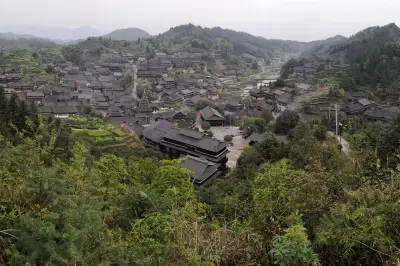
In the past, when taking a green train through Liuzhou station, I hardly ever stopped. Tourists mostly associate Liuzhou with its famous snack, Luosifen. But Liuzhou also has notable attractions, such as Chengyang Eight Villages in Sanjiang. This thousand-household Dong village is at the border of Guangxi, Hunan, and Guizhou in Sanjiang Dong Autonomous County. After the Guiyang-Guangzhou high-speed rail opened, you can take a direct train from Shenzhen North Station to Sanjiang South Station in just three and a half hours. In 2013, we drove to Sanjiang County—780 kilometers, some rough roads, taking nearly eleven hours, almost the whole day on the road.
Chengyang Eight Villages boasts the world's largest wind-rain bridge—Chengyang Yongji Bridge, one of the four great historic bridges in the world. The ancient bridge spans the Linxi River beside Chengyang Eight Villages. Its structure uses no iron nails; instead, holes are chiseled in columns and joined with mortise and tenon joints. The bridge has five four-story pagoda-style pavilions, with railings along the walkways. Visitors can sit on the bridge and enjoy the scenery on both banks. Besides Yongji Bridge, there are many wooden village houses worth photographing, but I prefer to listen to the 'Drum Tower Grand Song' at Chengyang Eight Villages and enjoy Lusheng dances and Duoye dances.
Hezhou is the place I've explored most deeply in Guangxi. Initially, I went for its beautiful mountains and waters, but I ended up becoming obsessed with its ancient villages and stockades. The first place I visited was the千年 old town of Huangyao. I stayed in a guesthouse in an old courtyard, walked and photographed every corner. I wandered through the trendy alley of Liyu Street, lingered at the Sima Mansion courtyard, watched locals washing vegetables and clothes at the Xianren Ancient Well, admired beautifully dressed women crossing ancient small bridges, visited ancient stages and watchtowers, and strolled under the Dragon Claw Banyan tree. I also learned to make 'Eighteen Stuffed Dishes' with locals, took a bamboo raft to see the landscape of Huangyao, and even dressed in ancient costume for photos.
Besides Huangyao Ancient Town, Hezhou has many ancient Yao villages with fewer tourists and simple folk customs, perfect for self-driving tours. The 'Xiaohe Ancient Road' built by Emperor Qin Shi Huang runs through Fuchuan Yao Autonomous County in Hezhou, also known as 'Fuchuan Post Road.' There are many Yao stockades along this ancient road. I couldn't forget them after one visit: Fuxi Village's thousand-year-old Yao stockade, Chashan Village's oil tea and shuttle-shaped rice cakes, Hutou Village's colorful fishing village murals, and Nanxiang Village's Xixi forest hot springs. Locals sum it up as 'Visit Fuxi, eat in Chashan, stay in Hutou, bathe in Nanxiang.'
'Eat healthily, breathe freely, sleep sweetly'—Hezhou's water quality, air, and natural environment are excellent, earning it the reputation of a longevity hometown. I attended the Longevity Culture Festival twice in Hezhou. Once I stayed at Gupo Mountain in Hezhou, and in summer there was no need for air conditioning. This is the filming location for the dramas 'Tea Is Hometown Thick' and 'Wine Is Hometown Mellow.' At Gupo Mountain, you can not only hike but also play in the streams, taste tea in the bamboo pavilion at the tea garden, and visit the distillery used in the show for a tour and tasting. Nearby is the Shibashui scenic area, where rafting is super fun. You can also visit Ziyun Cave in the Ziyun Fairyland, which is cool in summer and warm in winter.
In Huangtian Town, Hezhou, there is a unique Yushi Forest scenic area. The mountain is covered with Han white jade pillars, stone forests, and stalagmites formed during the Cambrian period. On a clear day, it's a beautiful sight—jade everywhere, but you can't take it away. A full tour of the精华线路 takes nearly two hours. After climbing to the top, there's a 460-meter-long granite stone slide that requires only a little courage—you slide down the mountain in a flash. Outsiders may not know about Yushi Forest, but it's very popular locally. On the path up to the top, you'll see an endless stream of visitors.
Heartfelt cultural attractions
Guangxi's scenery can captivate your eyes, but its cultural attractions capture your heart. Guangxi has twelve ethnic groups, with a large minority population. Among them, the Zhuang, Yao, Mulao, Maonan, and Jing ethnic groups have the largest populations in the country. Their culinary and clothing cultures are undoubtedly the deepest memories for tourists. In Chongzuo, I watched the Longzhou Tianqin Girls' Singing Group perform 'Singing Tianyao.' When several Zhuang girls, inheritors of intangible cultural heritage, appeared on stage, I was shocked even before they sang. Elegant black robes with red trims, red buttons and pendants, and bells on their toes swaying to the music.
When it comes to Guangxi cuisine, people naturally think of Luosifen. The craft of Liuzhou Luosifen is already an intangible cultural heritage. The aroma of Luosifen wafts through every street and alley. On a map of Liuzhou Luosifen, 26 restaurants are recommended, and there are countless small stalls and eateries. Besides Luosifen, Guangxi also has Guilin rice noodles, Nanning old friend noodles, and rolled rice noodle rolls. Once we drove to Baise, and Lonely Planet recommended local rice noodle rolls. On Guanghetong Street and Wenming Street, there was an unassuming little shop—Sanhe Rice Noodle Roll Shop—with 20 years of history. Locals lined up to buy. Minced meat, black fungus, bean sprouts, long beans, and greens were rolled in a thin, chewy rice noodle skin to form a roll, dipped in various sweet and sour sauces. Even a child could eat two or three in one go.
Wuzhou's turtle jelly, Yulin's beef jerky, Gongcheng's oil tea, and Lipu's taro are all indispensable foods for a Guangxi trip. But what impressed me most was the 'Bamboo Tray Feast': five-color glutinous rice, mugwort leaf cakes, fried river shrimp, small river fish, roasted pork, steamed sweet potatoes and taro, white cut chicken, etc., all served in a huge bamboo tray—colorful, fragrant, and tasty, and also in line with modern dietary views. I remember on Pingxiang Food Street, there were cheap and delicious fruit salads and pickled fruits everywhere, especially the pickled ones, usually made with mangoes, peaches, or even vegetables like radish, cucumber, and lotus root, pickled with vinegar and sugar—sweet and sour. But when I tried to eat the 'quick-hatching egg' (a nearly hatched duck egg), I really had to muster up courage to swallow it.
'Morning congee, noon sour fish soup, evening Luosifen'—people use this phrase to describe the convenience of taking high-speed rail to Guangxi for a weekend trip. Shenzhen is orderly resuming cross-province tourism. Choosing a nearby and fun place, Guangxi is the no-brainer choice. You can find your destination among three themed travel routes: landscape, folk customs, and red tourism. If you start from Shenzhen and want to avoid the hassle of travel, try taking high-speed rail to explore Guilin, Liuzhou, and Hezhou.
This travelogue is original by 'Walker Laohu'. Any publication of the text and photos (including but not limited to screenshots, screen captures, video conversions, etc.) under any name without my consent is prohibited.