Cultural Tourism Calendar丨After the Start of Winter, I'll Go to Guangxi to Slurp the Most "Fragrant" Noodles and Eat the Most "Precious" Pig
Late autumn and early winter, the weather is getting cooler!
It's time to replenish!
The proper way to put on some winter weight
Is of course to embark on a hearty Guangxi food journey
Slurp the most tangy, spicy, sour, and fresh noodles
Eat the softest and most fragrant Lipu taro
Taste all kinds of fruits as "suan ye" (pickled fruits and vegetables)
Various ethnic specialty dishes
The most authentic Guilinggao (turtle jelly)
Yulin niuba (dried beef) with eight hundred years of history
My mouth is already watering before I've even set off
**Have a Soul-Stirring Bowl of Noodles in Guangxi**
To slurp noodles in Guangxi, first and foremost, you need a bowl of Liuzhou luosifen (snail noodles)!
Sour, spicy, fresh, and refreshing... and also stinky! It all comes together in one bowl of rice noodles! The stink of luosifen mainly comes from pickled bamboo shoots, but although it smells funky, it tastes amazing, and the more you eat, the more addictive it gets. The broth is simmered with river snails, offering a spicy yet deeply savory flavor. Add pickled bamboo shoots, pickled long beans, fried peanuts, wood ear mushrooms, and other toppings; the rich texture combines with the sour and spicy taste—no wonder it has taken the whole country by storm! Besides the common toppings, in Guangxi you can also add fried eggs, tiger-skin duck feet, pot-roasted meat, tofu puffs, fried pig trotters, marinated eggs, and more. Dip them in the broth and enjoy—so satisfying!
Apart from luosifen, Guangxi has many other delicious noodles. Guilin rice noodles are also a must-try.
Although they also contain pickled bamboo shoots, pickled long beans, and peanuts, and may smell a bit like luosifen, they are actually completely different. Guilin rice noodles, also known as luorou (cured meat) noodles, are made mainly from wet rice noodles, char siu, and marinade, giving them a sweeter flavor. The rice noodles used are distinctive: white, smooth, and slightly thicker than other varieties, with a chewier texture. Some Guangxi locals even prefer the dry-mixed style—if you're interested, be sure to give it a try!
The third bowl of noodles: Nanning laoyou (old friend) noodles, one of Guangxi's "three great rice noodle giants"!
Laoyou noodles originated from laoyou noodles (the same name, but originally a noodle dish), named after a story between two old friends. Legend has it that to help a sick friend who couldn't recover, a tea house owner specially made "old friend noodles" that relieved the illness. Hence the name, which later evolved into laoyou noodles, becoming hugely popular. Laoyou noodles use cut rice noodles (ho fun) or yi noodles, with additions like pickled bamboo shoots, fermented black beans, pickled chili, ginger shreds, minced garlic, cilantro, and chopped green onions. You can also add pork, beef, pork liver, stuffed intestines, and other sides. Cooked in a clay pot, the bubbling broth releases a tangy aroma. A steaming bowl of laoyou noodles warms the stomach and dispels the chill.
**You Can't Skip a Lipu Taro**
If there's a standard for choosing taro, then Lipu taro sits right at the tip of the pyramid. Grown in Lipu, Guilin, these taros are large, with a delicate and fluffy texture. The flesh has distinctive areca nut patterns and a unique fragrance, hence the name "areca nut taro." During the Kangxi reign of the Qing Dynasty, it was designated as Guangxi's top tribute item.
Such a great taro naturally lends itself to various preparations! The most authentic and favorite among Guangxi locals is Lipu taro braised pork belly (kourou). The taro soaks up the rich aroma of fatty pork and sauce; paired together, it's fluffy, fragrant, soft, and not greasy—perfect with rice!
Besides the classic kourou, you can also enjoy steamed Lipu taro, Lipu taro steamed with spareribs, Lipu taro with minced pork, Lipu taro and cured meat rice, and many other dishes. Cut into strips for sugar-coated taro, or mash into a puree for various desserts—each preparation brings out a different taste.
**The Noble Pig: Bama Xiang Pig**
Who would have thought that "fair and delicate skin" could describe a pig? This little pig from Bama Yao Autonomous County in Guangxi is the renowned Bama Xiang pig. Even without any seasoning, it emits a fragrant aroma, earning the saying, "One family cooks the pig, and the fragrance reaches four neighbors; you can smell it from seven li away." It is honored as the "aristocrat" among pigs.
Bama Xiang pork is tender, bright red in color, and has a delightful fragrance without any strong gamey smell. Cooked, it remains tender and aromatic, beloved by food lovers.
Such a "tender-skinned" little pig is best roasted! Roast the whole pig until the skin is golden and crispy, bursting with meaty aroma, and each bite can even release juices! Divide the Bama Xiang pig into different parts: the pork can be blanched, braised, stewed with dried bamboo shoots, or stir-fried with onion and satay sauce; the ribs can be garlic-flavored or steamed; the head can be braised or stir-fried; the trotters, belly, and chops... each part made into a different dish offers its own unique flavor.
**Seaside Delicacies Not to Be Missed**
Guangxi faces the Beibu Gulf, with a long coastline and abundant marine fish resources. Don't miss these seafood treats!
The flower-striped sea cucumber (huacaoishen) produced along Guangxi's coast is one of the region's most famous precious seafood, named for its spotted pattern and fleshy spines. Rich in protein and cholesterol-free, it has high nutritional value. When simmered in broth, it absorbs the flavors and becomes extraordinarily delicious.
Beihai in Guangxi is also an important producer of squid. The squid here are scissor-shaped, not very large, but with sweet, tender, and crisp meat. Simple blanching is already delicious! Made into dried squid or squid in sauce as a snack, they are also great!
The coastline of Qinzhou Bay is winding, where saltwater and freshwater meet, with good water quality, and it has always produced abundant oysters. Qinzhou oysters are known for their large size, tender meat, and high yield. Whether eaten fresh, grilled with garlic, cooked into congee, or made into various oyster products, Qinzhou oysters can be considered the freshest marine flavor in Guangzhou.
**These Dishes Are Superbly Appetizing with Rice**
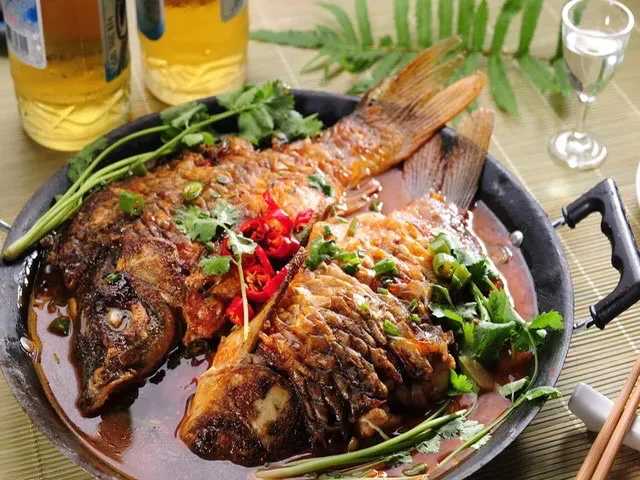
When visiting Yangshuo, a late-night snack is a must: Yangshuo beer fish. Walking along Yangshuo's streets, you'll see shops selling grilled fish and beer fish on nearly every street. The spicy and fragrant flavor, tender fish meat, add a bright touch to Guangxi's nightlife.
The method of using "vinegar blood" can only be found in Guangxi! Take a young duck from peak summer, save the fresh blood, and mix it with locally made sour liquid to make "vinegar blood." Stew the duck meat with young ginger or bitter melon, and just before serving, pour in the vinegar blood. The dish comes out thick and purplish-red, but the taste is even more delicious than regular braised duck.
A small piece of Yulin niuba (dried beef) has a processing history of over 800 years. Yulin niuba is translucent, coffee-colored, glossy, with a rich aroma, a balance of salty and sweet, a delicious and chewy texture, and a characteristic "sweet and aromatic wonderful taste." It is the most famous traditional specialty snack in Yulin.
Living in mangrove forests and feeding on fish, shrimp, crabs, shellfish, and algae from the beach, the eggs laid by sea ducks are more nutritious than ordinary duck eggs. The yolk is orange-red, with a stronger flavor. Salted eggs made from such sea duck eggs are particularly tempting. One salted sea duck egg with a bowl of hot plain congee is still very satisfying.
**One Trick to Eat All the Fruits and Vegetables Under the Sun**
No appetite? Then come eat Guangxi suan ye! Vegetable items: cucumbers, radishes, lotus root, purple cabbage, cabbage, long beans, chilies, ginger, scallions, etc.; fruit items: papaya, pineapple, star fruit, mango, plums (Sanhua plum, March plum), pears, guava, peach, even cantaloupe, green olives, etc.—whatever fruits and vegetables are in season, that's what goes in!
Everything can go into this glass jar to become suan ye of various shapes and colors. There are salty-sour flavors, as well as sour-spicy, sweet-sour. Each fruit and vegetable has its own character and taste, and every shop has its own recipe. Customers can also add seasoning like plum powder or chili powder according to their preference. Standing in front of a Guangxi suan ye stall, anyone can find their favorite.