In-depth Autumn Tour of Liuzhou! 'Ten Million Cantonese Tourists Travel to Guangxi' Themed Train Sets Off Again
"Themed train, depart now!" Accompanied by the unison shout of tourists, the "Ten Million Cantonese Tourists Travel to Guangxi" themed train departs again, embarking on a 4-day "Amazing Liuzhou, Golden Autumn Carnival" trip. "For a trip to Liuzhou, of course you have to eat a bowl of snail noodles." "To Liuzhou mainly to see the scenery, and incidentally eat snail noodles." Snail noodles truly are Liuzhou's top star, quickly winning the hearts of Cantonese tourists.
If there is one place to experience Liuzhou's charm in one stop, it's the Dalongtan Scenic Area, known as the "Karst Geology Museum." It integrates karst landscape, southern Chinese minority culture, and subtropical karst plant landscapes. Surrounded by mountains, over twenty peculiar peaks rise within Lei Tan and Long Tan. Even more astonishing, in autumn and winter, the two pools often have misty clouds, like a Penglai fairyland. Although it's not yet deep winter, tourists can't help but photograph the lush green trees and tranquil poetic scenes.
As an industrial hub in western China, Liuzhou has a long industrial history spanning a century. The Liuzhou Industrial Museum, converted from an old textile factory, largely preserves the original red brick and mud floor appearance. It displays charcoal cars, airplanes, and documents from traditional handicrafts to modern industry, illustrating the long history of industrial culture. "Wow, this fan is the same as one I used before!" The museum also gathers 1980s Liuzhou light industrial products, recreating a "newlyweds' home" arrangement that deeply resonated with the post-60s Cantonese tourists.
At nightfall, versatile Liuzhou presents another visual feast of light and shadow. This special train trip takes tourists to Panlong Mountain in the core area of the "Hundred-Li Liujiang Cultural Belt" to enjoy the night view. Cantonese tourists set up their phones early to capture the moment the lights come on. Shortly after 7:45 PM, the lights along both banks of the Liujiang River turn on one after another. The bridge spanning the river is like a musical score, and the flowing vehicle lights become dancing notes, playing a beautiful melody. Halfway down the mountain, there is a pavilion where everyone stops to gaze at the colorful alternating lights.
Climbing the mountain to enjoy the river view is poetic and serene, while the Yaobu Ancient Town at the foot is bustling and lively. Born among green mountains and clear waters, Yaobu Ancient Town has not only Jiangnan charm but also Southwest flavor. Many tourists change into ethnic costumes to take photos of the local decorations and sculptures. Liuzhou is also a very "delicious" city. At night, the snack stalls in Yaobu Ancient Town are crowded, with snail noodles, dry-mixed noodles, and glutinous rice cakes. Then, ascending Longcheng Tower by the Liujiang River in Yaobu, one can see the hundred-li Liujiang, twin pagodas on Panlong Mountain, and the city streets, marveling at the vitality of this "city that never sleeps."
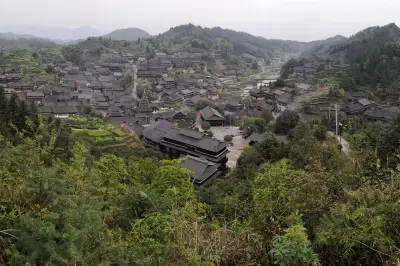
Welcoming the crisp autumn breeze, we continue to the outskirts of Liuzhou to Yubo Miao Village in Rongshui Miao Autonomous County. Surrounded by mountains, the Liujia River, a tributary of the Beijiang River, flows through the village, cascading down stepped terraces into stacked waterfalls forming shallow pools. Children immediately become energetic, playing in the water in groups, while adults also can't resist rolling up their pants to catch fish, feeling the joy of clear water jumping between toes. The scenic area also has water performances, with crowds on wind and rain bridges and suspension bridges, enjoying original Miao ethnic songs and dances.
The rich Miao characteristics are also evident at Yuanbaoshan National Forest Park. The mountain peaks undulate, and streams crisscross. Named for its resemblance to a gold ingot, Yuanbaoshan still preserves living fossils from the Quaternary glacial period—firs—and many peculiar rock formations showcasing nature's craftsmanship. Starting from the southwest of Yuanbaoshan, we arrive at another hidden paradise, Longnü Valley. Walking down from the highest point of the valley, the entire canyon is covered in green shade, making it hard to see the bottom. Streams connect into a series of waterfalls, tumbling all the way to the green pool at the valley floor. In 1930, after the success of the Baise Uprising, the Red Army passed through the Great Miao Mountains a second time. To cross Longnü Valley, the soldiers built a four-section wooden bridge with railings. Later, the bridge was used by locals until 1996, when it was destroyed by a flash flood. Finally, in 2013, a replacement cement bridge was rebuilt in the Dong ethnic style as a wind and rain bridge, symbolizing shelter for the people.
Many people visiting Xingping must check in at the spot depicted on the back of the 20 yuan note, but the charm of Xingping Ancient Town goes far beyond that. With over 1,700 years of history, Xingping is rich in northern Guangxi customs. Strolling along the bluestone-paved alleys, Ming Dynasty old houses and Qing Dynasty stages leave cultural traces everywhere. Unknowingly, the Cantonese tourists walk to the upstream of the viewing platform. "Every ten steps a view, every scene a painting." The jagged peaks reflect in the clear Lijiang River, where fishermen row boats on the river. Mountains and waters surround the ancient town, and old streets convey ancient charm.
Golden autumn gathering, autumn celebration. Did the November trip to Liuzhou make you fall in love with this city? The "Ten Million Cantonese Tourists Travel to Guangxi" themed train activity encourages more Cantonese tourists to head to Guangxi, experiencing the charm of "Travel to Guangxi in autumn and winter, warm mountains and waters welcome guests."