Guangxi Travelogue: Sanjiang's Chengyang Eight Villages
On the morning of October 20, 2024, after a buffet breakfast at the hotel, we checked out at 8:30 and took bus No. 1 just outside to Sanjiang Bridge West Bus Station, where we transferred to rural bus No. 5 heading to Chengyang Eight Villages. The fare was 8 yuan per person. We arrived at the scenic area's main gate at 9:10 am. The entrance fee was 50 yuan, plus 15 yuan for a sightseeing vehicle; seniors over 65 entered free.
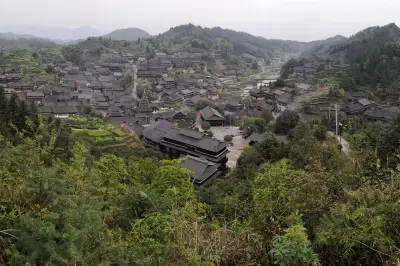
The Sanjiang Chengyang Eight Villages scenic area is located in Sanjiang Dong Autonomous County, the only Dong autonomous county in Guangxi. It consists of eight natural villages—Ma'an, Pingzhai, Yanzhai, Pingtan, Dongzhai, Dazhai, Pingpu, and Jichang—where more than ten thousand Dong people have lived for generations. Covering 7.6 square kilometers, the area boasts over 2,000 stilted wooden houses, 13 drum towers, and 11 wind-and-rain bridges, earning it the reputation of China's largest museum of Dong wooden architecture. The world-renowned Chengyang Yongji Bridge, one of the four great historical bridges of the world and inscribed with an inscription by Mr. Guo Moruo, is located here. The villages house over ten thousand Dong people, preserving rich ethnic customs: wooden Dong architecture, costumes, song and dance culture, and daily life traditions, along with the largest-scale Dong wedding ceremony passed down for over a hundred years. It is an outstanding repository of original Dong tourism resources, celebrated as the largest, most primitive, and most beautiful Dong village landscape in China, a living museum of Dong culture, and the largest Dong cultural tourism scenic area. On February 6, 2024, the Chengyang Eight Villages scenic area was designated a national 5A-level tourist attraction by the Ministry of Culture and Tourism of the People's Republic of China.
The regular route from the main gate actually covers just three villages—Ma'an, Pingzhai, and Yanzhai—which are connected into a single walking line. A normal stroll takes a bit over three hours. We took the sightseeing vehicle first to the Dong Painting Museum, then started our walk. From the museum, the next stop was Yongji Bridge.
Chengyang Yongji Bridge, also called Chengyang Wind-and-Rain Bridge or Chengyang Huilong Bridge, was begun in 1912 and completed in 1924. Spanning the Linxi River, it is a typical Dong structure—a stone-pier, wooden-frame pavilion-style bridge built mainly of wood and stone, with two abutments, three piers, and four openings. On the piers rise five pagoda-like pavilions and 19 covered corridors, all interconnected. The central pavilion features soaring upturned eaves; the pillars, tile eaves, and carvings are richly decorated. A fusion of corridor, pavilion, and pagoda, it holds a unique place in architectural history worldwide. As the finest example of a Dong wind-and-rain bridge, it is the best-preserved and largest of its kind, a crystallization of Dong wisdom and a gem of Chinese wooden architecture. On February 23, 1982, it was listed as a national key cultural relic protection unit by the State Council.
At the bridgehead, a welcoming ceremony awaited us: Dong women in ethnic dress, holding open umbrellas, stood singing mountain songs, blocking the way and offering wine to guests from afar. After crossing Yongji Bridge, we entered the village scenery, with its ethnic architecture and local customs. The commercial atmosphere, however, was quite noticeable; ancient villages and old towns everywhere seem increasingly similar.
Around noon, we reached the end of the scenic area, then took the sightseeing vehicle back to the main gate and caught bus No. 5 back to the county town. Here we made a big mistake: we had stored a backpack in a locker at the scenic area when we arrived and completely forgot about it when we left. We only remembered in the afternoon after reaching the high-speed rail station. It was too late to return. Suddenly, my wife thought to ask the scenic area to courier the backpack to our hotel in Guilin. We would be staying in Guilin for three days and could certainly receive it. Indeed, we contacted the scenic area, and the staff quickly arranged delivery to Guilin. We received the parcel and expressed our special thanks then; here once again, we want to convey our heartfelt gratitude to the Chengyang Eight Villages scenic area.