A 6-Day Independent Trip from Beihai to Liuzhou and Yizhou by High-Speed Rail, Following the Footsteps of Liu Sanjie
I had long known about Guangxi's annual Sanyuesan Festival, when people get time off to sing and celebrate. This year, when Sanyuesan came around again, I enjoyed it in Beihai. Inspired, I set out to see Liu Sanjie, the legendary song fairy, and follow in her footsteps.
First stop was Liuzhou, where the Zhuang song fairy Liu Sanjie is said to have ridden a fish to immortality. Liuzhou lies in north-central Guangxi, known as Pot City and also Dragon City. Since I was very young, I knew Liuzhou as a heavy industry hub, with automobiles, machinery, and metallurgy as its pillars. Later, I discovered its worldwide fame for luosifen (river snail rice noodles). It's also a historic and cultural city with unique landscapes, spanning 18,600 square kilometers and home to about 4.2 million people, of whom roughly 2.25 million belong to ethnic minorities—54% of the total. The Zhuang and Dong peoples are the oldest indigenous inhabitants. This year's Sanyuesan saw Yufeng Mountain's antiphonal singing go viral across China, with nearby roads so packed they were impassable. To avoid the holiday crowds, I planned my visit to experience its magic.
Day 1: An old classmate of mine, a national-level expert in our field who retired only at seventy, happened to be attending an expert symposium in Liuzhou. He invited me to meet up, so my wife and I bought high-speed rail tickets for 160 yuan and arrived in no time.
The quaint Yufeng Mountain Park is said to be where Liu Sanjie worked, lived, sang in antiphonal style, and ascended to immortality. A marble statue of her stands there. We booked a hotel near the park for 100 yuan through Ctrip.
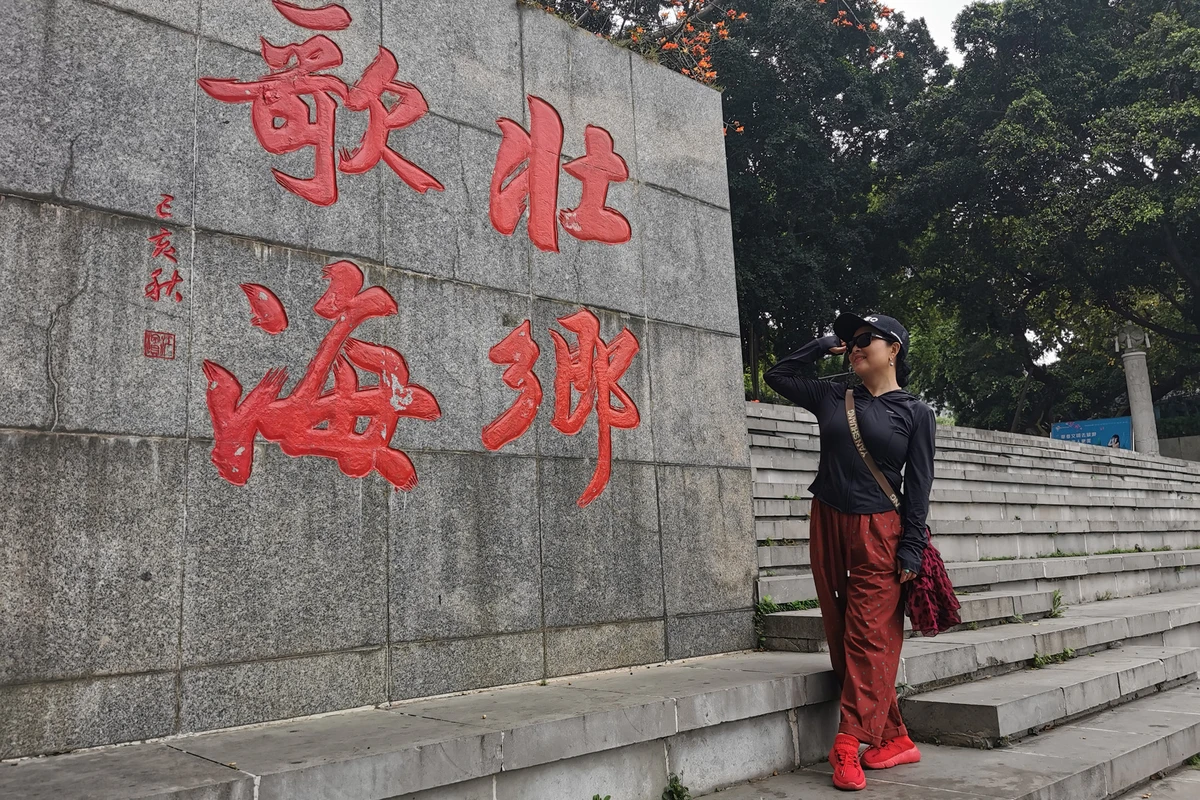
In the afternoon, we strolled around the riverside. Jiangbin Park, in the city center, is easily accessible from anywhere. It lies on the south bank of the Liu River, forming the core of the "Hundred-Li Liu River, Hundred-Li Gallery" scenic belt. Stretching 1.5 kilometers and covering 142,100 square meters, this large open park blends hills and water into a beautiful landscape for sightseeing, leisure, entertainment, fitness, and flood control. It's often called "Liuzhou's Bund." The well-arranged spaces, with their simple elegance and shifting views at every step, seamlessly merge river, garden, and city scenery. Distinct zones showcase the Zhuang song sea, floral splendor, emerald reflections, ancient wells, and timeless fables. Landmarks like the flood control monument, old Yujia Wharf, relief walls, and Zhaojia Well make it an ideal spot for tourism and relaxation.
For dinner, my old friend Wang Laoge treated us to an abundant feast of local Liuzhou specialties. It was one of life's four great joys—running into an old friend far from home—in our sixties. Chauffeured and warmly hosted, I felt proud for my accomplished buddy and honored myself.
Day 2: After another morning walk in the lovely Jiangbin Park, we rested and then visited Yufeng Mountain Park on foot. As soon as we entered, groups of song and dance lovers filled the air with one moving melody after another, each note heartfelt. Most were antiphonal love songs, with lyrics improvised on the spot to match the scenery and sentiment, echoing the grand tradition of Liu Sanjie's heyday.
Wang Laoge treated us to dinner again—his hospitality was hard to refuse. We were classmates long ago, though quite a few years apart in age. Now both gray-haired, we still looked like brothers.
Day 3: We hailed a cab to Longtan Park, a national 4A-level scenic spot just three kilometers south of downtown.
Longtan Park is a classic example of natural karst landscape gardening, and the largest and most beautiful park in Liuzhou. Lush forests, encircling hills that form a natural screen, and oddly shaped peaks rise around a lake and valley. The planned area is about 544 hectares. The park focuses on the colorful ethnic architecture, customs, and folklore of Guangxi's and southern China's minorities, blending mountain-water scenery, ethnic charm, and subtropical karst flora into one vast scenic area.
Just as our enjoyment peaked, dark clouds gathered, wind and rain lashed down, and thunder roared—a typical mountain weather phenomenon. We cabbed back, had lunch, and rested.
In the afternoon, we explored Ma'an Hill for a panoramic view of Liuzhou and then wandered the old town. Ma'an Hill gets its name from its saddle-like shape. Located on the south bank of the Liu River downtown, it echoes Yufeng Mountain to the east and west, and is one of the highest peaks in the city center at 270 meters above sea level. A direct elevator inside the hill whisks you from base to summit. Looking out, the entire city unfolds: rivers stretching into the distance, buildings standing tall. It's the perfect spot for seeking tranquility and admiring views from on high. Descending, we cabbed across the river to gaze back—it really does look exactly like a horse's saddle!
Strolling Liuzhou's streets and alleys, we saw 300,000 pink bauhinia trees in full, passionate bloom—a scene both romantic and magnificent.
Day 4: Up at 8 a.m., out at 9:30 to cab to Liuzhou Railway Station. Caught the 10:52 train from Liuzhou to Hechi (15 yuan) and checked into a hotel near Yizhou Railway Station.
Yizhou, a district of Hechi, is the hometown of the Zhuang song fairy Liu Sanjie. It's a city with a 2,100-year history and a multi-ethnic population, predominantly Zhuang. Covering 3,896 square kilometers, it has about 650,000 residents and is known as China's most folk-custom-rich tourist destination. Key scenic spots include the Xiajian River basin, a cultural ecosystem preserve for Liu Sanjie's ballad heritage.
In the afternoon, we strolled the nearby Citizen Square and explored Yizhou's downtown area. On the city's east side stands a paifang (decorative archway) built in the 25th year of the Qianlong reign, once called "Huikui Tower" or "Four-Memorial Archway." Sitting at a crossroads, it forms four arched gateways leading north, south, east, and west, all interconnected. The three-story structure has a first floor made entirely of large, finely chiseled stone blocks in a square layout—exquisite craftsmanship.
Day 5: After breakfast, at 8:30 we cabbed to Fengjing Park, which also serves as the Liu Sanjie Hometown Tourist Service Center.
Fengjing Park commemorates Feng Jing, a renowned Yizhou scholar. Feng Jing was brilliant from a young age, earning top honors in the county, metropolitan, and palace examinations—a feat known as "winning three firsts in a row." Only thirteen people in Chinese history achieved this, and Feng Jing was one of them.
At the visitor center here, we bought boat tickets for the Xiajian River Liu Sanjie Zhuang customs tour—85 yuan each. Liu Sanjie, also called Third Sister Liu, is a legendary song fairy of the Zhuang people. Different regions have varying versions of her story, but the one from Yizhou is the most widely circulated.
Aboard the tour boat, a guide in splendid ethnic attire regaled us with tales of local culture, scenery, and the legend of Third Sister Liu. Her beautiful singing brought to life the saying: "Yizhou, home of Liu Sanjie, is truly a sea of songs."
The Liu Sanjie Hometown Scenic Area is a national AAAA-level site, 7 km from downtown. The entire area is formed by the junction of the city's Longjiang River and the Xiajian River in Liu Sanjie Village, creating a wondrous "union of man and nature" that stretches 25 km. Many tourism activities are available: boat sightseeing, folk song singing, tracing Liu Sanjie's roots, ethnic performances, leisure stays, and farm experiences. It's now one of Guangxi's premier ethnic culture itineraries.
The Xiajian River, Guangxi's most beautiful waterway, is lined with emerald bamboo and filled with lilting songs. Along the way are spots tied to the song fairy's legend: the Song-Teaching Platform, the Love-Wishing Tree, Handkerchief Rock, and Sister-Gazing Stone. The river's strong ethnic character is captivating—activities include antiphonal singing, carrying a bride across a single-log bridge through three challenges, drinking cross-cupped wine, bamboo pole dancing, and long-soled clog dancing.
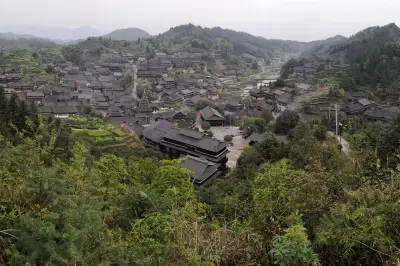
Liuhe Village is where Liu Sanjie once lived. Like many Zhuang mountain hamlets, it nestles against hills and water, known for simple folkways, warm hospitality, and a passion for singing folk songs. The village is shaded by lush trees and filled with birdsong and flowers, including several hundred-year-old longan trees (the "love-wishing trees") under which Liu Sanjie and A'niu Ge are said to have pledged their love.
Guided by song and scenery, we arrived at Liuhe Village within the Liu Sanjie Hometown Scenic Area. At the village gate, costumed young men and women stood on the steps, ready to challenge our boat's visitors to an antiphonal song duel before we could land. Our guide, a local girl, had prepared us with song booklets and taught us a few mountain tunes. She even picked four male passengers to dress as Master Mo and scholars from the movie "Liu Sanjie" for the fun. The shore-side girls sang simple questions from the booklet; we sang back the responses and happily disembarked.
Once inside, we drank welcoming wine, joined in throwing embroidered balls, visited the former residence and estate, watched an on-the-spot song contest by a folk song king, and enjoyed a grand welcome performance with bamboo pole dancing that visitors could join. About two hours later, we returned by the same boat to Fengjing Park Pier downtown, wrapping up a delightful day.
After lunch and a rest, we decided to see the Hechi Garden Expo Park. It's on the outskirts, beyond the range of shared e-bikes, so we hailed a taxi. The park is vast—two hours weren't enough to cover it all—with lush plants, flowers, and well-maintained recreational facilities. Few tourists visited, making it a fine spot for leisure. In the evening, after exploring, we found no convenient transport back to town. Stranded in the outskirts of "the song fairy's home, the sea of songs," we took a leisurely walk, a bittersweet feeling rising in our hearts…
Day 6: After breakfast, we took a train from Yizhou to Liuzhou, then transferred back to Beihai (171 yuan).
This easy, enjoyable trip cost about 1,000 yuan per person—excellent value!