Autumn Trip to Tianjin, Beijing, Shanxi and Ningxia in 2019 (Part 1)
Day 1: Zhuhai – Tianjin
In late October, my wife and I embarked on a journey north. Our itinerary covered Tianjin, Beijing, Shanxi, and Yinchuan in Ningxia. A direct flight from Zhuhai to Tianjin took us there in about three hours, arriving around noon.
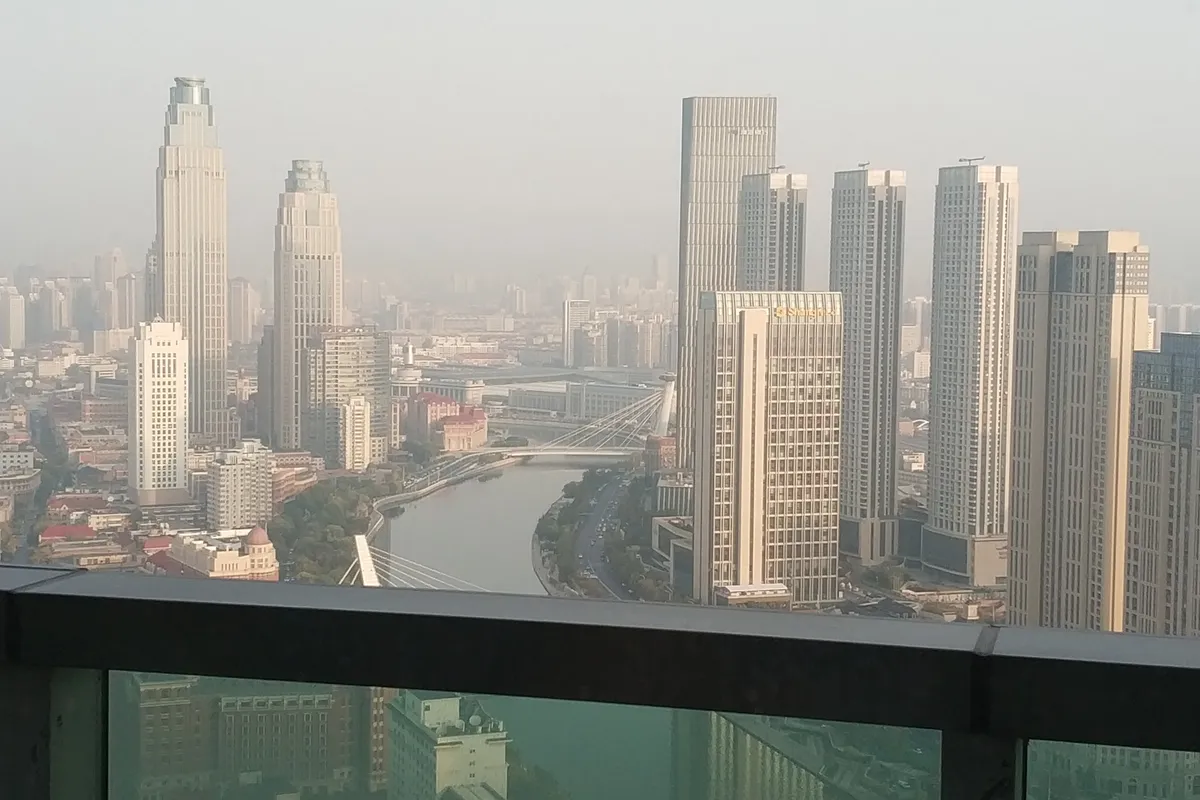
A driver was already waiting for us at the airport and took us to our accommodation for the next few days – the Xinda Plaza Hotel Apartments. It was around 1 p.m. by the time we checked in. The location was superb, right by the Haihe River, and both the living room and bedroom offered views of the water and the high-rises on both banks.
We dropped off our luggage and headed downstairs to the nearby food street for a quick lunch. After that, we strolled over to the Wudadao (Five Avenues) tourist area across the road. There were maps and introductions to the district, so we took a photo and followed the suggested route, admiring the garden-style European architecture along the streets. Many former Qing dynasty aristocrats and high officials of the Beiyang government once lived here. Each elegant old villa seemed to whisper stories of the past. They say there are over 2,000 such European-style buildings in the area.
We walked to the Prince Qing's Mansion and bought tickets to go inside. Originally the home of the famous eunuch Xiao Dezhang in the late Qing period, it was later purchased by Prince Qing Zaizhen and became his retirement residence. From the street you could only see the high walls and gate, with no hint of the interior. Once inside, it was a delightful surprise: a handsome Western-style villa and a Chinese-style rock garden existed together in perfect harmony. The main building had been renovated but kept its period character. The central hall was grand, encircled by a two-storey gallery, with an imposing crystal chandelier hanging from the ceiling. It could be used as a banquet hall or ballroom – stately and elegant. A side door led to the garden, where rockeries, ponds, and bridges created a lovely Chinese scene.
After the mansion, we continued along the street to Minyuan Square. This European-style sports ground is a core landmark of the Five Avenues, and the tourist center located there provided maps and video displays introducing the area's attractions. The newly restored square retained the sports and fitness facilities of the original Minyuan Stadium while adding leisure, exhibition, and specialty dining functions. Stepping inside, we saw a 400-meter running track and a sunken open square, where many locals and visitors were exercising. The old grandstands had been converted into indoor spaces, including a culture and sports museum that tells the history of Minyuan, the Five Avenues, and Tianjin culture.
On the small square opposite the gate stood a Dalong Post Office, where many tourists stopped to get a postmark stamp as a souvenir.
Our feet were getting tired, so we hailed a cab to Jingyuan (Garden of Quietude). Built in 1921 as Qianyuan, it was the private residence of Lu Zongyu, the Beiyang government's minister to Japan. From 1929 to 1931, the last emperor Puyi lived here with his empress Wanrong and concubine Wenxiu, renaming it Jingyuan, meaning “to quietly observe the changing situation in hopes of restoration.” The brick-and-wood building blends European and Japanese styles and stands in a tranquil setting. The exhibitions inside, with their detailed furnishings and documents, powerfully evoke the end of one era and the beginning of another.
We stayed until closing time before leaving Jingyuan. Then we made our way, as tourists do, to the famous Goubuli steamed bun restaurant – one of Tianjin’s “Three Delicacies.” The driver who had brought us there mentioned that only tourists go here; locals avoid it. I’d been to Tianjin several times and knew what to expect, but it was my wife’s first trip, so I didn’t want to spoil her curiosity. We went to a two-storey building: set meals downstairs, à la carte upstairs. Since we came for the buns, we ordered two different 88-yuan sets downstairs – each came with a steamer of buns, two small side dishes, and a bowl of millet porridge. After eating, my wife finally understood the name “Goubuli” – literally “dogs don’t care” – and she agreed it was apt. They were inferior to any southern-style buns. She experienced the three famous features of Goubuli: great reputation, high price, and so-so taste! Yet brand value means that most tourists visiting Tianjin still come here, so business was brisk with a steady stream of customers.
Close to Binjiang Avenue pedestrian street, we strolled there to walk off the meal. Shops selling food were everywhere, including giant 18th Street mahua (fried dough twists) – another of Tianjin’s three must-tries. One twist looked like it needed several people to finish.
The streets were bustling, and neon lights glittered. The old Quanyechang building, classical European in style, stood out with its dignified old-fashioned charm under golden lights. The name Quanyechang means “encourage diverse trades and enjoy one’s work,” and it is one of Tianjin’s landmark buildings. Opposite it was another old edifice, the former Zhejiang Industrial Bank, now with a Starbucks sign. Step inside, and you find a perfect fusion of European architecture and coffee culture. The century-old building has been carefully restored to preserve its original features and interior layout. A large metal coin engraving on the floor attracted many tourists taking photos. This outlet houses not just a café but also a tea bar and cocktail bar, with the historic bank counter turned into a curved bar. In the evening, a staff member demonstrated coffee brewing methods and let us sample different varieties at the bar. The second floor displayed old photographs of the building’s history and coffee culture exhibits, while the terrace offered a view of the glittering Binjiang Avenue and Quanyechang opposite – a picture-perfect night scene! We lingered over a cup of coffee and three different craft coffee beers before reluctantly heading back to the hotel.
Day 2: Ancient Culture Street – Italian Style Street
Morning sunshine beamed down. After breakfast at the food street downstairs, we took a cab to Tianjin’s Ancient Culture Street. This is the gathering place for the city’s most famous time-honored brands and handicraft shops, full of local folk character. There were Yangliuqing New Year paintings, Zhang’s clay figurines, Wei’s kites, and specialty snacks like Guoren Zhang’s nuts, Pitang Zhang’s candies, and Bengdou Zhang’s beans. At the clay figurine shop, we admired the lifelike painted sculptures. At the entrance of Ancient Culture Street, we tried Erduoyan fried cakes – another of Tianjin’s three specialties – and found them delicious, far better than Goubuli buns!
Tianhou Palace stands at the heart of the street, the core historical monument. Dedicated to the goddess who protects seafarers, it dates back over 600 years. Facing east, the complex includes a theater stage, flagpole, gate, archway, front hall, main hall, Fengwei Hall, sutra depository, Qisheng Hall, bell and drum towers, Zhangxian Pavilion, and four side halls – the oldest surviving ancient building group in Tianjin. Today it houses the Tianjin Folk Museum, which besides preserving the palace’s original displays, exhibits local customs related to water transport, marriage and childbirth, commerce, folk life, art, and beliefs. Many visitors had fun matching their birth year to their zodiac protector in the Tai Sui Hall. In the square, two tall wooden flagpoles stood renovated, while the original ones are kept in the courtyard as relics. The old theater stage still offers cross-talk and magic shows. Nearby, the former residence of Enlightenment thinker Yan Fu is marked only by a bronze statue, as his original house is gone.
Following a sign pointing to the Jade Emperor Pavilion, we walked over. Situated on the west bank of the Haihe River and built in the early Ming dynasty (1368), it has over 600 years of history and is one of Tianjin’s oldest structures. On its beams, you can still see dated “qianqiudai” strips recording restorations through the centuries. It was once the largest Daoist temple in Tianjin, dedicated to the Jade Emperor. Due to imperialist damage in modern times, only the Qingxu Pavilion remains from the original complex.
It was approaching noon, so we found a busy local restaurant for lunch. Afterwards, we admired the confluence of the three rivers and the famous Tianjin Eye Ferris wheel from a nearby bridge. Crossing the bridge, we walked along the east bank of the Haihe to the Italian Style Area, where over 200 Mediterranean-style buildings, celebrity residences, and film sites added to the charm. Passing a quaint Catholic church that looked quite old, we soon reached the Li Shutong Memorial Residence. Li Shutong, the famous Buddhist monk Hongyi, lived in a large Qing dynasty courtyard residence made up of four compounds in a field-shaped layout, with covered corridors and a small garden. Inside there was a Western-style study named “Yiyuan,” built when he returned from Japan in 1910 to express his grand ambitions. The garden, corridors, and elegant furnishings created a refined atmosphere, with wax figures recreating scenes from his life.
Outside, we found shared bikes and cycled to Liang Qichao’s former residence, comprising his home and the “Ice-Drinking” (Yinbingshi) study. The front building was the main house with a basement, with nine rooms on each of two floors. The east half was for Liang’s personal use, with a small study, living room, etc., while the west half housed his family. The rear building had a kitchen, boiler room, storage, and servants’ quarters, connected by corridors and a covered bridge. The study, a two-storey gray Western building, stood beside the residence. A water basin with a stone beast spouting water sat at the entrance. Inside, a central hall was surrounded by five rooms, mostly studies and library rooms on the ground floor; upstairs, another hall and bedrooms or study rooms. Liang Qichao spent his later years here immersed in writing. Designed by Italian architect Broni, the study features an atrium with a glass canopy. The exhibition halls reproduce the life and work of the Liang family, displaying letters, books, historical documents, and photos.
We cycled on through the Italian area, past red-roofed buildings and European sculptures, until we reached the pedestrian zone and Marco Polo Square, with its central column topped by the Goddess of Peace holding an olive branch. Many other celebrity homes are here: warlord Cao Kun’s residence is now a commodity exchange; Yuan Shikai’s and Feng Guozhang’s old houses are now restaurants; Cao Yu’s home and Zhang Ting’e’s former residence are also nearby. Near the square, an exhibition hall showcased Tianjin’s history and future urban planning, but we were too tired to visit. Even in the daytime, the Western restaurants and cafés lining the street were packed.
We took a cab to Central Park and wandered around. Seeing a crowd gathering, we went over and discovered the “Porcelain House” – a building entirely adorned with ceramics! According to the visitor center intro, its “Peace Wall” is made of hundreds of antique porcelain vases from the late Qing and Republican periods. On the roof, a dragon formed from old porcelain pieces spells out “China,” and behind it, a bird’s nest model created from broken china. It was late, the ticket price was steep, and my wife didn’t want to climb stairs – besides, we’d been to Jingdezhen many times and had porcelain fatigue. So, like most tourists, we snapped photos and moved on to Zhang Xueliang’s nearby former residence. This grand three-storey white Western-style house has large terraces on the second and third floors and a red roof inscribed with “Young Marshal’s Residence” in Chinese and English. Inside, you can see where the young marshal once lived.
Back at the hotel apartment, we bought some beer and cooked food from a nearby supermarket. In our room, we heated it up simply in the microwave and enjoyed dinner while gazing out at the Haihe River night view.
Day 3: Nankai University – Drum Tower
Waking to sunshine, we breakfasted at the food street and took a cab to the prestigious Nankai University. Coinciding with the university’s centenary, many alumni had returned to celebrate. Located in the southwest of the city, the campus is quite modest without many historic buildings, but its lakes and trees are refreshingly beautiful, and the scholarly atmosphere feels serene. Riding shared bikes, we noticed that Tianjin University, right next door, had blended with Nankai’s campus – it was hard to tell where one ended and the other began. The Mati Lake, with its large lotus pond that blooms in summer, was a highlight. Nearby, the Siyuan Hall, one of the oldest campus buildings, featured Roman-style architecture. And we saw the old school bell, which must carry centuries of Nankai’s history.
Leaving Nankai, we cabbed to Nanshi Food Street, opposite the hotel street. This three-storey arcade-style building had imposing gateways on all four sides. The open ground floor, like a veranda, was packed with snack stalls: Guifaxiang mahua, 18th Street mahua, Erduoyan, Bengdou Zhang, along with traditional crafts like sugar painting. The second and third floors were semi-open corridors lined with restaurants offering Sichuan, Shandong, and other cuisines, including Tianjin classic restaurants.
Afterwards, we cycled north along the broad avenue to the Drum Tower in the city center. Despite the name, it’s actually a bell tower. The three-storey tower sits on a square brick base with four arched gates leading to the four main streets. The first floor houses statues of Guanyin, Tianhou, and warriors Guan Yu and Yue Fei, plus exhibits on Tianjin’s urban development. The second floor bears a plaque reading “Fame Reaches Heaven,” and inside hangs a 300-jin iron bell. The tower’s big bell, 1.4 meters in diameter and 2.3 meters high, weighing 1,500 kg, is known as the “Bell King.” Its cast-bronze body is finely wrought, with intertwined dragons forming the knob. Inside, an exhibition recounts the history of foreign encroachment. From the tower, the city appeared hazy – maybe the smog index was high.
After lunch at a nearby restaurant, we strolled around but couldn’t enter the nearby Princess Residence as it was closed. Wearied, we caught a cab back. En route, we saw the enormous mechanical clock in the Century Clock Square, a striking metal structure with dial, pendulum frame, and base, symbolizing the interplay of sun and moon, East and West. The pendulum’s S-shape draws from the Taiji curve, embodying the alternation of yin and yang.
For dinner, we went to Kiessling, the oldest Western restaurant in Tianjin, just a short walk from our hotel. Founded in 1908 by a German named Kiessling, it originally sold bread and simple meals, and its authentic German fare and pastries attracted many celebrities – legend has it that Puyi and Wanrong dined here often during their Tianjin years. Today Kiessling offers multiple cuisines: the ground floor is a pastry shop, the second floor serves Russian dishes, the third German, and the fourth French. Since the founder was German, we chose the German restaurant on the third floor. A microbrewery setup sat prominently in the open kitchen area, surrounded by tables where you could watch the chefs at work. We ordered two types of freshly brewed beer, a mixed sausage platter, and signature beef dishes – everything tasted quite good, contrary to some negative reviews. As we left, my wife picked up several pastries from the ground floor. Outside, a neighboring building lit up with the glowing words “Long Live the Motherland” – a beautiful night scene.
Day 4: Tianjin – Beijing
After a leisurely wake-up, we took the high-speed train from Tianjin Station to Beijing South Station. With many departures and tickets bought online, we arrived in about half an hour. A taxi took us to our hotel, the Jingtailong Hotel on Zhushikou East Street, near the southern entrance of Qianmen Street. After checking in and dropping our bags, we walked straight to the nearby pedestrian street – I chose this hotel mainly for its convenience for eating and shopping. The sky had turned overcast with a fine drizzle, but it didn’t dampen our spirits.
Qianmen Pedestrian Street stretches about 800 meters from the Zhengyangmen Arrow Tower in the north to Zhushikou East Street. It has been Beijing’s most famous commercial street since ancient times. Today it’s still packed with long-established restaurants and shops, plus snacks from all over China – ideal for both shopping and dining. The buildings are all in vintage style, adorned with archways, old signboards, and red lanterns – is this what old Beijing feels like?
Just inside the southern entrance, we spotted a Qingfeng steamed bun shop, quite spacious. We tried a few kinds; the taste was ordinary, similar to Tianjin’s Goubuli, but more affordable. Further along, the bustling Dashilan and Xianyukou alleys were full of snack and pastry shops, so we bought as we went. In one branch alley, we had a bowl of luzhu (stewed pig organs) – the flavor was good, but the flatbread was a bit hard and needed more soaking. There’s a mini train sightseeing tram on the pedestrian street, but we only saw one pass in the whole afternoon.
Qianmen and its surrounding hutongs host numerous legendary eateries like Quanjude, Bianyifang, Donglaishun, and Liubiju, where you can enjoy roast duck, mutton hotpot, and other traditional dishes – I was already planning which ones to visit. Besides restaurants, there were venerable shops like Ruifuxiang, the Hat Culture Museum, and teahouses offering cross-talk and storytelling performances.
As dusk fell, we headed to Quanjude for roast duck dinner. Founded in 1864, it’s a time-honored brand. I’d been to Beijing many times and eaten plenty of Quanjude duck, but my wife wanted to try it again. The waiting area was packed, so we took a number. Through a glass wall, we could see the ovens where ducks roasted over open flames, turning golden and whetting our appetites. After nearly an hour, we were seated at a table on the second floor. We ordered what we’d already decided while waiting. The duck was decent, though pricey. Watching the chef slice the freshly roasted duck at our tableside, with a beer in hand, made for a cheerful evening.
Day 5: The Forbidden City
Clear skies today. After breakfast in the hotel’s adjacent restaurant, we took a taxi to the Forbidden City. Although it’s less than 3 km on foot, the drive took nearly an hour – what a “capital jam”! We’d purchased tickets online the day before. Entry is through the Meridian Gate, so from Donghua Gate we took a buggy the short distance. Plenty of visitors, but numbers are capped so it didn’t feel overcrowded. Groups were noisy lining up, but the individual queue was short. After snapping photos outside the Meridian Gate, we quickly passed through the turnstiles. To better understand the palace, we rented two audio guides that automatically played at each spot.
The Forbidden City, also known as the Purple Forbidden City, served as the imperial palace for the Ming and Qing dynasties. It is among the best-preserved and largest wooden architectural complexes in China – and the world. Sprawling in size, it contains over 70 palaces of varying sizes and reputedly 9,999.5 rooms. The complex divides into the “Outer Court” and the “Inner Court,” with the Gate of Heavenly Purity as the boundary. South of it, the Outer Court was where the emperor handled state affairs; north of it, the Inner Court housed the imperial family. Walking past the Hall of Supreme Harmony, the Palace of Heavenly Purity, and the Palace of Earthly Tranquility, then strolling through the Imperial Garden, was truly refreshing and enchanting.
Entering through the Meridian Gate, we crossed the five Golden Water Bridges in the plaza before the Gate of Supreme Harmony. Their graceful single-arch design contrasted beautifully with the imposing gate tower and the resplendent Hall of Supreme Harmony. This hall, commonly called the “Throne Room,” was where grand ceremonies took place, complete with a vast honor guard stretching to Tiananmen.
The Hall of Mental Cultivation is an H-shaped building with front and rear halls. From the reign of Yongzheng onward, the rear hall became the emperor’s bedchamber, while the front served as his daily office for meeting officials. The Palace of Earthly Tranquility, one of the three rear palaces, was the empress’s residence in the Ming dynasty but later transformed into a place of worship in the Qing. The Hall of Preserving Harmony, an exquisite structure, was where the emperor hosted minority princes and ministers on New Year’s Eve and, after Emperor Qianlong, where the palace examinations took place.
We visited the Treasure Gallery in the Palace of Tranquil Longevity area. Here stands a Nine-Dragon Screen: the upper part is a yellow-glazed tile roof, below which simulated wooden brackets rest. The screen’s background of clouds and water is picked out in blue and green, creating a vast sea-and-sky effect, while the white marble base adds solemnity. Further north, the Hall of Cultivating Character, the Hall of Joyful Longevity, and the Hall of Pleasant Brightness are arrayed, with the Hall of Joyful Longevity the most splendid. Its interior is lavishly decorated with fine woods like red sandalwood and rosewood inlaid with jade and enamel. In the north hall stands the largest jade carving in the palace collection – the “Yu the Great Taming the Water” mountain. Corridor walls outside feature the “Jingshengzhai Model Calligraphy” stone carvings, all by Emperor Qianlong. After becoming the Retired Emperor, Qianlong lived mainly here, and it later became Empress Dowager Cixi’s residence after her 60th birthday. The gallery holds an especially rich trove of treasures: Buddhist artifacts, ornaments, daily utensils, and curios, mostly made of gold, silver, jade, jadeite, pearls, and other precious materials by the finest craftsmen from across the land, representing the peak of artistry.
Next, we went to the Clock Exhibition Hall in the Hall of Ancestor Worship, to the east of the inner palaces. Built in the Ming Yongle period, this was the imperial family’s ancestral temple, with front and rear sections connected by a passage, forming the H-shaped layout. In ancient times, time was told by gnomon, sundial, and water clock, but from the late Ming, Western mechanical clocks gradually replaced them. By the 18th century, the Qing court used large numbers of such clocks. The gallery displays over 200 exquisite 18th-century clocks from Britain, France, Switzerland, and beyond. Their accuracy, ornate designs, and musical animations delighted the imperial family and became precious decorations.
By now we were weary from the sheer scale of the Forbidden City. We revived ourselves with cute stone-lion-shaped ice cream – a Forbidden City special – and some snacks. Then, continuing with our audio guides, we explored the twelve eastern and western palaces. The Eastern Six Palaces include the Palace of Great Benevolence, Palace of Celestial Favour, Palace of Accumulated Purity, Palace of Great Sunshine, Palace of Eternal Harmony, and Palace of Prolonging Happiness. The Western Six are the Palace of Eternal Longevity, Palace of the Cultivation of Mind, Palace of Gathered Elegance, Palace of Salubrious Fragrance, Palace of Eternal Spring, and the Palace of Inspiration (Hall of the Supreme Principle). In the Palace of Prolonging Happiness, there’s an unfinished three-storey Western-style building called the Crystal Palace, its iron structure and marble walls intended for a water-surrounded design – a fascinating concept halted by an empty treasury.
Continuing north, we reached the Imperial Garden, beyond the Palace of Earthly Tranquility, where the imperial family relaxed and enjoyed the scenery, and where climbing height and moon-viewing ceremonies took place. Originally named the Back Palace Garden in the Ming and renamed in the Qing, its layout follows a central axis, with the Hall of Imperial Peace at its heart and connected cypresses in front. Four pavilions representing the seasons – Pavilion of Ten Thousand Springs, Pavilion of Floating Verdure, Pavilion of a Thousand Autumns, and Pavilion of Clear Ripple – stand in pairs east and west. The most beautiful are the Ten Thousand Springs and Thousand Autumns pavilions. Though small, the garden is filled with ancient cypresses, locust trees, exotic flowers, and winding cobbled paths, giving it an elegant, regal charm.
From the garden north lies the Gate of Divine Prowess, the north gate and exit of the Forbidden City. Originally called the Gate of Mystic Might (Xuanwu), after one of the four directional beasts, it was renamed under Kangxi to avoid using the emperor’s personal name “Xuanye.” The gate stands on a 10-meter-high wall with five bays and a double-eaves hip roof. A Chinese-Manchu plaque reads “Gate of Divine Prowess,” and a stone plaque above the north arch says “Palace Museum.” From here, one can exit or climb the wall. Opposite is Jingshan Park, glowing in the sunset. To our delight, the gatehouse was hosting an exhibition of Kremlin artifacts – Russian tsars’ robes, military uniforms, ornaments, utensils, archives, and prints, all from 18th–19th century grand ceremonies. The displays, arranged by theme (entry procession, proclamation, enthronement, coronation, sacred rites, grand parades, extravagant banquets, and congratulatory celebrations), recreated the magnificent Russian court.
Walking east along the city wall offered views inside and out. At the corner stood a seemingly unassuming corner tower, a masterpiece of traditional timber architecture with nine beams, eighteen pillars, and seventy-two ridges. Such complexity shows extraordinary craftsmanship; besides decoration, it served as a defensive watchtower. Its yellow glazed tiles and gilded finial glistened under the blue sky. We walked the eastern wall all the way to Donghua Gate before descending and exiting the Forbidden City. As the sun set, tired but happy, we reluctantly left, the moat waters shimmering as we hailed a taxi back.
After a short rest, we went to Donglaishun on Qianmen Street for mutton hotpot. The restaurant occupied the second floor of a building in Dashilan, with a vintage tram model on the ground floor. Although Qianmen’s night scene was beautiful, we were too tired to explore further and strolled straight back for the night.
Day 6: Prince Gong’s Mansion – Nanluoguxiang – 798 Art Zone
Energized after a night’s sleep, we headed to Prince Gong’s Mansion after breakfast. Like the Forbidden City, we’d bought tickets in advance and rented audio guides at the entrance, then entered directly with our ID cards. This is the largest princely mansion from the Qing dynasty, first the home of the corrupt official Heshen, then of Prince Yonglin, and later associated with Prince Gong Yixin, hence its name. Its history mirrors the dynasty’s rise and fall, inspiring the saying “One Prince Gong’s Mansion, half the Qing history.” The well-preserved complex comprises over 30 building groups, divided into the residential (south) and garden (north) sections, separated by the rear mansion wall – supposedly 99.5 bays. The residence is organized along strict axes into central, eastern, and western routes, each with three courtyards. The main hall in the central axis, the Hall of Silver Peace and Hall of Fine Joy, has green-glazed tile roofs reflecting princely status. On the east, the front courtyard’s main hall is the House of Abundant Fortune, where Heshen’s son, who married Emperor Qianlong’s youngest daughter, once lived, effectively a princess’s residence. The rear courtyard’s Virtuous Way Hall was Prince Gong Yixin’s living quarters. The western route features the elegant Baoguang Hall and Xijin Study. The latter, with its exquisite nanmu partition carvings, was built by Heshen imitating the Palace of Tranquil Longevity. The garden, called the Park of Gathering Splendor, is larger than the Forbidden City’s Imperial Garden, with 31 ancient structures. Prince Gong employed hundreds of craftsmen to create it, making it the finest princely garden in the capital. The theme of “fortune” runs throughout. The Western-style gate, inscribed “Fortune” stele by imperial hand, and the grand indoor theater are known as the mansion’s “three wonders.”
By midday we took the subway one stop to Nanluoguxiang. This 800-meter hutong, stretching from Gulou East Street to Ping’an Avenue, is over 800 years old and one of Beijing’s oldest neighborhoods, preserving the Yuan-dynasty hutong layout and the largest traditional residential area. It brims with quaint boutiques and snack shops. We found a local specialty eatery and tried douzhi (fermented bean juice), jiaoquan (fried rings), chaogan (stewed liver), and baodu (quick-boiled tripe). Honestly, they weren’t to our taste compared to southern snacks, but it was a nice break. Turning into side alleys, with far fewer tourists, the old residences whispered stories of old Beijing, though most were occupied and not open. The Central Academy of Drama is also here, its old buildings visible behind fences.
From the north end, we took a taxi to the 798 Art Zone in northeast Chaoyang. Once an old factory complex, now transformed into a creative park, it’s filled with galleries, exhibition halls, and independent art spaces, all in sleek, design-forward settings. The area is about 1 km across, with galleries and centers housed in renovated factory buildings. The main activity is simply soaking up the artistic vibe. Most exhibitions are free, showcasing the cutting-edge works of resident artists. We meandered from one to the next. Sculptures and graffiti dotted the lanes – even the public restrooms were creatively designed. The numerous boutique art shops sold unique pieces like painted pottery and textiles. The afternoon flew by. As evening fell, we cabbed to Bianyifang in Xianyukou, near our hotel, to try its roast duck and compare with Quanjude. The difference lies in cooking method: Bianyifang uses the closed-oven technique, while Quanjude uses the open-hung oven. In closed-oven roasting, the heat radiates from the oven walls, decreasing gradually, so the duck bastes in its own fat, resulting in crisp skin, juicy and tender meat. Open-oven roasting, with direct flame from fruitwood, renders more fat, giving the duck golden, crispy skin and a smoky flavor. In short, I think Quanjude’s duck skin is better, while Bianyifang’s meat is superior. Both are excellent – preference varies. We ordered a whole duck and stuffed ourselves, then waddled back to the hotel. We passed the Liu Laogen Grand Stage and restaurant, splendidly lit, with a giant root-carved smiling god of longevity watching passersby.
Day 7: Red Leaves of Fragrant Hills
The day before, our driver had advised us to set off early to avoid traffic jams heading to Fragrant Hills. So right after breakfast, he picked us up. As we approached the entrance, we saw police setting up barricades for traffic control, but we slipped in just in time, arriving at the north gate of the park and buying tickets.
Fragrant Hills Park, in the western suburbs of Beijing, is a royal garden with a forested mountain landscape. It’s rich in ancient trees and monuments, a scenic spot and natural oxygen bar. Every autumn, the “Red Leaves of Fragrant Hills” draw crowds nationwide. That was our purpose. The cable car up hadn’t started running yet, so we ate some snacks while waiting among the growing queue. Soon, it opened, and we ascended to Incense Burner Peak. The park dates back nearly 900 years. During the Yuan, Ming, and Qing dynasties, the imperial family built retreats here for hunting and cooling off in summer. Spots like the Biyun Temple with its architectural blend, the only remaining wooden-gilded “Five Hundred Arhats,” the Zongjing Dazhao Temple (a residence for the Sixth Panchen Lama), and the Jiangnan-style Jianxin Studio, plus the Shuangqing Villa on the southeast slope, all beckoned. Halfway up, we saw a rock carved with the character “Mei” – a spot where the opera star Mei Lanfang once visited. Descending on foot to the east gate, we met throngs of tourists surging in, but the exit was relatively quiet.
We took the Western Suburban rail line from Fragrant Hills to Bagou, then transferred to reach Yuanmingyuan (Old Summer Palace) Ruins Park. It consists of Yuanmingyuan, Changchunyuan, and Qichunyuan. I’d seen the European marble pillars of the ruins before, and my wife’s feet were sore from walking at Fragrant Hills. With no buggies available on the Qichunyuan side, she didn’t feel like walking further. After snapping a photo at Tsinghua University’s west gate, we cabbed off. Hearing from the driver that the Niujie (Ox Street) area is a Hui Muslim neighborhood with an excellent hotpot restaurant called Jubao Yuan, we asked to be dropped there for a late lunch. It was already 1:30 p.m., and we were stunned by the long queues – people lining up for the ground-floor meat and pastry counters. Dining also required a number; we had to wait about 20 tables. With stools to sit on, we waited until almost 3 p.m. before squeezing into a small second-floor table that was being cleaned. We ordered hastily, and enjoyed what felt like the most delicious hotpot in years – perhaps hunger intensified the flavor. We ordered too much and took away lamb skewers and cakes. My wife also bought pastries downstairs. It wasn’t far back to the hotel. By dusk, we were in our room with a few beers from the shop downstairs. Not planning to go out again, we spent our last evening in Beijing watching TV and nibbling skewers and pastries.
Day 8: Beijing – Datong
Taking a high-speed train to Datong would have been easy, but we specifically wanted to see the new Beijing Daxing International Airport, so we booked an afternoon flight to Datong. We slept in, then after breakfast took a cab 50 km to the airport, arriving in just over an hour with smooth traffic. After checking in and dropping our luggage, we explored. The airport is enormous, with subway links to the city center and high-speed trains to the Xiong’an New Area. My wife had seen on TV that the underground parking lot featured robot parking services, so we went down to take a look. However, with few flights, the lot was empty and the robot service wasn’t in use yet. In the dining area, we found many restaurants including Quanjude and Lao She Teahouse, and to our surprise, a branch of “Waipo’s Kitchen,” a favorite from our visits to Hangzhou. We happily lunched there. After security, we arrived at the gate just as boarding began. My wife’s seat by the window gave us a clear aerial view of the starfish-shaped terminal building. The flight lasted just 40 minutes, and we landed at Datong Yungang Airport. A taxi took us to our hotel, the Yungang Jianguo Hotel. The cab didn’t use the meter; we negotiated a fare that was reasonable. The friendly driver told us that the city’s most famous restaurant is Fenglin Ge in the ancient city, and gave us his business card for a possible charter car later.
That evening, we went to the ancient city for dinner. Fenglin Ge sits in a pedestrian area near Huayan Temple, and at night the streets were quiet. Still, the restaurant required a wait. The building itself is a masterpiece of ancient architecture with flying eaves, bracket sets, and carved beams, inside a maze of winding corridors. After about an hour, we were seated. We’d already decided on our order: the must-try was the “hundred-flower shaomai” (steamed dumplings). When they arrived, they looked like blooming pear blossoms, the thin skins revealing the filling – tender and delicious, a local specialty. The ancient city was chilly under a starry sky, so we headed straight back to the hotel after dinner.
(Continued in Part 2)


