A One-Day Photo Journal of 45 Years of Rural Life Changes in Beijing's Suburbs
Three months into the pandemic, Beijing’s situation in late April was looking up, with no new cases for many days. With time on my hands, I suddenly recalled the village where I was sent forty-five years ago—a small hamlet southeast of Beijing, 33 kilometers from Tiananmen Square. I finished high school in 1975 and spent 1975–76 there as a sent-down youth. Back then, a male laborer earned 10 work points a day, which came to just 0.32 yuan a day over a year; women got 8 work points, and male sent-down youth also got 8. That added up to less than 10 yuan a month. At the prices of the time, 10 yuan was enough for a month’s food. Yet villagers also had to clothe themselves, raise children, pay for housing; when they fell ill, I don’t know how they managed—I can’t remember anyone ever seeing a doctor. In the evenings, villagers could only afford porridge, not enough to eat properly.
This is a satellite image of the village. I went back once in the winter of 1997. Now another 23 years have passed, and I wonder how many of the old neighbors are still there.
I set out at 6:30 in the morning, took subway Line 6; all passengers wore masks.
8:12, changed trains at Rongchang East Street Station on the Yizhuang Line.
An exterior view of a Beijing subway carriage.
Once out of the city, the subway runs above ground, on an elevated viaduct.
8:26, Tongji Nan Station, transferred to bus route Xing 58.
The interior of a county-level bus—very new, spotlessly clean.
Liangshui River. I didn’t remember there being a river here back then. I went online and checked: “Around the year 2000, the water quality of Liangshui River was already below Grade V, the worst. When pollution was severe, Beijing’s primary tributary system had 469 sewage outlets, with 86 along the Liangshui River basin. Complaints were frequently reported, and inspection officers enduring pungent stench just to patrol the river.” Now, the situation has greatly improved.
This should be near Majiaqiao, already within Daxing County.
I casually looked up online: a second-hand apartment in Majiaqiao, 2 bedrooms, 1 living room, 1 bathroom · 90.91 m², north-south facing, higher floor/6 floors, renovated, built in 2003, priced at ¥2.85 million, unit price ¥31,000/m².
Back then, this whole area must have been wheat fields. Now it only exists in memory.
Industrial zones began to appear.
They also provide job opportunities for surrounding villagers.
A Mercedes-Benz 4S dealership?
Liuminying Station. From the internet: “The Seventy-Two Lianying are a collective name for villages named ‘Ying’ (camp) in the Fenghe River basin in southeastern Daxing District. In the early Ming Dynasty, an imperial pasture overseen by the Shanglinyuan was established here, and immigrants from present-day Shanxi and Shandong provinces settled along both banks of the Fenghe, building villages mostly named ‘Ying,’ with 58 camps in total; villagers commonly refer to them as the ‘Seventy-Two Lianying.’”
The clothes of people getting off the bus—hard to tell if they are from the city or the countryside.
This grove of trees apparently planted just for greening, probably with no actual economic return.
First take a look at Zhangziying Town; it used to be called a commune.
The road is still quite wide.
9:00 a.m., two and a half hours to get here. The shops and buildings along the road are much the same style as in any county town around the country.
On April 15, 1975, I came out of this yard in a bullock cart sent by the village to begin my life as a sent-down youth.
Shophouses here probably bring in a monthly rental income of around ¥100,000 or so.
The villagers dress like this.
The town lies seven li south of the village. I rode back the same way.
I got off at Zhangziying Middle School Station. This is the place where I once taught—three books’ worth.
Roadside flower shed, someone working inside.
Public toilet beside the bus stop—I went in to have a look.
Not much different from a city toilet. Looks cleaner because fewer people use it.
Taking this photo to capture traces of historical progress.
Think about it: forty years ago, China’s GDP per capita was on par with India’s. Compare the two today, and Mr. Jin was absolutely right: whether a country’s standard of living can improve hinges on industrialization.
The villages on both sides of the road are called Qinshuiying Village.
In 1975, a day’s work in this village earned more than in ours—maybe about 1 yuan, two or three times our income.
Now the village is all single-story houses; I didn’t see any two- or three-story buildings.
The ground surfaces are all paved, so wind and rain no longer affect getting around.
A Chinese custom: every household has couplets pasted on the doors, renewed once a year.
The appearance of this town bus. Compare it with the buses in the democratic capital of India, New Delhi.
Probably a villager’s new car—license plates not on yet.
Are these couplets hand-written? Some culture there.
When people have money, they like SUVs. I travelled in Germany, and two-thirds of cars there are hatchbacks—fuel-efficient.
The houses are all roughly similar. In our big cities’ outskirts, you don’t see slums or shantytowns.
Back then, houses had walls made of adobe bricks with an outer layer of red brick. Today, those walls should all be brick-built.
The village entrance is now blocked off. Outsiders are not allowed in.
This is where the commune middle school once stood. In the winter of 1975 when a female teacher gave birth, someone from our village was temporarily sent to substitute. I then first stepped onto a junior-high podium. My monthly salary was 35 yuan; I handed 18 yuan to the production team in exchange for work points, and the rest covered food. I was probably teaching the first year of junior high—I no longer remember clearly. I lived in the school’s teachers’ dormitory, two to a room; my roommate was a language teacher from a nearby village. I recall him once asking how to solve a factorization problem because a student had asked him, and he was the form teacher. He had confiscated a tattered novel a student brought to school. I read it. Later I learned it was called “The Romance of Laughter and Tears.” At that time, student miscellany fees were 2 yuan—perhaps per semester? One student couldn’t afford the fees. Back then, peasants hardly ever saw cash. Eggs were the villagers’ currency, used for barter.
It was here that I was on January 8, 1976, when Premier Zhou passed away.
The main school building. Notes from the internet: “October 2017: national regulations specify that teachers’ treatment should be no lower than that of civil servants; but suburban teachers receive low pay, on par with poorly funded government offices. In Huairou, teaching senior high with six classes a week, monthly salary ¥2,500—good value, really. Primary school teachers earn a bit over ¥3k; from our institution, we once sent someone to a primary school near my home.”
Notes from online, April 15, 2018: “In urban Beijing, monthly salary around ¥3,000; in Beijing suburbs, a new graduate secondary school teacher earns around ¥1,600 per month. Same for senior high—both are classified as secondary education. It mainly depends on promotions. First-grade or senior-grade secondary teachers earn more, but those titles are hard to get because of fierce competition!”
Zhangziying School serves primary and junior secondary levels with a total of 1,500 students. For senior high, students apparently go to Huangcun, the central town of Daxing District. The security guard told me that teachers’ monthly salaries can go as high as ¥5,000. School is closed, and they didn’t let this visiting former substitute teacher in.
I took another bus and got off on the south side of Zhunao Village. Surrounding factory buildings, or office blocks.
9:50, at the south gate of Zhunao Village. A plaque reads: Zhu Nao Village. Back then, villagers liked to use the character 瑙 (agate)—as in “red agate.”
Under a shade canopy sat a male villager. I walked over and recognized him as one of the village’s only two high-school graduates from those years, surnamed Yuan; but I couldn’t recall his given name. The other was a girl surnamed Wei. I hadn’t seen him since I left the village. After a bit of prompting, he actually still remembered my name. He looked fit, with a straight back—that’s the benefit of not smoking. Back then, few men in the village didn’t smoke.
Here are the villagers’ homes, two-story buildings.
A single-color building is home to one household.
Shops on the ground floor, living quarters upstairs.
This is someone’s house, three stories.
Many village houses were built between 2015 and 2017, costing ¥400,000–500,000, 2–3 stories high, with a floor area of 300–450 m². Running water, flush toilets, piped natural gas, internet.
This is the outdoor unit of a home air conditioner. Household heating runs up to 10,000 kWh per year at ¥0.1/kWh = ¥1,000; usage beyond that is charged at market rates. Villagers no longer burn firewood or coal, which helps solve Beijing’s air pollution—government subsidies cover it. Cooking uses piped natural gas.
This is the new home of Brother Jia, the former production team leader, built right on the site where our sent-down youth base once stood.
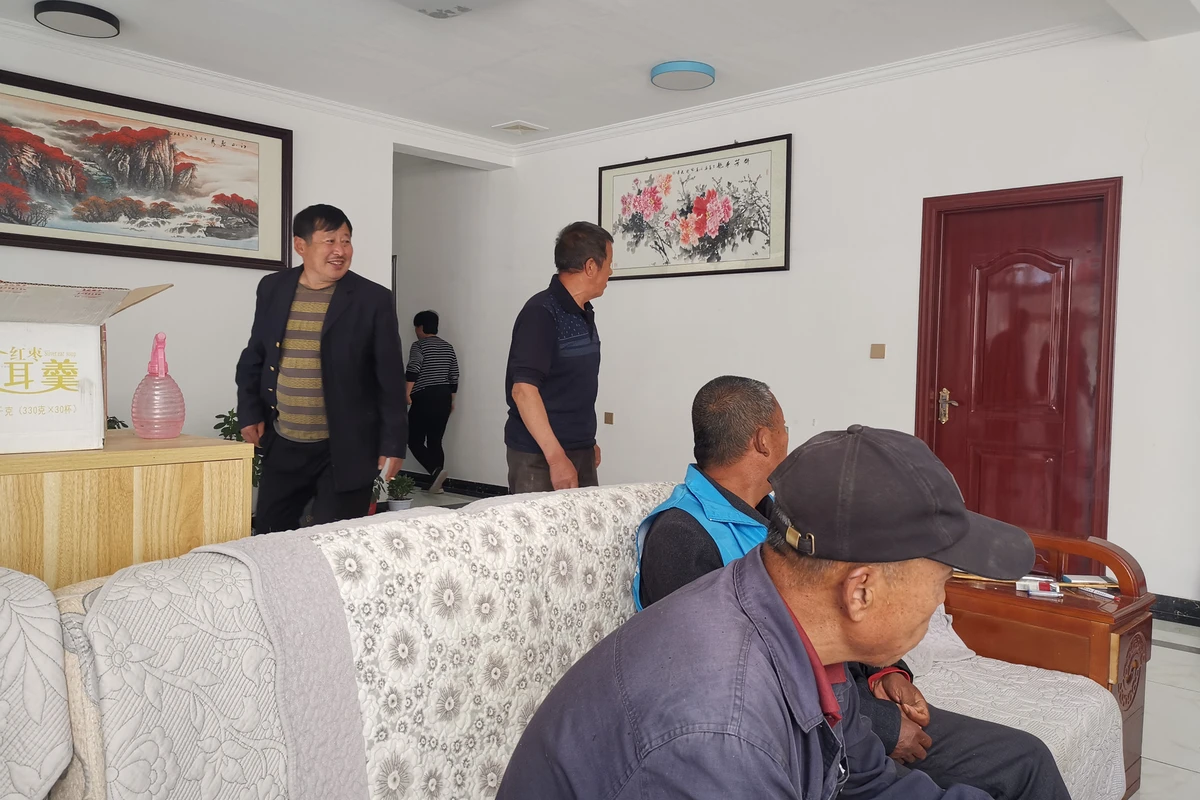
The owner, Brother Jia, standing at the dining-room door. Born in 1952, he’s a tidy person; the sitting room has whitewashed walls, and the house is spick-and-span. The living conditions far exceeded my imagination—I am truly happy they enjoy such a good life.
Village homestead land: each family gets a plot of 14 m × 20 m = 280 m². Brother Jia’s building has a ground floor area of 14 m × 10 m = 140 m², equal to the usable area—spacious and bright. Floor tiles 80 cm × 80 cm, with skirting boards.
The woman in the red jacket is the team leader’s wife. People recalled that back then, the village had just over 100 people and 11½ confirmed bachelors. During my two years there, there wasn’t a single new bride. Later, all the bachelors found wives.
Several familiar villagers were called over. The smoking fellows were still lighting cigarette after cigarette. No one in the village now farms the land; the young people all work for wages.
This is Brother Xiang, the former work-point recorder, also nearly 70; he’s still in fair health and doesn’t smoke either.
In the middle is Brother Sheng, the team leader’s older brother, an electrician back then—maybe he’s become chatty. The team leader’s family had five brothers and two sisters.
I’d originally planned to eat at a village restaurant at noon, but due to the epidemic, it was closed. So at noon I ate at the team leader’s house—five cold dishes, five hot dishes, meat pies, dumplings, and white liquor.
Rural medical insurance costs ¥360 per year for adults, children and the elderly (men over 60, women over 55) pay half. Nine-year compulsory education is free. The government gives an old-age allowance of ¥800 per person per month. From the villagers’ committee’s land-industrialization income, each person receives ¥2,000 per year. Farmland rent is ¥200 per mu per year, but no one rents it.
In all, I met five villagers. I went to each of their homes to see for myself how they lived.
The second family I visited was Brother Xiang’s. His house is a three-story building with several rental rooms but no commercial shophouse.
Zhunao Village has 150 registered residents. Monthly income totals ¥700,000, per capita ¥4,600, mainly from rental housing (¥700 per room per month) and shops (a restaurant ¥60,000 per month).
The passage beside the ground-floor annex.
Brother Xiang’s sitting room is on the third floor, not as large as the team leader’s. Brother Sheng’s wife passed away early, so now he lives with his son’s family. His daughter-in-law served us tea, and the family is living happily.
Leaving Brother Xiang’s, we came to the third home: Brother Sheng’s house. The woman pouring water is Sister Sheng.
Brother Sheng’s kitchen and dining area.
Brother Sheng’s bathroom—washing machine, flush toilet, everything you need.
The fourth home: this is the exterior facade of Brother Yuan’s house. The ground-floor restaurant space is rented out, bringing in ¥60,000 a month.
The staircase inside the building.
The hall outside the third-floor living room, resembling an old-style courtyard.
The door of the third-floor living room.
Inside the living room, even the grandchildren’s toys.
On the wall hangs a photo of Brother Yuan, his wife, and their grandchildren.
The kitchen, with modular cabinets.
At 3:00 p.m., the last family, the fifth: Little Fuzi’s house. He was born in 1962 or 1963. His place has the largest floor area—the whole homestead plot is built up. That red door is his main gate.
A long corridor inside, rental rooms on the left and right providing him steady rental income.
This is Little Fuzi’s sitting room.
15:45—time flew. I was back on the bus coming.
The sky is very blue, with a few clouds.
The blue sign ahead reads: “6th Ring Road, Da Zhou Yi Intersection.”
This is Beijing’s Southern 6th Ring Road.
Eight lanes running both directions.
The life of my fellow villagers is much better now, and nothing could make me happier.
I wish their children and grandchildren an even brighter future.
Getting off the bus, time to transfer to the subway line.


