Post-Pandemic Journey West to Shanxi and Shaanxi
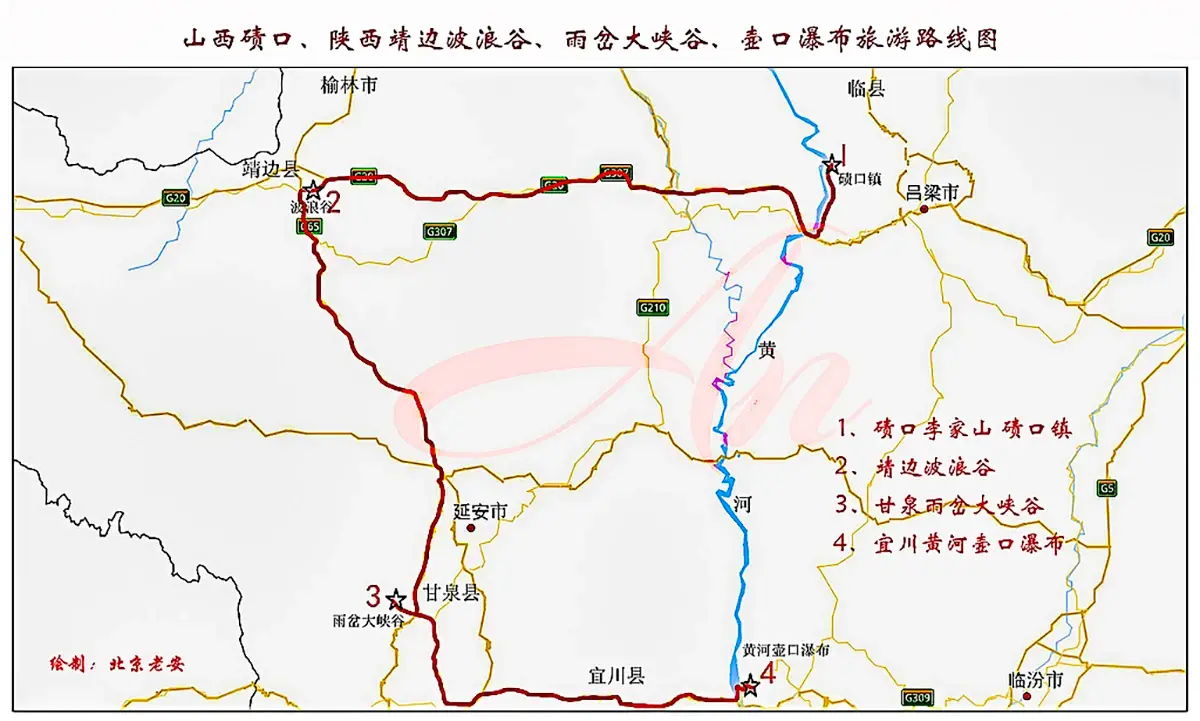
It was my first trip across provincial borders after the pandemic. On September 4, I set off with the Souku Photography Group on a four-day tour to the Qikou Lijiashan Village in Shanxi, the Jingbian Wave Valley, Ganquan Grand Canyon, and Hukou Waterfall, straddling Shaanxi and Shanxi.
In the morning, we took a shuttle bus from the compound to gather at Yuanmingyuan, and the coach departed right at 7 am. We made quick rest stops at two service areas (Wangdu in Hebei and Jingle in Shanxi). After ten hours on the road, we reached Qikou in Lin County, Lüliang, at 5 pm, and switched to a local minibus to wind our way up the twisting mountain road to Lijiashan Village.
The first thing I saw in Lijiashan was an old man in a rustic hamlet, his head wrapped in a white towel, wearing a sheepskin vest – and what really caught my eye was the QR code hanging on a tag around his neck, a striking contrast between old traditions and new technology.
Lijiashan Village, in Qikou Town, Lin County, Shanxi, has been named a nationally historic and cultural village. Around a hundred courtyards remain, from opulent Qing Dynasty houses to ordinary cave dwellings, harboring the customs of the Loess Plateau and the deep culture of the Yellow River – invaluable material for studying ancient folk life.
The village’s terrain is extraordinary. Buildings are scattered across a hillside that climbs several hundred meters at a slope of about forty degrees. Almost every structure is perfectly adapted to the land, cleverly integrated with the mountain’s contours. From a distance, structures in all kinds of styles cascade one above another, from the bottom of the ravine to the crest, in as many as nine tiers – staggeringly beautiful.
While I was editing my travel notes, Teacher Qin (whose online name is “A Practitioner Wandering the World”) posted a photograph in our group chat. I was stunned. “Wow, this is the Potala Palace,” I blurted – the Potala of the Loess Plateau. (The photo was taken by Teacher Qin.)
Two small ravines flow southward through the village, merging at its southern end and pouring into the Yellow River. The ridge between them resembles a phoenix’s head, while the hills to the left and right are like its wings. In feng shui, this topography is believed to be highly favorable for gathering wealth. The lanes inside the village rise and fall, paved neatly with stone blocks.
In the evening, villagers rested after a long day, cooking, eating, chatting as couples. Old Li, the experienced model, confidently sang a Shanxi folk song – a Xintianyou melody. He smoked his pipe with leisurely ease and then led his little donkey home.
We spent the night in Qikou Ancient Town, Lin County, Lüliang, Shanxi – at the Yellow River Homestay, right on the border between Shanxi and Shaanxi. Qikou was once a bustling ferry port, a major hub for goods moving north along the Yellow River. Nestled below Wohu Mountain, the town’s main street twists east then north for over two kilometers. Streets link to streets, lanes meet lanes, lanes all connect, courtyards adjoin – a visiting design professor once remarked, “This architecture is what I call ‘three-dimensional, interpenetrating vernacular building.’ Its style is globally distinctive.”
We stayed at the Qikou Inn, in the heart of the ancient town, backed by the Lüliang Mountains, facing the Yellow River and right next to the old Qikou pier. The inn was originally the Sihetang trading house, dealing mainly in sesame oil. In its heyday, “a hundred boats moored at its door, a thousand camels passed its gate,” its business reaching Baotou and Yinchuan to the north, Shaanxi’s frontier to the west, and Taiyuan, Beijing, and Tianjin to the east. After many changes, it was turned into an inn in the early 2000s. The buildings are on two levels: the lower level is cave-style, while the upper level features a row of houses with traditional lattice windows and wooden doors. Blue-stone walls, grey-tiled roofs, and upswept eaves rise and fall with the terrain. Lines of red lanterns hang here and there, lending life to this ancient courtyard.
Though the inn is now adorned with beautiful flowers and rows of red lanterns that bring plenty of vitality, the stone-paved floors, steep staircases, and series of decorative touches all hint at its storied past.
Qikou was once a flourishing center of water and land transport. Products from the northwest – grain, furs, medicinal herbs – came by water to this point and were then carried further by mules, horses, and camels over land. On the return trips, goods like tea, matches, and daily necessities were brought back and shipped northwest by river. Now, with modern roads and railways, Qikou has lost its old glory.
At sunrise, the crimson dawn spread across the land, and the Yellow River looked especially beautiful. Standing by the river, I gazed at its ceaseless flow, my heart surging as I pictured the scenes and splendor of days gone by.
Leaving Qikou, we traveled to the Jingbian Wave Valley, a natural landscape in Jingbian County, Yulin, Shaanxi. Jingbian is quite close to Yan’an. I had always thought it was a defined scenic area with clear boundaries, but the wave valley (locally called the Jingbian Red Sandstone Canyon) is actually a sprawling treasure hidden deep in the mountains. Millions of years of wind and water have carved the sandstone into rippling patterns – circles and clusters like waves. A true feng shui treasure, I marveled at nature’s magical sculptures and grand pictures, a vast stretch of sweeping Danxia landforms. We took our fill of photos, and Teacher An’s “little airplane” (drone) fully demonstrated its talents, capturing an unobstructed panorama of the entire valley.
We were lucky that the yoga instructor, a beautiful woman in our group, showcased graceful poses in front of the lenses of us photographers, adding even more beauty to the already stunning scenery.
When we reached the water Danxia area of Scenic Zone 3, the Longzhou Lake encircled by mountains was like a mirror of the sky reflecting everything around it. Nestled among the stone valleys, a crescent of emerald-green water appeared – to our amazement, everyone praised it as looking like a map of China, an image with great visual impact. The calm green lake and the red sandstone created a perfect landscape painting.
This spot serves as a creative photography base.
We had planned to capture the sunset at the water Danxia, but unexpectedly, a wild wind whipped up dust that filled the sky. We had to change plans and head back to Jingbian town. Just when the weather was grey and hazy, the sky suddenly turned a brilliant red. The bus erupted in cheers. Teacher Liu and the driver went out of their way, finding an impromptu vantage point for shooting: a modern oil refinery. The photography enthusiasts were lightning fast – ha, forgetting all about their backaches and leg pains – scrambling onto walls and the top of a water tanker truck to seize the beautiful moment. Under the fiery sunset, the refinery looked extraordinarily striking. Later, everyone joked and laughed, “This must be because we have good karma – the heavens are looking after us!”
I quickly snapped two shots without properly focusing; just look at the spirited poses of the photographers.
The photo below was taken by Teacher Hongyehong (Red Leaf Red) – I’m borrowing it. It shows a photographer absorbed on top of an abandoned water tanker truck.
Photography is exhausting but joyful. We set off early for the Ganquan Yucha Grand Canyon, a place I had long dreamed of photographing. At the scenic area, we boarded the park shuttle. The road was lined with greenery, with little wildflowers of all colors blooming along the way. After about 35 minutes, we arrived at Mudan (Peony) Gully.
I had thought we could go straight into the Yucha Grand Canyon, but the guide told us the best time to photograph it is around noon to 2 pm when the sun is overhead. Since it was still early, we took a look at Mudan Gully. It’s said that a massive earthquake hundreds of millions of years ago split a large mountain in two, creating a huge fracture. After eons of wind and rain erosion, it became a canyon. The trailside is dotted with wild peonies, hence the name Mudan Gully. The canyon is about 100 meters long and roughly 1 meter wide. The ground is uneven and often slippery – you have to be very careful. After about an hour of exploring, you simply retrace your steps.
Getting from Mudan Gully to the next spot, Ganquan Grand Canyon, takes a 20-minute shuttle ride.
The Ganquan Yucha Grand Canyon is a natural wonder, a “living Danxia and China’s Dream Valley.” This astonishing geological treasure was opened to the public in 2017, a unique and famous canyon and a holy land for photographers. It is about 300 meters long, 1 to 2 meters wide, with the narrowest spot at the bottom just 20 centimeters across. When the sky is clear and the midday sun slips through the crack, shafts of light illuminate kaleidoscopic colors and bizarre shapes.
The Hukou Waterfall of the Yellow River is a popular tourist destination, located in Hukou Township, Yichuan County, Yan’an. The Yellow River serves as the boundary here, with Shanxi on one side and Shaanxi on the other; our hotel was on the Shanxi side, and right across the river was Shaanxi. The Yellow River roars and surges with the power of an avalanche, like a tide in a storm. Its crashing waves thrill the soul, its indomitable spirit displays magnificence, and its all-conquering momentum overwhelms you.
Our motherland’s landscapes – vast, profound, majestic – are here to share. The Yellow River Cantata bursts forth with greatness and pride in our hearts, having nurtured a brilliant civilization that soars to the sky. It stirs the hearts of the Chinese people, making our blood boil with passion!


