Tracing Beijing's Ancient City Remnants: The Shifting Landscapes (Part Four: Inner Gates of Ming and Qing – Middle Section)
In the previous episode, we said that the Yuan dynasty’s inner city south wall was moved by the Ming from the Chang’an Avenue line to the Front Three Gates line. This south wall stood in front of the imperial city, so the three gates on its southern side are called the “Front Three Gates”.
The westernmost of the Front Three Gates is Xuanwumen. Before the wall was moved south, this was the Yuan dynasty’s Shunchengmen. After the wall shifted south in 1419 (the 17th year of the Yongle reign), the name Shunchengmen was still used. Why didn’t Zhu Di rename the Front Three Gates? Because he had a major matter on his mind and couldn’t be bothered with gate names. What major matter? That year, Zheng He’s fifth voyage to the Western Seas was about to return. Zhu Di had dispatched Zheng He to the seas to track down the Jianwen Emperor, who had fled to the immortal mountains in the ocean. The Eastern Sea immortal mountains are close to us, and the immortals there probably had quite a few dealings with the imperial court – naturally through the chief at the White Cloud Temple. Those Western Sea immortal mountains were something the Chinese used to sneer at, and it was possible that the Jianwen Emperor had gone there. Zheng He’s previous western voyages had turned up not a single hair of the Jianwen Emperor, so this time he wanted to drift longer on the sea and search further afield. According to records, on this fifth voyage Zheng He reached Lasa on the eastern coast of Africa, which is today’s Aden port in Yemen. After this voyage Zheng He produced the famous Zheng He Navigation Chart, the world’s first nautical chart. The Portuguese had heard about this chart from Marco Polo, and they dreamed of developing a sailing route eastwards from Portugal that would link up with Zheng He’s route and then reach the gold-plated palaces Polo had described. Starting from Prince Henry the Navigator’s first expeditions in 1418, via Bartolomeu Dias rounding the Cape of Good Hope, in 1498 (the 11th year of the Hongzhi reign of the Ming) Vasco da Gama finally sailed to Aden, connecting with Zheng He’s route. Back in Beijing, Zhu Di was eagerly awaiting news of Zheng He, and certainly had no mood to bother about whether the Front Three Gates should be renamed. Zheng He did not disappoint. Upon his return, he reported: “We searched every immortal mountain in the Western Sea, but saw not a single strand of Zhu Yunwen’s hair.” Relieved that his nephew was not hiding on any immortal mountain, Zhu Di issued an edict lauding Zheng He with spiritual rewards, and also approved a pile of silver as material reward. Over twenty years later, Zhu Qizhen succeeded as the Yingzong Emperor. Right upon ascending the throne in the first year of the Zhengtong reign (1436), he had the Front Three Gates rebuilt, and took the chance to change Shunchengmen’s name to Xuanwumen. Xuanwu means “proclaiming martial valour” – as in “if jackals come, meet them with hunting rifles”.
The archery tower and barbican of Xuanwumen were demolished during the Republic of China period, and the gate tower itself was torn down in 1965 when the loop subway line was built. So now it’s all gone. Now it’s clear: Beijing’s old loop line was built along the inner city wall, which is why the stations are all named after inner city gates. That loop is today’s Line 2. Outside Xuanwumen there used to be a vegetable market; the market crossroads was called Caishikou, roughly equivalent to today’s Xinfadi wholesale market. On ordinary days, all sorts of middlemen wholesaled fruit and vegetables here, then pushed carts or carried poles into the city through Xuanwumen, weaving through the hutongs hawking their goods. During the Autumn Assizes, prison carts would roll out of Xuanwumen. The executioner and supervisor would pull up a stool at any old vegetable shop, stop the cart in the street, and when the “Xuanwu noon cannon” fired – synchronised with the Deshengmen cannon – they would behead the convicts. In the old calendar, wǔ shí sān kè (the third quarter of the hour of the horse, i.e. noon) was pretty much exactly twelve o’clock. So Xuanwumen was the gate that handled prison carts.
The easternmost of the Front Three Gates is Chongwenmen. During the Yuan dynasty, this gate was called Wenmingmen, but the common people called it Hademen, with the “ha” in the third tone. After the wall moved south in the 19th year of the Yongle reign, the name was changed to Chongwenmen in the 4th year of the Zhengtong reign. Chongwenmen and Xuanwumen flank the imperial city, embodying the Confucian ideal of “civil governance in peace, martial prowess in war” – wen on the left, wu on the right. In ancient times, emperors all aspired to rule the realm with wen and expand territory with wu. Going straight north through Chongwenmen you would eventually reach the Confucian Temple – very literate, right? It was just a terribly long walk. This Chinese cultural concept of “civil and martial” later spread to the West. I once saw a Western understanding of this in the old palace of Florence, Italy. That palace was Cosimo I’s residence after he became Duke of Florence in 1537, which corresponds to the 16th year of the Jiajing reign of the Ming under Emperor Shizong (Zhu Houcong), nearly a hundred years after Wenmingmen had been renamed Chongwenmen. By then, the names Chongwen and Xuanwu were already well-known far beyond China’s borders. In front of his Palazzo Vecchio, Cosimo I didn’t erect two gates but two statues. On the right stands Michelangelo’s famous David, representing spiritual power; on the left stands Bandinelli’s equally famous Hercules and Cacus – Hercules being the god of strength in Greek mythology, representing brute force. Here too, a civil and a martial figure stand at the entrance, but their positions are entirely reversed. You can see that their understanding of Chinese culture is not yet thorough.
Back then, Chongwenmen was mainly the gate for transporting wine – the wine that fills ponds and forests. A tax office was set up inside the gate specifically to collect wine tax, and the proceeds were used to buy cosmetics for the empress and consorts in the palace. There’s an old saying: “Tobacco and liquor go together.” Since Chongwenmen had liquor, it naturally had to have tobacco too – that’s where “Hademen Cigarettes” come in. The name Hademen originally should have been “Hadamen”, because inside Chongwenmen during the Yuan dynasty there was a Prince Hada’s mansion. No one knows which prince Hada was, and the location of his mansion is even more of a mystery. Hademen cigarettes were a product of the British American Tobacco Company, a case of trademark piracy. The British had a cigarette factory in Qingdao, and that’s where they made Hademen cigarettes. After the founding of the People’s Republic, people felt the Hademen brand carried colonial overtones, so production was quickly stopped. A couple of years ago, the Qingdao Cigarette Factory brought this brand back onto the market, and nobody called it colonial any more – some might even feel proud of it.
Among the Front Three Gates, one has actually been preserved, or rather not demolished: the central gate, Zhengyangmen, commonly known as Qianmen. Zhengyangmen means “the midday sun hangs over this gate”. The ancients would say, in classical terms, “The sage ruler faces south, the sun reaches its zenith, and all nations gaze up in awe.” This gate was originally Lizhengmen in the Yuan, and after being moved south in the 19th year of the Yongle reign it still bore the same name; it was also renamed together with the other two southern gates in the first year of the Zhengtong reign.
The main road running along the Front Three Gates isn’t called “Front Three Gates Avenue”; instead, it’s named after each gate – something like Xuanwumen West Street or Chongwenmen East Street. Here at Qianmen, naturally, you have Qianmen West Street and Qianmen East Street. The subway loop line has a Qianmen station. When you exit the station and look north, there stands the Qianmen gate tower.
Look south, and you see the Qianmen archery tower.
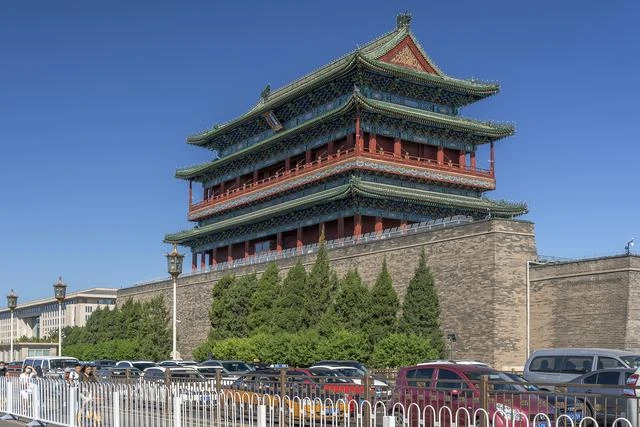
The Qianmen gate tower is the only surviving inner city gate tower in Beijing. Let’s take a look from the front.
This gate tower, completed in the 4th year of the Zhengtong reign (1439), has now stood for five hundred and eighty years, destroyed several times and rebuilt again. What we see today should be the appearance after reconstruction in the 33rd year of the Guangxu reign of the Qing (1907). It’s a two-storey building with a double-eaved hip-and-gable roof, a structure of dougong brackets in the Ming style. The building is seven bays wide and three bays deep, surrounded on the ground floor by a veranda with pillars; the upper storey features a balcony with railings all around, and supporting eaves poles at the four corners. The roof is covered with grey tiles edged in green glazed trimming. At the ends of the main ridge are not chiwen but dragon tails. The hip ridges are unusually grand: no immortal riding a phoenix at the front, but nine roof-beast ornaments, a very high specification. Beneath the eaves hangs a wooden plaque inscribed with the name “Zhengyangmen”.
Now turn around to have a look at the archery tower.
This archery tower follows the same form as the Deshengmen archery tower we saw earlier, just a size larger. Look more carefully and you’ll notice a minor difference: first, the arrow slits have curved hoods, a 1915 addition. Another difference is the broad platform-like terrace behind the front portico.
Go to the front and you’ll see that this archery tower has an arched gateway. This is the only archery tower among the inner city gates with such an opening, because the emperor used it for ceremonial entries and exits, and in 1949 the People’s Liberation Army held its official city-entering ceremony right here.
Look up higher and you’ll spot the stone plaque inscribed “Zhengyangmen” still in place. Compare this stone plaque with the “Pingzemen” one and the gap is huge – there isn’t even an inscription, so it’s definitely not an original Ming piece. Study it closely: the last stroke of the character “門” (gate) has no hook. Tinkering with Chinese characters like this wasn’t something the Ming people did; only Qing emperors could pull off such stunts. In the Qing dynasty, changing characters began under the Qianlong Emperor, particularly on steles and plaques, and later emperors kept up this sort of silly habit.
Beside the arched gateway hangs a plaque indicating it is a Major Historical and Cultural Site Protected at the National Level, listed in 1988, the third batch. In that same batch, Beijing also registered the Yuanmingyuan ruins, the Imperial Ancestral Temple, the Confucian Temple, the Altar of Land and Grain, the Tianning Temple Liao pagoda, the Silver Mountain pagoda forest, the Fahai Temple, Niujie Mosque, the Liulihe Yan capital site, and a residence at Chongli Lane in Dongsi Liutiao. The lions by the archway don’t look like original residents of this spot.
Although Zhengyangmen retains the largest gate tower and archery tower among the nine inner city gates, quite a few ancillary structures were demolished. Most importantly, in 1915 the barbican was torn down. Inside the barbican, apart from the Guandi Temple, there was also a Guanyin Temple – something that made it different from the barbicans of other gates. The horse-ramp inside the barbican was almost certainly demolished at the same time. The sluice gates and drawbridge towers on the east and west sides of the barbican were also removed, and the moat was filled in.
Beyond the arched gateway of the archery tower, there used to be a large stone bridge over the moat. This bridge was unusual: the central span served as the main roadway, and there was an extra span on each side, like auxiliary lanes. In fact, the middle span was the imperial path, flanked by white marble balustrades; the side spans were ordinary stone bridges.
After crossing the stone bridge you would come to a memorial archway (pailou). This was the most impressive pailou in the capital at the time: a six-pillar, five-bay structure. All nine inner city gates of Beijing had pailou outside them, but only the Qianmen pailou was six pillars and five bays; the others were four pillars and three bays. Take a look at the recently rebuilt Qianmen pailou.
Six tall central pillars, and on top of each pillar’s canopy (pilu cap) sit two lions facing each other. The plaque between the beams reads “Zhengyang Bridge”, the name of the bridge over the moat behind it.
In the old days, people would say Qianmen was “four gates, three bridges, five-arched pailou”. The four gates were the gate tower and archery tower archway, plus a sluice gate on each side; the three bridges were the main and auxiliary spans of Zhengyang Bridge; the five-arched pailou is the one shown above. This “four gates, three bridges, five-arched pailou” was unique to Qianmen, the only one of its kind in the capital.
That same British American Tobacco Company didn’t just roll “Hademen” cigarettes for profit in China; it also turned Qianmen into a cigarette brand – the famous “Daqianmen” (Grand Qianmen) cigarettes. Daqianmen cigarettes were produced in Shanghai, and the pack featured a picture of the Qianmen archery tower. Unlike Hademen, which once ceased production, Daqianmen cigarettes have never stopped being made, though of course they were taken over by the new China’s Shanghai Cigarette Factory. In the planned economy era, cigarette output was also planned. In Beijing, the everyday brands you’d normally see were cheap ones like “Badaling” and “Fragrant Hills”, while Shanghai produced “Flying Horse”. Only during festivals would households be allocated premium cigarettes by permit; Grade-A cigarettes like “Zhonghua” were never distributed. The “good” cigarettes issued by permit were Grade-B: Daqianmen and Peony.
Zhengyangmen, strictly speaking, refers to the gate tower and archery tower in the pictures above. When people say “Qianmen”, however, they generally mean the vast commercial district outside Zhengyangmen – that is, Qianmen Avenue beneath the five-arched pailou and the maze of large and small lanes branching off it. This bustling commercial strip stretches all the way south to Zhushikou. In the past, this street was called Zhengyangmen Avenue; after 1965 it was renamed Qianmen Avenue. Beijing’s commercial areas once had an unspoken hierarchy: Wangfujing Department Store was for the high-end elite, Xidan Bazaar was mid-range, and Qianmen was where ordinary folk roamed a sea of small shops.
The Qianmen area still carries traces of the old fang (ward) system: the east side of the road was Dongfang (East Ward) and the west side was Xifang (West Ward). Qianmen is home to many of Beijing’s time-honoured brands. Below the five-arched pailou, the Dabei Photo Studio can count itself as one of them. With over a hundred years of history, it occupies the most prestigious spot on the east side – Qianmen Avenue No. 2.
What used to be across the street at No. 1? I can’t recall; after the street renovation it was taken over by Starbucks. On Qianmen West Street there’s an American chain that opened its very first branch in China after half a century in the U.S. – Kentucky Fried Chicken. After China’s reform and opening-up, the earliest foreign restaurant in Beijing was Maxim’s de Paris at Chongwenmen in 1983; the Qianmen KFC, opening in 1987, was the second.
Some of the names of Qianmen’s once-bustling commercial streets survive in the hutong names, like Liangshi Dian Jie (Grain Shop Street). Look at what Liangshi Dian Jie looks like now.
Don’t be fooled by its current tumbledown appearance – there are still buildings like this one! Clearly this was once a glamorous street.
The most famous spot on Liangshi Dian Jie is this time-honoured shop at No. 3.
This is a truly ancient establishment, its plaque allegedly written by the Ming dynasty villain Yan Song – that alone tells you how old it is, doesn’t it? It dates from the ninth year of the Jiajing reign (1530), four hundred and ninety years ago. Whatever you think of Yan Song as a person, his calligraphy is absolutely superb. This plaque is said to be the original, repeatedly restored; it’s a miracle it has survived. It’s a masterpiece of Yan Song’s strong brushwork, and calligraphy students come to study it, then buy a jar of Liu Bi Ju pickled vegetables to take home and eat while practising their characters. The “Six Necessities” (liu bi) in the shop’s name refer to the six ingredients and utensils for making pickles – all of which must be the very best.
Dashilar, of course, is famous nationwide and needs no introduction; I won’t even look inside, it’s a mess. The lane dedicated solely to eating is Xianyukou, and I’ve eaten there myself. Sitting inside, looking out at the street.
The shop owner stands at the door, energetically beckoning passers‑by to come in.
Finally, a few elderly ladies come in, each buying three “zila red” and three “zila white” – two traditional Beijing-style mooncakes, pronounced something like “zī lā hóng, zī lā bái”.
To welcome the 2008 Beijing Olympics, Qianmen Avenue underwent renovations starting in 2003. After the makeover, the only landmark that essentially stayed in place and kept its original appearance was the Quanjude Roast Duck Restaurant. Among the time‑honoured brands that returned – or perhaps never really left – Duyichu is the only one still on the avenue. Old Zhengxing, which moved from Shanghai after liberation, used to be here too, and its chicken soup buns were incredibly delicious; they’re gone now. Beijingers’ beloved door‑frame hutong braised pork and lung stew is also history. Mentioning braised offal naturally brings up fried liver; the stir-fried liver at Tianxingju on Xianyukou is still around, but the quality of their steamed buns has declined massively.
The most famous former department store on Qianmen Avenue was this: the Quanyechang (Exhortation to Industry Hall).
The earliest Quanyechang was set up in 1905; the present building was rebuilt in 1923 after a fire, designed by a foreigner in a Neo-Baroque style. “Quanye” means encouraging industry – this was originally an exhibition hall for industrial products. Before 1949, it had turned into a marketplace for individual vendors selling just about everything; after liberation, it became a state‑run department store. In the 1970s, it was the Xinxin Clothing Store. Today the building is a protected heritage site of Beijing municipality.
Heading west from Quanyechang, a patch of old houses was cleared and new buildings rose. Let’s take a turn through them. Brand‑new office towers.
New buildings, but still in an old style.
Downstairs are all sorts of shops – the office workers from upstairs can browse on their breaks.
And there are plenty of eateries and bars, so they can grab a meal. But if they work late past midnight, everything will probably be closed, and they’ll have to go to the KFC on the corner for chicken. That character “坊” (fang) on the wall – does it hint at the old “ward” system?
As it turns out, this whole block is called “Beijing Fang”. Is this the only fang left in the city now? With the “fortune” character shining down on shops in Beijing Fang, business is surely guaranteed.
All in all, the Qianmen area has long been a place for commerce and entertainment, and it still is.
The Ming-Qing inner city of Beijing had these nine gates. But gates alone aren’t enough – there had to be a city wall too. More on that next time.


