A Small Town Journey: The Autumn Hues of Gubei Water Town
"Autumn, this northern autumn—if only it could be kept, I would trade two-thirds of my life for a mere sliver of it." This is Yu Dafu’s expression of love for the northern autumn.
Seeing the goldenrain trees outside, a blend of red and yellow, I'm reminded of last year’s autumn in the capital and its autumn stories…
"In autumn, one must live in Beiping. I don’t know what paradise looks like, but judging from my life experience, autumn in Beiping is paradise." Autumn in Beiping was Lao She’s dream…
Last late October, XL was studying in Beijing. It happened to be a Saturday when her course ended. To spend one more evening with me in Beijing, she gave up the chance to join her classmates on an Aranya study trip. On Friday night, she and a few friends waited for me over drinks until late—I was deeply touched.
Flight KN5912 (20:27–21:50) arrived on time at the newly opened Daxing International Airport. Most of the shops were still under renovation; the scene was messy but orderly. After the hurried travelers left, the hall was empty and silent.
A friend of my girlfriend arranged a pick-up, and we raced forward, racing against time.
Friends reunited, we drank and chatted joyfully; before it grew too late, we were already tipsy.
In the early hours, we checked into the East Hotel in the Jiuxianqiao area of Chaoyang District, Beijing. Here’s a corner of the hotel.
At this hour, the lobby was very quiet. In Beijing, where space is at a premium, the lobby isn’t as spacious and grand as hotels inland, but it’s simple and still cozy. Facing the bed was a floor-to-ceiling glass wall with a broad view; when I drew back the curtains, lights still twinkled in the night sky.
The alarm went off punctually at 8 o’clock. I never thought we’d be able to get up, but somehow we did.
Mainly because we had a scheduled time with the driver, who had already arrived to pick us up—I’d hate to keep him waiting.
Passing through Boya International Center, we headed north.
During dinner the night before, Dawei strongly recommended going to Labagoumen to see the red leaves and the primeval forest. The journey was quite long, so we just caught up on sleep in the car.
On the way, we grabbed hamburgers and soy milk from a fast-food joint to make do for breakfast—we needed to recover our strength quickly.
Passing through a 'Socialist Good Countryside' village, we spotted a copper hotpot restaurant and drooled together—truly, socialism is good.
Over hills and dales, many wild sections of the Great Wall peeked out among the mountains. At 11 o’clock, we arrived at Labagoumen.
Labagoumen Primitive Forest Scenic Area is at the northernmost tip of Huairou County. Nanhou Peak, the highest point, rises 1,700 meters. The vast primeval forest, sheer cliffs, and mysterious canyons are natural wonders rarely seen around Beijing.
With distinct seasons, the climate regularly cloaks the capital in a riot of colors. You must have heard the saying: 'Once autumn arrives, Beijing becomes Beiping.'
Our luck was good—look, the sky was so blue.
But the hiking trail made my exhausted girlfriend nervous. She started to negotiate with me: Could we... not... climb it...
Silently, I took all the luggage, including her jacket she’d taken off. And this was only the beginning...
The autumn in the capital is beautiful and fleeting, much like the happy moments in life—precious and meant to be savored.
Autumn leaves spread a thick blanket over the earth, adding to the season’s desolation and quietude.
Autumn winds swept in, like a pair of deft hands, dying the mountains and fields into a poetic scroll.
On this journey, together, we lost ourselves in the brilliant colors and savored the many beauties of the world.
Labagoumen is a primitive forest; the facilities are not complete, but it’s full of wild charm, and a stroll here offers a special kind of pleasure.
I knew you wanted to turn back, so we wouldn’t venture deeper into the primeval forest to explore its hidden depths.
We took the first loop back, saving the best time for the main destination of this trip—Gubei Water Town.
From the observation deck, we looked far out; peaks folded upon peaks, stretching endlessly.
The outskirts of Beijing are mountainous, part of the Yanshan range—one of the famous mountain ranges in northern China and also a strategic location.
Jagged rocks set against the blue sky painted a quintessential northern landscape.
We were about to descend from this viewing platform. If time allowed, we could have gone further in. After all, primeval forests are becoming rarer, especially near the capital.
The leaves had all fallen; by late autumn, the bark would have turned even whiter.
The late autumn sky was especially deep blue, different from summer’s sky.
Red, yellow, white, gray, black, blue—all colors blended together.
The lush green of high summer
had transformed into the fiery red of autumn.
Vigorous tree trunks stretched their arms toward the sky, as if they, too, wanted to embrace that autumn blue.
The north has distinct seasons, each brief.
The capital’s autumn seems even more adorably beautiful!
Seeing it was getting late, we had to head to our main destination before sunset.
Goodbye, Labagoumen. You’re the kind of place to visit once in a lifetime, and only once.
We drove over mountains straight to Gubei Water Town. Fortunately, the road was narrow and tranquil, the scenery beautiful and secluded. The saying is so true: the most beautiful scenery is always on the road.
We arrived at the old town at 4:20 p.m., the afternoon sun already waning, a streak of red—stunningly beautiful! Here, we discovered the most beautiful season in the capital.
Gubei Water Town is located in Gubeikou Town, Miyun District, nestling at the foot of the Simatai Great Wall. Gubeikou has been renowned since ancient times for its strategic importance and rugged terrain. The Miyun County Annals describes it: 'The capital controls the northern frontier through three key passes—Songting, Gubeikou, and Juyong—with Gubeikou being the most critical.'
Gubeikou’s unique military culture attracted countless literati. Su Zhe, Liu Chang, Nalan Xingde, and other literary masters left behind many famous verses here. Emperors Kangxi and Qianlong praised it multiple times, eulogizing its dangerous and vital terrain as 'a strategic choke point leading to the desert, a Heaven-sent lock and key guarding the imposing pass.'
Simatai Great Wall lies north of Simatai Village, Gubeikou Town, right next to Gubei Water Town, 120 kilometers from Beijing, in the Yanshan Mountains. Built along steep ridges, it is celebrated for its five traits: precipitous, dense, uniform, ingenious, and complete.
In 1987, Simatai Great Wall was inscribed on the World Heritage list—the only ancient architectural site in China that preserves the original appearance of the Ming Dynasty, designated by UNESCO as an 'Original Great Wall.'
From afar, there it was, Simatai Great Wall, completely different in character from Badaling. This was the real steep barrier defending against northern nomadic tribes in ancient times. A poem testifies:
The Heavenly Ladder soars into the clouds, the Heavenly Bridge hangs amid a sea of mist. The graceful Fairy Tower stands tall; to climb Wangjing Tower is truly a challenge.
Gubei Water Town is a well-developed and successfully operated cultural-tourism town. In recent years, as town developments have swept across the country, Gubei Water Town has risen to fame as a model of successful operation, drawing countless industry professionals to study it.
It also benefits from the fame of the Simatai Great Wall, billing itself as 'a resort town with distinctive northern charm at the foot of the Simatai Great Wall.'
The town’s architecture is in the traditional northern courtyard style, distinctively draped in various creepers.
In late autumn, the capital’s most beautiful name comes from its most beautiful autumn colors.
At this time, the most beautiful Gubei Water Town also dons the most beautiful autumn hues.
There are still green trees not yet deeply brushed by autumn winds.
Given a bit more time, they should turn deep red too.
Xie Fuchun, a century-old brand, is also here. All the shops in the town follow the old style, cloaked in red with hardly any green.
A cold breeze gently blew, quietly slipping into our collars.
Days pass in a hurry; in the blink of an eye, it’s already late autumn.
Unlike the picturesque guesthouses of Moganshan with their beautiful landscapes, the homestays here are mostly courtyard compounds, more solemn, a perfect place for quiet contemplation.
A rainbow of vines danced in the air, dyeing the entire building red. It was starting to feel a bit visually overwhelming.
Suddenly, an archway appeared—Shanshui Chang (Eternal Landscape).
A sick body best feels the early wind and dew; dreams of returning know not the long road ahead.
What night is tonight? The landscape is eternal!
This yellow tells us it’s not yet late autumn.
Around the corner, a small shop suddenly appeared, bustling with people.
Warm light from inside filtered through the window lattice, falling on red leaves and turning them into another beautiful hue.
The chilly wind outside did nothing to hinder the cozy warmth within.
We decided to ascend the Simatai Great Wall at night, of course by cable car.
This night belonged to Gubei Water Town.
The Great Wall under the night sky has stood for centuries; its broken stone walls reveal the glorious history it has witnessed.
When ancient soldiers were on duty, the lighting must have been even dimmer and murkier.
As we climbed higher, the guardrails on both sides were too low—Simatai truly lives up to its reputation as the exemplar of a precipitous Great Wall.
The wind on the wall was very strong. We were dressed in quite a bit, but still couldn’t withstand the bone-chilling cold.
The staff on duty were all bundled in thick military coats; we should have worn even more to fend off this autumn chill.
Below the battlements were jagged rocks, making the precipitousness plain to see. Truly, one man can hold the pass against ten thousand!
Clumps of dwarf pines still stubbornly rooted themselves among the rocky debris.
Respect life, respect nature.
Under the dim yellow light, everything was unclear. We took a photo, promising to return in the daytime next time.
This is a map of the Simatai Great Wall scenic area; we had just reached the East 6th Tower.
In the pitch-black night sky, a long dragon of lights snaked into the distance—this is the most beautiful night view of the Great Wall.
The moon at the bridgehead was man-made, adding a splash of brightness to the darkness.
Moonlight like water, home is where you are.
Grand in scale, it exuded a touch of warmth amid the stern cold.
After descending, we decided to find food. We’d have to go back to the restaurant we’d passed earlier.
The drone show is a major highlight of Gubei Water Town. I’d never seen such a large-scale, precisely controlled drone array before—it was also a commemoration for our trip.
In the distance, the drones assembled, then converged above the central square of the old town, forming different patterns.
In a formation, with colors interlaced, they floated gently closer.
One moment, they transformed into a fairy tale of stars and moon.
The next, into a town gate.
Then into a Jiangnan water town.
Then into a solitary traveler.
The sky was very dark, no moon in sight. The drone show was stunning, perfect!
Ravenously hungry, we had two dishes and a soup, plus two flasks of Simatai liquor, with my beloved by my side—what a joy!
It was late. After dinner, we hurried back. The homestay we stayed at was wonderful—two king beds upstairs, and a living room and kitchen downstairs. We washed away the day’s fatigue and fell asleep in each other’s arms...
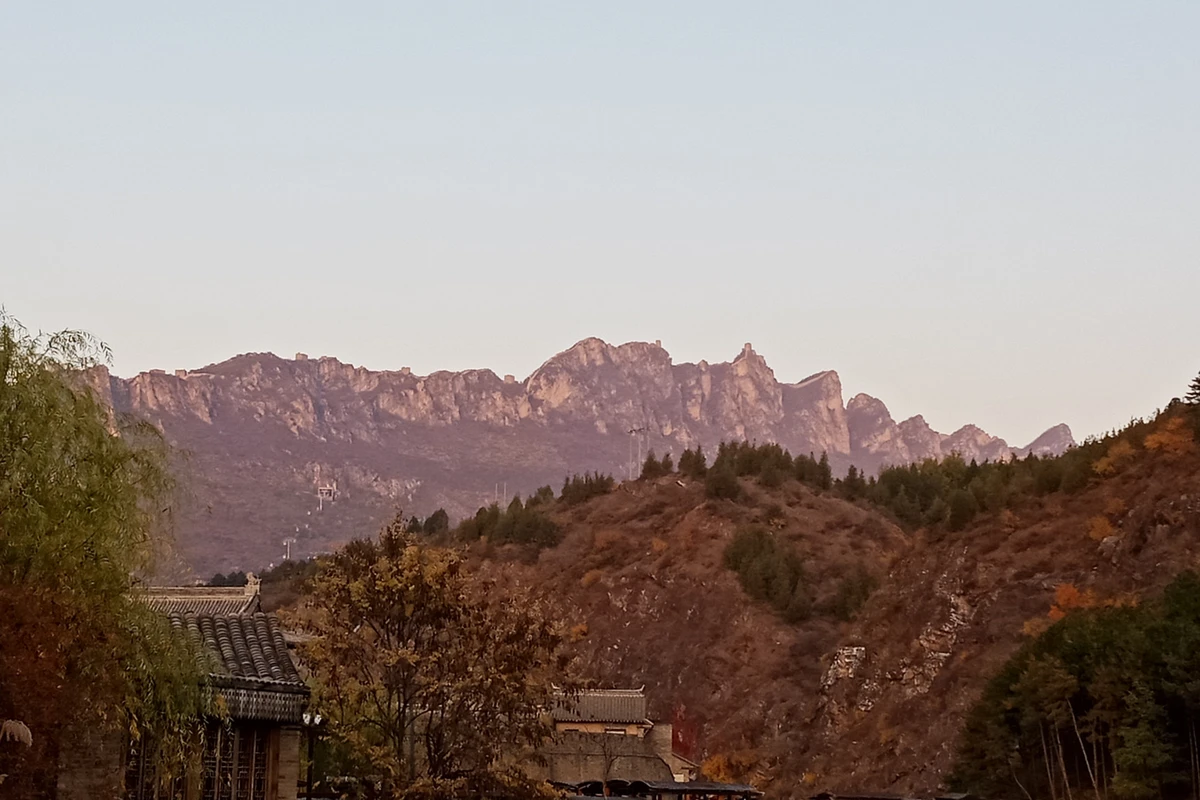
We got up at 9:30, and from the balcony, the Simatai Great Wall still stood in the distance.
After five hundred years, the Simatai Great Wall will still be there.
A hundred years from now? Who will remember us?
Our driver picked us up to return to the city. We planned to meet friends for lunch at 798. Once more, I looked back at the distant Simatai.
We will come back, and will definitely see you again at your most splendid time of the year.
Along the road, wild persimmons on the hills were bright red, yet no one picked them. Persimmons are wonderful—we’ve also planted a large field of persimmon trees.
They symbolize: everything goes as you wish, peace in all seasons, wealth in all seasons, perfection, Four Comprehensives, Four Confidences... I’m digressing.
From afar, the layered forests were dyed in brilliant colors, a beauty that rivals the Western Hills.
This autumn, why not visit Gubei Water Town, to embrace the red leaves and capture a captivating charm of the golden season.
Green, yellow, red, and the grey-white rocks of the hilltops formed an ocean of color, presenting a classic picture of a northern autumn.
At noon, we arrived at the Botanical Restaurant at Cherish Moments in 798 for lunch, a very distinctive Western restaurant.
The city’s warmth was still strong, and the blue flowers bloomed profusely.
This is right next door to the train carriage restaurant where we had pasta and salad last time. Darling, do you remember?
A year later, the design of our Botanical Garden Restaurant’s plant-based eatery also took inspiration from here—a sort of tribute to our love.
Starting next year, I won’t need to go to 798 to see our favorite restaurant every day.
Green is the color of life, and of all things growing. The owner carefully tends to these lovely plants.
After the meal, we took the high-speed train back. The short two-day trip passed like that—fulfilling and joyful!
Some people are free and untamed as the wind.
Some are as stubborn and immovable as a hill.
Some love to chase endlessly.
Some love to be content wherever they are.
Treasure, cherish, stay together, accompany each other.
In memory of our beloved northern autumn hues!


