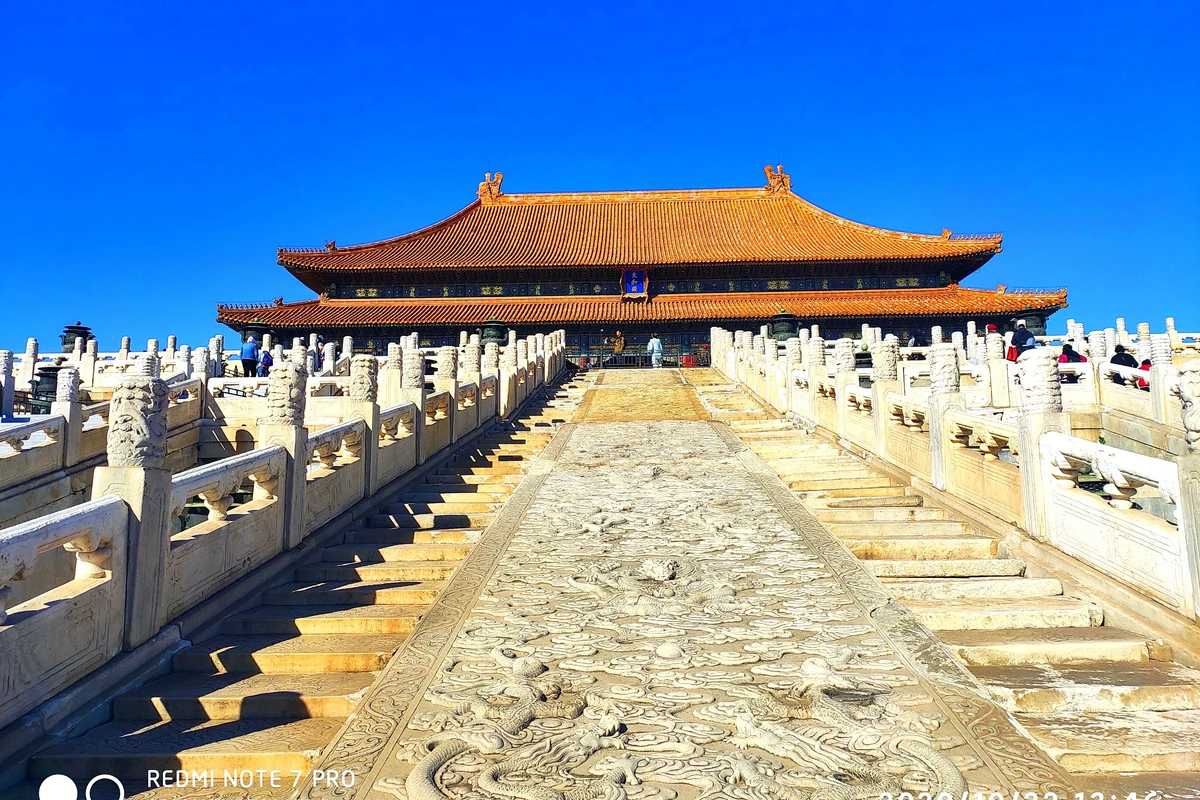
Embrace the Charm of History, Heed Its Lessons, and Savor the Splendor of China’s Past – The Forbidden City
Beijing’s Forbidden City served as the royal palace of the Ming and Qing dynasties. Originally known as the Purple Forbidden City, it lies on the central axis of Beijing. The complex centers on the Three Great Halls, covering 720,000 square meters, with a floor area of approximately 150,000 square meters, over 70 large and small palaces, and more than 9,000 rooms.
The Forbidden City is a rectangular citadel. It stretches 961 meters from north to south and 753 meters from east to west, enclosed by a 10-meter-high wall and a 52-meter-wide moat.
There are four main gates. The front gate, Meridian Gate, has a concave plan. Behind it, five white marble arched bridges lead to the Gate of Supreme Harmony. The east gate is the East Glorious Gate, the west gate the West Glorious Gate, and the north gate the Gate of Divine Might. At each corner of the wall stands a 27.5-meter-high turret with a cross-shaped ridge.
Meridian Gate is the main entrance, popularly called the Five-Phoenix Tower. Its east, west, and north sides are connected by 12-meter-high ramparts, embracing a square courtyard. Battered by centuries of wind and rain, the gate still stands proudly, inspiring reverence. Here emperors issued edicts and ordered military expeditions. When imperial proclamations were read or annual calendars distributed, civil and military officials assembled in the square in front of the gate to listen. The central passage was normally reserved for the emperor alone. The empress entered through it once on her wedding day, and the top three scholars of the palace examination—zhuangyuan, bangyan, and tanhua—were allowed to exit through it after their triumph.
The East Glorious Gate and West Glorious Gate face each other across the complex. Outside each gate stands a dismounting stele. Inside, the Golden Water River runs north–south, spanned by a stone bridge, with three gateways to the north. Both gates share the same design: a rectangular layout, red terrace, white marble pedestal, and three arched openings (square outside, round inside). Gate towers with yellow-glazed double-eave hip roofs stand above, five bays wide and three bays deep, surrounded by colonnades. Civil and military officials used the east side gate, while imperial clansmen used the west side gate.
The Forbidden City, a symbol of Ming and Qing imperial power, has a history of 600 years. Twenty-four emperors ruled China from here for over 500 years.
Its construction was an act by feudal rulers to deify their authority, and also a crystallization of the wisdom of the hardworking and brave Chinese people.
The construction took 14 years and was completed in the 18th year of the Yongle reign (1420) of the Ming Dynasty. Its completion cost countless laborers their blood and lives.
Stepping through Meridian Gate, the overwhelming impression is one of grandeur and vastness. Treading on this sacred ground, my heart fills with pride and wonder at the wisdom of those who came before. Every brick and tile seems to tell a story, whispering of bygone glory.
The sheer scale of the Beijing Forbidden City is breathtaking, making you wish you had discovered it sooner.
In front of the main gate stand two iron vats, filled with water for firefighting.
The buildings within the Forbidden City are divided into the Outer Court and the Inner Court. At the heart of the Outer Court are the Hall of Supreme Harmony, the Hall of Central Harmony, and the Hall of Preserving Harmony, collectively known as the Three Great Halls, where grand state ceremonies were held.
Ancient Chinese planning of the Forbidden City followed the concept of “harmony between heaven and humanity,” using constellations to correspond with the capital’s layout to emphasize the legitimacy of the regime and the supremacy of imperial power. Since feudal palaces were forbidden areas ordinary people could not enter, it was called “Purple Forbidden.” In the early Ming, it was together with the outer forbidden wall called the “Imperial City.” Around the mid- to late Ming, the palace city was distinguished as the “Purple Forbidden City,” while the outer walled area remained the “Imperial City.”
The front palaces were designed to be magnificent, with open, bright courtyards symbolizing the absolute power of feudal rule. The Hall of Supreme Harmony sits at the very center of the Forbidden City’s diagonal lines, and ten auspicious beasts perch on each of its four corners. The designers believed this would display the emperor’s majesty and overawe the world. In contrast, the rear Inner Court was required to be secluded and compact, so the Six Eastern Palaces and Six Western Palaces each form self-contained units, with their own gates and walls, arranged symmetrically in orderly fashion. Behind the Inner Court lies the Imperial Garden.
The entire Forbidden City complex is resplendent, solemn, and elegant, acclaimed as one of the world’s five great palaces (alongside the Palace of Versailles in France, Buckingham Palace in the UK, the White House in the US, and the Kremlin in Russia). It has been listed as a UNESCO World Cultural Heritage site.
I think the most fascinating thing is the sundial. “Sundial” originally means “shadow of the sun,” and the ancients used the sun’s shadow to tell time. The bronze gnomon, when illuminated by the sun, casts a shadow whose length and direction constantly change, allowing time to be read. The angle between the dial face and the gnomon happens to equal the local latitude.
In front of the Hall of Supreme Harmony stand a pair of bronze turtles and bronze cranes, symbols of longevity and eternal blessings.
No trees are planted in the Outer Court. First, because the palace structures are wooden, trees could easily spread fire, and lightning during rain posed a danger. Second, it accentuated the imposing dignity of imperial power, keeping the ceremonial guard array neat during grand rituals and exercises of authority. Third, it protected the emperor by preventing would-be assassins from hiding behind trees. Fourth, from a superstitious perspective, the Forbidden City’s layout resembles the character “口” (mouth); planting trees inside would turn it into the character “困” (trapped), so they avoided that to keep the emperor from being “trapped.”
Architecturally, the entire Forbidden City uses variations in form, height, and rhythm to combine into a unified whole that conforms to the hierarchical system of feudal society, while also achieving artistic balance and dynamic visual effects.
Strolling among the majestic ancient buildings, I am struck by the weight of history in the red walls and yellow tiles, while the grey bricks and relief carvings dazzle my eyes. Sculpted creatures like gold qilin, cranes, and aged tortoises are vividly lifelike and exquisitely crafted, embodying auspiciousness and majesty.
The Three Great Halls, tempered by the passage of time, appear even more archaic, dignified, and solemn, as if they have absorbed all the vicissitudes of the world and can look serenely beyond worldly affairs.
Chinese architecture boasts an extraordinary variety of roof forms. In the Forbidden City alone, there are over ten distinct types. Taking the Three Great Halls as an example, each has a different roof style. Palace roofs are covered with glazed tiles of various colors.
The center of the Inner Court consists of the Palace of Heavenly Purity, the Hall of Union, and the Palace of Earthly Tranquility, collectively called the Rear Three Palaces, the main residence of the emperor and empress.
The rear half of the Forbidden City is called the Inner Court. Its main gate, the Gate of Heavenly Purity, is flanked by glazed screen walls and leads to the Rear Three Palaces. The Inner Court centers on these three halls, with the Six Eastern Palaces and Six Western Palaces on either side, serving as the venue for daily administrative affairs and the living quarters of the emperor and his consorts. The rear half differs architecturally from the front half. While the front buildings symbolize the emperor’s supreme authority, the Inner Court buildings mostly form self-enclosed courtyards.
The Inner Court features deep, secluded courtyards and dense building clusters. In the rear garden, there are evergreen pines and cypresses, as well as rockeries of exquisitely arranged stones. Pavilions, terraces, and kiosks are tucked among them, creating an atmosphere of quiet beauty and tranquility.
And then there is the Imperial Garden. Within, rockeries and curious stones rise everywhere, pavilions and halls complement one another, and ancient trees tower into the clouds—a scene of wealthy splendor.
This single Imperial Garden, having weathered centuries of romance and worldly dust, remains elegantly charming and deeply moving.
The Treasure Gallery of the Palace Museum occupies the west wing of the Hall of Imperial Supremacy, the Hall of Mental Cultivation, the Hall of Joyful Longevity, and the Lodge of Retired Ease in the northeast corner of the Forbidden City. It is a treasure house containing gems of every kind, glittering gold and silver vessels, pearls, jadeite, filigree phoenix crowns, ivory carvings, and countless peerless rarities.
The Nine-Dragon Screen indeed features nine writhing dragons, each distinct in form and spirit, each with its own striking charisma, making visitors pause and linger, lost in thought.
Most of the Qing dynasty court treasures collected by the Palace Museum were produced in the imperial workshops within the Forbidden City under imperial decree, while some were tribute items sent by local officials for festivals and celebrations. These treasures were crafted from precious materials such as gold, silver, jade, jadeite, pearls, and various gemstones, with the finest artisans summoned from across the land. They invested boundless ingenuity and spared no expense, often spending years on a single piece; the craftsmanship represents the pinnacle of its time. The objects were used in a wide range of court activities—rituals, religious ceremonies, daily life, and leisurely pursuits—all reflecting the supremacy and solemnity of imperial power, the regal opulence and elegance, and offering a subtle yet vivid glimpse of that era.
In the Treasure Gallery, every piece of imperial finery is truly unparalleled, whether judged by its aesthetic or historical and cultural value.
The significance of these Qing court treasures today goes far beyond their material and craftsmanship; they embody the profound depths of Chinese traditional culture, serve as a vivid portrayal of that historical period, and stand as dazzling gems forged from the national spirit.
Tucked behind the Gate of Constancy in the northern section of the Palace of Tranquil Longevity, the Well of Consort Zhen was originally an ordinary well. Its opening is capped with a stone pierced by holes on two sides for inserting an iron locking bar. In the 26th year of the Guangxu reign (1900), when the Eight-Nation Alliance attacked Beijing, Empress Dowager Cixi and Emperor Guangxu fled west in haste. Before leaving, Cixi summoned Consort Zhen—who had been confined in a small courtyard north of the Pavilion of Beautiful Scenery—to the Lodge of Retired Ease and ordered eunuch Cui Yugui and others to push her into the well inside the Gate of Constancy, drowning her. The well has since been called the Well of Consort Zhen.
A building on its own arouses little feeling. Only through the passage of time and the vicissitudes of human affairs can it radiate its true splendor—that is the charm of the Forbidden City.
Some may think Chinese architectural culture is lifeless, unlike the glitzy castles and palaces abroad. But it has a long history and rich cultural depth. Just as Westerners may favor the outwardly dazzling sparkle of diamonds, the Chinese prefer the smooth, gentle warmth of jade. It is a kind of restrained beauty, a quiet beauty, and also a beauty of depth. So we need not envy others; we should treasure what is ours. The Forbidden City is the pride of the Chinese nation.
Architectural scholars consider the design and construction of the Forbidden City an unsurpassed masterpiece. Its ground plan, three-dimensional effects, and formal grandeur, magnificence, solemnity, and harmony—its majestic and luxurious architectural vitality—represent the very essence of ancient Chinese architectural art. It symbolizes China’s long cultural tradition and attests to the remarkable achievements of its craftsmen over five hundred years ago.
After the founding of the People’s Republic of China in 1949, large-scale renovations were carried out on the Forbidden City, and a vast number of cultural relics were catalogued. In 1961, the State Council designated it as a National Key Cultural Relic Protection Unit. As of August 2019, the Palace Museum housed 1,862,690 items/sets. In 1987, the Forbidden City was inscribed as a UNESCO World Heritage Site and has since operated as the Palace Museum.
The Gate of Divine Might was originally called Xuanwu Gate during the Ming Dynasty. Xuanwu, the Black Tortoise, is one of the Four Mythical Creatures—aligned with the north. Thus, the north gates of imperial palaces were often named Xuanwu. During the Kangxi reign of the Qing, the name was changed to Gate of Divine Might to avoid a naming taboo. This gate also follows the form of a gate tower, with the highest grade double-eave hip roof, but its hall has only five bays with a surrounding colonnade and lacks the forward-projecting wings, so its formality is one rank lower than Meridian Gate. It was used as a daily entrance to the palace. Today the Gate of Divine Might serves as the main entrance to the Palace Museum.
After visiting the Forbidden City, I cannot help but feel an affection for this imperial city—the Zijincheng. It is not merely the concentrated symbol of feudal imperial power, but also a crystallization of the collective wisdom of ancient Chinese craftsmen. It bears witness to the tragic scenes of dynastic change as well as the song and dance of peaceful prosperous reigns. Inside its walls, there are spring-like jubilant melodies and lonely, helpless partings... Countless love stories are woven into its fabric, and endless tales of family and nation are etched into its stones. A single city is like a film, a historical legend.


