Beijing Travel: Visiting Shuiguan Great Wall and Exploring Guyaju (Photos)
Yanqing County in suburban Beijing is a great place with a rich variety of natural and cultural attractions. On July 10, 2012, our reporter team visited the imposing Shuiguan Great Wall, which was cut through during the construction of China’s first independently designed Jingzhang Railway, and later the Guyaju (Ancient Cliff Dwellings), an unsolved millennia-old mystery located 20 kilometers northwest of the Badaling Great Wall.
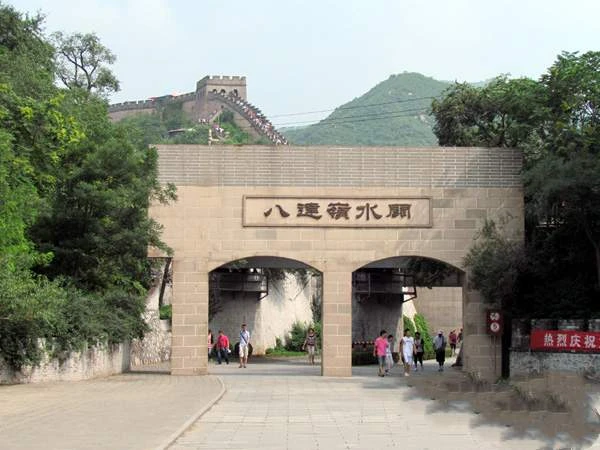
Iron Wing Strong Pass Gate (Photo: Feng Ganyong)
Upon arriving at Shuiguan Great Wall, Cao Hongsen, then deputy general manager of the Badaling Shuiguan Great Wall Tourism Company, personally received us and accompanied us on a tour. What surprised the reporter was that when we talked about the Shuiguan Great Wall, Mr. Cao mentioned the many inexplicable grievances the scenic area has suffered over the years.
Square relief wall (Photo: Feng Ganyong)
Mr. Cao said: For some reason, many tourists mistakenly think Shuiguan Great Wall is not the “real” Great Wall compared with Badaling, but that is a huge misconception. In fact, Shuiguan Great Wall, located 40 kilometers northwest of Beijing, is not only an important part of the Badaling Great Wall but also has a profound cultural heritage.
Photo at Shuiguan Great Wall (Photo: Tan Shu)
Seventy-two scenic spots scattered like pearls around the scenic area — Tanqin Gorge, Goldfish Pool, Stone Buddha Temple, Camel Rock and many others — lie within a 25,000-square-meter area, together with cultural landscapes such as Zhan Tianyou’s former residence, all offering rich tourism and cultural resources.
Main Pass Arrow Tower (Photo: Feng Ganyong)
Chatting as we walked, we passed through the Iron Wing Strong Pass gatehouse and a view suddenly opened up. Here was the 6,000-square-meter cultural square of Shuiguan Great Wall. On one side stands a giant bronze relief wall 80 meters long and 8 meters high, vividly depicting various figures surveying, drawing, supervising construction, quarrying, firing kilns and building walls, bringing to life the scene of Qi Jiguang overseeing the construction of the Great Wall back then.
Distant view of Chuanzi No.1 Beacon Tower (Photo: Feng Ganyong)
Climbing up to the Main Pass Arrow Tower, Mr. Cao pointed to a six-eye beacon tower in the distance on the right and told the reporter: Generally, Great Wall beacon towers have three or four eyes, but the beacon tower at the starting point of the Badaling Chuanzi No.1 section is a six-eye tower, which shows it was a very important military strategic fortress in its day.
Beacon tower on the left (Photo: Feng Ganyong)
The arrow tower where we now stood is 15.63 meters high, with an average width of 12 meters. Its walls were built with blue stone slabs following the mountain contours, and boundary stones left by craftsmen from Shandong and Sichuan are still faintly visible. The hillside is dotted with strangely shaped rocks, steep and precipitous. Gazing out from the Great Wall, the wall looks like a giant dragon winding through hills ablaze with autumn colors.
Overlooking the cultural square (Photo: Feng Ganyong)
Mr. Cao then said with emotion: In fact, Badaling Shuiguan Great Wall has a long history, having endured over 400 years of wind, frost, rain and snow. It is a Ming Dynasty Great Wall site, built under the supervision of the famous anti-Japanese general Qi Jiguang. This section was built in a strategic valley. The wall forms a “V” shape from the Water Gate Arrow Tower, following the mountain ridges, like a giant dragon or a roc spreading its wings. The arrow tower served as both a watchtower and a water gate, an architectural style extremely rare along the entire Great Wall — hence the name Shuiguan (Water Pass) Great Wall. With rugged terrain, the wall crawls over lofty mountains, passes steep cliffs, links forts, faces beacon towers, and features arrow notches on both sides to fend off thousands of enemies. Shuiguan Great Wall stretches from Chuanzi No.1 in the east to the Jingzhang Railway in the west, 6.8 kilometers in total, renowned for its unusual beauty, perilousness, steepness and sturdiness.
Side view of the Main Pass Arrow Tower (Photo: Feng Ganyong)
The scenery is picturesque in all four seasons: spring flowers in profusion, summer lush greenery, autumn leaves blazing across the mountains, winter a recumbent dragon in snow. With clear waters and green hills framing the majestic Great Wall, and spiritual ancient temples in this outstanding locale, in spring the hillsides on both sides are covered with blossoms and a distant wall appears like mist, allowing people to fully appreciate the greatness of the Chinese nation. Basketball star Michael Jordan and F1 driver Toranosuke Takagi have both visited Shuiguan Great Wall; the Hong Kong superstar Andy Lau shot the background of his song “Chinese People” here. Shuiguan Great Wall is increasingly becoming a must-visit among Great Wall tourist attractions.
Wandering on Shuiguan Great Wall (Photo: Feng Ganyong)
Passing through the Main Pass Arrow Tower and turning left up to another tall beacon tower, from this vantage point the “V”-shaped layout of Shuiguan Great Wall is clearly visible. This is the eastern section of the Badaling Great Wall, cut through during the construction of China’s first independently built Jingzhang Railway. The engineer who designed this railway, Mr. Zhan Tianyou, is world famous. Walking three kilometers west along the wall, one can see China’s first railway — the Jingzhang Railway — and its herringbone track. Mr. Cao joked: Perhaps Mr. Zhan Tianyou was inspired by the “V”-shaped Shuiguan Great Wall when he designed this railway…
Zhan Tianyou's former residence (Photo: Feng Ganyong)
At the foot of Shuiguan Great Wall is a small courtyard where Mr. Zhan Tianyou once worked. The ordinary little compound has three main rooms with a side room on each side. Inside the main room, some precious historical photos from the railway construction period are on display, offering a glimpse into the demeanor of this modern great man.
Courtyard of Zhan Tianyou's former residence (Photo: Feng Ganyong)
Coming down from Shuiguan Great Wall, we walked to the Tanqin Gorge Ancient Post Road, which is under planning, once traveled by Emperor Kangxi on his western tours. This nearly one-kilometer-long ancient post road holds many historical relics, including cliff carvings such as Wuguitou and Wulang’s image, as well as natural and cultural sights like a Buddhist temple, Guandi Temple, Guanyin Pavilion, Maitreya Listening to the Sound, and Foye Platform.
Stream along the ancient post road (Photo: Feng Ganyong)
Stepping into the Tanqin Gorge Ancient Post Road, we found steep cliffs all around. A short distance east, on the stone cliff, the six Chinese characters “Tanqin Gorge, Wuguitou” are carved. This was originally the famous Guanggou landscape “Tanqin Gorge.” In ancient times, winding paths, green hills and clear waters flanked a stream between sheer stone walls. The water cascaded gently down and flowed through crevices, gurgling crisply, echoing off the stone walls on both banks, so melodious and lingering it sounded like a plucked string instrument — hence the name “Tanqin” (Zither Playing) Gorge. The Yuan Dynasty poet Chen Fu, visiting here, wrote: “The moon serves as the zither’s golden frets, the wind its strings; its clear sound needs no fingers to pluck. Bo Ya’s lofty melody is written among the wind-swept pines and scattered rocks.”
Maitreya Listening to the Sound in Tanqin Gorge (Photo: Feng Ganyong)
The Qing Dynasty poet Wei Yuan described this scenic spot: “No more sorrow of the battlefield, just seeking the resounding zither gorge.” When the Jingzhang Railway was being built, the hill to the northeast and the gorge were leveled; later, when the Badaling Highway was constructed, the mud and rocks from blasting filled in the gully. Now the inscribed stone wall remains, but the melodious sound of the stream swirling through the gorge is gone forever.
Wulang's Image at Tanqin Gorge (Photo: Feng Ganyong)
Around noon that day, the “Cultural Journey” program of China National Radio’s Hong Kong Voice connected live with our reporter group. Accompanying CNR reporter Tan Shu vividly shared with Hong Kong listeners her impressions of Shuiguan Great Wall and its unique natural and cultural landscapes.
Tourists visiting Shuiguan (Photo: Feng Ganyong)
Ji Zhi, then general manager of Badaling Shuiguan Great Wall Scenic Area, said: Shuiguan Great Wall, with its unique natural scenery and multi-layered knowledge, showcases the 5,000-year history of the Chinese nation, presenting masterpieces that best represent Chinese wisdom from three different eras — ancient, early modern and modern — allowing visitors to fully appreciate the richness of 5,000 years of culture. Zhang Zhe, general manager of Zhongtang International Travel, who accompanied us, told the reporter that she values the cultural depth of Shuiguan Great Wall greatly. In recent years, she has brought thousands of tourists from Henan, Shandong and other places to visit here, receiving much positive feedback.
He who has never been to the Great Wall is not a true man (Photo: Feng Ganyong)
Leaving Shuiguan Great Wall, our reporter team drove to Guyaju, located in Zhangshanying Town, Yanqing County, northwest of Badaling, with the Gui River to the south and Haituo Mountain to the north. These are cliff dwellings carved by ancient people unrecorded in any historical texts on steep rock faces. It remains a fascinating millennia-old unsolved mystery.
Entering Guyaju (Photo: Feng Ganyong)
Accompanied by Mr. Han Zhanli of the Guyaju Scenic Area, our reporter group strolled along the mountain paths. After walking a section through a big canyon, from a high vantage point we could see clusters of wondrous Guyaju dwellings on the mountainside. Nearly every vertical cliff on three sides of the canyon is filled with artificially chiseled large rock chambers, rectangular or square, the largest over 20 square meters, the smallest only 3–4; single rooms, two or three interconnected rooms, suites arranged in parallel, or two stories; some are typical “three-room dwellings.”
Photo at Guyaju (Photo: Zhang Nong)
The eastern cliff of Guyaju’s front gully has the most caves — 48 — while the southern and northern cliffs together have 43; the eastern cliff of the back gully has 26. In front, middle and back sections, there are altogether 117 caves with over 350 bays. The caves are staggered like a natural village. Typically a dwelling is a three-room layout — one bright room flanked by two dim ones — but there are also single and double rooms, about 2 meters high, 1–6 meters deep, and 3–20 square meters in area.
Landscape behind Guyaju (Photo: Feng Ganyong)
Under the ridge between the front and back gullies, there is a large palace-style cave with two levels, facing west. The lower level is a hall with a stone desk and several side rooms, one of which leads to the upper level. This looks very much like an assembly hall or meeting chamber, locally called “Official Hall,” “Golden Chanson Hall,” or “Guyaju Hotel.”
Overlooking from Guyaju (Photo: Feng Ganyong)
Inside, there are six finely carved stone pillars supporting the upper level. The upper level contains living rooms similar in style to the lower level. Legend has it that a horizontal inscribed board reading “Qingshui County Government Office” once hung in front of this cave. All the caves are fully equipped with doors, windows, kang (heated sleeping platforms), stoves, mangers, wall cabinets and flues. Everything that should be round is round, and what should be square is square, all meeting aesthetic standards. Door frames, pivots and air vents are meticulously hewn, with sharp edges and corners, and chisel marks still faintly visible. Close your eyes, and you can almost smell the smoke from a cooking fire drifting through the silence of history.
Lush greenery at Guyaju (Photo: Feng Ganyong)
Yanqing’s Guyaju is also wondrous because its magnificent and skillful craftsmanship illuminates the architectural achievements of ancient times. All stone chambers have no pillars or beams, yet multi-story structures are built; there are no stairs or boards, yet levels stack upon each other and connect. And every chamber respects the harmony of roundness and squareness, revealing a primitive aesthetic sensibility.
A corner of Guyaju (Photo: Feng Ganyong)
Sitting deeply in thought within a stone chamber feels like being inside a historical repository of knowledge. Every cave seems like a wordless book, recreating scenes of glittering spears and armored horses, slash-and-burn cultivation, allowing later generations to read between the weighty air both heroism and the themes of war and peace.
Front mountain landscape of Guyaju (Photo: Feng Ganyong)
Several distinct rock veins formed through 130 million years of geological change and naturally formed stone walls between mountains make visitors marvel at the mysteries of nature. As a result, it has been praised as “The No. 1 Labyrinth in China,” “Beijing’s Second Zhoukoudian,” “Beijing’s Dunhuang,” and “the Goldbach Conjecture of human art.” Mr. Du Xianzhou, then president of the Architectural Society of China under the Chinese Academy of Sciences, acclaimed it as a blank page in architectural history, an uncut gem in the annals of cultural relics, and a beauty not yet discovered in the world of tourism.
Xi Wangfu (Prince’s Residence) at Guyaju (Photo: Feng Ganyong)
Today, Guyaju has received multiple honors such as “Beijing Municipal Key Cultural Relic Protection Unit,” “Beijing Scenic Area,” “National Youth Science Education Base,” “Capital Civilized Scenic Area,” “Green and Safe Scenic Area,” and “Social Classroom” resource unit for municipal primary and secondary school students. It has become a well-known destination in Yanqing, Beijing, for scientific exploration tourism. (Text and photos: Feng Ganyong)


