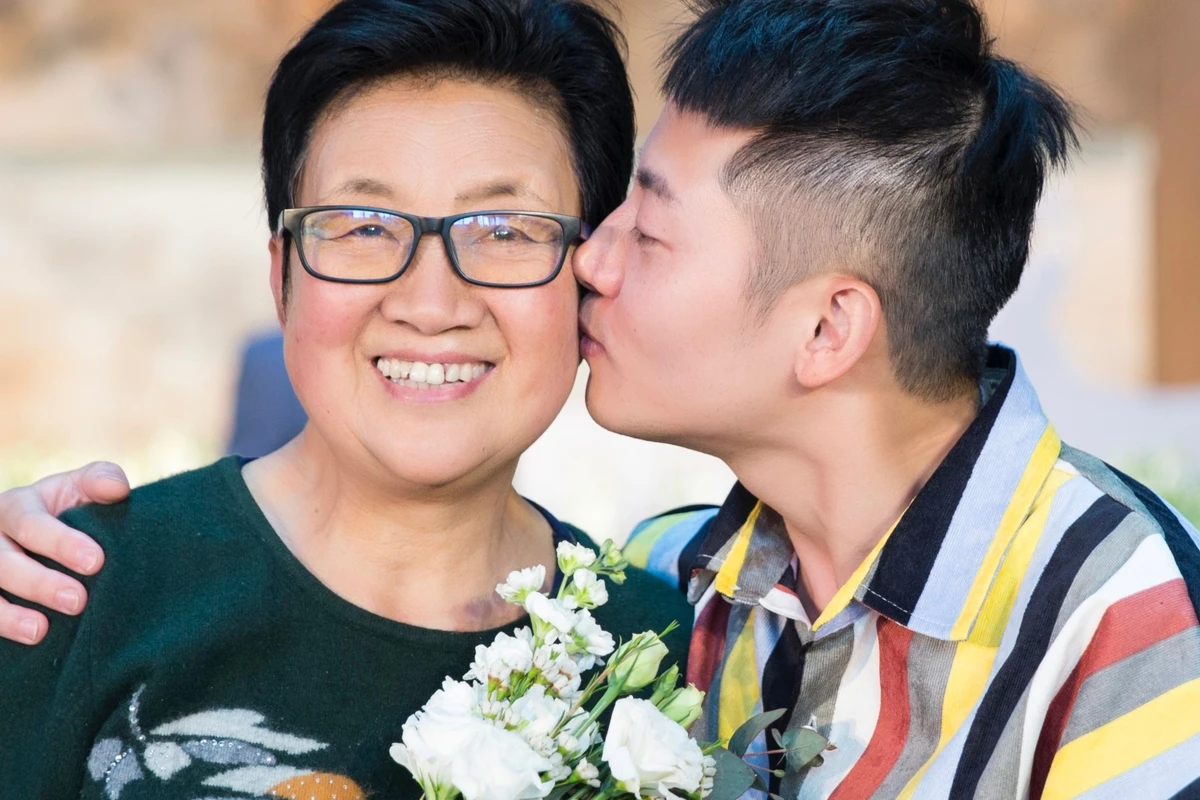
This Children’s Day, All I Want Is Grandma’s Company
That night, I dreamed of Grandma. I called out to her, dressed in a lake-blue dress; she winked at me as if she didn't know me, then turned and ran off into a field of sunflowers.
Grandma ran faster and faster, growing younger and younger.
In an instant, she became a child, though her look remained—shoulder-length hair soft and fluffy, bare feet beneath the lake-blue dress. She lay amidst a sea of moss phlox, purple, red, white, pink...
Before her eyes, the story of her life flickered in rapid rewind, every age waving to her from the sky.
She gently closed her eyes, a faint smile appearing on her plump little face.
At that moment, it seemed all the flowers were blooming just for her, the breeze sweeping in for her alone, dragonflies and butterflies dancing to make her smile.
She fell deeply asleep, still smiling, never to wake again.
When I woke the next morning, my lips were curled into a smile too, but my eyes were wet.
I’d never had such a blissful dream—everything was warm, even the tears.
Then came Mom’s call, hesitating before telling me: Grandma... she has passed away.
This Children’s Day, I only want Grandma to be with me, to let this 80-year-old child at heart talk with me.
She passed away two days ago.
I scrolled through our WeChat chats, revisiting our recent conversations, searching every trace for a sign that she’d be leaving us, and found none.
At the start of the month, she’d had a full physical at her work unit, and the report said she was very healthy. Proudly, she quoted the doctor: 'An 80-year-old’s age but a 50-year-old’s body.'
I still remember my joyful reply: when it cooled down a bit, I’d take her on a trip.
On the other end of the phone, she said happily, 'That would be wonderful!'
Yes, Grandma turned 80 this year.
I remember her knitting her brow, drawing out her words: 'Life passes so quickly—just a blink and you’re almost 80, an old monster.'
I hugged her, kissed her cheek, and cooed, 'How could that be? You’re still so young—at least until 100!'
She shook her head hastily: '100? Then I’d be a really ancient monster, too scary to look at!' Barely two years since she said that, and now I can’t see her anymore.
When I returned home for the holidays this year, Grandma was overjoyed. Last year’s pandemic was fierce, every city in lockdown; I didn’t go home for the Spring Festival and hadn’t seen her for a whole year.
She brought over-the-phone grumbling into real life, sighing that travel agencies wouldn’t take her anymore, group tours refused her, so only I could take her traveling.
Despite being 80, Grandma was indeed in good shape—sturdy and sturdy, walking faster than most young people. I couldn’t even keep up; often she’d lecture me from ahead: 'Young people need to walk more. Look at me, because I love walking, I’m so healthy!'
Even crossing the street, she’d rush to beat the end of a green light, and if a driver didn’t yield to pedestrians, she’d shout, 'Such bad manners!'
I’d tease her: 'You have to understand drivers. When you ride in my car in Beijing and see pedestrians dashing across so cars can’t go on green, you say they’re the ones with no manners.'
Grandma’s love of walking came from her love of travel.
I remember during elementary school, I’d often receive toothbrushes and toothpaste from hotels all over the country, brought back as gifts from Grandma.
I was amazed she could go to so many places; she’d take off whenever she had free time.
I heard her recount many travel stories, and the one I remember most vividly was during the Red Guard’s great exchange visits, when she and a bunch of colleagues took free trains to Shanghai for a trip. They spent all their money, then went to the Shanghai branch office to borrow more that they never repaid, and just kept traveling.
As a child, hearing Grandma tell such vivid, amusing tales of unfamiliar times and strange cities truly stirred my heart.
Perhaps the seed of travel was planted in my heart by Grandma when I was little.
For people of Grandma’s generation, travel was mainly by group tours—cheap, convenient, and someone to explain everything.
But once she passed 70, tour groups would no longer accept solo elderly travelers, afraid of the liability if something happened.
So, gradually, I took Grandma to many places, and she experienced many firsts in her life.
We went to Hong Kong—her first outbound trip, her first time flying first class. Hong Kong Airlines attendants smilingly looked after her, which made her uncomfortable. After the meal, she whispered, 'This little spoon is nice; can I take it?'
At The Ritz-Carlton, Hong Kong, she stayed in a luxury five-star hotel for the first time. Also the first time staying in the world’s tallest hotel, sweeping views of Victoria Harbour beneath her.
Grandma said the clouds reflected the sea on the ceiling; you could watch clouds from bed, from the swimming pool, even at breakfast among the clouds. She marveled, 'Poems say "Heights are too cold," and also "How could this be the mortal world?" So such a place truly exists, exactly like the poems say.'
At the Tian Tan Buddha, Grandma took her first crystal cable car, 360-degree views, looking down at the vast abyss below. She sat in a corner, too scared to move. I said let’s take a picture, and instantly she beamed, flashing a V-sign.
At Disney, although many rides weren’t for her, it didn’t stop her from being as happy as a child, posing with various cartoon characters, striking poses at every spot. My Hong Kong friend Fanshu, who came along as our photographer, kept praising Grandma’s lively pace.
That day, Grandma took the MTR for the first time. We had taken a taxi to Disney, but on the way back she insisted on the subway. Changing at Central, we walked for tens of minutes through endless crowds, and for the first time I saw her panting: 'In Hong Kong, better take a taxi.'
At Lei Yue Mun, she saw an immense array of live seafood for the first time—buy live, kill, and cook on the spot. She marveled at the sky-high prices while savoring every bite.
At Temple Street, Grandma had her first sugar water feast, praising each kind. She ate two thick slices of soft toast with milk. She exclaimed, 'If they had a shop like this in Hefei, I’d go every day!'
During the trip, Grandma praised Wong Tai Sin Temple most—not really for its efficacy, but because it was so large. Walking for two hours under the blazing sun gave her a good workout (laughing).
Grandma and I also went to Macau.
We stayed in the VIP rooms at The Venetian’s Yubin Hui, a two-story penthouse villa that was even larger than the apartment she rented at the time.
The second day, she told me to cancel my room and stay with her.
I said, 'Wouldn’t it be more convenient for you alone?'
She looked around wide-eyed, then whispered, 'I’m scared.'
At the Yubin Hui’s restaurant, Grandma enjoyed an exquisitely luxurious meal for the first time. Every dish amazed her—abalone, sea cucumber, Sichuan pepper, lobster—things she’d only read about in novels or seen on screen. She never imagined she’d taste them in her lifetime.
At The Venetian’s artificial sky, she rode a gondola and 'traveled' to Europe for the first time.
Beneath the night sky, the Ruins of St. Paul’s were all ours. Moonlight poured like water onto the façade as Grandma studied every vivid statue.
The House of Dancing Water show lulled her into a deep sleep, a pity for those VIP tickets. But in her memory, the performance was quite spectacular—she just didn’t remember sleeping through most of it.
Grandma quite liked another City of Dreams show, 'Se Huo.' This was her first time watching a large-scale erotic live show, and my first time in such a high-end nightclub. I blushed and was flustered; Grandma didn’t mind at all, leisurely sipping wine and watching muscular men 'tease' other female guests.
We also went to Guangzhou.
The lifestyle at Mandarin Oriental, Guangzhou delighted Grandma enormously. She caressed every lamp in the room, opened every drawer, smelled every toiletry.
The courtyard-style layout always got her turned around, so she pulled me into her room again.
She said to me in surprise, 'Every lamp has a shade beneath it, the light is gentle and comfortable.'
She asked, 'These toiletries smell so nice, with so many flower scents—I can’t bear to use them. Can I take them home?' I smiled, 'Don’t be reluctant to use them. If you like them, ask housekeeping to bring extra bottles.'
The elevator lobby with sofas also pleased her. Though she never seemed to tire from walking, the moment she saw a sofa she’d sink into it, saying, 'This hotel is even more comfortable than home.'
We cruised the Pearl River night scenery on the vintage 'Nanhai Shen Hao' sponsored by Guangzhou Daily. Grandma had come to Guangzhou when she was young, but it was completely different now. From her heart she said, 'I’ve lived through so many eras, and in the end, they’ve been wonderful. I’ve witnessed this country become more and more beautiful.'
My Guangzhou friend Gigi specially recommended taking Grandma to Shamian Island. Old trains, European churches, bicycles, parks—indeed, Grandma was delighted, because she got to walk a lot again (laughing).
My memories with Grandma in Beijing are the most.
Before each trip to Beijing, on the phone Grandma would list loads of must-see places; she wanted to go everywhere, and revisit everywhere.
The Forbidden City was a must-repeat. She examined every corner, recalling her youth. She said the first time she came to Beijing, when she stepped out of Beijing Station, stood on Tiananmen Square, and entered the Forbidden City, every step felt solemn and sacred. Even now, each visit still stirred the same feeling.
Grandma said, 'The Forbidden City has changed so much!' I asked, 'How? Aren’t these ancient buildings?' She answered, 'When I came thirty or forty years ago, many areas were closed off. Now both the east and west palaces are open.'
But she wasn’t entirely satisfied: 'The Imperial Garden is too small, isn’t it? All those scheming scenes in Qing court dramas took place there, right?' I laughed, 'That’s just for the shows. The garden is kept small to gather auspicious energy.'
At the Forbidden City, we wandered from opening to closing and still missed many spots. Grandma said, both regretfully and expectantly, 'Next time, next time.'
I visited the Summer Palace for the first time, and Grandma acted as my guide, explaining that it was built by Emperor Qianlong for his mother’s birthday, and that Suzhou Street was where eunuchs and maids dressed as vendors and passersby to amuse Empress Dowager Cixi.
Grandma said, 'The Old Buddha didn’t live healthily, always traveling by sedan chair. Walking is much better.'
Beside the plum-blossom-scattered Kunming Lake, we dined at Tingli Guan. This restaurant is hard to book; important guests from home and abroad often visit. I had to reserve a week in advance.
We had a court birthday feast based on an imperial kitchen menu: horse meat, donkey meat, beef, fish, aiwowo, lǘdagun. Delicacies once out of reach for ancient people. For Grandma, 'Not delicious, but worth eating!'
I asked, 'Why worth eating if not delicious?' She said, 'To taste Empress Dowager Cixi’s birthday banquet—it’s an honor.'
On the stage, I sat her in the seat of honor under a plaque brushed by Cixi herself, and sang 'When Will the Moon Be Clear and Bright?' making her laugh heartily.
She smiled from ear to ear and said, 'Your expression is just like a prince, an a-ge!' I teased back, 'Then you’re the Old Buddha.'
At Ritan Park, I truly dressed Grandma up in embroidered Qing dynasty gowns and let her be the Old Buddha for real.
It was Grandma’s first time putting on makeup. The makeup artist couldn’t believe it: 'You look so young, and you’ve never worn makeup?' Grandma said, 'People of my generation didn’t know about makeup. Just draw eyebrows and red lipstick. Nothing like you young people, several helping me for over an hour.'
My own makeup took even longer—hiding my hair, putting on a queue wig and shaved-forehead look took an hour.
Meanwhile, we learned about Manchu imperial dress.
When Grandma put on the long dark-blue phoenix-embroidered robe, topped with hair ornaments and swaying buyao, she truly looked like a kind, serene, and dignified Old Buddha.
I also donned a golden dragon robe, not easy to walk in. Grandma slowed down too, letting me support her as we strolled the gardens.
Grandma said, 'These clothes aren’t practical; you can’t walk in them.' I laughed, 'The people who wore them never needed to walk—they rode in eight-man sedan chairs, doing everything in the chair.' She clicked her tongue, 'That’s no way to enjoy life; I’d much rather walk!'
That day it started snowing, from flurries to fat flakes, falling on red pillars, blue tiles, and green trees. Watching the snow from the pavilion, we felt as if we’d traveled back in time.
After a swift snowfall the sky clears, wishing you peace and contentment.
In Beijing I took Grandma to taste many flavors she’d never experienced.
At Opera Bombana, we had Michelin-starred Italian cuisine; chef Marino took Grandma’s hand and showed her around the kitchen.
Though neither understood the other’s words, so much life’s communication needs no language.
When each artistic course was presented, she couldn’t bear to touch them, asking repeatedly, 'Can I eat this?'
Grandma asked, 'Do Italians spend a long time just arranging the plate for every meal?'
My good friend Jessie, the restaurant’s PR, smiled and said, 'Grandma, Italians only come to restaurants like this for important occasions. Normally they just have pizza and pasta, not as elaborate as this.'
We also had Spanish food at Migas in the China World Tower.
Decorated like a Spanish market, the restaurant felt like strolling through a busy market: hams hanging in windows, oysters and lobsters laid out on ice.
From 5J Iberico ham to French oysters and tapas, everything pleased Grandma’s palate. She couldn’t stop praising: 'Spanish food is really good, it suits Chinese tastes so well.'
At Siam Taste in New World Women’s Department Store, we had Thai food.
She pointed at a live shrimp, its head separated from its body yet still moving, and refused to eat it: 'It’s still alive! Eating it might make you sick?' I said, 'It’s like Chinese drunken shrimp.' She replied, 'Drunken shrimp aren’t so big.' I said, 'That’s because you haven’t had the big ones. Next time I’ll treat you.' She quickly shook her head, 'At my age, better eat less cold raw stuff.'
At Ran Sushi in Parkview Green, one of my favorite Japanese restaurants, to my surprise it didn’t suit her taste at all. Eating foie gras and sea urchin, she said, 'Japanese really can’t cook. Spanish is much better.' I didn’t know whether to laugh or cry.
Grandma joined me as a guest on China Radio International’s program 'Walk and Watch.' She told host Shuyang, 'In Beijing, you can eat so many delicious foreign cuisines, there’s no need to go abroad.'
Shuyang replied, 'But it’s still worth seeing other countries.'
She said, 'I’m 78, flying over ten hours might not be realistic anymore.'
I chimed in, 'Let’s eat well in Beijing first; next year I’ll arrange for you to travel Europe with me.'
That conversation still echoes in my ears, yet Grandma has left, and I’ll never take her traveling again.
I recall our last WeChat call, when she asked where I’d been traveling lately.
I said I recently endorsed a trip to Huai’an. Grandma immediately asked, 'Did you visit Premier Zhou’s home?' I told her I not only went to Premier Zhou’s home, but also to the home of Wu Cheng’en, the author of Journey to the West.
Grandma said, 'I’d really love to see Huai’an too.'
I said, 'Great! I’ll arrange it right away!'
After hanging up, I carefully researched private custom tours on Ctrip, planning a wonderful week-long trip from Nanjing to Yangzhou to Zhenjiang and finally Huai’an.
Once the itinerary was set, before I could tell her, Grandma had left. I’ll never hear her voice again.
In Grandma’s life memories, the happiest times she could never forget all happened in her childhood.
She told me about her father riding home on a tall horse after passing the entrance exam for the Whampoa Military Academy, her eyes sparkling. But because of family reasons, he gave up further study and instead ran a small business in Anqing.
She told me about her mother working as a nanny for a wealthy Shanghai family, her eyes full of amusement. The young men of old Shanghai rich families wore such tight underwear; her mother even secretly brought one home to show her.
She told me about New Year’s when she was little, her eyes festive: wearing new clothes, holding a small red bowl her father made, sneaking a taste of the offerings meant for the Kitchen God with her older siblings.
She told me how when the Japanese came to Anqing, they gave candy to every child, but her mother would nervously hide her and her brother under the table, so the Japanese wouldn’t find them. She told me about her mother taking her to Shanghai, working as a nanny while raising her. Her grades were good, so her father saved money to send her to study in the US when she grew up. Then the Cultural Revolution began, and America became an unreachable promise.
She told me about her father having an affair, someone writing him a love letter that her mother discovered; her mother nearly committed suicide. That was the saddest memory of her childhood.
Grandma said she’d lived through so much, and just talking casually would make a 'One Hundred Years of Solitude.' She always said, when we had time, we’d sit and chat, and she’d tell me her whole life story.
One day during my last holiday home, I held Grandma’s hand on the sofa, little dog Yuanyuan leaped onto her lap, and I said I wanted to hear her story.
I asked about her first job, how she met my grandpa, her parents. She just brushed me off with a few words. When I probed, she frowned: 'Why are you asking all this now?'
I coaxed, 'Didn’t you say you’d tell me a One Hundred Years of Solitude?' She sighed and shook her head, 'I don’t want to talk about it anymore, don’t want to.'
So many secrets of a life are buried deep in the heart, wanting to speak yet silent, wanting to speak yet silent.
That was the last face-to-face talk with Grandma. Not even half a year later, she was gone. I’ll never hear her voice again.
There are so many memories with Grandma. While sorting through material these past two days, I cried my eyes out.
Every memory has become a final edition, never again.
Life is but a dream, so fleeting.
We can never travel together again.
Grandma, now that you’re in heaven, will you still miss us?
In that other world, will there be someone like me, to keep you happy and make you smile?
By the floor-to-ceiling window, I put my hands on the ground, kicked my feet up, and did a headstand.
I don’t remember where I heard this: 'When you want to cry, just do a headstand, and the tears won’t fall.'
Seems that was a lie—the tears are still streaming, all over my face.
The memory of Grandma will vanish from the memory of the world. Everything she experienced will never, ever be repeated, for the individual fated to endure one hundred years of solitude will have no second chance on earth.
Grandma, I miss you so much. Do you know?


