No Snowy Spouts at Dragon Pool, Only Ancient Cudrania Branches Remain: Visiting Tanzhe Temple in Western Beijing
Everyone in Beijing knows Tanzhe Temple, an ancient temple said to predate the city itself. According to official research, Tanzhe Temple was first built in the first year of the Yongjia reign of Emperor Huai of the Western Jin (307 AD), over 1,700 years ago. Jinshan Temple in Zhenjiang, which I visited last time, was built in the Taining period of Emperor Ming of the Eastern Jin (325 AD), four reigns later than Tanzhe Temple. Don’t be fooled by the four emperors’ difference—it’s only eighteen years, which tells you how chaotic the late Western Jin was.
Tanzhe Temple was originally called Jiafu Temple. A monk came, built a hall, set up a Buddha statue, and lit incense. At that time, monks only chanted sutras, with little understanding of how many sets of scriptures or how many Buddhas there were. By the time of Wu Zetian in the Tang Dynasty, an eminent monk named Huayan arrived. He came bearing the Avatamsaka Sutra, and Jiafu Temple followed the Huayan school. After the Huichang persecution of Buddhism, another eminent Chan monk came, rebuilt the temple, lit incense again, and Jiafu Temple switched to the Chan school, renamed Longquan Temple. The Jurchen emperor Jin Xizong Wanyan Dan was the first reigning emperor to burn incense at Tanzhe Temple, in the first year of the Huangtong era (1141). He renamed Longquan Temple as Dawanshou Temple and donated silver for its renovation. In the Jin Dynasty, a crown prince who never became emperor, Wanyan Yungong, came to burn incense. The abbot, Chan Master Chongyu, composed an inscription carved on a stele behind the temple wall, still there after over 800 years. Wanyan Yungong’s son became Emperor Jin Zhangzong, who later built Xiangshan Temple in Beijing for his daughter to worship Guanyin.
The Mongol khans killed countless people to conquer the realm. After Kublai Khan established the Yuan Dynasty, his daughter, Princess Miaoyan, refused to enter the city and insisted on staying at Tanzhe Temple, kneeling daily before a Guanyin statue and chanting sutras to atone for her father’s sins. Because Princess Miaoyan became a nun at Tanzhe Temple, Yuan emperors rarely dared to visit and worship in person. Instead, they would sometimes invite the abbot to dine in the palace, surely asking him to perform regular prayers and scripture recitation on their behalf.
Legend has it that the monk Dao Yan (Yao Guangxiao) lived at Tanzhe Temple in the early Ming, but there’s no official record; it smacks of later Ming monks currying favor. Yao Guangxiao served as advisor to Zhu Di and his son Zhu Gaochi—how could he live in such a remote mountain temple? He always resided at Qingshou Temple near the imperial palace, roughly where the Xidan Telegraph Building now stands (long gone). It’s also rumored that after retirement, Yao lived in a monk’s cell at Tianning Temple beside the Second Ring Road, but that’s unverifiable since Yao never really retired. In the Ming Dynasty, Tanzhe Temple was hugely influential; the emperor would even dispatch trusted aides to serve as abbots—these were “imperially appointed abbots,” a practice the Wanli Emperor carried out. Ming emperors twice bestowed official names on Tanzhe Temple: first, the Xuande Emperor bestowed “Longquan Temple”; later, the ill-fated Yingzong Emperor, after reclaiming the throne, bestowed “Jiafu Temple.” The perk of imperial favor meant Tanzhe’s real estate was never short of funds. Ming abbots often managed to secure palace funding, so temple halls were constantly renovated.
The Qing Dynasty followed Ming precedents, and the Kangxi Emperor, in keeping with tradition, appointed an abbot for Tanzhe Temple. He transferred a monk named Zhenhuan from Guangji Temple in the city to serve as temple head. Zhenhuan was well-versed in the Vinaya school, so Tanzhe Temple switched to Vinaya from then on. Zhenhuan came with ample funding—definitely more than fifteen strings of cash—and during his tenure, high buildings rose. Kangxi later visited on an inspection tour and inscribed a plaque reading “Imperially Built Xiuyun Chan Temple.” So Zhenhuan didn’t just renovate; he rebuilt Tanzhe Temple to imperial standards. From then on, Tanzhe Temple became the largest Han Chinese imperial temple in the capital region. Kangxi favored Tanzhe, so his homebody son Yongzheng followed suit, and his grandson Qianlong couldn’t be left out. Qing emperors all came to burn incense here; it was their must-visit Han Buddhist temple, alongside the Tibetan Buddhist Yonghe Temple and the shamanic rituals secretly practiced in the palace.
The People’s Republic turned Tanzhe Temple into a park, opening it for public visits. To protect the ancient structures, incense burning within halls is forbidden, with censers placed outside. In the late 1960s, Tanzhe Temple was closed for a period, reopening in 1980. Religious activities resumed in the 1990s, it was listed as a National Key Cultural Relics Protection Unit in 2001, and in 2007 its 1,700th anniversary was celebrated.
A few years ago, when I came to Tanzhe Temple, cars could park in the lot right at the mountain gate. Not anymore. The parking lot has been moved far away, so that before and after visiting, you must pass through a market set up by local residents. You can buy peachwood swords to ward off evil, jujube-wood walking sticks for climbing, vegetable dumplings to fill your belly, and slingshots for shooting birds. None of that tempted me, but not far from the stalls I stumbled upon a historic relic.
This is clearly a monk’s burial pagoda from the Liao, Jin, or Yuan period—likely the one for Princess Miaoyan of the early Yuan, known in the temple as Master Miaoyan.
Walking further, there are more old sites, albeit somewhat dilapidated.
Don’t let this broken stone path fool you—it’s flanked by red walls. And see the central strip of bluestone slabs? This is the configuration for imperial processions. Whether Jin Xizong Wanyan Dan (pronounced “Dan”) walked this way to enter the temple, I don’t know, but Qianlong certainly took this path to burn incense, though of course he was carried in a sedan chair at the time.
In the past, monks lived inside the temple; now they live outside, in a courtyard with a huge, ghostly white-bark pine.
Walking up to the main gate of Tanzhe Temple.
Outside the gate stands a pailou—a four-pillar, three-bay archway with a single-eave roof of yellow glazed tiles, marking it as imperial. The front plaque reads “Jade Cliffs and Cinnabar Springs,” the back “Fragrant Forest, Pure Land.” Ancient pines frame the archway, along with Tanzhe Temple’s signature tree.
Tanzhe Temple has never been officially named “Tanzhe Temple”; that’s what people call it. Behind the temple is a spring-fed Dragon Pool (Longtan), and on the hillside grow cudrania trees (zhe trees), hence the popular name. Cudrania is called “yellow mulberry” in the south, but thanks to the favorable feng shui of Baozhu Peak behind the temple, a few thrive here. Some quack doctors claim that the bark can help families add sons, so people keep climbing up to strip the bark and brew medicinal liquor for their wives. Over time, the trees have dwindled; apart from this one, you’d be hard-pressed to find another anywhere.
Past the archway, there’s a gully dug by the mountain god for flood drainage. A bridge spans it so pilgrims can cross to the other shore—it’s called “Huaiyuan” (Embracing Distances), likely built in the Ming Dynasty. Look at the mountain gate behind the bridge.
It’s brick and stone, three arched portals with white marble architraves. Inside, it’s a vaulted ceiling without beams—a wuliang hall. Outside, it sports a single-eave hip-and-gable roof with yellow tiles and green trim, probably a Qing-period renovation, purely decorative. A plaque reads “Imperially Built Xiuyun Chan Temple” in Kangxi’s calligraphy. Just so visitors don’t walk up to the gate and misunderstand the sign, the park administration has hung a vertical plaque that says “Tanzhe Temple.” At the sight of it, visitors breathe a sigh of relief: “Didn’t get lost.” When monks first came to China, they had no fixed abode, often dwelling and practicing in mountain caves. Later, formal temple gates were still built of brick and stone with arched portals and vaulted ceilings, avoiding beams—simulating caves so later monks wouldn’t forget their roots. The White Horse Temple in the Han Dynasty once had such a gate, and when later rebuilt, it preserved the vaulted form.
Tanzhe Temple is upscale, not just because of dynastic imperial support, but also because of white doves.
Story goes: in an ancient temple in Bingzhou, an abbot was skilled at chanting sutras. Outside on a beam, a pair of doves nested and raised two chicks. While chanting, the monk would say to the doves, “If your two chicks are those entangled in karmic obstacles, may they be delivered.” After a long while, one day the two chicks suddenly fell to the ground, coughed blood, and died. The monk shook his head, unable to stop sighing. The next day, the monk dreamed of two children coming to pay respects, saying they were the doves who listened to sutras on the beam, born as doves due to past sins, but thanks to the monk’s chanting, they were now reborn as twins in a wealthy family in the neighboring village. At sunrise, the monk went to the village to find that, indeed, a family had twin newborns the day before. This is one of the Buddhist stories urging people to chant sutras and do good.
After passing the two guardian deities Heng and Ha inside the gate, you enter Tanzhe Temple. Beyond the mountain gate is, of course, the Hall of Heavenly Kings, though that’s not always the case; many temples combine the mountain gate and Heavenly Kings Hall into one. Tanzhe Temple is built along the slope, so the Hall of Heavenly Kings sits on a terrace above the gate. Let’s look at it.
The incense burner in front is for pilgrims; the pavilions on either side are for the monks’ own use. The Hall of Heavenly Kings is three bays wide, with the central bay serving as the entrance and the side bays having window sills and lattice windows. The doors and windows are divided by mullions in the “six-petal flower” pattern (sanjiao liuwan), a design exclusive to imperial architecture. Since this is an imperially built temple, nobody reports them for using this pattern. Above, there’s a bracket-set beam structure and a single-eave hip-and-gable roof of green glazed tiles. Under the lintel hangs a gilded seven-dragon plaque reading “Hall of Heavenly Kings,” attributed to Kangxi. But the calligraphy doesn’t quite look like his original; it was probably re-written by a later hand.
Inside, the hall naturally enshrines Maitreya Buddha—a wooden, gilded statue here. Maitreya is the future Buddha, who won’t be born from the Tushita Heaven for another 5.6 billion years. So where do temple Maitreya images come from? The earliest Maitreya statues were semi-cross-legged bodhisattva figures; later, the big-belly image became common. That big-belly figure is actually the likeness of the monk Budai (Cloth Sack). In Chinese Buddhism, arhats were originally sixteen, right through the Tang Dynasty. Later, after the late Tang and Five Dynasties, two more were added: Damoduoluo (from Tibetan Buddhism) and Budai (from Han Buddhism). I once saw in the mountain gate hall at Xihuang Temple that behind the Maitreya statue stood not Skanda, but Damoduoluo, the two of them sharing the same shrine.
Inside, the ceiling is a gilded flat coffered ceiling with dragon designs, and the shrine is magnificent, with gilded wood relief carvings.
On the platforms on either side stand the Four Heavenly Kings—nothing unusual. But there are also murals of Han generals on the walls: those are the Four Duty Deities (Si Zhi Gongcao), in charge of years, months, days, and hours, all deities. They belong to the heavenly generals in Daoist mythology, protective gods. When the Jade Emperor set heavenly nets to capture Sun Wukong, the Four Duty Deities pitched in. Here’s the monthly deity, Huang Chengyi. It’s not uncommon for Buddhist temples to have small shrines for other gods—like Guan Gong or wealth gods—but to hang divine images in a Buddha hall as Tanzhe does is quite rare.
In a small courtyard east of the Hall of Heavenly Kings, they now display a big bronze cauldron.
This is the smallest of Tanzhe Temple’s three bronze cauldrons, once used for cooking. The ones for porridge and steaming buns, much larger, have been lost. They say the porridge cauldron was so vast that the kitchen monk had to use a ladder to climb in and scrub it clean. And if a wandering monk dropped by for a meal, the kitchen monk would just add water to the pot without extra grain. The fire door is inscribed with “Tanzhe Temple,” supposedly as a fire-prevention charm. Let these three characters endure the smoke and flames in place of the temple, so fire won’t burn the main halls. It’s a bit like Yu the Great’s flood control—redirecting rather than blocking.
The Hall of Heavenly Kings has courtyard walls on both sides with gates. The space between the mountain gate and the hall is the first courtyard, the Heavenly Kings Plaza. Climbing up past the hall, you reach the second courtyard, the Main Hall Plaza.
On either side of the steps are two auxiliary halls. The east is the Qielan Hall (Sangharama Hall). It’s three bays wide, two bays deep, with a beam structure, a gray-tiled overhanging gable roof, and a front portico. Qielan Hall is dedicated to the Buddha’s protector spirit—not Skanda, but King Pasenadi. His son was Prince Jeta (pronounced “Qituo”). It was in the garden of Prince Jeta and King Pasenadi that a vihara was built, where Shakyamuni preached—thus, the Jetavana Monastery.
In front of Qielan Hall are several mock orange (Tai Ping Hua) bushes in full bloom. Mock orange originally came from the south, common in Sichuan. Someone once offered them to a Ming emperor, and they were planted in the imperial garden—still in front of the Jiangxue Xuan in the Forbidden City’s garden. When they bloom, they’re incredibly fragrant. Visitors all stop to sniff madly and exclaim, “What flower smells so good?”
Opposite Qielan Hall is the Patriarch Hall. A volunteer was wiping the plaque as I approached.
The Patriarch Hall mirrors the architecture of Qielan Hall. I asked the volunteer which patriarch was enshrined inside. He said he honestly didn’t know. Given that Tanzhe Temple now follows the Vinaya school, maybe it’s a Vinaya patriarch? The Vinaya school originated at Jingye Temple in Xi’an, and its actual founder was the Tang monk Daoxuan. Daoxuan assisted Xuanzang in translating scriptures and later entered the Zhongnan Mountains. Actually, in most temples today, the Patriarch Hall usually enshrines the Chan patriarch Bodhidharma—the one who faced a wall in a cave behind Shaolin Temple for nine years during the Northern Wei. Why did Bodhidharma face the wall? He wanted to localize Buddhist theory. He thought for nine years in that cave and came up with a set of teachings: you don’t need literacy to grasp the Buddha’s truth. That became the Chan school. Bodhidharma is thus the first patriarch of Chinese Chan. And guess what? His approach worked well. By the sixth generation, the Chan master was the Tang monk Huineng, who was illiterate. Huineng, of the southern Chan school, needed someone to read texts aloud to him and had to ask a scholar to write his verses on the wall. His most famous work is: “Originally there is no Bodhi tree, nor bright mirror stand; originally there is nothing, so where can dust alight?”
Standing in front of the east and west side halls, you ascend a staircase to the spacious platform before the Main Hall, edged all around by a white marble balustrade.
This Main Hall is five bays wide, three bays deep, with bracket-set beam construction, a double-eave hip-and-gable roof of yellow glazed tiles with green trim, seven ridge beasts, and gilded double-dragon hexiang-style painting—extremely high status, showing its imperial foundation. The central bay and two side bays in front have doors; the outermost bays have window sills and lattice windows, all with the three-cross six-panel lattice pattern, even gilded. The gable walls are solid, no windows; the rear has a central door. Two plaques hang above: the upper is “Main Hall” in gilded calligraphy by Mr. Zhao Puchu, the lower is “Ocean of Blessings, Wheel of Pearls” on paper, by Qianlong. I glanced back at the Heavenly Kings Hall plaque—also likely re-inscribed by Zhao Puchu.
The most intriguing feature of the Main Hall is the pair of chiwen (dragon-owl roof ornaments) on the main ridge.
These were remade in the Qing Dynasty based on the original Yuan Dynasty chiwen, reinforced with iron bands, to which a gold chain is tied. That gold chain is thicker than any gold chain ever worn by China’s richest men. Legend says that when Kangxi came to burn incense, he looked up before the Main Hall and noticed the chiwen looked too old. He took off his own gold chain and gave it to the abbot, telling him to use it to secure the chiwen so they wouldn’t fall and hurt anyone. No other building’s roof ornaments anywhere have such a gold chain—it’s unique in all the world, one of Tanzhe Temple’s treasures. Good thing it’s a Qing item; if it had been bestowed by a Song emperor, it would never have survived till now—some thief like Shi Qian would have swiped it long ago. After Shi Qian, the world was free of thieves.
Inside the Main Hall, the shrine holds a triad of one Buddha and two bodhisattvas, the Huayan Three Saints. In the center is Vairocana, a clay gilded statue, flanked by the venerables Kashyapa and Ananda. Vairocana is the Dharmakaya Buddha, seated in full lotus, left hand in meditation mudra, right hand in fearlessness mudra.
On his left is Samantabhadra.
On his right is Manjusri.
In its earliest Tang-Wu Zhou days, Tanzhe Temple followed the Huayan school, and the enshrinement of the Huayan Three Saints in the Main Hall likely dates from that period. Even though the temple later switched to Chan and then Vinaya, the statues in the Main Hall have never changed. Some temples have a dedicated Huayan Hall for these three saints, like Lingyin Temple in Hangzhou.
Following the eaves of the Main Hall along the platform, you can walk to the rear, where steps lead up to the next level. Below the platform, staircases on both sides also take you up.
The next level is very spacious, not just a simple plaza. Something must be missing from the center.
I cornered a sweeping monk on a side path and asked. He told me there used to be a Three Saints Hall here, along with a monks’ dining hall, both collapsed in the Qing Dynasty. Since the Main Hall already has the Huayan saints, the former Three Saints Hall here probably enshrined the Western Three Saints—Amitabha in the center, with Guanyin and Mahasthamaprapta on either side. If the central Amitabha were standing, it would be a welcoming Buddha, and the hall would be called the Welcoming Buddha Hall.
Though the Three Saints Hall is gone, the two merit stelae in front remain. I went up to look, but the inscriptions were barely legible. In the spot where the hall’s shrine once stood, a bronze incense burner now sits.
On either side of the former hall are relics of the past: four ancient trees. First, a pair of sala trees.
Behind the sala trees stand a pair of ginkgo trees.
There’s a reason Buddhist temples plant bodhi trees: Shakyamuni meditated beneath one for seven days and nights and attained enlightenment, becoming the Buddha. Compared to Bodhidharma’s nine years of wall-facing, Shakyamuni became a Buddha after just seven days—so you can imagine how powerful he was. But Beijing’s climate can’t support bodhi trees, so what to do? Temples in the Beijing area plant sala trees, a type of seven-leaf deciduous tree. I saw them at Yunjusi Temple too, but the staff there falsely claimed they were bodhi trees. Tanzhe Temple’s two sala trees are said to be 600 years old, but the ginkgoes behind them have exceeded a thousand years. The one on the east is called the “Emperor Tree,” shown in my photo above. A temple volunteer said that whenever a new emperor ascended the throne, a new shoot would sprout from the tree’s base; whenever an emperor died, a branch would fall. I asked which dynasty this miracle started. He said he forgot. I asked if foreign emperors counted. He said probably not. I didn’t press further. Then I walked to the bottom of the stairs to the next platform and looked up.
Above is the two-story Pilu Pavilion. It’s seven bays wide, two bays deep, with bracket-set beam construction, a single-eave overhanging gable roof of yellow glazed tiles with green trim. Both stories have porticoes; under the upper eaves hangs a horizontal plaque reading “Pilu Pavilion,” said to be in Kangxi’s hand; above the lower door hangs a plaque reading “Realm of Perfect Enlightenment,” attributed to Qianlong. Let’s go inside.
Inside, the hall enshrines the Five Dhyani Buddhas, a Han esoteric Buddhist arrangement. In the center is Vairocana, called Mahavairocana in esoteric Buddhism. To his left, inner side, is Ratnasambhava, representing the wisdom of equality; outer side, Akshobhya (pronounced “Achu”), representing mirror-like wisdom. To his right, inner side, Amitabha, representing discriminating wisdom; outer side, Amoghasiddhi, representing all-accomplishing wisdom. The four Buddhas represent the four wisdoms, while Vairocana represents the wisdom of the Dharma realm—together, the five wisdoms, hence they’re also called the Five Wisdom Tathagatas.
On the ground floor of Pilu Pavilion, the east and west walls are covered with continuous murals—illustrated Buddhist stories. Here’s a detail from the west wall.
The brightest part depicts “The Herding Maiden Offers Milk Porridge.” It tells how Shakyamuni, during six years of asceticism, went from one meal a day to one meal every seven days, and finally nothing, becoming emaciated. Two herding girls by the river saw his misery and cooked a milk porridge to offer him. After eating, he regained his strength and vowed to preserve his wisdom and lifespan to save sentient beings. In the scene, a maiden holds a bowl of porridge, and Shakyamuni’s hands form the anjali mudra in appreciation.
The story below is “Repelling the Demon Army.” After six years of asceticism and regaining strength from the porridge, Shakyamuni encountered Mara. Mara tried to prevent him from becoming a Buddha, launching numerous attacks, all in vain. No matter how the demon army charged, Shakyamuni used the radiance from behind his head and body to knock them flat. Mara finally conceded defeat. At last, a great protective deity appeared and dispersed the demon army. In the painting, Shakyamuni sits in full lotus, left hand in meditation mudra, showing contempt for Mara; right hand in earth-touching mudra, subduing Mara.
When a Buddhist temple has a multi-story pavilion, it’s usually a sutra repository, with statues on the lower floor and scriptures above. Tanzhe Temple’s Pilu Pavilion isn’t a sutra repository; I suspect the upper floor also holds statues. Since the first floor has the Five Dhyani Buddhas, the second should enshrine the Three Bodies of the Buddha from the Avatamsaka Sutra: Vairocana in the center (Dharmakaya), Locana on the left (Sambhogakaya), and Shakyamuni on the right (Nirmanakaya). The second floor isn’t open now, so I couldn’t go up.
The main ridge of Pilu Pavilion is adorned with many brick carvings, truly exceptional. Such carved ridges are rare on northern halls.
On the front of the ridge, the brickwork shows dragons playing with a pearl; on the back, phoenixes frolicking among peonies. The front is too high to see. The photo above shows the back, where the phoenixes look more like big roosters. Don’t be fooled by the slightly off phoenix-and-peony carving—the chiwen at the ends of the ridge are exquisitely beautiful.
On the chiwen’s dragon body, there’s a high-relief flying phoenix, painted in color and gilded. Such fine chiwen are extremely rare. If you visit Tanzhe Temple, don’t miss them. Again, it’s hard to see the details from the front; I had to walk to the slope behind Pilu Pavilion to catch every detail like this.
Pilu Pavilion is the last building on the central axis of Tanzhe Temple and the tallest. Behind the Three Saints Hall is Pilu Pavilion, and to its east, there’s a small courtyard.
This is the Abbot’s Courtyard. It’s a quadrangle, with the main hall facing south, five bays wide, where the abbot lives. Ancient cypresses tower in the yard, and there’s a bronze water vat, so the abbot doesn’t have to go far for water.
Deep in the Abbot’s Courtyard is an even smaller, very secluded yard. In it stands a square pavilion, under the eaves of which hangs a horizontal plaque inscribed “Yi Gan Pavilion” (pronounced “Yi Gan”) by Qianlong—this is commonly known as the “Floating Cup Pavilion.”
On the beams inside are Suzhou-style paintings. Take a look at this one.
It shows a group of people seated at a feast, while in front, a red hare horse carries a warrior with a magnificent beard brandishing a long sword. Is this “Guan Yu accepts a challenge and slays Hua Xiong before his drink gets cold”?
Yi Gan Pavilion: “gan” refers to fine jade, “yi” means supremely beautiful. So, the name implies a large piece of jade-like stone inside. I stepped up for a look.
“Here there are lofty mountains and steep hills, dense woods and tall bamboo, plus a clear, rushing stream that glimmers on either side, which we channel into a winding watercourse for floating cups, seating ourselves in order along its banks.” Sound familiar? You’ll surely think of Wang Xizhi’s “Preface to the Orchid Pavilion.” Qianlong had such a fine stone carved with grooves for “floating cup” wine games. The emperor and the abbot would sit opposite each other, while eunuchs and young monks set wine cups afloat on the winding water. Emperor and monk would drink the cups that came near. Qianlong no doubt sipped aged Shaoxing wine, while the abbot might pick out a cup of something more palatable. A palace maid would offer Qianlong a plate of drunken shrimp, while a novice monk served the abbot a bowl of boiled edamame. Qianlong built this pavilion simply to pressure the old monk into pretending to appreciate refined culture. Tanzhe Temple lacks no “lofty mountains and steep hills”—but what about “dense woods and tall bamboo”? Indeed, they’re here.
See those golden-yellow bamboo? Think they’re dead? Not at all—this is a very high-grade “jade-inlaid gold” bamboo. Beyond the woods and bamboo, Wang Xizhi also mentions “a clear, rushing stream.” Qianlong had someone create one; otherwise, how could there be a winding watercourse?
Oh, so the water flowing through the grooves is dragon’s spittle. It first propels the cups in the pavilion, then flows out and into the bronze vat in the Abbot’s Courtyard. So the abbot daily drank the emperor’s verbal leftovers.
Qianlong seldom shared a bed with the old monk, no matter how profound the monk’s attainment. He was used to sleeping alone on a cold kang, and where was his kang? Right in the small courtyard above the bamboo grove. Inside the main room, there’s a mock-up of Qianlong’s throne; the figure in the middle looks like an old man from Mentougou, flanked by two young fellows from the same area.
This is the VIP seat east of the former Three Saints Hall. Tall buildings have been erected on either side, where ordinary folks like us can have tea, but with the pandemic not fully gone, it’s currently closed.
From Pilu Pavilion, you can also head east, climbing steps to a platform roughly at the level of the pavilion’s second floor. On the platform are two ancient cypresses.
That building is the Yuantong Baodian (Perfect Penetration Treasury Hall).
Inside, in a gilded wooden shrine at the center, is a clay gold-bodied Guanyin statue. The surrounding walls display 32 painted images of Guanyin in various manifestations. Above the shrine hangs a silk banner, incredibly inscribed “To Guanyin Bodhisattva”—who would dare write such a thing?
East of Yuantong Hall stands the Vajra Longevity Pagoda. There’s no relic inside, so don’t call it a stupa.
They say it was built by Prince Yuejing Zhu Zhanrong in the second year of the Ming Zhengtong era (1437). This Zhu Zhanrong was a grandson of Zhu Di and the younger brother of the Xuande Emperor. Zhu Di enfeoffed him as Prince of Yue, with his fief in Quzhou, Zhejiang. Though titled, he never went to take up his fief, spending his days idling in the capital. He was the first and, due to having no heirs, the only Ming Prince of Yue. Posthumously named “Jing,” his fief was dissolved. With nothing to do in the capital, he came to Tanzhe Temple and built this Vajra Longevity Pagoda, storing his mother Empress Dowager Zhang’s birth date and sutras inside, specifically praying for her long life. But for some reason, the pagoda proved ineffectual. Construction finished in the second year of Zhengtong; in the fourth year, Zhu Zhanrong died, and in the seventh, Empress Dowager Zhang passed away.
Behind the Vajra Longevity Pagoda, on the retaining wall, is a stone tablet—the very inscription from when Prince Wanyan Yungong of the Jin Dynasty visited to burn incense and worship, produced by Tanzhe Temple’s then-abbot, Chan Master Chongyu, 800 years ago. Because it’s behind the pagoda, and the pagoda is fenced off, I didn’t get to see it closely. But even if I had, I wouldn’t recognize the characters, as they’ve weathered beyond recognition. No matter—the “Rixia Jiuwen Kao” (Examination of Ancient Records of the Capital) records the inscription: “A forest of yellow leaves, autumn across myriad hills; I accompany an imperial procession, joining this splendid outing. Grotesque rocks crouch like jade tigers; old pines coil like reclining dragons. Overlooking a sheer ravine, I find a meditation hut; swiftly, a waterfall plunges past the perilous cliff. Laughable are those running in the red dust; few will pause their hearts here for rest.”
Passing east beyond the Vajra Longevity Pagoda is the Kshitigarbha Hall. Inside is a statue of Kshitigarbha (Dizang), and the side walls feature beautiful woodblock prints. Here’s one: “The Six Realms of Rebirth.”
After seeing Kshitigarbha Hall, I climbed higher from its side, rushing through the red dust. From that dusty vantage, I could see the back of the Vajra Longevity Pagoda and the rear slope of Pilu Pavilion’s roof, including those exquisite chiwen. Climbing up to the western path of Tanzhe Temple, I found three halls side by side. The central one is the largest: the Guanyin Hall.
Guanyin Hall is three bays wide, two bays deep, with bracket-set beam construction, a single-eave hip-and-gable roof of yellow glazed tiles, and five ridge beasts. It sits on a one-foot-high white stone platform with a white marble balustrade all around. Without a portico, corner bracing poles have been added. Under the eaves hangs a plaque reading “Lotus Realm, Vessel of Compassion,” inscribed by Qianlong. Inside, on the central shrine, is a clay gold-bodied statue of Guanyin, flanked by Sudhana and the Dragon Maiden. The walls display several woodblock prints depicting the story of Sudhana’s 53 visits to wise masters. This tale is also from the Avatamsaka Sutra: Sudhana, following Manjusri’s guidance, embarked on a quest to visit wise beings and cultivate the bodhisattva path. He visited 53 masters, including Samantabhadra, and finally received teachings from Guanyin on Mount Luojia, staying by her side.
To the left of Guanyin Hall is the slightly smaller Manjusri Hall.
To the right is the slightly smaller Samantabhadra Hall.
West of these three halls stands another shrine: the Dragon King Hall.
A Dragon King Hall should have a dragon king statue, but there’s none here, though perhaps there was one in the past. The most magical thing about this hall is the stone fish hanging under the western portico.
This isn’t a petrified fish fossil but a carving. The stone is quite unusual, looking almost like ebony but ringing like metal or jade when struck. Some say it fell from the sky—so it’s a meteorite. Tests show it contains copper. It’s another treasure of Tanzhe Temple. They say if you’re sincere, touching the stone fish can cure all diseases. In the past, sick people would come to touch it; now, it’s off-limits, sick or not. I wonder if the hospitals complained it was hurting their business.
From the Dragon King Hall, a flight of steps leads down to an area west of the Three Saints Hall, another large compound.
On the north side, facing south, is the Vast Goodness Ordination Platform.
I stood at the entrance and took a peek.
The ordination platform has three tiers of white marble Sumeru bases, with Buddha statues on top. The platform itself isn’t large; fitting the three witnesses and seven preceptors would be a squeeze. This platform is smaller than the one nearby at Jietai Temple, but because Tanzhe Temple is a major monastery, it can confer full bhikshu ordination—a major ordination. Behind the ordination hall hides a very fine bronze incense burner, though I don’t know why it’s tucked away back there.
The courtyard also has a few smaller rooms.
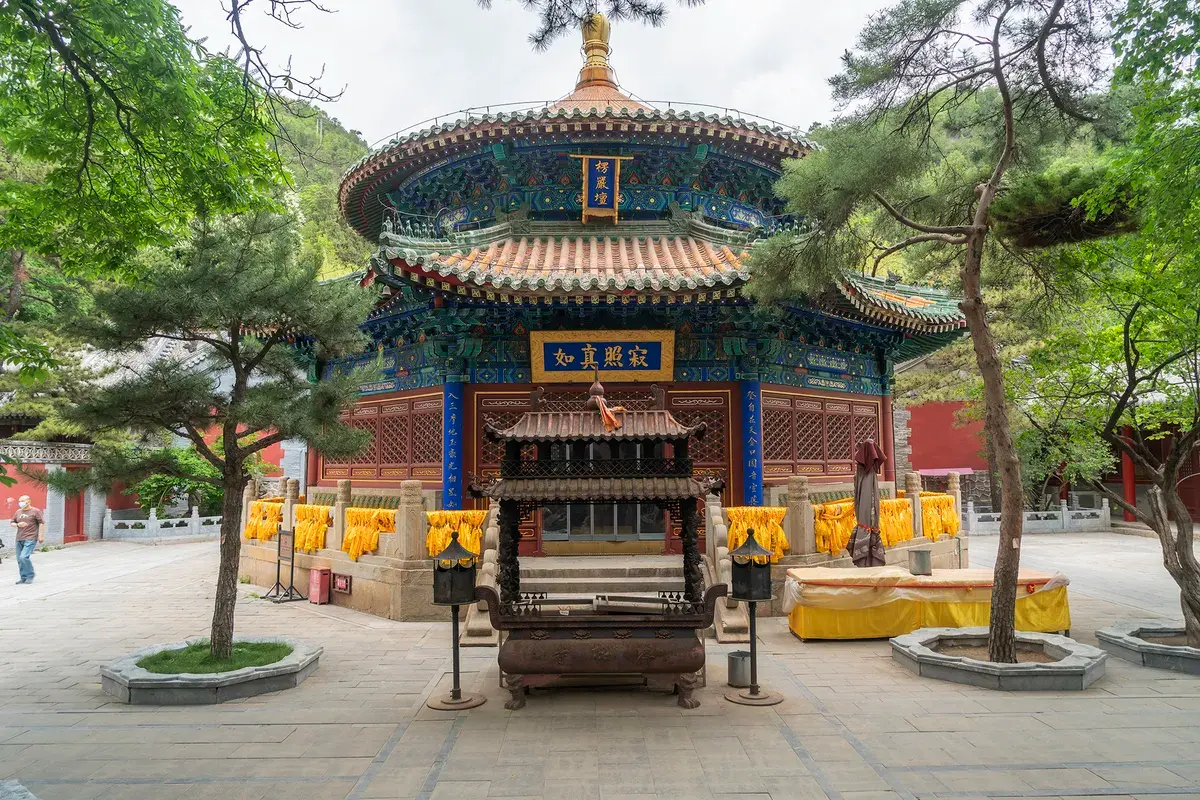
At the center is the most important structure: the Surangama Hall.
This is a double-eaved octagonal pavilion. Below, it’s octagonal; above, a circular pointed-arch roof with a gilded inverted-bowl finial, yellow glazed tiles with green trim. Doors open on all four sides; the other faces have window sills and lattice panels—partition doors and windows with the three-cross six-panel pattern. The Surangama Hall sits on a two-foot-high white stone platform with a white marble balustrade. Let’s examine the eaves.
This square-below, round-above architectural form is popularly called “an umbrella.” This Surangama Hall was built in the Yongzheng reign of the Qing Dynasty. Due to years of neglect, it was dismantled for protection in the 1970s and reconstructed to its original form in 2013, looking brand new—likely repainted within the last couple of years.
“Tan” denotes a place where eminent monks give discourses; round ones are called “tan,” square ones “tang.” The Surangama Hall at Tanzhe Temple is a dedicated venue for the abbot to lecture on the Surangama Sutra, a major Buddhist text that all schools, exoteric and esoteric, must study, and recited daily during morning services.
Inside, there’s an inner chamber. At its center is a painted wooden statue of Shakyamuni seated. Against a dim blue-toned backdrop, the warm-colored statue and canopy are strikingly beautiful. Look up at the ceiling structure.
It’s a multi-tiered, four-column beam structure, each tier rotated slightly, rising in an interlocking pattern—somewhat like an inverted-dipper caisson ceiling. I’m not great at describing such frameworks, but it’s dizzyingly intricate. The canopy seems to catch some light, standing out brilliantly in the dark interior. The Surangama Hall, inside and out, is gorgeous, and now a must-see at Tanzhe Temple.
On the south side of the courtyard, facing north, is the Chandan Hall (Sandalwood Hall), which enshrines a sandalwood Buddha statue.
Legend says the first wooden statue of Shakyamuni was carved while he was alive, based on his reflection in water, hence the watery ripple pattern on the statue. This type of statue has been passed down, but it’s extremely rare because sandalwood itself is very rare. I once saw a Chandan Hall at Dailuoding on Mount Wutai, with a ripple-pattern statue inside. Tanzhe Temple’s sandalwood Buddha lacks the ripple pattern; the temple calls it an Amitabha statue. Sandalwood is also called white sandalwood. The giant Buddha at Yonghe Temple is carved from a single piece of white sandalwood—very precious and a Guinness World Record holder. That Yonghe Temple statue is a gilded Maitreya Buddha, not a ripple-pattern sandalwood Shakyamuni.
Beyond the standardized Heavenly Kings Hall and Main Hall on the central axis, the buildings in this courtyard are crucial: the central Surangama Hall, the southern Chandan Hall, and the northern Ordination Platform. It’s because of this courtyard that Tanzhe Temple is more complete than most monasteries and remains the most important Han Chinese Buddhist temple in the capital.
On the hills around Tanzhe Temple, there are several caves, all with Guanyin statues, hence called Guanyin Caves—some to the east, some to the west. To save energy until lunch, I skipped them. Old temples always have forest of pagodas for eminent monks’ tombs; Tanzhe Temple is said to have over 70, but I didn’t visit for the same reason.
After finishing the temple tour, rural vendors had already set up lunch along the roadside. I inquired and found they only had vegetarian vegetable dumplings—not my thing. I went back down the hill and found a village eatery for a proper meal, where I got some meat. Many years ago, in a farmhouse around here, the auntie actually went to the village to buy a live chicken just for us. The lady apologized that there were no old hens, only a speckled rooster, and then she pressure-cooked us a big bowl of chicken stew with mushrooms. That meal was unforgettable. Today’s farmhouse lunch filled me up, but three days later I’ll have forgotten what I ate. After eating, I burped three times, drank a pot of coffee I’d brought, and headed home.


