Strolling Down Nanchizi Street: A Hidden Garden Art Museum
When the Ming Yongle Emperor Zhu Di moved his capital from Nanjing to Beijing, he built a new imperial palace, which was a carbon copy of the Nanjing palace. This Ming imperial palace in Beijing is what we now call the Palace Museum, or the Forbidden City. The Nanjing Ming palace was built first, with the palace constructed before the imperial city walls, while in Beijing, the palace and the imperial city were built simultaneously.
Inside Beijing’s imperial city, there were palace gardens to the east and west of the main palace, also following the regulations of the Nanjing Ming palace. These were called the Western Garden and the Eastern Garden. The Western Garden is today’s Zhongnanhai; the Eastern Garden no longer exists. The Western Garden was a place for the emperor’s enjoyment, vast and filled with water. The Eastern Garden had no water and was for more relaxed leisure. In the Eastern Garden, there was initially a Hongqing Palace, also called the Southern Palace (Nangong), which Zhu Di built as a crown prince’s residence. It’s unclear if his son Zhu Gaochi ever lived there. Actually, it was first intended for Zhu Di’s grandson Zhu Zhanji, so it should have been called the Imperial Grandson’s Palace. Because it served as a crown prince’s residence, it was also named Chonghua Palace, derived from the Book of Documents—Shun’s Canon: ‘Shun succeeded Yao, magnifying the glory of his cultural virtue.’ The character ‘Chong’ is pronounced with the meaning of weight/gravity, not repetition. The Qing Qianlong Emperor later adopted this meaning and renamed the West Second Residence in the palace, where he had lived as a prince, as Chonghua Palace after renovations.
According to both official and unofficial histories, after Zhu Zhanji (son of Zhu Gaochi), his grandson, the Zhengtong Emperor Zhu Qizhen (posthumously known as Ming Yingzong), indeed lived in this Southern Palace. In the 14th year of the Zhengtong reign (1449), Emperor Yingzong personally led a campaign against the Mongolian Oirat tribe, but was betrayed by the eunuch Wang Zhen and captured at the Tumu Crisis. As the country could not be without a ruler, his half-brother Zhu Qiyu was entrusted with the throne, becoming the Jingtai Emperor, essentially an acting monarch. A year later, the Oirats released Zhu Qizhen without ransom. His brother Zhu Qiyu was not pleased to see him return, telling his ministers, ‘It was you who appointed me emperor; now he must become the Retired Emperor.’ He then confined Zhu Qizhen to the Southern Palace in the Eastern Garden. It is said that the walls and gates were sealed tight, leaving only a small opening for delivering food—so narrow that noodles had to be slipped in one by one, and steamed buns had to be broken into crumbs. The word ‘crumbs’ is said to originate from this. Seven years later, in the 8th year of Jingtai (1457), Zhu Qiyu suffered a stroke and was bedridden. Zhu Qizhen, supported by his old followers, launched a coup known as the Southern Palace Incident, reclaiming the throne in the Hall of Supreme Harmony and restoring himself as the Yingzong Emperor. Once back in power, he exiled Zhu Qiyu to the Western Garden. Within two months, the Jingtai Emperor passed away. Zhu Qiyu was not buried in the Tianshou Mountain imperial cemetery in Changping but was instead interred at a princely tomb at Jinshankou in Yuquanshan.
Generations later, the Jiajing Emperor Zhu Houcong came to power. He was fond of alchemy and sought a quiet place outside the palace to secretly practice it. The treacherous minister Yan Song suggested the Southern Palace as a peaceful retreat, but the emperor, realizing Yan was sending him to the unlucky spot where his ancestor had been imprisoned, grew suspicious of Yan from then on. Eventually, he had someone expose Yan Song’s crimes, and Yan was dealt with.
During the Ming Dynasty, after Emperor Yingzong’s miserable confinement there, the Southern Palace was shunned by subsequent Ming emperors and fell into decline. Besides the Southern Palace, the Eastern Garden also contained the Huangshicheng (Imperial Archives), built during the Jiajing reign. It was a brick-and-stone structure with a vaulted ceiling and no beams, used to store royal historical records. At the end of the Ming, the rebel leader Li Zicheng seized Beijing and occupied the palace, setting up office in the Hall of Martial Valor (Wuyingdian). But his rule lasted only days; he started several fires within the imperial city before fleeing westward. One of those fires burned in the Eastern Garden, devastating it.
With the Manchu invasion, Dorgon escorted the young Shunzhi Emperor Fulin and Empress Dowager Xiaozhuang into the Forbidden City to settle. Since Fulin was still a child, the Empress Dowager appointed Dorgon as regent. Dorgon was also known by his princely title, Prince Rui. To facilitate his regency and visits to the palace, Dorgon had his soldiers clear the burned ruins of the Southern Palace in the Eastern Garden and built his Prince Rui Mansion there. He reconstructed the main hall where Ming Yingzong had once slept, turning it into his own bedchamber. In the 7th year of Shunzhi (1650), Dorgon led troops out beyond the Gubeikou Pass to hunt wild boar on the Bashang grasslands, but was accidentally injured and died. Officially, it was said he fell from his horse, but secret reports claimed that a guard’s crossbow misfired, hitting Dorgon in the heel. At first, Shunzhi honored Dorgon posthumously, declaring him ‘Emperor Chengjing’ and naming him Qing Chengzong. Soon, however, someone accused Dorgon of multiple acts of sedition. Shunzhi stripped him of his titles, exhuming his grave and scattering his remains, and the Prince Rui Mansion was confiscated. During the Kangxi reign, the abandoned mansion was turned into a Tibetan Buddhist temple. A century later, in the 43rd year of Qianlong (1778), the Qianlong Emperor fully rehabilitated Dorgon and converted the temple into what is now Pudu Temple.
Although the Qing dynasty rebuilt the Western Garden, it did not restore the Eastern Garden. After Dorgon’s mansion, the Eastern Garden became imperial storage grounds. Besides the Huangshicheng archives carried over from the Ming, stores for silk, lanterns, porcelain, and more were added. The Ming-era Huangshicheng survived, while the Southern Palace was converted into Pudu Temple. Early in the Qing, a small temple called Pusheng Temple was built to the east of Huangshicheng. It housed two rare horizontal merit steles—the only ones of their kind in Beijing: one commemorating the temple’s construction under Shunzhi, the other its renovation under Qianlong. Today, these steles are at the Five Pagoda Temple north of the Beijing Zoo. Why there? Because Pusheng Temple no longer exists; in 1915, it was turned into what is now the Western Returned Scholars Association (Ou-Mei Tongxuehui).
While the Ming Eastern Garden decayed in the Qing and became storage, during the Republican era, various officials moved in and made homes there. High-ranking officials lived in former princely mansions, while lesser ones found dwellings throughout the city. After 1949, those Republican officials were removed, and their residences were taken over. Army officers and local leaders then moved into parts of the old Eastern Garden area. Today, as you walk along Nanchizi Street, you’ll see some courtyards with private garages—these are not ordinary households. In recent years, Pudu Temple has been partially restored and reopened to the public, allowing neighborhood residents to let their children play, with mothers knitting under the trees. I visited recently: the temple gate and main hall still stand. The main hall opens for exhibitions; it was rebuilt after Qianlong cleared Dorgon’s name and retains Qing-era architectural style. The gatehouse dates from Kangxi’s reign, much like other small Qing temples in Beijing, such as Songzhu Temple on Shatan North Street near Peking University’s Red Building.
Ancient Chinese city planning originally followed the lifang (ward) system since the Xia and Shang dynasties, reaching its peak in Tang-era Chang’an. You can still see traces in some old villages in Shanxi. Later, in the Northern Song, the layout evolved from wards to a street-and-lane (jiexiang) system, which has persisted to the present day. A well-preserved Ming-Qing example is the Three Lanes and Seven Alleys in Fuzhou, which I’ve visited. Old Beijing is a classic example of the street-and-lane system, and naturally, the Ming Eastern Garden outside Donghuamen was no exception. Despite Qing alterations, Republican chaos, and recent decades of haphazard construction, you can still glimpse the old Beijing streetscape. Beijing’s lanes are called hutongs. Around Donghuamen, you’ll find names like Nanchizi Street, Pudu Temple Front Alley, Duanku (Satin Warehouse) Hutong, Ciqiku (Porcelain Warehouse) Hutong—a mix of major streets and narrow lanes. The southern end of Nanchizi Street meets East Chang’an Avenue. At that intersection, on the west side of Chang’an Avenue, once stood the Eastern Chang’an Gate. Opposite, west of the Forbidden City on Nanchang Street, was the Western Chang’an Gate. Chang’an Avenue is named after these two gates, which were demolished in the 1950s. In the documentary The Founding of a Nation, you can still see footage of parade troops marching through the Eastern Chang’an Gate.
Starting from Tiananmen East Station on Subway Line 1, walk north along Nanchizi Street, and you’re tracing the old Ming Eastern Garden. On the east side of the road, you’ll spot the sign for Pudu Temple Front Alley; duck in and visit Pudu Temple. Continue north, and you’ll see a sign for Pudu Temple West Alley. Take this narrow lane, and at the end, turn north to see a small door set into the west wall.
This is the destination of my visit today: the Nanchizi Art Museum, hidden in the bustling city, a true recluse. The museum was renovated in recent years and, like Pudu Temple’s main hall next door, is usually closed except during exhibitions. Right now, it’s hosting ‘The Way of Heaven: Tai Xiangzhou Ink Art Exhibition,’ running until September 20. That small door is never casually open. If you have a reservation for the show, you can ring the bell, and it will open—revealing a smiling attendant. The door is simple: brick frame, a pair of wooden panels with brass fittings, and old-fashioned knockers, understated and unadorned. No stone door guards, which tells you it’s a side entrance, not the main gate. Above the lintel is carved a character I couldn’t quite decipher, something like ‘X Jian’ (possibly a family name, kept private), and ‘Jian’ means mountain stream, hinting at water within. But don’t get your hopes up—the water isn’t the ‘chi’ (pond) of Nanchizi’s name.
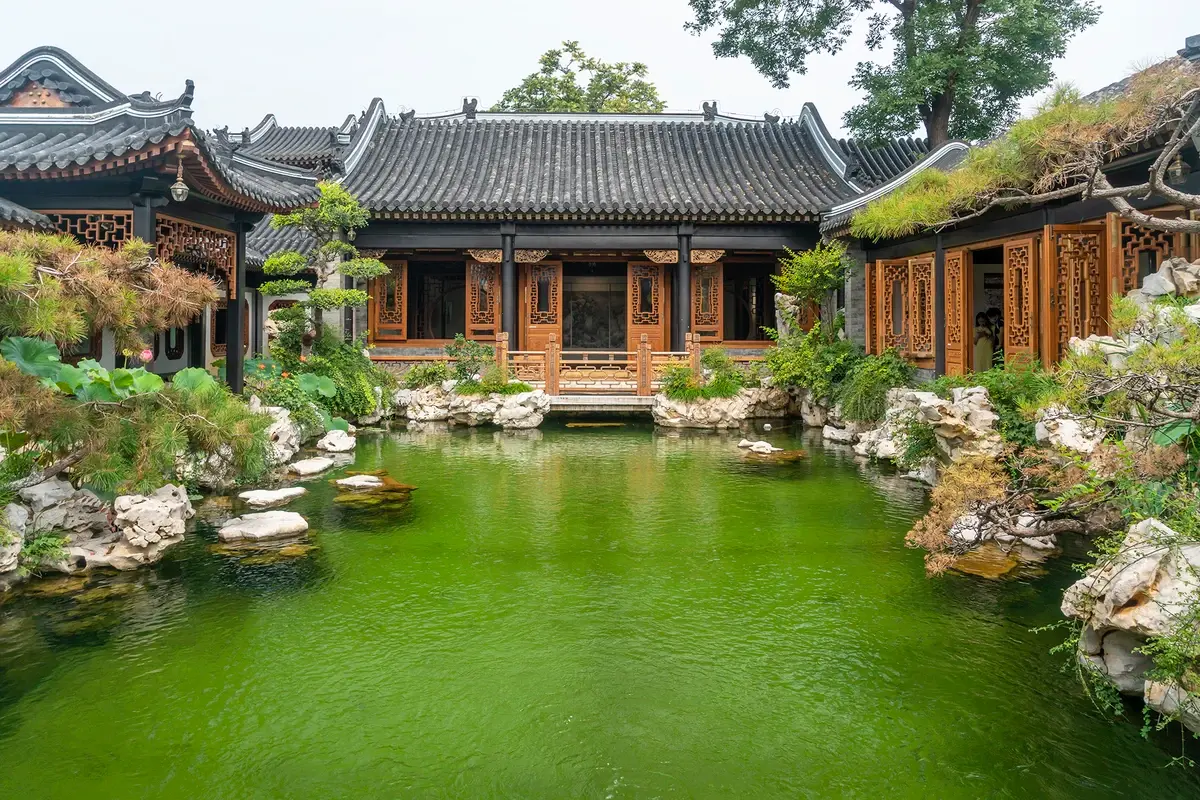
Stepping inside, you get a sweeping view of the garden. A pond of emerald water, which, according to the ancient rule that circular is ‘chi’ and square is ‘zhao,’ should be called a ‘yu zhao’ (fish pond). Following the layout of a Beijing courtyard house, several buildings are arranged around this pond.
To the north stands the main house; to the east a wing, to the west a covered walkway, and to the south a reverse-facing house. The main house, viewed from the front, is three bays wide and one bay deep. The central bay has a four-panel partition door, while the side bays have sill-wall lattice windows. A porch with columns runs along the front, and under the tie-beams are openwork wooden queti (brackets) without cloud blocks. Above is a post-and-beam structure with a grey-tiled round-ridge flush-gable roof. Behind it, you can glimpse another building with a grey-tiled single-eave hip-and-gable roof, topped with Qing-style chiwen ornaments. A small white stone terrace extends over the water, fenced with a wooden balustrade of Buddhist staff design. The columns, beams, and lintels are all painted black—a very telling detail. This main house is spacious, much larger than a commoner’s home but not as grand as a princely mansion. The black paint, as opposed to the imperial red or princely green, indicates the owner was below provincial-governor rank—probably equivalent to a circuit intendant or prefect in Qing times.
It turns out to be a front-and-back room arrangement, divided by a central shrine with openwork moon gates on either side. Look up in the front room: exposed post-and-beam structure, a single vault. Now the inner room: its ceiling is a flat, coffered ceiling with plain white panels—no crane or peony motifs. This would be under that hip-and-gable roof visible from outside, so the whole structure has a double-vault, connected-ridge roof.
The main house is the primary exhibition hall. On the north wall hangs an eight-panel screen ‘Parallel Universe III’—a rare sight, since four-panel screens are more common. Behind the shrine is the exhibition’s poster piece, a long scroll titled ‘The Way of Heaven.’ The shrine and moon gates are adorned with auspicious woodcarvings. Look at this one on the side of the shrine: five magpies on a plum tree, known as ‘magpies on plum branches’—symbolizing happiness reaching one’s brow, utterly auspicious.
To the east of the main house is a small side room where staff are. Perhaps the artist himself is hiding in there, ready to emerge and discuss his art with visitors, or hold forth on the cosmology of ink painting.
Leaving the north room, you can wander down the covered walkway to the right. Glancing inside and out along this west corridor. Just stepped out of the north room and now into the depths of the west corridor. If only one could set wine under this corridor, awaiting the moon and drinking a thousand cups, staff in hand like an immortal. The corridor’s inner side has lattice windows for enjoying the garden; the outer side has frosted glass—to discourage peeping Toms. One pane even bears a painting of bananas, apples, and a big pear, along with an octopus. The next probably features cigarettes, matches, osmanthus candy, and a pangolin.
Midway down the corridor is an open waterside pavilion. Behind this pavilion, on the west wall, there’s a door. That door leads to the owner’s main courtyard, meaning we’re in the eastern garden. While private gardens often sit behind the main compound, having one on the side is also traditional. From the pavilion, looking across, you see the east wing.
The east wing is like the main house but smaller: three bays wide, one bay deep, with a post-and-beam structure and grey-tiled round-ridge flush-gable roof. The central bay has a partition door, and the side bays have sill-wall lattice windows. Naturally, it’s less grand than the main house—no porch, no terrace.
The south building is also three bays wide, one bay deep, with a grey-tiled round-ridge hard gable. Unlike the north house, it has no porch or moon terrace; instead, in front is a projecting open pavilion over the water. The roof ridges of this projection feature a distinctive curve known as ‘juan sha,’ creating upturned eaves. Such curves are rare in northern architecture but common in the south, though they actually originate from ancient Qin and Han building techniques.
Standing in the south room, looking north. It’s also an exhibition space. Under the east wall is the star of this room: a Taihu Lake scholar’s rock. The paintings here are inspired by the artist’s appreciation of such rocks, a union of image and text. China has a long tradition of rock appreciation. The abdicated Song Emperor Huizong was a connoisseur; he collected exotic rocks from the south for his flower-and-stone shipments to Kaifeng, building the Genyue garden. Many of these rocks were porous limestone from Lake Tai, hence the name Taihu rocks. When the Jin dynasty sacked Kaifeng, they not only took Emperors Huizong and Qinzong but also dismantled Genyue, carting many rocks to Yanjing (Beijing). They built Qionghua Island in the imperial garden outside the city—now Beihai Park.
Take a look at the south room’s lattice windows. Apart from the north main house which has three-panel windows, the rest are like these: floor-to-ceiling two-panel windows with cloud-pattern mullions. The west end of the south room is partitioned off as a cozy chamber, lined with traditional Chinese camphorwood wardrobes. Ordinary folks store insect-prone valuables in camphor chests; the wealthy used camphor closets. In the old days, if someone was short of cash, they might pawn a fur coat. The pawnbroker would give it a shake and say, ‘Insect-eaten, mouse-nibbled fur coat.’ Even if it came from a camphor chest and was pristine, the pawnbroker said that to lowball the price.
This chamber has a door leading directly into the west corridor. Look at the lower panel details. The wood appears to be faux rosewood, but it’s actually elm. The brass plates are stamped with cloud patterns—high-end hardware known as ‘lead-forged’ plates. In the palace, such plates would also feature dragons. Reinforcing joint areas with plates is called ‘locking’; in the palace, they’d be gilded, hence ‘gold-locked doors and windows.’ Here, it’s brass locks. The carved relief on the door’s lower panel shows a river, a mountain beside it, orchids, chrysanthemums, and lotus below, with an eagle keeping watch above—auspicious beyond belief.
A house is an essential structure, but to elevate a garden, more scenery is needed. A courtyard must have trees, and in Beijing, it must have locust trees. This one is clearly not a recent planting, nor from the Qianlong era, but it has some age. The old house sits by the pond, an ancient locust behind it. Locust blossoms drift in the wind, rippling across the water. Where there’s water, there must be lotus. Summer passes, leaving late lotus blooms standing by the pond—not merely for self-admiration, but for the sighs of appreciative visitors. On the west corridor, besides the waterside pavilion, there’s also a little pavilion. Next to it grows a tree bearing strange fruit. When I asked the staff, they said, ‘Ornamental quince, not for eating.’ A rare sight in the capital, this southern fruit. An elegant garden also needs rocks. Chinese garden rocks come in two types: the porous Taihu rocks, piled to create mountains; and flat stones, stacked into peaks. This garden has both, heaped in corners or arranged in the water.
The most imposing feature is a hill in the southeast corner. Atop it sits a round pavilion—reminding me of the ‘Near the Moon’ pavilion in Yangzhou’s He Garden, same spot, same style. Spring Wind Hill, Spring Wind Pavilion. Spring breezes blow and spring light clears; one day I’ll sit here listening to spring rain, boiling wine with friends, drunk on spring feelings.
This little garden at Nanchizi Art Museum may not be as lavish as a princely garden, but it’s exquisite and charming. Beijing has many princely gardens—Prince Gong’s Mansion garden is huge, and the garden at Prince Chun’s Mansion where Soong Ching-ling lived is also large; even the Grand View Garden in Cao Xueqin’s Dream of the Red Chamber is quite sizable. I suspect the original owner here was a mid-ranking officer under Fu Zuoyi, maybe a division commander—nothing too high. The garden looks rebuilt, and someone may still be living in the main courtyard to the west. The architecture is neat and orderly, typical of old Beijing residential style, different from the Suzhou-Yangzhou southern gardens. Not far from here, behind the National Art Museum of China, once stood the ‘Half-Mu Garden’ (Banmu Yuan), the residence of Jia Hanfu, a Shaanxi governor in the Kangxi era, designed by the master garden-maker Li Yu. Despite its name, it actually covered over ten mu. Demolished in the 1980s, it has been replicated at the Chinese Garden Museum as a representative northern garden. This Nanchizi museum doesn’t advertise its size, but it might truly be just half a mu. Though small, it has everything: halls, corridors, pavilions, water, rocks, pines, locust trees, lotus, and plum, all complementing each other. The layout is dense but not cluttered. In sum, this Nanchizi Art Museum is a fine miniature of northern Chinese gardens—well worth a visit.
The courtyard quiet, summer sun slanting; green shade covering the ground, spring flowers gone. Old dreams of spring fly far away. Jagged rocks and perilous railings, swallows under the eaves; pond lotuses at rest, hidden frogs croaking. Holding wine, bright moonlight shines through window gauze.


