A Class Reunion by the Bohai Sea in Late Summer, Followed by a Group Tour to Xinjiang
In August 2015, I went to Beijing for our 50th class reunion, and then, together with two childhood pals, took a trip to Xinjiang. On August 17, I took the high-speed train from Xiamen, arriving in Beijing in just 11 hours. I recalled that in the 1960s, when I traveled from Xiamen back to Beijing to visit family, I had to transfer at Yingtan and Shanghai, and the journey alone took four days. Fifty years have flown by, and China's railway has indeed made great progress.
On the morning of August 18, I returned to my alma mater, Peking University, to reunite with old classmates. Back in our prime, we were full of vigor, but now we are all in our twilight years. Nearly a quarter of the class had passed away, and with others unable to return for various reasons, fewer than half of the original class actually made it. Still, given that we were all in our seventies, gathering on such a scale was no easy feat. Hand in hand, we revisited 'Yanyuan', took group photos in front of the university library, and snapped pictures by the 'Weiming Lake'. The library was built after we graduated, while Weiming Lake, with its iconic 'lakeside pagoda reflection', remained unchanged, as it had for half a century. These spots are the top photo-ops at our alma mater, which students call 'One Pagoda, One Lake, One Library'. The pagoda among these three sights, I used to know only as a water tower, but now I learned it has a lovely name: 'Boya Pagoda'. Lunch was at 'Changchun Garden' (outside the West Gate), costing 100 yuan per person, Dutch treat, thoughtfully arranged by He M.Y., the only classmate who stayed on at the university. It felt quite sumptuous. Our class's first Communist Youth League secretary, Wei Z.S., gave a warm speech during the meal, encouraging everyone to meet again in 5, 10, or 15 years.
The class reunion lasted four days, from August 18 to 21. The entire event was planned and organized by our former Party cell leader Chen M.Y. and the second Youth League secretary Ma X.Z. The venue chosen was 'East Daihe' in Suizhong County, Liaoning Province, right on the Bohai Sea coast. Right after lunch, we boarded a bus and set off. When old classmates get together, old roles persist: the class leaders remained class leaders, and the 'nobodies' stayed nobodies. I had been one of the 'nobodies', so this time I just relaxed and let the class leaders handle everything. We arrived at East Daihe at 18:00 and checked into 'Nagehai Farmhouse' near the Suizhong power plant, with twin rooms — it was decent. The sea was just 200 meters away, and nearby attractions included 'Jiumenkou Water Great Wall' and 'Jieshi Palace'. We also chartered a luxury yacht and cruised the sea for a while. 'Shanhaiguan' was also close, but we couldn't visit because our chartered driver (from Beijing) flatly refused, claiming parking for non-local vehicles was too difficult.
After the reunion, we returned to Beijing and disbanded. I then teamed up with X.D. and Y.C. to visit Xinjiang; the three of us had grown up in the same compound in Beijing, so we could be considered 'childhood pals'. Xinjiang is vast, and we all favored a group tour. The two of them booked a tour called 'Dreamlike Kanas': a 10-day trip covering Urumqi, Kanas, Karamay, Devil's City, Turpan, and Heavenly Lake, with round-trip sleeper train between Beijing and Urumqi included. The basic tour fee was 3,280 yuan.
On August 25, early morning at Beijing West Station, we met the travel agency's send-off staff and used our ID cards to collect three hard-sleeper tickets for train Z69 (Beijing West → Urumqi South): two upper berths and one middle berth. We also received three return tickets for train Z70 from Urumqi to Beijing, all lower berths. Then, using our ID cards (for those 70+), we waited in the station's special waiting area for 'mothers, the elderly, and the weak', went through a dedicated gate, and boarded early. Train Z69 is called 'Xinjiang Tourism Express', staffed by a Urumqi crew, with new YW25T hard-sleeper cars, all semi-enclosed compartments, and toilets usable even during stops. Departing Beijing at 10:00, we passed Shijiazhuang at 12:40 (25-minute stop), Taiyuan at 15:03, Lvliang at 16:32, crossed the Yellow River at 17:02, reached Dingbian at 19:49, then entered night travel.
On August 26, at 6:51 early morning we passed Jiayuguan, at 9:51 Liuyuan (transfer point for Dunhuang), at 13:02 Hami, stopped briefly at Turpan at 16:44, and arrived at Urumqi South Station at 18:19. The local guide met us at the exit with a 'Dream Tour' flag, did a headcount, and led us onto a bus heading to the 'Western Regions International Hotel' in Urumqi's Tianshan District. The guide introduced himself: his surname was Zhang, and the bus driver's surname was Li — they would be taking care of us from now on.
We each received a Uyghur-style cap, took a group photo at the hotel entrance, and then settled into our rooms, a triple standard room. According to the contract, the tour didn't cover our lunches and dinners in Urumqi, only breakfast at the hotel. So that evening we paid for our own meal: 'big plate chicken' for 90 yuan, plus an extra portion of noodles for 10 yuan — enough for the three of us. The restaurant was right across from the hotel, run by a Hui Muslim boss from Tianshui, Gansu. The hotel lay in Urumqi's old city, where most residents were Uyghur. After dinner we strolled around; the streets were filled with faces of 'European' stock, bustling and lively, a thoroughly harmonious atmosphere.
August 27: up at 6:00, breakfast at 6:30, departure at 7:00 — the sky still pitch-dark. Being the oldest, I was dubbed 'Old Man' by my fellow travelers, and the guide specially seated me in the front right seat, the best scenic spot on the bus. We drove out of town onto the G30 Lianhuo Expressway westwards. At 8:36 we made a quick stop at Wugongtai service area in Hutubi County, Changji Hui Autonomous Prefecture; the flower beds there were especially pretty.
Shortly after setting off again, we turned onto provincial road S201, heading west then north towards Karamay. The guide began his spiel, emphasizing that Xinjiang's long winters mean guides can only work a few months a year, making a living is tough, and aged nearly 30 he still hadn't married because of money. He admitted he benefits from tourists' spending, but not as scandalously as some journalists claim. Then he went on to recommend optional tours, most of which matched what we were told when we signed up in Beijing, except the Kanas itinerary was drastically cut — no 'Hemu' or 'Black Lake', and the saved time would be used for 'China-Kazakhstan border outpost', 'White Sand Lake', 'Singing Sand Dunes' and so on. These places are all under the Xinjiang Production and Construction Corps; the local travel agency is a Corps subsidiary, and the guide himself a Corps kid, so 'keeping the benefits in-house' seemed his principle. The full optional package cost an extra 1,330 yuan; he handed out forms on the spot for us to sign and confirm. I signed and paid right away. Almost everyone paid in full, though a few opted out of certain items; the guide accepted that graciously and didn't push.
At noon, we turned right at the grand Karamay entrance roundabout, continued north on national highway G217, and stopped for lunch at 'Niujie' (Ox Street) in Karamay's Baijiantan district. By contract, lunches and dinners were 10 to a table, eight dishes and a soup, budgeted at 20 yuan per person. True to form, 'eight dishes and a soup' it was — but entirely vegetarian, and the same vegetable slightly re-cooked became another dish. The guide forewarned us that tour meals ensure you're full, not well-fed.
After lunch, we stayed on G217, crossing the Dzungar Gobi northwards, passing the Karamay oilfield with its countless nodding donkeys bobbing up and down. About an hour later, we turned left off the highway to a optional attraction called 'Huyang Tribe' — the main draws were the 'poplar forest' and 'Gemstone Beach'. The poplar trees were sparse, hardly a 'forest'; 'Gemstone Beach' was a vast stretch of Gobi scattered with pebbles of every hue, called 'Gobi jade'. The ethnic Uyghur boss's wife, who attended Chinese schools, spoke flawless Mandarin. She told us the poplars here live a thousand years then die, stand a thousand years without falling, and lie another thousand years without rotting.
After seeing the poplars, we hunted for 'gems'. Among us, X.D. was quite the jade connoisseur. He said the local stone was 'golden silk jade', with yellow and red the most prized. So I picked only yellow or red translucent pebbles and got a bagful. They said a rarer 'black gem' is even more precious; I found a shiny black stone with many round pits on the surface — I suspect it might be a meteorite.
We left around 16:00, backtracked to G217 and headed north, after about an hour entering the G3014 Kuitun-Altay expressway via the 'Urho' exit. The famous Yardang landform 'Urho Ghost City' lay far on the right side of the road. Actually, from the expressway we could already see many castle-like mud hills — 'Yardang' in the Uyghur tongue. Further on was vast grassland with herds of cattle and sheep, though the grass was very short — the classic lines 'boundless sky, vast wilds, wind blows grass low to reveal... perhaps mice' came to mind.
At 19:00 we exited the expressway at Bayintuohai interchange and returned to G217, heading north for Burqin. On the right, at the edge of the steppe, a huge body of water faintly appeared — the guide said that was Ulungur Lake, also called 'Fuhai', covering 800 square kilometers, Xinjiang's renowned 'Gold Coast' and fishery. Then we encountered low mountain ridges; the guide said reaching Kanas requires crossing three such ridges, this being the first.
Around 20:00 we reached Burqin but didn't enter the town, instead taking provincial road S227 straight to 'Rainbow Beach' scenic area. The Irtysh River flowd along the left of the road — China's only major river draining into the Arctic Ocean. We entered Rainbow Beach at 20:43; the guide said it was privately developed by a Hong Kong boss, and I (70+) got in free with my ID. Rainbow Beach lies on the banks of the Irtysh, another Yardang formation — richly colored, beautifully scenic — but we arrived so late it soon grew dark. Yet the guide claimed he chose this timing on purpose because the weather was clear for sunset and afterglow; on overcast days he'd bring groups the next morning. Still, in my opinion, rushing through such splendid scenery like a blur was a shame. Sunset? You can watch that anywhere, not necessarily by the Irtysh.
We left at 21:35 in total darkness and drove into Burqin town, having dinner at the 'Sutong Holiday Hotel' — again 'eight dishes and a soup', all vegetarian. It was 22:30 by the time we finished and checked into the 'Burqin County Commerce Hotel'. We got another triple room. Y.C. and X.D. habitually take after-dinner walks; I used the time to shower and tidy up. They returned well past midnight, saying Burqin's nightlife was vibrant, and they'd found a food street with special grilled fish.
August 28: the plan was Burqin → Kanas → Jiadengyu. Up at 6:00 again, a buffet breakfast at 6:30 in the hotel restaurant, the only non-vegetarian item being egg — one per person. After breakfast we followed S232 north towards Kanas. At 8:20 we crossed the second Altai ridge; behind the mountain lay Burqin County's largest township, Chonghur, home to Kazakh herders. The village houses were pretty; the guide said they were government-subsidized 'New Countryside' dwellings. We stopped briefly at Chonghur's tourist development zone — Russian-style buildings, a small supermarket. The guide suggested stocking up on snacks because things ahead in Kanas would be exorbitantly expensive.
Continuing, we soon saw neat little houses with red roofs and yellow walls, all the same design — herders' winter bases, commonly called 'winter dens', also government-funded. Now the herders are all up in the mountains; when heavy snow seals the passes, they come down for winter. Then we climbed the third and highest Altai ridge on the winding '66 Turns' of S232. At 9:34 we reached the top, seeing some white yurts and a tourist bus parked — likely a viewpoint. Further on we spotted Kanas Airport with its white walls and red pointed roofs, another Russian touch. Nearby was 'Russian Village', populated by descendants of White Russians who fled here in the 1920s and are now one of China's 56 ethnic groups; they build homes only with logs, no bricks.
At 10:05 we passed the Agongati Grassland Stone Man Scenic Area, now a 'Kazakh Cultural Park' with yurts for lodging, a parking lot, boardwalks, shops, and sanitation facilities — but tickets were outrageously priced at 198 yuan per person. We only stopped outside to rest, didn't enter. Ten minutes later we drove onto a high slope; below stretched vast grasslands the guide called 'Xinjiang's Shangri-La'. At 10:42 we passed a border checkpoint; the guide said we were a Beijing tour group and we were waved through immediately.
We then entered the Kanas forest zone, with tall pines appearing by the roadside. At 11:12 we drove through Jiadengyu, originally a tiny hamlet now turned into a tourist resort by outside investors. Guide Xiao Zhang said it bustles only a few months a year; in winter, temperatures drop below -40°C and the resort is virtually empty. At 11:17 we arrived at the Kanas scenic area; our bus had to park outside, and we transferred to the scenic shuttle. I (70+) got in free with my ID but still needed a shuttle ticket.
Around noon we entered the area, boarded the shuttle with the guide, and headed north along S232. Enchanting scenery flashed by, glimpses of Kanas Lake appeared and vanished, the on-board commentator described the sights: Camel Neck Bay, Kanas River Bridge, Wolong Bay, Moon Bay, Shenxian Bay, until we reached the 'Transfer Center'. Here, shuttles to different spots all required separate tickets. We disembarked for lunch — again, eight vegetarian dishes and a soup.
Our half-day Kanas itinerary consisted of: a boat tour on the lake, a visit to a Tuvan household, then free time. After lunch, the boat tour: we followed the guide from the Transfer Center by shuttle, passed through a Tuvan village, then walked through forest and meadow to the pier. The scenery was lovely; the famous 'Fish-Watching Pavilion' sat on the distant high mountain opposite, said to be the best place to spot the 'lake monster'. But only a handful of people have ever truly glimpsed it, and with so many tourist boats, even a monster would likely stay hidden.
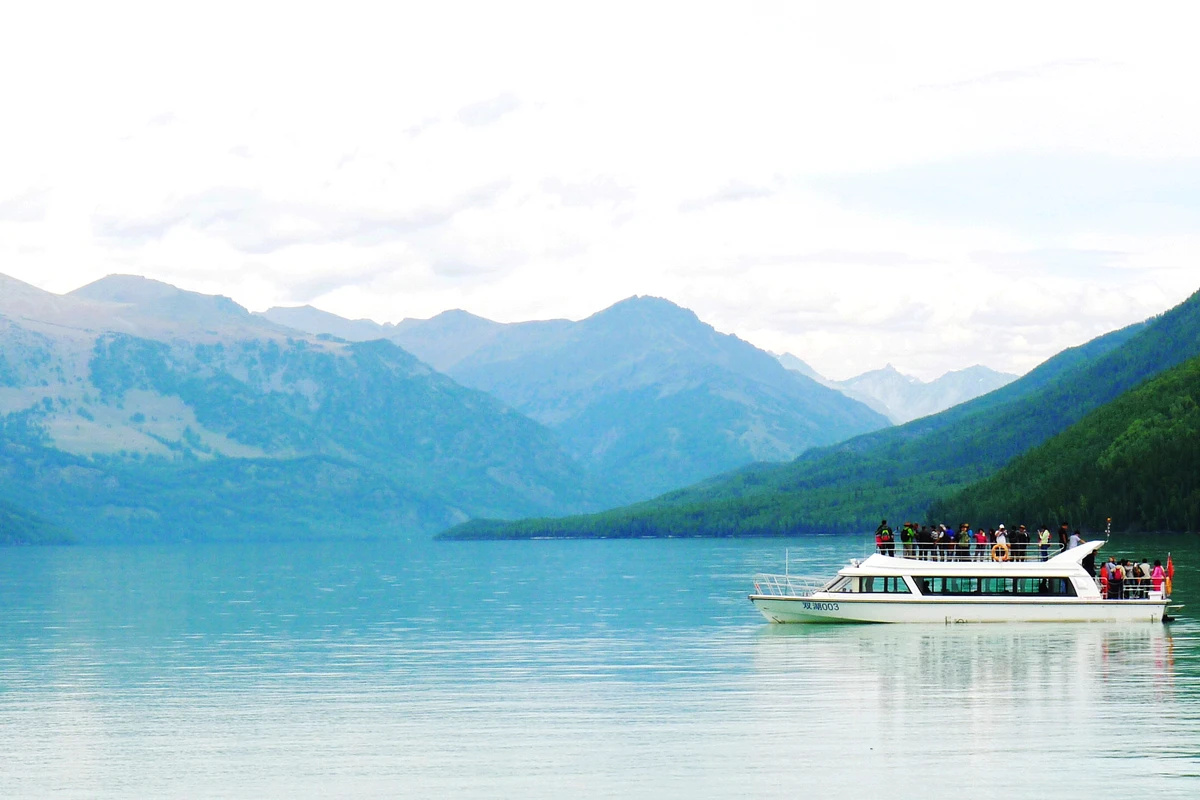
Kanas Lake lies in the dense forests of the Altai, China's deepest moraine-dammed lake and the only one in the Arctic Ocean watershed. It's long and narrow, half lake, half river. The narrow bits we passed earlier — Wolong Bay, Moon Bay, Shenxian Bay — are really just the Kanas River; the wider stretch where we boated is the actual lake.
We boarded at 14:15, sailed north for about half an hour, then stopped for passengers to take photos on the top deck, then returned the same way — about an hour in total. Kanas is a famously changeable lake, its hues shifting with weather and seasons. We noticed the water sometimes slightly blue, sometimes milky, sometimes tinged green. This is because beneath the high plateau's blue skies and white clouds, surrounded by lush hills, different light angles create these multi-toned reflections.
Next was the 'Tuvan family visit' in the village we'd passed earlier. The Tuvas, numbering only about 2,000 in China, all cluster near Kanas and belong to a Mongol subgroup. Three theories explain their origin: migration from Siberia 500 years ago; migration from Outer Mongolia 400 years ago; or descent from soldiers left behind by Genghis Khan during his western campaign, eventually becoming today's Chinese Tuvas. The visit, an optional extra, wasn't cheap. A woman explained Tuvan customs and history, then two young men performed music and dance — about one hour overall.
Then we were free to roam. Travelers could walk or take the shuttle back along the Kanas River to the main entrance. The guide reminded us that shuttles allow hop-on hop-off at Shenxian Bay, Moon Bay, Wolong Bay, etc., but the last bus was at 20:00; our group would meet at the parking lot then.
At the Transfer Center we boarded a bus; at 17:18 we reached Shenxian Bay. Disembarking, we found the viewing platform separated from the river by a wide meadow and a wire fence — impossible to get near the water. Greatly disappointed, X.D., especially, insisted we immediately catch the next bus to the next spot. But Y.C. and I felt that since Kanas was supposed to be the highlight of our whole Xinjiang trip, having it compressed into half a day and wasting an hour on that 'lecture' already felt unfair; if we didn't at least take a 'I-was-here' photo, it would be an utter waste. So we persisted in staying. X.D., seeing we wouldn't listen, was indignant but powerless — he took the bus alone to the next stop, Moon Bay.
After snapping photos, there was still time, so Y.C. and I decided to skip the bus and walk the wooden boardwalk to Moon Bay, enjoying the scenery along the way. The path wound beneath tall, straight pines; the forest was exceptionally quiet, with only occasional fellow hikers. But the boardwalk always kept its distance from the Kanas River, never close to the water — disappointing us again. Mid-walk, X.D. called; he'd waited a long time at Moon Bay and now decided to walk ahead to the next bay, Wolong Bay.
After about an hour we reached Moon Bay and unexpectedly ran into guide Xiao Zhang. He'd seen us walking from the shuttle and felt uneasy, so he'd gotten off at Moon Bay specially to wait for us. Many consider Moon Bay the very best spot on Kanas Lake; the river, hemmed in by high mountains on both banks, traces a graceful crescent shape — hence the name. The viewing deck sits high above the water, a fair distance away, but from there the blue crescent seems close enough to touch, sparking endless reverie.
As we were taking photos, X.D. called again — he'd reached Wolong Bay and said the stretch of boardwalk from Moon Bay to Wolong Bay ran close to the water and was beautifully scenic. But Y.C. and I never got the chance to experience it, because the other group members hadn't walked, and we'd now become the tail end; the guide had stayed precisely to prevent us from dragging everyone down. Moreover, it was near the last shuttle time, and park staff had started urging people off the boardwalk. So Y.C. and I obediently followed the guide onto a bus, arriving at Wolong Bay around 19:00 and immediately spotting X.D. In the boardwalk gamble, Y.C. and I had miscalculated, while X.D. had 'backed into a lucky win.' Wolong Bay's name comes from a sandbar midstream said to resemble a 'Chinese dragon', but I couldn't see it no matter how I looked — a dinosaur maybe, but not a dragon.
At 19:10 we left Wolong Bay, took the shuttle straight to the exit, boarded our own bus, and after about ten minutes arrived at Jiadengyu village, checking into the 'Green Hotel' — again, a triple room. Dinner at the hotel restaurant was all vegetarian: cabbage, celery, green peppers, potatoes, tomatoes, nothing else. Wherever we went, the dishes were always the same, flavors nearly identical.
August 29: up at 6:30, departed without breakfast. We left Jiadengyu at 7:10 on S232 south. The hotel packed us rolls, Xinjiang naan, fried peanuts, pickles, and boxed milk; the guide said we'd eat later. Dawn was just breaking, no smoke from herders' yurts. After 8:00 the sun rose; we passed the Grassland Stone Man area, Russian Village, Kanas Airport.
At 8:50 we reached the '66 Turns' we'd crossed the day before. The bus stopped near several yurts at the top; this was where we'd have breakfast. The spot doubled as a viewpoint for the 66 Turns, with souvenir stalls and restrooms — a simple roadside service area. The yurt host provided tables and chairs for our guide to set out breakfast, also selling fresh hot milk. Before leaving, I saw the guide settling accounts with the host, but couldn't tell who was paying whom.
After breakfast, we descended the 66 Turns, passed through Chonghur, crossed another ridge, and around 10:00 turned off S232 onto a side road towards Habahe County. At 10:30 we passed 'Yelaman', seeing large tracts of new houses, all uniform red roofs, yellow walls, iron-fenced yards — like little villas. The guide said these were government-subsidized winter homes for Kazakh herders, empty now as the herders were still in the mountains. Further on we saw tumbledown mud-brick houses — their former winter dens.
At 11:28 we entered Habahe town; many buildings were European-style. The guide went to the border police to get our frontier passes. Fellow travelers stretched their legs; roadside mutton skewers tempted everyone, fed up with 'eight vegetarian dishes and a soup'. I was a beat too slow — all sold out before I could buy.
Twenty minutes later we set out again, leaving town on Z840 westwards. The outskirts of Habahe were exquisitely pastoral: flowers, boardwalks, elegant viewpoints, vast wetlands. At 11:56 we crossed the Haba River and suddenly came upon a great birch forest — the guide said it was Habahe County's Birch Forest Scenic Area. Rich oasis, cattle and sheep everywhere.
Then we entered desert, the road stretching straight into the distance, barren Gobi on both sides. At 12:37 a large body of water appeared on the left; I thought it a desert lake, but the guide said it was the famous Irtysh River, rising in the southern Altai, flowing west through Beitun, Burqin, Habahe and into Kazakhstan, then on through Russia to the Arctic Ocean. This was a bend of the Irtysh, clear and blue, with green islets on the far bank — beautiful. Some tourist buses were parked and passengers taking photos. Some in our group also asked to stop, but Zhang and Li pretended not to hear; the bus sped on, and we missed the Irtysh.
At 12:44 we entered an oasis, crossed the Bieliezeke River (a tributary of the Irtysh), a narrow ribbon of green; soon we were back in desert. About 20 minutes later, another oasis: this was the jurisdiction of the 185th Regiment of the Xinjiang Production and Construction Corps' 10th Agricultural Division, a long strip running north-south along the China-Kazakhstan border.
On we drove, arriving at 13:16 at Sandeke Militia Outpost, manned solely by border guardian Ma Junwu and his wife. The outpost lies over 500 meters from the eastern desert, less than 20 meters from the border river (the Alakebieke) to the west, no other homes for dozens of square kilometers. Ma's motto is 'One lifelong mission — guarding the motherland'; he'd been there 27 years, a national model worker and moral paragon, received by President Xi Jinping twice. The border river was now in dry season, looking no bigger than a backyard ditch. I picked up a translucent yellow pebble at the edge as a keepsake of standing on China's western border.
At 13:52 we left the outpost, continued north on Z840, and at 14:03 reached the 3rd Company of the 185th Regiment, where we had lunch — again, 'eight vegetarian dishes and a soup'. A 'company' is essentially a small village of 10–20 households; the farmhouses were uniform in style but each company had its own characteristic. The 3rd Company sits right beside White Sand Lake scenic area, a must-stop for tour groups; every family ran tourism and restaurants. After lunch at 14:50, we boarded a scenic shuttle, passed through birch forest, crossed desert, and arrived at White Sand Lake. The lake lies deep in the desert, surrounded by dunes. Though no stream feeds it, the water is crystal clear and the level constant — its source remains a mystery. A 1-kilometer boardwalk rings the lake; the end platform offers a broad view perfect for photos. From there, the lake mirrored the sky in vivid blue, surrounded by layered greenery, with golden dunes reflected in the water, complemented by reeds and water lilies — absolutely stunning. Faraway mountains and fluffy clouds stretched along the horizon, but that was already Kazakhstan.
At 15:40 we left White Sand Lake, returned to the 3rd Company parking lot, boarded our bus, and drove further north along the border. At 16:08 we reached the 1st Company of the 185th Regiment, the northernmost point of Northwest China, known as 'Northwest's Extremity'. We visited an exhibition hall, then went to the 'Northwest's Extremity' viewing platform, where we gazed at the foreign landscape of Kazakhstan. The guide organized a group photo there; we three childhood pals also snapped one holding a Chinese flag.
At 17:10 we departed the 1st Company, backtracked south, and after about 50 minutes reached 'Singing Sand Dunes'. The area mainly offers various desert recreational activities at extra cost, not suitable for the elderly, so we declined and stayed outside the entrance. The scenic area is less than 10 meters from the border river; tall watchtowers and dense razor wire form the unique landscape here.
At 18:36 we left Singing Sand Dunes, drove south on Z840 then east back to Habahe town so the guide could cancel our border passes. Before entering town we again saw flower-adorned roads, beautiful grasslands, wetlands, and herds. After the guide finished his errand and the bus refueled, I quickly phoned home in Xiamen to say all was well. It was 20:30 and the sun still high, but back in Xiamen it had been dark for two hours.
We left town on S227 toward Burqin. The guide alerted us to watch for the Kazakh female traffic police at the exit — a local attraction. But luck wasn't with us; we got a handsome young man instead. At 20:50 we passed Burqin's Rainbow Beach area again, near a wind farm; the setting sun cast the ground in reddish-brown. At 21:12 we entered Burqin town, a bright moon already hanging high, and soon it was fully dark. We checked into the 'Burqin County Commerce Hotel' once more, dinner still the 'eight Xinjiang specialty dishes and a soup'. After dinner the three of us strolled out and at a night market sampled the famous charcoal-grilled Fuhai dogfish and mutton skewers, 75 yuan total. I also wanted pilaf, but others thought it too greasy, so I let it go.
August 30: up at 6:00, hotel's free breakfast at 6:30, boarded the bus at 7:10. The guide announced no sightseeing today, just returning to Urumqi. We drove south on G217, at Bayintuohai interchange onto G3014 Kui-A expressway, then at 11:42 exited at Baijiantan and entered Karamay's Baijiantan district. Lunch was again at 'Niujie', again the 'eight dishes and a soup'.
Everywhere in Xinjiang you find peddlers selling Gobi jade and stone carvings; Niujie had many. Among us, X.D. is a stone fanatic and fancies himself a connoisseur. At every stall he'd study the wares and chat animatedly with the sellers. At one stall, a pretty red stone the size of a fist was on display; X.D. pronounced it 'Brazilian agate'. The vendor swiftly agreed, praising him as a true expert. Flush with pride, X.D. casually asked the price — 200 yuan. He counter-offered 100, and to his surprise, the vendor instantly accepted, forcing him to pay. Later I reckoned: such a lovely agate, if really from Brazil, shipped to China then to remote Xinjiang, couldn't possibly sell for just 100 yuan, cheaper even than local Karamay gobi stone (golden silk jade). I suspected it was actually glass, but X.D. dismissed my guess with scorn.
After lunch we continued south on G217, at 13:02 turned onto S201 at the Karamay entrance roundabout, heading southeast then east, eventually joining G30 (Lianhuo) expressway via the Wugongtai interchange toward Urumqi. Around 19:00 we hit the city, making a beeline for 'Forst Jewelry & Jade Store' on Zhongshan Road. I have zero interest in jade; soon a few of us were wandering noisily inside. Seeing this, the guide quickly ushered us into a side room, had a waiter serve tea, and suggested we sit, read newspapers, and not disrupt others' shopping. For him, shopping was far more crucial than sightseeing. So while we raced through every scenic spot, shopping time was generous — as long as one person shopped, the guide was content to let the whole group wait. Bored, a few of us stepped outside to people-watch, only to encounter Uyghur men aggressively hawking jade, even chasing us back onto the bus.
Back at 'Western Regions International Hotel', I insisted on having pilaf for dinner, but the other two were firmly against it, so we split up. On nearby Fukang Street was a chain eatery, 'Kaidirui Pilaf'. I ordered the 'olive oil pilaf' set for 30 yuan plus two mutton skewers for 12 yuan. The pilaf was delicious, with side dishes and yogurt, but the portion was too small; I didn't feel full. Only later did I learn online that in Xinjiang, you can get free refills on pilaf.
August 31: a 6:00 wake-up call from the front desk, breakfast at the hotel's 'Garina Restaurant' at 6:30, departure before dawn at 7:00, heading for Turpan on the G30 Lianhuo expressway. After daybreak it turned overcast, even drizzling at times; we'd had sunny days throughout Xinjiang, yet here we were encountering rain in Turpan, China's reputed 'dry pole'. At 9:00 we passed a wind farm, endless rows of giant windmills, spectacular. The guide said early turbines were imported and expensive, but local production drove costs down, and now Xinjiang's wind power is fiercely contested, the best wind fields carved up by major energy companies. From the bus, the sheer number of turbines was mind-boggling; later, when we passed a convoy hauling turbine blades, the colossal size of the machinery truly left us awestruck.
At 9:43 we reached Turpan and exited the expressway, immediately spotting the 'Turpan Visitor Service Center'. The guide went to buy tickets; we all got off to stretch, and I took my 'I was here' photo. Then we drove 45 kilometers to the 'Bezeklik Thousand Buddha Caves', arriving at 10:41. A national key cultural relic site, the caves are carved into a cliff halfway up a gorge. A small river runs through, lush green on the canyon floor, but utterly barren above — stark contrast.
The earliest caves date from the 5th century, the latest from the 14th, with their zenith in the 10th–11th centuries. Back then, the Uyghur king of Gaochang abandoned Manichaeism for Buddhism and expanded the site into a royal temple. But after the 15th century locals converted to Islam, and the temple fell into ruin. In the early 20th century, European 'explorers' carted off hundreds of crates of surviving murals. Today, apart from the caves themselves, hardly any artifacts remain. Wandering around, I found little to see. Just as I was about to leave in disappointment, I saw some tourists in splendid attire interacting with an elderly Uyghur man — a father and daughter danced to the old man's accompaniment while the mother filmed. Other tourists joined in; I snuck a few shots too.
Behind the caves lies the famed 'Flaming Mountains' of Turpan; you can hike or rent a camel. The three of us hiked up a path to mid-mountain for the obligatory photo. Some group members wanted to reach the summit, but the guide strongly dissuaded them, saying we were lucky it was a rare cloudy day; normally, even this much climbing would roast you under the scorching sun.
At 12:20 we left the Flaming Mountains and returned to Turpan city, arriving at the 'Grape Valley Folk Village' at 12:59. We paid to visit a Uyghur family home, listened to customs, watched a dance performance, enjoyed grapes, watermelon, and Hami melon, and finally shopped for raisins. Raisins came in many varieties, but prices weren't cheap. None of us bought any, but some group members were quite zealous, their picking and choosing eating up huge amounts of time. The guide waited patiently until the last shopper finished, then around 14:00 rounded everyone up. It was local lunchtime; little 'guli' (girls) were heading home from school — Uyghur girls are often called 'guli', boys 'balangzi'.
The Grape Valley village gate was quite distinctive, and many wanted photos. The guide initially refused, saying our lunch was scheduled to include a performance while eating, and the show had already started, but eventually he gave in to everyone's insistence and we stopped for another 5 minutes.
After the photo op we boarded the bus; the guide announced we were heading to the 'Turpan Grand Theater' to watch the 'Turpan Grand Ceremony' song-and-dance show. The theater was built by an inland investor, performers were local Uyghurs, the show was excellent — everyone raved. He added that the lunch included was sumptuous: big plate chicken, lamb chops, pilaf, yogurt, skewers, naan, and various sides; except for limited skewers, you could ask for more. Later I learned online that the 'Turpan Grand Ceremony' is a package element of the 'Turpan Day Tour' launched by the Turpan Tourism Bureau, performed once daily from 13:30 to 15:00, box-office price 238 yuan. However, we arrived at 14:20; the show was already underway. In the theater hall (which doubles as the restaurant), each empty seat had a plate of food set before it; everyone found a spot and ate. The performance was indeed spectacular — music, lighting, choreography all top-notch — and the meal was my best in Xinjiang. But being late, we only saw just over half the show, and with the hall dark, we didn't know where to ask for more pilaf. The root cause was the extended raisin shopping; the guide hadn't explained when the show started. For him, making sure we ate well and had fun was far less important than letting the keen shoppers shop to their hearts' content — the inherent contradiction between guide and tourist: core interests irreconcilable.
Next was the Karez Museum; we arrived at 15:30. Turpan's annual rainfall is less than 1/160th of its evaporation, yet it's a famous grape region — the secret is the karez irrigation system. Karez consists of vertical shafts, underground channels, surface channels, and 'laoba' (small reservoirs). Turpan neighbors the Tianshan; snowmelt forms a vast aquifer beneath the Gobi. Locals exploit the altitude difference between the Tianshan foothills and the Turban Basin to create this underground water system, impervious to heat and wind, cleverly irrigating the fields. The junction of underground and surface canals is called 'Dragon's Mouth' — click, another 'I was here'.
After the Karez, we visited a 'Uyghur Ancient Village Museum', then drove to the west side of Turpan city to 'Jiaohe Ruins', arriving at 17:00. The ancient city is built on a willow-leaf-shaped mesa, with rivers dividing around it — hence 'Jiaohe' (river junction). It was the capital of the 'Anterior Cheshi Kingdom' during the Han Dynasty's '36 Kingdoms of the Western Regions', over 2,000 years old. The Tang Dynasty established the 'Anxi Protectorate' here, the era's supreme military-administrative body for the Western Regions. Jiaohe Ruins are a national key heritage site, and as part of the China-Kazakhstan-Kyrgyzstan joint 'Silk Road' World Heritage nomination, it's listed in the World Cultural Heritage directory.
The entire city is built of 'raw earth' — no bricks, adobe, or stone; instead, they dug down from the ground, carving streets, houses, and courtyards directly into the raw soil layer. So unlike typical ruins where lower = older, at Jiaohe, lower = newer. Over millennia of wind and rain, one ethnic group left, another moved in, and later arrivals dug further into the previous occupants' floors — a city sculpted out of a loess plateau. This process ended in the 14th century with the flames of war: the Mongol nobility of the Eastern Chagatai Khanate abandoned Buddhism for Islam, launched a jihad, and forced Buddhist residents here to convert. After fierce battles, Jiaohe fell and was abandoned.
At 18:00 we left Jiaohe and drove back to Urumqi. At 19:00 we crossed the Gobi, seeing muddy water everywhere — it had evidently just rained heavily. At 20:24 we saw the Tianshan's 'Bogda Peak' cloaked in snow, resplendent. For dinner, across from the hotel we had 'flat bean flag noodle soup' and mutton skewers. 'Flat bean flag soup' is made by cutting dough into tiny diamond shapes and cooking them in rich beef bone broth with diced lamb, scallions, lentils, and seasonings — a hearty soup recommended by the guide.
September 1: today's destination was 'Heavenly Lake of Tianshan' in Fukang, Changji Hui Autonomous Prefecture, not far from Urumqi. In theory a relaxed schedule, but the guide still had us up at 6:00 (like Xiamen's 4:00), breakfast at 6:30, departure under the stars at 7:00. Soon we arrived at an auto parts mall on Kunlun East Road in Urumqi's Shuimogou District, which contained a tourist shopping spot called 'Hualing Jewelry International Jade City'. The huge store had only one small entrance, completely inconspicuous as a shop from outside. As usual, a few in the group were maniacal shoppers, the majority indifferent and bored. We lingered until 8:55 before finally leaving for Heavenly Lake. The guide herded us out so early purely for shopping — but it paid off; on the bus he cheerfully announced that someone had spent over 10,000 yuan on jade, netting him over a thousand in commission. To thank us, lunch would be upgraded: besides the traditional 'eight dishes and a soup', everyone would get a mutton skewer and a milk-flavored naan.
At 10:10 we arrived at the 'Heavenly Lake of Tianshan' scenic area. Shedding his 'Uyghur lad' look of the past few days, the guide plopped his green cap onto my head and called me 'Baiyi (wealthy lord)'. A green cap on a Uyghur man symbolizes status, entirely unlike the Chinese 'green hat' — something we learned during yesterday's Turpan family visit. The Heavenly Lake entrance gate was quite imposing; 'Baiyi' took his 'I was here' shot.
The guide handled formalities, led us onto the scenic shuttle, and up S111. Soon we reached a large parking lot, the old visitor center where tour buses used to park directly before buying tickets to enter. Here we had lunch — the same monotonous all-vegetarian 'eight dishes and a soup', plus the promised skewer and milk naan.
After lunch we rode the shuttle up, passing 'West Small Heavenly Pool' at 11:46, finally reaching the Big Heavenly Pool parking lot, the end of S111 — still over 200 meters uphill to the lake. If you didn't want to walk, there were small sightseeing carts for an extra fee. We hiked up, reaching the lake at 12:08; the shore was packed with people, lively.
'Heavenly Lake of Tianshan' stretches 3,400 meters long, 800–1,500 meters wide, and up to about 105 meters deep. Crystal-clear waters, lush lakeside meadows, snowy peaks in the distance, and verdant slopes of spruce and pine all around. Everyone swarmed toward the lake, but the guide blocked us, saying we'd be going up to Maya Mountain, the highest peak ringing the lake, for an even better bird's-eye view — so we should hurry to queue for the 'Maya Mountain shuttle'.
The yellow minibuses, nicknamed 'bumblebees', had all-glass roofs and seated 13; our group neatly filled two. The route ran from the lake to the lower station of the Maya Mountain cable car, round-trip 100 yuan per person. According to the ticket, we were supposed to stop at Huixian Terrace, Big Pot-Bottom Pit, Incense Burner Terrace, Tianshan Alpine Stone Forest viewing platform, Lingdan Temple... but our driver was a real piece of work: after leaving the lake, he drove non-stop for 15 minutes and first deposited us at the 'Alpine Stone Forest Viewing Platform', ignoring the guide's requests to stop midway. This platform had a broad vista — you could look down on the lake and across at the 'Alpine Stone Forest' on opposite Maya Mountain. The jagged rocky spires in the distance looked like rows of horse teeth, hence the name 'Maya (Horse Tooth) Mountain'.
Guide Xiao Zhang unfurled his 'Dream Tour' flag, gathered everyone for a group photo, and also had each small subgroup take a picture with him. Our group was overwhelmingly female — ladies made up over two-thirds — and Xiao Zhang had been charming them throughout the trip.
After the photo, we boarded the bumblebee for 4 minutes to the cable car's lower station, the endpoint. The ride up took about 19 minutes total; at around 50 yuan per person, it wasn't cheap. Next to the lower station was another viewing platform, 'Denggan Mountain Scenic Cluster'; from there, pine forest, grassland, and layer upon layer of green hills stretched away like an oil painting.
The cable car extends over 1,000 meters horizontally with a height difference of about 300 meters, linking Maya Mountain with Denggan Mountain, round-trip 120 yuan. There were also wooden hiking paths alongside, so relatively few people actually took the cable car; we didn't queue long. At 13:02 we reached the upper station, which also had a 'Maya Mountain Scenic Cluster' platform. Compared with the lower station, the view here changed dramatically: dense primeval pine was replaced by jagged stone forests; behind the massive 'horse teeth', a crisp snowy peak appeared, and Heavenly Lake lay panoramic in the distance.
The 'Maya Mountain Scenic Cluster' sits atop Maya Mountain's high peaks, consisting of boardwalks linking multiple viewing platforms, extending upward from the cable car upper station. Most group members heeded the guide's advice and didn't climb further after taking the cable car; only we three felt we'd never come to Tianshan again, and decided to make the most of this one chance — climb as high as we could. At nearly 3,000 meters altitude, trudging up steps was taxing. Gasping, we reached the second platform, but X.D. felt dizzy and weak and had to retreat; only Y.C. and I pressed on. At 13:40 we reached the third platform, where we could glimpse Bogda Peak, a famous summit of the eastern Tianshan. Yet the boardwalk continued upward seemingly without end; both Y.C. and I lost steam and decided to just enjoy the view here, snap photos, then descend. Still, being the oldest in the group and having climbed highest, I felt a touch of pride. I struck a Uyghur 'yakexi' pose against the backdrop of alpine stone forest and snowy peaks for a photo. Some tourists, spotting my cap, asked if I was Uyghur; I played along with a broken accent and fooled them, and when I later spoke standard Mandarin, someone even praised my pronunciation!
At 14:00 we returned to the upper station where the guide was still waiting, took the cable car down, then the bumblebee, and arrived back at the lake at 14:40. The guide announced an hour of free time; we'd meet at the parking lot below the lake. The three of us strolled the north shore, snapped a few pictures, and at 15:20 left the lake, walked downhill to the lot to join the group. The guide counted heads, then led us onto the shuttle down, transferred to our bus, and drove straight back to Urumqi. 'One Day at Tianshan' ended; 'Six Days in Xinjiang' was drawing to a close. Guide Xiao Zhang distributed feedback forms on the bus; we all marked 'satisfied'. True, he never missed a chance to feather his own nest, but he was also thorough in his duties — as he said, guides need to eat, raise a family, marry. We understood.
At 18:45 we reached Diwopu Airport, where seven ladies from our group disembarked to fly back to Beijing that evening. The rest of us would catch the train the next afternoon and needed overnight lodging in Urumqi. The bus re-entered the city; at 19:46 we passed a grand Islamic-style building — the guide said that was Urumqi's famous 'International Grand Bazaar', not far from our hotel; nowadays most shops are run by Han bosses who hire Uyghur girls as sales clerks.
Back at the hotel, the guide distributed taxi money for us to get to the train station on our own tomorrow. We three could share one taxi, receiving 15 yuan in total. I also got a tour refund of 230 yuan since at some scenic spots, those 70+ get free entry. For dinner, we again went to the Tianshui Hui restaurant across from the hotel for 'big plate chicken'; once more 100 yuan for three.
September 2: our return train Z70 was to depart Urumqi South Station at 13:02. The guide had arranged our breakfast the night before; at 9:00 a.m. we went down to the hotel basement's Garina restaurant, ate, rested a bit in the room, and checked out at 11:00. Instead of taking a taxi, we hopped a city bus for 1 yuan each and reached Urumqi South Station at 11:30. Our whirlwind Xinjiang trip was officially over. Standing on the station square, I used the waiting hall as background for one last keepsake photo.


