Strolling through Xiangshan Temple
Beijing’s autumn is the most beautiful season—crisp air, clear skies. Seizing the fine weather, I set off impromptu to Xiangshan Temple in Xiangshan Park. Xiangshan Park entrance fee is 10 yuan, and Xiangshan Temple is free, closed on Mondays. Both bus and subway have a Xiangshan station; we took bus 563 to the Xiangshan East Gate stop, and after getting off, it was just a few minutes’ walk to the East Gate.
The East Gate of Xiangshan Park.
The 'Zhongling Yuxiu' (Nature’s Elegance) Archway.
The Qinzheng Hall in Jingyi Garden.
On the south side of Qinzheng Hall, a signpost points to the Xiangshan Temple scenic area.
A hand-painted panorama of the Qing-dynasty Xiangshan Temple.
A guide map of Xiangshan Temple after restoration and reconstruction.
Xiangshan Temple was built along the mountain slope, well-arranged, solemn, and magnificent, once the foremost temple in the Western Hills and one of the twenty-eight scenic spots of Jingyi Garden. It was burned down by the Anglo-French Allied Forces in 1860 and the Eight-Nation Alliance in 1900, leaving only relics such as Zhile Hao, Tingfa Pine, the Shaluo Tree Imperial Stele, and the Stone Screen. On November 28, 2017, after five years of restoration and reconstruction, the Xiangshan Temple scenic area within Xiangshan Park officially reopened, bringing back the unique imperial temple layout of 'Front Street, Middle Temple, Rear Garden'.
From the East Gate of Xiangshan Park, head south, cross a stone bridge, and follow the ancient flagstone path beside Jingcui Lake Road to reach the Xiangshan Temple scenic area.
Entering the front street of Xiangshan Temple, the first thing that catches the eye is the stone carving 'Maimai Street' (Shopping Street).
According to historical records, the Qing dynasty was the heyday of Xiangshan Temple. Emperor Qianlong twice brought his mother and civil and military officials here to celebrate birthdays and worship Buddha. To let the royal family experience the bustle of a market, this road was lined with shops run by eunuchs and palace maids in disguise, hence the name.
The 'First Visit to the Western Hills' paifang, a four-pillar, three-bay, three-eaved archway, with eight diagonal bracing pillars front and back.
Emperor Qianlong’s imperial inscription: 'Xi Shan Shou You' (First Visit to the Western Hills).
The inner side of the First Visit to the Western Hills paifang.
Emperor Qianlong’s imperial inscription: 'Capital's Crown'.
The pillar bases of the archway, carved from bluish-white stone, feature exquisite plantain leaf patterns, padma (Sanskrit for 'lotus petal'), linked pearls, ruyi clouds, and iron clamps for reinforcement.
Walking along the Maimai Street, at its end is a square pond with a stone bridge over it. This is a release pond, also called a merit pond. Emperor Qianlong named it 'Zhile Hao' (Joy-Knowing Moat), one of the twenty-eight scenic spots of Jingyi Garden. 'Zhile Hao' means 'the moat where one knows the fish’s happiness,' alluding to the debate in the Zhuangzi between Zhuangzi and Huizi on the bridge over the Hao River. It is one of the four relics remaining after Xiangshan Temple was burned.
Looking down at Zhile Hao.
The 'Xiangyun Ruzuo' (Fragrant Clouds Taking Seats) paifang, a four-pillar, three-bay, three-eaved, upthrust-pillar style archway, marks the beginning of the Middle Temple area. From Xiangshan Temple’s Maimai Street to the outside of this paifang is the front street.
Emperor Qianlong’s inscription: 'Xiang Yun' (Fragrant Clouds) plaque.
The inner side of the Xiangyun Ruzuo paifang.
Emperor Qianlong’s inscription: 'Ru Zuo' (Take Seats) plaque.
Opening hours of Xiangshan Temple scenic area.
Entering the Middle Temple area, the ancient flagstone path is flanked by two flagpoles, each capable of flying eight banners. Vertical inscriptions on the banners read 'Zhuangyan Guotu' (Solemn Nation) and 'Lile Youqing' (Benefit and Joy for All Beings).
Climbing two flights of stone steps leads to the Jieyin Hall (Reception Hall).
The Jieyin Buddha Hall serves as the temple’s front gate, a xieshan (hip-and-gable) style building with three bays and splayed shadow walls on both sides.
The gable walls of Jieyin Hall connect to the splayed shadow walls.
At the center of each shadow wall is a brick-carved pattern of nine baoxiang flowers (one of the Three Auspicious Treasures).
On the front eave of the Jieyin Hall’s gate hangs a plaque inscribed 'Xiangshan Da Yong'an Chan Si' (Great Yong'an Chan Temple of Xiangshan).
Emperor Qianlong’s imperial brush: plaque of 'Xiangshan Da Yong'an Chan Si'.
Inside the Jieyin Buddha Hall, the main enshrined figure is a standing statue of Amitabha Buddha.
Above the front door inside the hall hangs a plaque with Emperor Qianlong’s poem.
Qianlong’s 'Composed While Visiting Xiangshan Temple'
I paid no heed to its decay, and now encounter its renewed splendor.
Originally there is the law of conditioned existence, what does it have to do with the supreme sect?
The five-word verses are dregs; all around are arranged hibiscus.
One kind neither old nor new: the Tingfa Pine before the steps.
Above the rear door inside the hall hangs another imperial poem plaque.
Qianlong’s 'Xiangshan Temple'
The year before last I visited in winter, last year I came in spring.
Folk vainly think of past and present; the Buddha dissolves the mind of coming and going.
Dharma milk pours into a thousand streams; celestial flowers fall in ten thousand woods.
The pine beside the steps listening to the Dharma—entrust it to be your bosom friend.
Beyond Jieyin Buddha Hall, climb another forty-one stone steps to reach the Tingfa Pine platform.
On either side of the steps behind Jieyin Hall stands an ancient towering pine. This is the only plant-named scenic spot among Jingyi Garden’s twenty-eight sights, the 'Tingfa Pine' (Pine Listening to Dharma), named by Emperor Qianlong. The one on the south side is 25 meters tall, the north one 20 meters. Looking out from the Heavenly Kings Hall, they seem to be eavesdropping on the old master Buddha preaching inside.
Emperor Qianlong borrowed the ancient story of the stubborn stone nodding while listening to sutras to name these old pines 'Listening to Dharma Pines'.
On the trees are red plaques issued by the Beijing Municipal Bureau of Landscape and Forestry, marking them as first-class ancient and famous trees (those over 300 years old receive the first-class red plaque).
Past the Tingfa Pines, climb another seventeen steps to the Heavenly Kings Hall.
The 'Heavenly Kings Hall', also called Maitreya Hall, is the first major hall in a Buddhist temple.
The Heavenly Kings Hall is a xieshan-style building. Enshrined in the center is Maitreya Buddha, behind him is Skanda, and on either side are the Four Heavenly Kings: the Guardian of the East, Growth of the South, Wide Eyes of the West, and Much Hearing of the North. Couplet: Maitreya’s carefree big belly holds all worldly affairs; sentient beings, fortunate with open hearts, embrace all human feelings.
Emperor Qianlong’s plaque: 'Heavenly Kings Hall'.
Above the front door inside the hall hangs an imperial poem plaque by Qianlong.
Qianlong’s 'Casual Verse While Paying Respects at Xiangshan Temple'
Withered trees in a cold forest at dawn’s light, I ride a light palanquin up winding stone steps.
High peaks clad in white divide the fragrant realm, in the ancient hall’s golden shine I pay homage to the Great Compassion.
Neither going nor coming—that is 'suchness'; not now, not then—what doubt remains?
By chance I follow joy, not along the common path; the Two Classics and Three Models serve as my teacher.
Above the rear door inside the hall hangs another imperial poem plaque.
Qianlong’s 'Twenty-Eight Scenic Poems of Jingyi Garden, Number Twelve: Xiangshan Temple'
The temple was built during the Dading reign of Emperor Shizong of the Jin dynasty, nestled among rocks and ravines, with five tiers of halls, resplendent in gold and jade. From below, the layers can be counted. Formerly named Yong'an, also called Ganlu. I note that there is a Xiangshan at Longmen in Luoyang, adopted by Bai Juyi as his pseudonym. Since the mountain names are the same, why not name the temple after the mountain?
Goose Hall transmits the precious realm, Deer Park originally an immortal district.
During summer retreat I study Vimalakirti, with palms joined I bow to Manjusri.
I share tea, water brought from afar, a pure vegetarian feast satisfies.
Wanting to compose new lines, I ponder the formless void.
The exquisite painted patterns on the beams of the Heavenly Kings Hall.
Auspicious beasts painted on the beams, meant to dispel disasters and ward off evil.
Past the Heavenly Kings Hall, follow the stone steps up to a platform.
On the north side of the flagstone path, the Shala Tree Song Stele: an imperial stele of Qianlong, made entirely of white marble, well preserved and in regular shape, a rectangular block. The stele body is carved with Qianlong’s inscription. The east side bears Manchu, the south Chinese, the west Tibetan, and the north Mongolian—the orientation matching the geographical locations of those peoples. It is one of the four relics left after the temple’s destruction.
The top of the stele is carved with a dragon spine.
The body: south side carved with Chinese, north with Mongolian, east with Manchu, west with Tibetan.
At the base, all four sides are carved with exquisite lotus pedestals and Vajra warrior guardian deities.
Bell tower on the north side of the path.
Drum tower on the south side.
The 'Edict-Bestowed Xiangshan Yong'an Chansi Gratitude Stele' was erected in the twelfth year of the Zhengtong reign of the Ming dynasty (1447) by Eunuch Fan Hong of the Directorate of Ceremonial. When Qianlong expanded Xiangshan Temple, this stele was toppled and buried. It was unearthed in June 1992 during the clearing of the temple site; at that time, the head, body, and base were in three pieces, the inscribed texts chiseled, the top broken. After restoration, it stands again at its original spot.
A few steps later, climb to another platform. On either side of the path stands an octagonal building blending Han and Tibetan styles—the Mandala. Mandala, a Sanskrit word, is a circular or square sacred space built during esoteric practice to ward off evil spirits, symbolizing the origin of the universe.
The southern mandala originally enshrined Yamantaka, who subdues demons and protects the good, known as the Great Wrathful Vajra, an incarnation of Manjushri. Now its original bronze statue is displayed in the form of a thangka painting.
The northern mandala originally enshrined the Supreme Bliss Vajra King, also called Cakrasamvara, the principal deity of the Mother Tantra in the Highest Yoga of Tibetan Buddhism.
On the lintel above the mandala door, exquisite paintings: at the center, the Tibetan Buddhist six-syllable mantra; on both sides, symbols like the Kalachakra Tenfold Powerful One; below the center, a golden twin dragons playing with a pearl. These paintings reflect the architectural style blending Han and Tibetan influences at Xiangshan Temple.
The six-syllable mantra: 'Om Mani Padme Hum.' Literally: This mantra is the subtle essence of Avalokiteshvara’s mind; reciting it millions or billions of times accumulates merit and leads to liberation.
The Tenfold Powerful One: composed of ten symbols (three patterns and seven Sanskrit letters). It holds supreme sacred meaning and immense mystical power.
The paintings above the mandala windows differ: at the center, the golden twin dragons playing with a pearl; below, the six-syllable mantra.
From the mandalas, climb forty-five steps to the 'Yong’an' paifang, a four-pillar, three-bay, three-eaved archway.
Qianlong’s plaque: 'Yong’an' (Eternal Peace).
Inner side of the Yong’an paifang.
Qianlong’s plaque: 'Ganlu' (Sweet Dew). According to records, there were already Ji’an Temple and Xiangshan Temple in the Tang dynasty. In the Yuan dynasty, they were rebuilt and renamed 'Ganlu Temple.' In the Ming dynasty, rebuilt again as 'Yong’an Chan Temple.' During Qianlong’s reign, it was expanded and bestowed the name 'Da Yong’an Chan Temple'.
South of the paifang is the Manjushri Hall.
In front of Manjushri Hall, an ancient cypress called 'Qiu Long San' (Coiled Dragon Umbrella).
North of the paifang is the Samantabhadra Hall.
From the Yong’an paifang platform, climb fifteen steps to the platform of the 'Yuanling Yingxian Hall' (Hall of Complete Manifestation).
Climbing the steps, you see a large stone screen standing before the Yuanling Yingxian Hall. Over 3 meters tall and over 6 meters wide, it is made of white marble. The screen is divided into three panels by four pillars. The top is adorned with a semicircular inverted golden wheel; the pillars are carved with curling cloud motifs, and the horizontal lintel features vase-shaped corbels. The base is a Sumeru pedestal finely carved with lotus patterns, symbolizing purity and immaculacy. It is one of the four relics left after the temple’s burning.
On the front (south-facing) side of the screen, three pagoda-shaped designs are carved, each containing Buddhist sutras handwritten by Emperor Qianlong: the Diamond Sutra, the Heart Sutra, and the Sutra of the Eight Realizations. The pagodas are adorned with carved Buddha images, flowers, and other motifs, uniquely styled. Only one face still clearly shows the pagoda patterns; the other two have been weathered and are now blurred.
Couplets on the screen pillars: 'Flower rain softly falling forms a world of blue lotuses; Cloud peaks rising high reveal the white-ray light of the Buddha.'
Another couplet: 'Wisdom mirror’s perfect light extends the Six Perfections; The fragrance of the heart-lotus far spreads the Three Vehicles.'
On the back (north side) of the screen are carved, in Qianlong’s own hand, images of Avalokiteshvara, Dipankara Buddha, and Manjushri, along with imperial eulogies.
Exquisitely carved white marble lotus Sumeru pedestal.
The 'Yuanling Yingxian Hall' is a hip-roofed building with a glazed tile roof, seven bays wide and three bays deep, the largest single structure in Jingyi Garden. It corresponds to the Mahavira Hall in typical temples and serves as the main hall of Xiangshan Temple.
Inside, the main altar enshrines the Buddhas of the Three Times, flanked by seven-story octagonal Amitayus pagodas. On the Sumeru pedestals to the north and south are eighteen arhat statues. Behind the main altar is a statue of Guanyin. Plaque couplet: 'High peaks clad in white divide the fragrant realm; In the ancient hall’s polished gold I pay homage to Great Compassion.'
The 'Yuanling Yingxian' plaque is by Emperor Qianlong. The golden plaque is extremely exquisite, its frame carved with nine golden dragons—one seated dragon and eight coiling ones, like stars surrounding the moon.
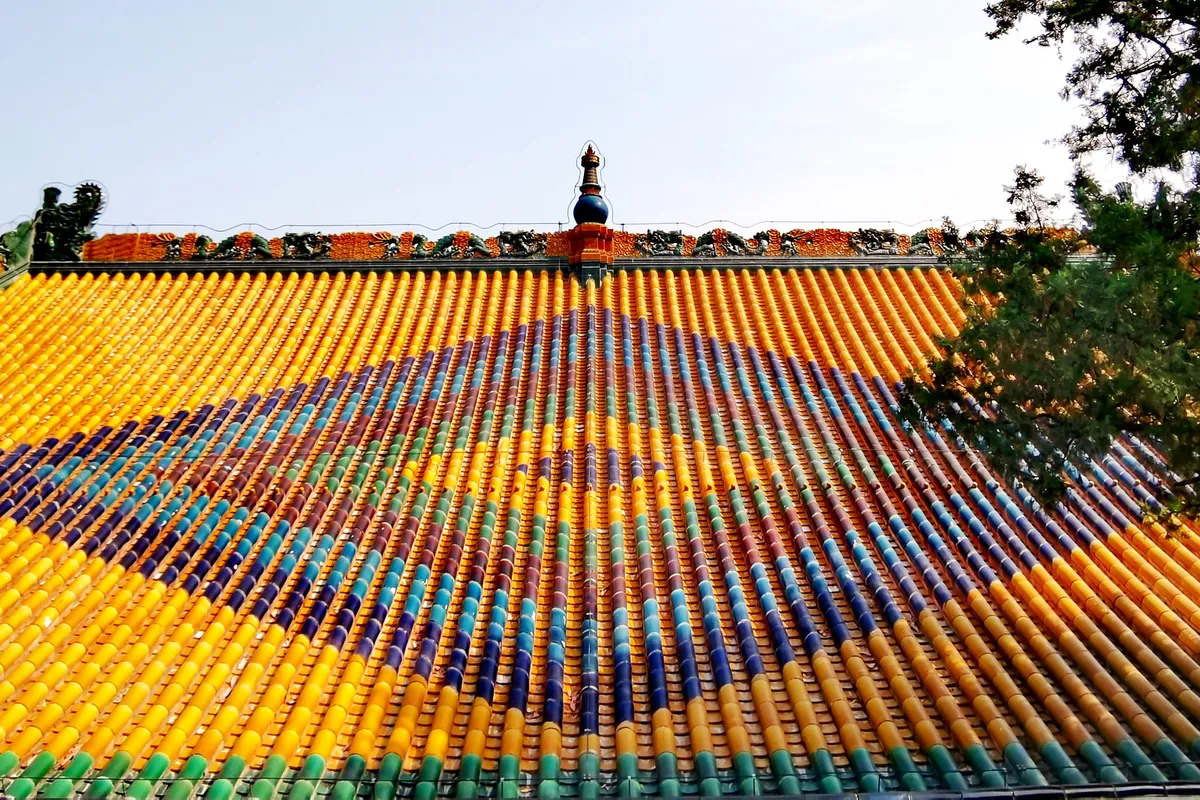
The hall’s golden glazed tile roof and colored decorative patterns, which in Buddhism symbolize samsara.
The jewel top at the center of the dragon ridge on the hall’s roof.
The dougong brackets and upturned eaves. Along the eaves, the ridge beasts from left to right: an immortal riding a phoenix, dragon, phoenix, lion, heavenly horse, sea horse... and glazed beasts on the hip ridge. Below the immortal is the corner beam beast decoration.
The green glazed tile ends and dripping tiles are all decorated with running dragons.
At the base of the exterior walls of Xiangshan Temple’s halls, there are beautiful and practical brick-carved ventilation holes with floral designs—admirable ancient craftsmanship.
A small scene on the south side of the hall.
On the west side of the hall, north and south, are two screen gates leading to the rear garden of Xiangshan Temple. Both sides of the gates bear stone couplets in Qianlong’s calligraphy. South gate couplet: 'As the body moves, it appears in an auspicious land; The nose constantly breathes the pure fragrance.'
North gate couplet: 'Jade bamboo fills the courtyard, beholding the Dharma image; A cloud-filled valley reveals the Chan style.'
Climbing nineteen steps, you arrive behind the Yuanling Yingxian Hall, on a high platform that is the Rear Garden of Xiangshan Temple.
The first thing you see is the 'Yanjie Kuan' (Broadening Vision) open hall. Under its east-facing eaves hangs a blue-lettered plaque 'Yanjie Kuan' written by Qianlong. On both sides, the hall connects to covered corridors. The corridors turn west and go up as climbing corridors, winding upward to connect with the highest building in the rear garden, the 'Qingxia Jiyi' Pavilion. Beneath the corridors, inner steps lead to the Shuiyue Kongming Hall.
'Yanjie Kuan' is a xieshan-style building with three bays, couplet outside: 'The heart’s seal holds subtle depth; What meets the eye delights in clarity.'
Qianlong’s inscription: 'Yanjie Kuan' (Broadening Vision).
Exquisite painted designs on the beams of Yanjie Kuan.
This is the most splendid spot in Xiangshan Temple. Directly ahead is the temple’s most majestic structure—the Zhanbo Xianglin Pavilion. Behind it, rockeries embrace both sides, and outer corridors encircle the mountain.
The Zhanbo Xianglin Pavilion is a three-story hexagonal pavilion. On the first floor’s front eave hangs a plaque 'Zhanbo Xianglin' (Fragrant Forest), and originally it enshrined Guanyin. On the second, plaque 'Wuzhu Falun' (Non-Abiding Dharma Wheel), originally enshrining Amitayus, Ratnasambhava, and Dipankara. On the third, plaque 'Guangming Lian Jie' (Bright Lotus Realm), originally enshrining Amitabha, Medicine Buddha, Guhyasamaja, Cakrasamvara, and Yamantaka.
Plaques hung tier by tier from top to bottom on the front eaves of Zhanbo Xianglin Pavilion, all in Qianlong’s calligraphy.
Side view of Zhanbo Xianglin Pavilion.
The forty-six-bay climbing corridor in the rear garden going up; beneath it on the inner side is a stairway path.
Interior paintings in the climbing corridor.
Exterior paintings on the corridor.
Layout of the rear garden buildings, from bottom to top: Zhanbo Xianglin Pavilion, Shuiyue Kongming Hall, Qingxia Jiyi Pavilion.
Between the pavilions is the Shuiyue Kongming Hall (Water-Moon Clear Void Hall), where Emperor Qianlong once enjoyed tea and rest.
The Qingxia Jiyi Pavilion stands at the highest point of the rear garden, a double-eaved xieshan building with three bays. On the lower level hangs a plaque 'Qingxia Jiyi' (Azure Mist Detached Retreat); inside, it enshrined five zixiang incense-molded Buddhas and three bronze Buddhas. On the upper level hangs the plaque 'Jiufeng Yongyong' (Vulture Peak’ Surging Clouds). From here, leaning on the rail, the entire capital city spreads before your eyes.
Plaques in Qianlong’s calligraphy hung from top to bottom on the front eaves of Qingxia Jiyi Pavilion.
Exquisite interior paintings on the corridor of Qingxia Jiyi Pavilion.
Auspicious paintings on the beams of Qingxia Jiyi Pavilion.
Leaning on the rail in front of Qingxia Jiyi Pavilion, the capital city stretches out in full view.
The forty-six-bay climbing corridor going down from the rear garden.
Strolling through the Xiangshan Temple scenic area, along the ancient flagstone path and stone steps, ascending from Maimai Street, one by one the mountain-hugging temple structures—the First Visit to the Western Hills paifang, Zhile Hao, Xiangyun Ruzuo paifang, Jieyin Buddha Hall, Heavenly Kings Hall, mandalas, Yong’an paifang, stone screen, Yuanling Yingxian Hall, Yanjie Kuan, Zhanbo Xianglin Pavilion, Shuiyue Kongming Hall, Qingxia Jiyi Pavilion, and the circling corridors—unfold like an ancient scroll painting before one’s eyes. The seamless fusion of imperial temple architecture with the beautiful natural surroundings is breathtaking, leaving visitors spellbound and longing to stay.


