Midsummer Romance – 2017 Central Europe Trip 7: Love at First Sight! Budapest, the Pearl of the Danube and Twin City
Again lost in a daze, crossing the border without any awareness. As soon as we entered Hungary, known as Europe's granary, the scenery by the roadside instantly changed! Golden wheat fields everywhere, shimmering golden waves of wheat, as beautiful as a painting, beyond words...
According to the tour guide, most of Hungary's territory is a great plain below 200 meters above sea level, a landlocked country with fertile soil, rich in various agricultural and livestock products, 80% for export. The nomadic heritage runs deep. It is said that here you can deeply feel the passionate, unrestrained, and bold nature of the Hungarian people. I kept hoping to see some Gypsies, but never spotted any, even though our Hungarian driver kept warning us to be careful of them.
Actually, I know very little about Hungary. Now that I think about it, the closest associations are Liszt's *Hungarian Rhapsodies* and Brahms's *Hungarian Dances*, and my favorite *Csárdás* which is said to originate from Hungarian folk dance music... And I could recite the name Budapest because of the actor Chen Peisi (whose brother is named Chen Buda)... (Embarrassed face)
Budapest is split by the S-shaped Danube River into two cities, truly a twin city. Buda on the west bank is built on hills, home to the famous Fisherman's Bastion and other ancient buildings; Pest on the east bank is flat, housing the Parliament Building, Palace of Arts, many grand hotels, and also the new political, financial, cultural, and educational center.
I came to Budapest without much expectation, but surprisingly, I fell in love with it from the first sight.
Budapest Keleti Railway Station (Eastern Station), where international trains mainly arrive and depart. (There are also Nyugati Station (Western Station) closer to the city center, and Deli Station (Southern Station) in Buda on the west bank.)
Everywhere we went in various cities, we saw dogs. Europeans consider them family members. There are special trash bins for dog waste on the streets, and dog-friendly drinking fountains next to human ones...
On a tour bus, we crossed the most famous of the nine bridges connecting the twin cities: the Széchenyi Chain Bridge, arriving at Buda on the west bank of the Danube. The majestic lions at the bridgeheads are like the business card of this chain bridge, which is the oldest and most beautiful bridge in Budapest. It is said that when night falls, the lights on the long bridge chain sparkle like a necklace of dazzling gems, adorning the beautiful Budapest and the quietly flowing Danube.
Near the Chain Bridge, you can see the old Sikló funicular built in 1870. It takes less than 10 minutes to reach the top of the hill where Buda Castle is located.
Finally it was our turn. We boarded a sightseeing boat and cruised on the Danube, which gradually turned from blue-green to golden in the twilight.
Elisabeth Bridge, commemorating Empress Elisabeth (Sissi). Hungarians truly loved her.
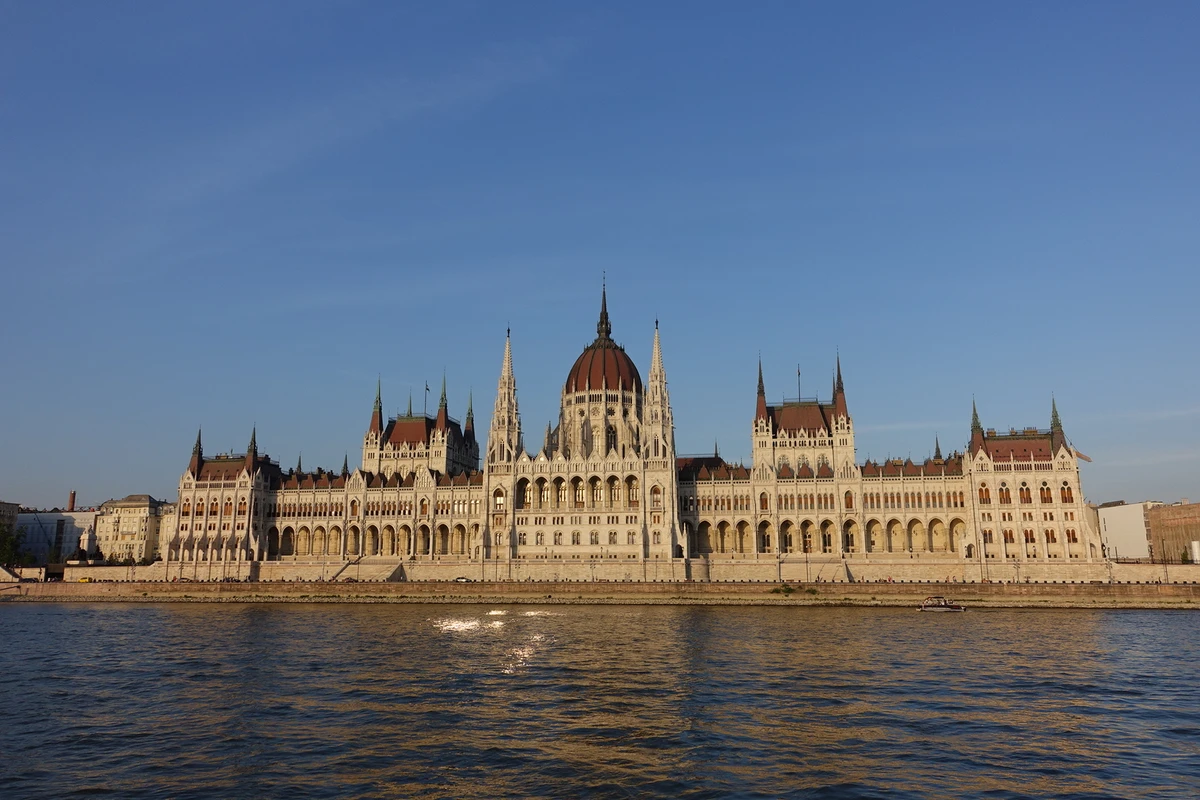
The Gothic-style Hungarian Parliament Building is not only a landmark of Budapest but also an absolute beauty. As we sailed by, we couldn't take our eyes off it. It is said that it took 8 years to build, completed in 1904, using 400,000 bricks, 1 million precious stones, and 40 kg of gold. The interior is also equipped with modern electrical appliances, extremely luxurious.
This Hungarian Liberty Statue stands on Gellért Hill on the Buda side, one of the symbols of Budapest. It was created in 1947 by the famous Hungarian sculptor Kisfaludi Strobl Zsigmond, originally commemorating the Soviet Red Army soldiers who sacrificed their lives for the liberation of Budapest. It was originally called the "Liberation Monument." Later, due to various conflicts between the two countries, deep grievances and hostility brewed, and this statue, even after a name change, was nearly destroyed several times...
Let me specially mention our hotel, Buddha Bar Hotel (also with chains in Paris and Prague). This very beautiful neo-Baroque building is called Klotild Palace. In stark contrast to the classical elegance outside, the interior of the hotel is completely red, very festive (suitable for honeymoon trips). Occasionally there are gold dragon motifs, which the designer interprets as Asian style. I find it a bit garish and can't appreciate it... However, the hotel facilities are standard, and the location is great. It's less than a 10-minute walk to the Elisabeth Bridge on the Danube.
When we went out early in the morning, the weather suddenly changed. I really hoped for a heavy rain, as this low-pressure stuffy weather was more unpleasant, but it didn't happen... Fortunately, this is Budapest, a place I cannot help but love. We took a bus again to Buda Castle District on the other side of the Danube, this time climbing to the top to appreciate it up close.
The neo-Gothic Matthias Church, standing on the hill, is an omnipresent backdrop in Budapest. It was originally built in 1269 by King Béla IV. Later in the 15th century, King Matthias added a spire bell tower and renamed it Matthias Church. Because the coronation ceremonies of Hungarian kings were held here, it is also called the "Coronation Church."
I really love the beautiful glass vault of the church, the bright mosaic patterns that still look stylish today and have a strong ethnic flavor. On the rightmost spire in the photo, you can see a statue of a small crow holding a gold ring in its beak. Legend says that a magical crow once snatched a poisonous ring, saving King Matthias's life, and since then the crow has become a symbol of good luck in Hungary. It's a pity we couldn't enter this beautiful church...
In the square in front of the church, a photography team was shooting an advertisement for Ferrari.
On the other side of the church is the Trinity Column commemorating the Black Death in medieval Europe.
I quickly snapped this photo of the Fisherman's Bastion when no one was around. It could serve as a perfect model for a sandcastle on the beach, exactly like the castles of little elves in fairy tales. Unfortunately, we didn't have more time to enjoy it slowly...
On Buda Castle Hill, there are also many residential houses, and along the streets are the usual cafes, small restaurants, handicraft shops, etc.
This is the former Sándor Palace, now used as the Presidential Office. We hurried to catch the end of the hourly changing of the guard ceremony. (Actually, the ceremony is quite simple, not as solemn as in other countries.)
On a pillar next to Buda Castle, there is a statue of an eagle with its claws gripping a sword, about to spread its wings and fly. It was built in 1896 to commemorate the millennium of the founding of Hungary. This sacred eagle in the hearts of Hungarians is called "Turul," and it is said to have led the Hungarians to this rich and beautiful land...
The World Heritage symbol roughly means that since 1987, the Danube riverside scenery within sight and the castle cluster behind have been designated as World Heritage.
Looking over at Pest, the Chain Bridge and the Parliament Building are most eye-catching, with the Danube flowing silently...
Looking over at Pest, it's easy to see many tower cranes working. This ancient city, having experienced many hardships, is still full of potential and vitality...
Buda Castle was first built in the 13th century. After many vicissitudes, the current castle was rebuilt after the war. It was once the residence of Empress Elisabeth (Sissi), who loved Hungary. Now it houses the Hungarian National Museum, National Library, and Art Museum. The statue in the square is of Prince Eugene of Savoy, the military commander who liberated Buda in 1686.
I really like a group of exquisite statues called "King Matthias Hunting." The king, dressed in hunting attire with a full catch, stands proudly at the top. His loyal hunting dogs are vividly sculpted.
Returning to Pest, we went straight to the Parliament Building, but we still couldn't enter. What a pity.
I especially like these little guardian beast sculptures. At first I thought they were thin little lions. When I zoomed in, almost none of them had the same expression! For example, the one on the left in the photo, though tightly gripping a small javelin, couldn't help yawning out of boredom...
On the bank not far from the Parliament Building, there are sixty pairs of iron shoes, some even mismatched. This is the "Holocaust Memorial Sculpture" created in 2004 by Hungarian sculptor Gyula Pauer. On the ground nearby are three iron plaques with inscriptions in English, Hungarian, and Hebrew: "In memory of the victims who were shot and thrown into the Danube by Arrow Cross militiamen in 1944-1945." On the night of October 15, 1944, fascist Arrow Cross militiamen rounded up large numbers of Jews on the Danube bank and shot them. They threw the bodies into the river but left the shoes, because the executioners needed to sell the shoes for money... According to statistics, between 1944 and 1945, about 600,000 Jews were killed in Hungary, accounting for 70% of Hungary's Jewish population. Even in the 21st century, there are still anti-Semitic far-right radicals trying to reverse history and damage these sculptures.
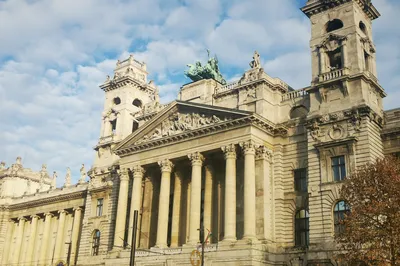
Passing by the Museum of Contemporary Art near Heroes' Square, its English name is "Budapest Hall of Art or Palace of Art," distinct from the Hungarian National Gallery opposite it. It is said that both museums have rich collections and the buildings themselves are listed as World Heritage, very worth visiting.
Heroes' Square is located in the central area of Pest. The square is paved with blue and white tiles in a striking pattern. In the middle of the square stands the Millennium Monument, built in 1896 to commemorate the 1000th anniversary of the Magyar conquest of the Carpathian Basin. There are several statues on the square, representing the leaders of the seven tribes that founded Hungary in the 9th century and other famous Hungarian historical figures.
To understand a city, there is no better way than exploring the local market. Budapest Central Market was built in 1896, over a hundred years old. It is the largest indoor market in Hungary.
As soon as we entered the clean and tidy market, we regretted eating too much lunch. We wanted to try everything.
Hung with bright red chili peppers! This should be the heavy spice brought by the Turks after the 16th-century Turkish occupation. It is said that there is a combination of putting a dried chili in coffee. I guess even us spice-loving Sichuanese wouldn't understand...
Since the Austro-Hungarian Empire, Hungarian foie gras export has been a major item in foreign trade. It is said that the famous French foie gras and the foie gras from Italy and Austria mostly come from Hungary. The REX CIBORUM brand foie gras (logo with a small crown) in the photo is one of Hungary's national treasures.
Looking back at Budapest, let the beautiful scenery be fixed in my heart. The romantic Central Europe trip is over. I look forward to seeing it again...