A Couple Quit Their Jobs to Travel the World: 4 Months Across Europe (Nordic Chapter)
PS: This is a repost of a story from 2016.
I woke up and gradually realized I was lying on a dirty, narrow single bed in a cheap hotel in Yau Ma Tei. A strange, disorienting feeling filled my mind. I wasn't sure where I had been or what I had done in the past few months. It felt like none of it had really happened, as if I had just woken from an incredibly long dream. In that dream, we spent four months crossing all of Europe, seeing countless beautiful sights, and experiencing an endless array of thrilling, adventurous, embarrassing, frustrating, exhausting, and exhilarating stories...
It was only after returning home and facing the thousands of photos on my hard drive that I began to believe it had all truly happened. At the start of the trip, I thought about not writing a travelogue about this journey. On one hand, I had traveled quite a bit since quitting my job, and writing about every trip seemed like an enormous project that made me feel weak just thinking about it. On the other hand, I felt that travel means different things to different people. Sometimes it's better to keep it as a beautiful private memory. Years from now, when I'm old, I could tell my grandchildren about the adventures I had when I was young and spirited. That would be a comfortable and pleasant thing. So after returning, I did nothing. But scenes from weeks and months ago kept flashing through my mind. From time to time, we would ask each other, 'Remember that?' and chat a bit about it, talking about what was the best and what we regretted. In these spontaneous conversations, I gradually realized that if I didn't record it, someday I might forget those thrilling stories. I would forget standing on the edge of the breathtaking Pulpit Rock in Norway overlooking the fjord, forget watching the sunrise at the seaside after walking through the limestone alleys of Vieste in the morning filled with enchanting scents, forget the leisurely feeling on the peak of Hydra, forget picking up garbage at the train station in Bari, forget wandering the streets of Bergen surviving on cheap bread, and forget that the worst pizza was actually in Italy. Worse still, I would forget why I set out in the first place and doubt the meaning of this journey in my youth. After thinking it over for two days, I felt this was terrible. I had to try to write it down! So that when I get old and senile, I can still take out these words and show them to her...
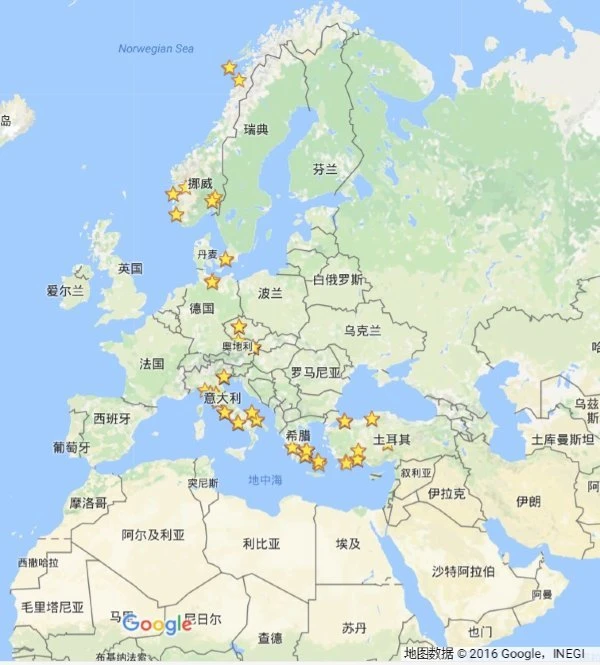
A total of 36 stops (overnight stays count as one stop; non-overnight stops are not counted but will be mentioned in the main text). They passed through eight countries: Norway, Denmark, Germany, Czech Republic, Austria, Italy, Greece, and Turkey. It took nearly four months, from summer to winter, with temperatures ranging from around 35°C to as low as -3 to -5°C. Along the way, they used every mode of transportation: planes, ships, trains, and buses countless times. For accommodation, they combined the cheapest hostels, Airbnb apartments, and free Couchsurfing. They also slept on trains and ferries.
(Our group photos at each stop. Since we didn't deliberately take them, we used solo photos where there were no group shots, and if there were no selfies, we used local scenery photos.)
Stop 1: Oslo, Norway
Stop 2: Bodø
Stop 3: Lofoten Islands – Reine
Stop 4: Lofoten Islands – Å i Lofoten
Stop 5: Bergen
Stop 6: Flåm
Stop 7: Stavanger
Stop 8: Copenhagen, Denmark
Stop 9: Lübeck and Bad Segeberg, Germany
Stop 10: Prague, Czech Republic
Stop 11: Český Krumlov, Czech Republic
Stop 12: Vienna, Austria
Stop 13: Venice, Italy
Stop 14: Cinque Terre – Riomaggiore, Italy
Stop 15: Cinque Terre – Manarola, Italy
Stop 16: Cinque Terre – Vernazza, Italy
Stop 17: Lucca, Italy
Stop 18: Siena
Stop 19: Montalcino / San Gimignano
Stop 20: Florence, Italy
Stop 21: Rome, Italy
Stop 22: Naples (and Mount Vesuvius), Italy
Stop 23: Vieste, Italy
Stop 24: Bari / Mediterranean Ferry
Stop 25: Athens, Greece
Stop 26: Hydra, Greece
Stop 27: Piraeus (Ferry)
Stop 28: Ios
Stop 29: Santorini – Fira
Stop 30: Santorini – Oia
Stop 31: Istanbul, Turkey
Stop 32: Fethiye
Stop 33: Antalya
Stop 34: Eğirdir
Stop 35: Cappadocia
Stop 36: Safranbolu
I am certain that one day in November 2015, I felt extremely frustrated in a company meeting room. I had felt, more than once, that I was wasting my life. I felt I needed to do something to make me feel that I truly existed and was experiencing this world, so that every minute would be valuable and every second not superfluous. Then for a few nights, as I lay in bed listening to music, I began to daydream. I imagined myself lying in a train car crossing Siberia, or hiking on a desolate mountain slope. How wonderful that would be. I was sure I needed a very long journey, one long enough to bore myself (isn't that thought boring?), long enough to wear me out physically and mentally, long enough to make me want to go home.
In the following period, the plan slowly took shape. First, I gradually confirmed the route, then started researching destination information. I was incredibly efficient in this regard, as evidenced by the piles of travel guides and hundreds of saved bookmarks. It took me about half a year to search and browse English-language websites related to the destinations, evaluate the feasibility of the route, make adjustments, and refine it into an itinerary (for visa application). I also read some reference books on long-distance global travel.
The work was so extensive that I felt even if I hadn't completed an undergraduate degree, I had probably finished several semesters of coursework.
This was a task that needed to be overcome and completed. Before this, I had never been to Europe. Although my passport had visa records from a few other countries, I instinctively felt that applying for a three-month Schengen visa (the maximum for tourist visas) was a very risky move. I consulted many travel agencies online about this. I realized my application was very special; no agency seemed willing to accept my itinerary of up to three months in Schengen. Moreover, I got trapped in a vicious cycle regarding the visa type. If I applied as unemployed (having quit), the rejection rate might be high (and my hukou was from a high-risk immigration area). But if I applied as employed, I would need to provide a leave approval letter, but then there would be a reasonable doubt that no company would give such a long leave. Eventually, I decided not to use any agency but to prepare the materials meticulously according to the visa center requirements. By the time I submitted the visa application in May, each of our application materials was over a hundred pages. In the end, all efforts were worthwhile. Five days later, the Schengen visa was approved smoothly.
So the final plan was as follows: We would go from the Arctic Circle all the way south through Northern and Central Europe, across Italy, cross the Mediterranean to Greece, tour the Greek islands, reach the other side of the Mediterranean in Turkey, and finally return to the Asian side. The entire trip would last nearly four months, with 36 stops. At my urging, my wife and I both quit our jobs in May and became unemployed youth. After a few warm-up trips to other countries, we officially boarded an intercontinental flight to Scandinavia at the end of July.
Eighty-one trials and tribulations, starting from day one.
When I had the strange thought that our trip was like a 'Journey to the West' and I joked that we were destined to go through 81 trials, we had already been abroad for three months. Looking back, I realize that the 81 trials started from the very first day. When we departed from Hong Kong, a typhoon was making landfall. All flights that day were canceled, and many were delayed. Fortunately, our flight date was just one day away from the typhoon's landing, so we barely missed it. However, Russian Airlines' online check-in was already closed, and neither the domestic airline customer service nor Ctrip could confirm if our flight would proceed. My biggest worry was that passengers who had been rebooked earlier might take up our seats, causing us to be rescheduled as well. We arrived at the airport hours early to check in. It was a false alarm. Once on the plane, we immediately encountered a delay during the Moscow transfer. We had less than half an hour. Sleepy-eyed, we got off the plane and started a desperate sprint through Moscow airport. When we reached the gate, we swapped? No, we frantically ran to another gate, drenched in sweat. What? Closed!? The plane had left!? We grabbed a ground staff member for help. The female staff member coldly pointed to her watch, indicating it was only 1:00 and boarding time hadn't started. I was confused, pulled out my phone, and asked her, 'Isn't it 2:00?' The female staff member confirmed again firmly. I suddenly realized something, but I didn't really understand. Was it daylight saving time? Winter time? As a Chinese person, I just can't keep track. At least on my phone, Moscow is in UTC+3. I had carefully adjusted the time zone on the plane. Was my phone lying to me? What the hell?
First Stop Oslo: Comfortable Beyond Comfort
The plane arrived in Oslo at 9 PM, but it was still bright outside, though the sky was overcast. The midnight sun further disrupted our already chaotic biological clocks. Oslo's airport used a lot of wood materials, pure Nordic design, creating a strangely cozy atmosphere after the long flight. With a nervous heart, I entered the Nordic region, knowing that even with a visa, entry is not guaranteed. For a Nordic country like Norway, I had no experience with border control. There was a Korean tour group ahead of us, and the immigration officer let them through quickly. I intentionally let my wife go first. Sure enough, when it was our turn, the officer started asking all sorts of questions. My wife couldn't handle it, so I had to step forward and indicate we were together. It wasn't easy to explain in a few words, so I immediately reached into my backpack and presented the English itinerary. Seeing this, the officer was satisfied and asked if I wrote it (obviously, if I said someone else wrote it, I could go home). Then he complimented me with 'impressive' (good, from then on, it shouldn't be too difficult). Next, he asked what my job was. Advertising. Why such a long vacation? Uh, I quit. What do you plan to do when you return? Find a new job. Will it be difficult to find a job? I don't think so, because I have a good education. Have a nice trip. Stamp! Cleared for entry.
Norway, with its long, narrow territory, has only about five million people. Even in the capital Oslo, the population is very sparse. By Chinese standards, it's just a small county town—a rather small one... We slept for five hours and got up, eager to breathe the fresh air of the first Scandinavian capital city.
As we walked the streets of Oslo, a strange thought quickly occurred to us: Where is everyone? Indeed, there were very few cars on the streets, traffic lights seemed like decorations, shops were so quiet they looked like they were about to close, restaurants weren't open, and it was hard to tell where the bustling city center was because there were no people anywhere. Later we found out that while Norway's population is indeed very sparse, we had simply gotten up too early. Nordic cities generally don't come alive until the afternoon. Restaurants don't open until after 12 PM, and the busiest time is during dinner. I don't know if it's Norway's unique high-latitude geography that dictates this business schedule, but I'm sure that even if Norwegians only sleep in because of the midnight sun and polar nights, they should be among the top in the 'most comfortable people in the world' ranking. Honestly, on my first day in Oslo, I suddenly understood why the world's economic engine is in China. I quickly came to a startling conclusion: The Norwegian people (or perhaps European people?) are too comfortable and know how to enjoy life too much. It seems there is no such thing as 'going to work.' Leisure (not the economy) is the top priority for the people and society. Leisure is the real deal. Let economic development go to hell?
This is absolutely true. As you walk through the city, you can feel this relaxed, leisurely atmosphere from every detail. For example, today is a weekday, but you don't see the hustle and bustle of office workers. Dads are out pushing strollers (yes, I know you enjoy as long a paternity leave as your wife, longer than my trip). Young people are sitting at roadside cafes drinking and chatting (off work at 3 PM?). Passersby are lying on the grass in the park reading. Here, if you can sit, you don't stand; if you can lie down, you don't sit upright. Even the chairs on the street are designed for lounging. And even the trees in the park are 'lying down'! Let me remind you again: today is a WEEKDAY! Is this what a weekday should look like... It's too much... Thinking this, I instinctively found a bench in the park and lay down for a nap. The sun at noon was warm on my face, so comfortable it almost melted me... Too comfortable... This is so unfair to people from Singapore, China, South Korea, Japan... zzz
Donald Duck is an iconic cartoon character in Norway and the Nordic region. It's so popular that if you visit a Nordic home, there's a good chance you'll find a well-worn Donald Duck comic in the bathroom. I'm also a Donald Duck fan. Every time I see these books, I can't put them down. Unfortunately, they're in Norwegian or Danish, so I can't read them. Even if I could, I wouldn't buy them because they're incredibly expensive.
At the end of July, we saw the 'eighth' Harry Potter book released in Norway.
This was our means of survival: yogurt with bread or crackers. This combination was the cheapest meal in Norway and what we ate the most. Yogurt is rich in protein and fat, bread or crackers provide starch—the three essential nutrients. Eating this long-term at least keeps you full and healthy. As shown, we started eating at the airport.
The airport bookstore was full of Lonely Planet guides.
Stop 2: Bodø – A Livable Norwegian Small Town
If I had to describe Bodø in three words, I'd say peaceful, modern, and sparsely populated. But it's not a major tourist destination. For most travelers, unless they're heading to the Lofoten Islands, they probably wouldn't come to Bodø—a modern little Norwegian town within the Arctic Circle that serves as a convenient transit point. Transportation in Norway is extremely expensive. A bus ride typically costs 30-40 yuan per person. For us, taking a bus together was like taking a taxi several times in China, so we couldn't afford it. After arriving at Bodø Airport, we decided to walk to our destination. Outside the airport was a beautiful, quiet residential area. Roads were lined with wooden houses, reflecting Norway's high living standards. It left us in awe. Near the harbor, there were still very few people. Walking through Bodø's commercial district and streets, it felt strange: although the buildings were highly modern, as if symbolizing past prosperity, it seemed the workers had all disappeared after construction, leaving the place like a prosperous ghost town. This made me wonder: maybe Norway has so little sunlight that during July and August, the rare short summer, all Norwegians go on vacation?
Without money for transportation, we had to expend more energy hiking with our luggage (we would soon discover that bringing a suitcase was a mistake). Although we often felt exhausted, it was my favorite way to deeply observe and experience the local culture.
Stop 3: Lofoten Islands (Reine) – Into the Arctic Circle
The Lofoten Islands are a tentacle along Norway's fragmented coastline within the Arctic Circle. Ever since I first heard the name, it had been a dream destination, and I made it a must-visit on this European trip. Getting to the Lofoten Islands is not easy. After arriving in Oslo, you can take a train or plane to Bodø, then a boat to the islands, or you can reach them via land or small aircraft from where the archipelago connects to the mainland. Whichever way, it's expensive. But that wouldn't stop us from visiting the Lofoten Islands. My motto is: the more difficult and remote a place is to reach, the more worth visiting. In my opinion, if natural scenery is the standard, Norway is the most beautiful country in the world, and the Lofoten Islands boast Norway's most magnificent natural landscapes. Just looking at the fragmented geography of the islands on a map made me deeply fall in love with this treasure land.
The picture shows us waiting for the ferry. The terminal was very inconspicuous, located in a remote suburb (well, everywhere here looks like a suburb). We dragged our suitcases around for a long time and couldn't be sure. There were no signs at the terminal, and there wasn't even a restaurant nearby (unbelievable!). We were confused until the last moment when we finally figured out which boat to board. During the wait, we met an American high school student who could speak Chinese. He approached us and started chatting (his American friend who couldn't speak Mandarin looked quite annoyed that he was speaking Chinese...). PS: This was the only time we encountered a foreigner who could speak Chinese on the entire trip. He was on a gap year, traveling along the Norwegian coast by cruise ship (rich guy, because Norwegian cruise ships are extremely expensive...).
We bought tickets on board. The first deck was for cars, and the upper deck was for passengers.
Gloomy weather, biting wind, and occasional drizzle—that's typical Norwegian weather. But another characteristic is that it can suddenly clear up and give way to blue skies. That was the biggest surprise in Norway.
Distant mountains surrounded by clouds and mist.
As I said, after a three-hour boat ride, the sky cleared up when we arrived at Moskenes on the Lofoten Islands.
We waited for the bus at an inconspicuous spot. This so-called 'bus' was actually a long-distance coach that spanned the entire Lofoten Islands. Although we only rode one stop to Reine, the fare was still outrageously expensive—about 50 NOK per person, roughly 40 yuan. Payment was by credit card, which was also a Norwegian feature.
When we arrived in Reine, I was stunned. I admit it's the most beautiful place I've ever seen. Words cannot describe it. Even though I had been traveling all day and it was 9 PM, I couldn't wait to drop my luggage and go out to take photos.
Reine is a fishing village on the islands, peaceful and beautiful. There weren't many tourists (and if there were, the village couldn't accommodate many). In fact, the village is so small that it probably doesn't exceed 500 meters in radius. There aren't many residents or houses either. There are only two restaurants (including one that is also a convenience store, souvenir shop, and fast food joint...), plus a bus stop and a few benches. Aside from that, there are no other public facilities. The homestay we booked was just a white three-story wooden house next to the 'bus station,' a 30-second walk away.
The red-painted, sheet-metal-and-wood houses are characteristic of the islands, traditionally used as fishermen's homes.
I pride myself on having photographed countless sunsets, but this was the latest sunset I've ever captured. Since we were within the Arctic Circle, I took this sunset photo at past 9 PM. Later, I asked our host how long it stays dark here now. He told me the sun sets for only two or three hours, and then it rises again soon (i.e., in the early morning). Moreover, even after sunset, the sky doesn't get completely dark.
At first, I didn't understand what these wooden frames were for. Over the next few days, I quickly realized they were used by local fishermen to dry fish.
The homestay was clean, tidy, warm, and cozy. The house was entirely wooden, with four or five rooms. The host lived with us, sharing the bathroom and living room. From this small fishing village house, we could see the high living standards of a highly developed country like Norway. By Chinese standards, this is a remote small village, which proves the saying: a truly developed country is not judged by how modern its cities are, but by how modern its rural towns are.
We planned to stay in the Lofoten Islands for a week. The next morning, we intended to hike near Reine.
The scenery in Lofoten almost made us cry with its beauty. Almost every few steps, we saw scenes that we thought only appeared on postcards. It immediately lifted our spirits. As shown, Xiao Tao was very excited.
Our goal was to climb Reine Mountain. Hiking is definitely one of the great pleasures of Lofoten. As nature and outdoor enthusiasts like Norwegians, we couldn't miss it. At the entrance of an inconspicuous uphill path, we saw a prominent English warning sign. It basically said the trail was very dangerous and local guides no longer recommended climbing. Anyone continuing up would be responsible for their own safety. 'Those who know the risks still take the path'—I didn't say much to Xiao Tao. I thought that although we didn't have any gear, we should at least go in and check. If it didn't work out, we could come back. Besides, I had heard before leaving that many people had climbed this mountain, so it shouldn't be a problem. And given Norwegians' typical boldness, this mountain was nothing to them.
Norway indeed has no shortage of steep peaks, and the Lofoten Islands are no exception. This seemingly unremarkable little mountain turned out to be quite steep. Some sections were indeed very dangerous, requiring hands and feet to scramble over. If it rained, it would be slippery, and I'm sure someone must have fallen, hence the warning sign at the foot. Unfortunately, the weather didn't cooperate that day. It started raining halfway up. Luckily, we were wearing our shell jackets and softshell pants. After discussing with my wife, we decided to continue climbing.
From the mountain, you can see the winding island road.
The actual situation was steeper than the photo shows. In the rain, we had to use our hands and feet, and soon we were covered in mud. If we weren't on a long trip and couldn't bring much gear, I would definitely recommend carrying hiking poles.
When we reached the top, the wind was howling, and my wife lost interest. But the view from the summit was truly spectacular. Standing on the precipice, we could see the entire village of Reine below. It was exhilarating. (Too bad the weather was bad; the photos would have been even more beautiful.)
In the following days in Lofoten, we hiked to other fishing villages on the islands. I think Hamnøy is the most beautiful place. The scenery along the way was also stunning.
Eating a meal on the island was a real challenge. It was either burgers, burgers, or more burgers. Or maybe a sandwich or French fries. The fish burger in Reine was pretty good. But with high prices, if you didn't want a burger (around 10-20 yuan), you'd have to spend over a hundred per person at a restaurant (of course, the main dish still involved bread, which was frustrating).
Stop 4: Lofoten Islands – Å: Solitude at the End of the World
Calling it 'Å village' isn't quite accurate. In Norwegian, the village's name is the letter 'A' with a small circle over it, pronounced 'oh.' 'Å' village is at the very tip of the fragmented chain of Lofoten Islands. It's also a traditional fishing village. Even when tourists visit, they usually come on day trips. Even in the peak summer season, we didn't see many tourists. Hiking on the sparsely populated hills near Å, watching clouds drift by, listening to the wind of nature and the echo of our hearts—that's what we loved about Å. (Sometimes we saw European travelers camping in the wilderness.)
Stop 5: Bergen: Encountering Shitty Weather and Shitty Luck
If anyone says Bergen is the most vibrant city in this gloomy and subdued country, no one would argue. Indeed, Bergen is world-famous and one of the most popular destinations in the eyes of tourists from all over Norway and Europe. It is the gateway to Norway's iconic fjords, where busloads of tourists come to take photos. Yes, strictly speaking, I mean Bryggen and Vågen harbor in Bergen. Bryggen's iconic wooden houses—the rows of colorful triangular-roofed buildings by the harbor—are a UNESCO World Heritage site. But I never really felt its charm. As far as I could see, it's now essentially a collection of tourist souvenir shops and expensive restaurants. Even so, we were extremely excited when we first arrived (the bustling Vågen fish market and our growling stomachs). Folks, imagine our mood: this was a dream destination for many travelers longing for Norway, and we were finally standing in a postcard!!!!
As mentioned, by the time we arrived, we were starving. During our entire stay in Lofoten, we lived on a 50-gram Snickers bar costing over 10 RMB to fill our hungry stomachs due to lack of food (lack of food? Of course, because it was too expensive to eat). When we reached the fish market, we started drooling. We looked at one stall after another but found none cheap. Maybe they really had high-end deep-sea seafood, because I saw huge crabs, huge scallops (my favorite), huge salmon (Norwegian salmon is famous), and huge mussels—well, I admit mussels are common seafood in Fuzhou, but in Bergen, a plate of mussels cost 100 RMB. I saw a group of foreign tourists greedily eating mussels at the harbor. Ha, they're so easily impressed!
At the fish market, I asked the boss, 'How much for a crab leg?' The fish market girl, seeing a poor Asian tourist, tactfully told me one crab leg cost about 100-200 NOK (since it's sold by weight). Over a hundred for a single crab leg? Huh?
Due to extreme hunger and my great love for scallops, I excitedly spent 100 NOK on a plate of scallops—well, actually just four on a skewer. They were huge, but I felt the fish market's cooking skills needed improvement...
After eating the scallops, I realized I wasn't full at all. So I spent another 200+ NOK on a main meal—which was actually takeout. I asked the clerk why there were two prices on the menu. The clerk told me one was for dining in, the other for takeout. Jeez, Norway is always like this. Whether in restaurants or McDonald's or Burger King, if you choose to eat in, you have to pay extra. As long-term budget travelers, we naturally tried to save wherever possible. The money saved could buy us a lunch in China.
Well, I admit we spent over 200 on takeout and ate miserably at the windy harbor. The appearance was quite different from the display in the shop... After finishing, we felt cheated. This only strengthened our resolve to survive on McDonald's discounted burgers from then on (a double cheeseburger cost about 20+ RMB. In the end, this was the phrase I used most often in restaurants, whether in Norway, Austria, Germany, or Italy: 'Hi, I'd like one double cheeseburger.')
Bergen's specialty painting store, filled with all kinds of brushes, paint, and paper.
Mount Fløyen is a popular weekend hiking spot for Bergen residents. As hiking enthusiasts, we couldn't miss it. Unfortunately, those two days, the weather in Bergen was foggy, dampening our enthusiasm for taking photos at the top. The cable car to the mountain is not far from Vågen harbor. A round trip cost about 90 RMB, so we bought one-way tickets and planned to walk down.
I randomly snapped a photo. Norwegians have great sense of the camera...
Mount Fløyen is one of the famous attractions in Bergen and Norway.
The cold, damp weather couldn't stop Bergen residents from exercising on the mountain.
What shitty weather. I had expected a spectacular view of Bergen harbor from the observation deck at the top, but all I saw was a thick, white fog. The whole mountain was clearly shrouded. That day, Mount Fløyen was definitely not as beautiful as the official tourism website promoted. It was raining intermittently, and the ground was extremely slippery. In an unfortunate moment, I slipped on a stone and fell into a mud puddle! Damn... Lying in the puddle, I felt dazed. Luckily, I was wearing my softshell jacket, or I would have frozen to death on the way back to the hostel.
Fortunately, I wasn't injured, but this fall and the continuous rain really dampened our mood for further hiking. As we descended, the thick fog gradually lifted, and we caught a panoramic view of Vågen harbor from halfway up the mountain. Well, at least it made up for some disappointment. The following days saw better weather, but we never went back up. Probably because we thought the cable car was too expensive, and hiking up was too tiring: ) That said, on the way down, we saw some beautiful Norwegian wooden houses built halfway up the mountain. It made me think how wonderful it would be to live here, opening the window every day to overlook the beautiful Bergen scenery. How can Norwegians be so happy...
Stop 6: Flåm: A World-Class Village Deep in the Fjords
If Bergen is just the gateway to Norway's fjords, then Flåm is the heart of Norway's world-class fjords. It lies at the end of the famous Sognefjord. This small village of fewer than 800 inhabitants welcomes over half a million tourists from around the world every year. Several giant luxury cruise ships carrying thousands of passengers visit daily.
The ship was remarkable, boasting the newest design for fjord sightseeing. Its zigzag shape was avant-garde, offering more deck space for passengers to get close to the fjord. But the price was much higher than ordinary sightseeing boats! We boarded at Gudvangen and sailed through the Nærøyfjord—a UNESCO World Heritage site—all the way to Flåm.
However, once night fell and the day-trippers left, Flåm returned to its original appearance as a quiet village deep in the fjord. So it's essential to stay overnight in Flåm to experience the essence of the fjord. Of course, as everyone knows, Flåm is a very small village. The number of accommodation options is not proportional to its widespread fame. To find an affordable place here, you need to book early (six months in advance is not too soon. If you only have three months, you might end up sleeping on the street). Flåm Youth Hostel is hailed as the best youth hostel in Norway and the second most popular in the world. Compared to the local accommodation that often costs over 1,000 or 2,000 a night, the double room here at just over 500 for two people is very budget-friendly. Plus, there are free lounges and a kitchen. It's undoubtedly the best choice for backpackers on a budget. The shared bathroom is on the first floor. When checking in, the front desk gives you some coins (one per person per day), and each coin gets you 5 minutes of hot water (completely acceptable considering the price). We stayed in Flåm for three days and were satisfied with everything.
Thanks to the kitchen, we finally had our first semi-Chinese meal in Europe after half a month. It was simple, but we were so grateful... (The fried rice almost became soup rice.)
Scenery of Flåm village.
On our first day in Flåm, we went kayaking. Kayaking is undoubtedly the best way to get up close and personal with the fjord. Our guide was an Irishman.
Another day, we went hiking. On this 'Journey to the West,' we did more hiking than anything else. As the saying goes, 'Sweep every pagoda you see, climb every mountain you see,' haha...
The grass bends when the wind blows, revealing sheep and cattle... Walking along the country roads, smelling the manure, all worries disappeared into thin air, haha... Are you cattle here also carefree?
As soon as we arrived in Flåm, we looked for this mountain because from the top you can overlook the magnificent view of the end of the fjord. The weather was clear that day, perfect for hiking. It took us about an hour to reach the top. We explored various photo spots and took the following pictures.
The Flåm Railway is considered one of the most beautiful train rides in the world. If you search for 'most beautiful railways in the world,' this one will definitely appear. But I suspect its fame in China far exceeds its global average. Because a few days later, when we left Flåm and boarded this train, I noticed about a third of the passengers were East Asian faces, and I don't think they were Korean or Japanese.
Based on my personal experience, I think the Norwegian Tourism Board oversells it. The Flåm Railway is famous for the difficulty of its construction and its steep gradient. But the scenery along the way, in my opinion, is quite average. Plus, the journey is very short, and more than half of it is through dark tunnels. I don't particularly recommend the Flåm Railway. Maybe my expectations were too high?
We changed trains at Voss and continued back to Bergen. We stayed one night in Bergen before heading to our next stop, Stavanger!
A small interlude: on this train, we met a group of Taiwanese uncles and aunties. They warmly invited us to sit with them. I learned they were alumni of the Department of Chemistry at National Tsing Hua University in Taiwan, touring Northern Europe as a group. Norway was their last stop. I chatted with them about our travels in Taiwan two months earlier and praised the friendliness and warmth of the Taiwanese people.
Stop 7: Stavanger: Standing on Top of a Thousand Rocks
Compared to the world-famous Bergen, Stavanger generally does not hold a major place on Chinese travelers' Norwegian itineraries. Norway has countless fjords, and Stavanger, in the south, is not easy to reach. But in my opinion, Stavanger is the jewel of Norwegian cities. On a gloomy morning, we packed our bags, dragged our suitcases to the long-distance bus station near Bergen's train station. I also went to a nearby convenience store and bought some bread, yogurt, and hot dogs to fill our stomachs. We successfully boarded a long-distance bus to Bergen (actually Stavanger? The text says 'to Bergen' but should be 'to Stavanger'? Let me check: original says '前往卑尔根的长途大巴' but that seems a mistake; from context, they are going from Bergen to Stavanger. I'll translate it as 'to Stavanger' to match the context). Actually, the original says '搭上了前往卑尔根的长途大巴' but they are leaving Bergen, so it should be 'to Stavanger'. I'll correct to Stavanger. Started on a 5-hour long journey. Morning physical exertion made us drowsy on the bus. I had studied the map earlier. Although I knew that Bergen and Stavanger were separated by fragmented land and bays, I thought the bus would just detour on land. But when I woke up a bit, I found myself standing on the deck of a ferry, with the wind whistling in my ears—the ferry was crossing between islands, and the bus was in the vehicle hold, with all passengers going upstairs. In the following journey, the bus turned into a ferry, then the ferry turned back into a bus. I don't know how many times we transferred until we finally reached Stavanger. I thought: Norway is truly the land of fjords. Here, ferries are even more important than cars as a mode of transport!
Stavanger is actually Norway's oil hub. Because of the discovery of oil, it became the most important city in southern Norway. But in my eyes, Stavanger is a peaceful, beautiful, livable city far from the tourist crowds. To some extent, it is very similar to Bergen: both are neighbors of fjords, both have a harbor with rows of iconic colorful wooden houses, and both have a lake in the city center. At first glance, they look like twins. But when you actually explore, I fell in love with Stavanger. Under the sunshine, Stavanger has no noisy tourist market but more pleasant green lawns and flower gardens. Locals lounge lazily on benches (by now we had learned the Norwegian way of enjoying life—we lie down...), reading newspapers while enjoying one of the rare sunny days of the year. Elsewhere, swans on the lake gracefully stretch their wings and preen their feathers. Oh, if Oslo is Norway's political center and Bergen is Norway's tourist center, then Stavanger is Norway's understated livable center.


