Chengdu – The Land of Abundance, a Gastronomic Capital
Chengdu, a place you never want to leave once you arrive.
A Land of Abundance that you never want to depart from – Chengdu, this ancient capital of Shu with over 3,000 years of history and brilliant culture, not only boasts numerous surrounding attractions but is also a world-famous gastronomic capital. It is absolutely a must-visit destination for your travel bucket list.
This is the highland of Chengdu's cultural and creative industries. Many people say it resembles Beijing's 798 Art Zone, but I feel it carries a stronger impact of historical contrast than 798.
What used to be a red-brick factory is now a cutting-edge art exhibition space; what was once a boiler room is now a music bar; what was formerly a Soviet-aided office building now houses cafes and hotels. Everywhere here reflects the changes of the times and creates a strong contrast. It feels as if there is a crack in time and space, yet everything coexists harmoniously.
Eastern Suburb Memory, originally Chengdu Eastern Music Park, is a modern cultural industry new zone renovated from the former state-owned Hongguang Electron Tube Factory. It officially opened on September 29, 2011. On November 1, 2012, it was renamed Eastern Suburb Memory.
Initially a music-themed park, you can see many sculptures related to music and art elements. As a relic of an old industrial site, the remaining factory buildings, abandoned pipes, tanks, machine tools, etc., have been fully utilized by designers, many of which have become works of art.
First, it carries the memory of old industrial elements: red bricks, factory buildings, pipelines, large chimneys, machine tools, and other industrial tools and elements. After a series of renovations, it has been transformed into a leisure park area.
Of course, it's not just these elements that leave memories, but also the heritage of industrial civilization. Besides the memories of old industry, there are also memories of life in the 1960s, 1970s, and 1980s: bicycles, letters, red-lacquered wooden furniture, supply and marketing cooperatives – full of nostalgia for the old times.
It is a music hub, where you can see musical instruments placed casually around. In this park, there are many musicians or music students, carrying a guitar or other instruments, dragging a speaker to perform live on site. Many people stop by, gather around, and listen.
Even the bar owners play and sing themselves. There are many cafes, dessert shops, and bars in the park. When I passed by a bar, the owner was playing and singing, so I chose that place without hesitation. The weather was just right, and at that moment I really enjoyed such time; I love environments with live music performances.
At Eastern Suburb Memory, there are cafes and beverage shops, but also a pleasant place you shouldn't forget – bookstores. For those who enjoy slow living and refined life, books are essential.
The most enjoyable time is sipping afternoon tea or coffee while reading a favorite book. Or watching a drama performance in a theater, experiencing something like an online movie. Perhaps in such an environment, you will realize that life can be so comfortable, and you can enjoy the peace that time brings.
The industrial-style photography, music enjoyment, and slow pace of life here are exactly the life and state I love most. So for me, Eastern Suburb Memory Music Park is the best place for leisure.
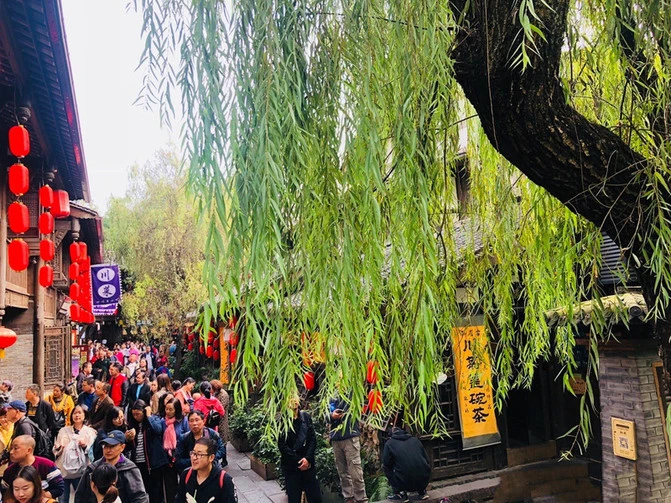
Jinli Ancient Street is located in Chengdu, the Land of Abundance in Sichuan. Walking into Jinli Ancient Street in Wuhou District, Chengdu, feels like traveling back in time. China has countless ancient streets, but this one is unforgettable.
Jinli Ancient Street is near Wuhou Temple. It is neither wide nor narrow. On the surface, it looks no different from ordinary alleys, but once you enter, you realize it is quite unique. Red lanterns hang at the main gate, and inside is no exception – all the way, there are long vertical lanterns in strings, giving a feeling of an ancient market.
As I went deeper, a small ditch by the roadside caught my attention. There were many water plants in the ditch, and the water was so clear that you could see the bottom. Little goldfish were swimming around everywhere. When tourists threw food, the goldfish would immediately rush to grab it, their joyful movements causing ripples in the water. Where there is water, the air is naturally good. These cute little creatures bring new vitality here. This is an ancient street full of life all the time.
Where there are beautiful sceneries, there is naturally delicious food. Jinli Ancient Street has a wide variety of food. Each shop has a large signboard, offering an array of food and drinks.
The names of the shops are particularly artistic, easily giving you a feeling of traveling back in time. There are also many spicy skewers in roadside shops – a treat for tourists who love spicy food.
Cold noodles, glutinous rice cakes, ice jelly, grilled meat skewers, steamed sweet cakes, and many other delicacies with unknown names.
Some sell sugar-coated haws, some make sugar figurines, some sell antiques, some sell paper fans – they are everywhere.
There is also a flavor indispensable to ancient alleys: candy sellers. Those white hard candies can stick to your teeth, but they are especially sweet and delicious.
This is the ancient street in my impression – it perfectly fulfills my expectations of a beautiful ancient street. If I had enough time, I would love to have a photoshoot there, holding an oil-paper umbrella, with a nice hairstyle, wearing ancient costumes, strolling leisurely – it would certainly be a unique experience.
The surrounding shops are all antique-style, with many decorations carrying an 'ancient feel'. Nothing seems modern. Even after leaving, the feeling lingers. Step into Jinli Ancient Street, and it recreates an ancient dream for you!
Chengdu Jiaoliao Humanistic Boutique Hotel is located within the Kuanzhai Alley scenic area. Amid the hustle and bustle of Kuanzhai Alley, it provides a quiet haven, creating a space full of classical, elegant Chinese cultural atmosphere.
From a travel perspective, Jiaoliao Hotel is adjacent to Chengdu's Kuanzhai Alley and Jinli, with convenient access to local customs and specialties, such as snacks, Sichuan opera face-changing, etc., allowing you to experience Chengdu's cultural entertainment.
It is a quiet resting place hidden in the bustling city, seemingly separated from the noise of Kuanzhai Alley. With its antique style, the sound of dripping water and birdsong come together perfectly.
"Ying lian ji chi cang tai, xiao kou chai fei jiu bu kai" (Pity the clogs' prints on green moss, a small knock on the brushwood door long unanswered). The ancient gate is awakened every day by the hustle of people coming and going, like an old man from ancient times, carrying the vicissitudes he has experienced, telling us unknown stories. Entering the hotel, every plant and tree exudes serenity, every bamboo and stone embodies elegance.
The first impression of Jiaoliao Hotel is a new Chinese-style design full of natural elements. The hotel extensively uses materials like mountain, water, stone, and bamboo, all very close to nature. The overall space is laid out with lush plants and elegant bamboo. According to the staff, the hotel's guest rooms cover about 1,400 square meters, and suites are equipped with study, living room, kitchen, and other functional areas. Hearing this, my friend and I couldn't help but marvel at the hotel's excellence!
It is said that the most special thing about this hotel is that it offers SPA services in the rooms, with a customized technique developed specifically for the hotel. Combining local culture, environment, and climate with some traditional Chinese medical therapies, they created the hotel's unique 'Jiaoliao Chaolin' (Jiaoliao Nest in the Woods). It provides travelers with comprehensive services to cultivate body and mind and feel nature. After a short rest, we also experienced a SPA – it was really good. The masseur had skillful hands, allowing us to enjoy total relaxation in the utmost comfort.
Every room here is equipped with facilities of international five-star hotels, from mattresses to toiletries and smart toilets – all perfect and delightful. There is also 24-hour butler service. When we rang the bell, the butler would respond. There is also a dedicated butler window nearby. When called, the butler would place what we needed inside, which is convenient and not intrusive. Overall, it was very nice!
It is not an exaggeration to describe this hotel as poetic. Each room has a different name: Haolai (Artemisia hedge), Fanli (Fence), Dapeng (Roc), Cangying (Eagle), Ziran (Nature), Yanqian (Simple words), Youwei (Subtle presence), and many other room types. My friends and I stayed in Yanqian and Youwei. We felt that these names matched us quite well – it was a kind of fate.
Our room was surrounded by green bamboos, with mountains and water in view. Even on a rainy day unsuitable for outings, we could open the window and listen to the raindrops falling on the bamboos. Turning off our phones, holding a good book, we enjoyed a slow life away from the noise and freed ourselves from worldly worries, relaxed and at ease.
Later, we gradually learned the origin of the hotel's name. It is said that the name Jiaoliao comes from Zhuangzi: 'The wren nests in the deep forest, using only one branch.' This conveys the desire to stay away from the mundane, abandon distractions, keep the original heart, return to nature, and be free and unfettered amid the noise.
Jiaoliao Humanistic Boutique Hotel is a quiet stream in the clamor, a unique blossom in the mortal world. Drawing from natural humanity and crafting refined emotions, it creates another way of life.
It offers you wind in the courtyard and moon on the eaves, allowing you to taste Zen charm among mountains, forests, stones, and bamboos, and fully enjoy the pleasure of carefree leisure.
If there is something I truly want to take away, it is the memories of Chengdu...


