The Zijingguan Great Wall
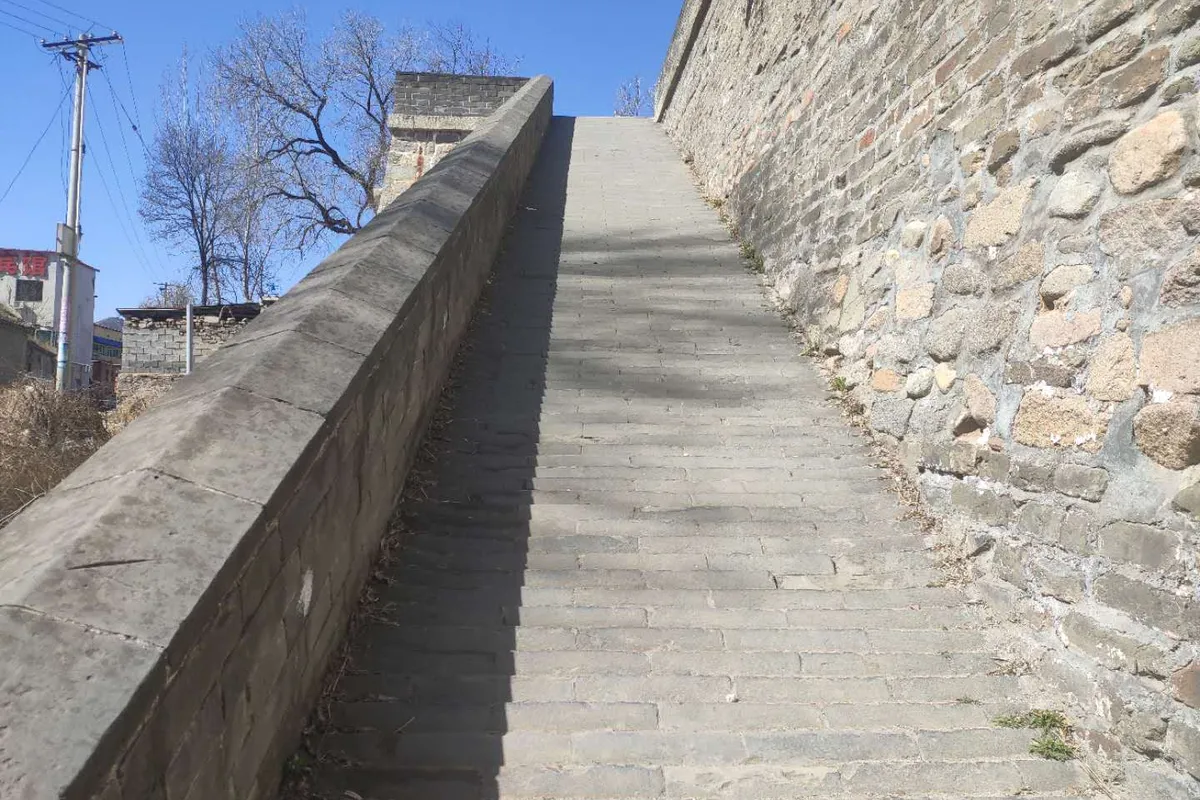
Walking slowly up the horse path, your body leans forward involuntarily, your feet pressing hard on the upright grey bricks, moving with great caution, afraid you might slip and take a big tumble.
As the weather warms, tiny blades of grass poke through the cracks between the bricks, stretching out tender green leaves that speak of life’s hope. Yet this age-old grey‑brick path holds the marks of centuries: the worn bricks carry the deep breath of time, and you can almost see mounted warriors galloping up to defend the pass.
Reaching the wall’s crest, the view opens wide. Distant ridges roll beneath a blue sky, and a crumbling section of the wall snakes across them. In these peaceful days, those ramparts have long lost their purpose, leaving behind only echoes of a proud and turbulent past.
The top of the wall is remarkably flat, about five metres wide – enough for five horses to ride abreast, or ten people to walk side‑by‑side. The paving bricks are laid in a cross‑bond pattern, their joints neatly filled and smoothed with lime, a technique that also helps stop wild grass from breaking through.
Along the outer side stands a chest‑high defensive parapet that once shielded soldiers. The gaps between the crenellations, called lookout openings, were used to watch the enemy. Below these, small square holes served as arrow loops. On the inner side runs a shorter wall – a rampart – acting as a railing. Beneath it, drainage holes channel rainwater over the wall’s outer face.
Holding onto the battlements, I gaze out. Beyond the wall stretches a peaceful land; no trace remains of the smoke‑shrouded sieges of old. A river flows quietly – it must have witnessed dynastic changes and the cruelty of wars. Now an old man sits by its bank, fishing with a quiet heart, soaking up sunshine and a good life. A few white geese lounge by the water, content in their simple freedom: they nibble grass when hungry, drink from the river when thirsty, with not a care for the world’s troubles.
Across the river, a wood is just beginning to leaf out. Tucked among the trees, you can make out a village where people must be living a settled, happy life.
Turning around, I see a section of wall that has completely lost its original form, reduced to an earthen base as high as the wall itself, covered in dry weeds and a few leafless saplings, with a winding footpath trodden by generations of walkers. Behind those trees are village homes: a two‑storey house peeps through, and one family is rebuilding – a person sits atop the roof working.
To the south, a house nestles right at the foot of the wall. Its grey‑tiled roof is thick with mugwort, like an old person’s hair telling of long years. Several tall trees cluster around the courtyard, deepening the sense of quiet. Even with commercial life not far away, this simple, ancient little yard feels like a Peach Blossom Spring amidst the bustle.
I walk down from the wall and step outside the pass. The city gate is built of long, massive stone blocks – heavy, imposing, strategically vital. The archway is not large, a real choke point, a military stronghold where one man could hold the pass against ten thousand.
Above the gate, four large characters are carved: ‘He Shan Dai Li’ – meaning that however long time may pass and however the world may change, one’s loyalty will never waver. It was a warning to the garrison: serve the country faithfully, and never open the gate in surrender.
Outside the wall, a few willow trees are putting out tender new green. Their soft branches sway gently in the breeze, like tender hands stroking the hard stone, while the stones, it seems, whisper one old story after another.