Nature's "Natural Oxygen Bar," a "Gold Mountain" Hidden Deep in the Taihang Range
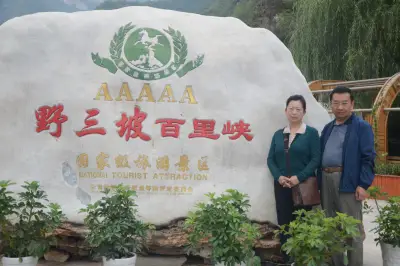
In the romantic spring season, I took my daughter to the "natural oxygen bar" deep in the Taihang Mountains, a "gold mountain" hidden there—Hushan. This is the only gold-themed cultural tourism scenic area in Hebei Province and even in North China.
Hushan is an "ecological mountain," with its main peak Sanjian Ridge rising over 1,100 meters above sea level, forming a line with the ancient Northern Heng Mountain, one of the Five Sacred Mountains where ancient emperors held sacrifices. The scenic area combines mountains, forests, springs, streams, waterfalls, lakes, and scenic beauty, with pristine ecosystems and dense forests. The vegetation coverage rate exceeds 90%, earning it the reputation of nature's "natural oxygen bar."
Listening to the crystal-clear stream, not far from the scenic area entrance, the "Times Memory" exhibition hall came into view. Hanging by the door is a sign that reads "Dongfanghong Elementary School"—so evocative of bygone days! The room recreates a school classroom from the past, instantly bringing back memories of my own childhood.
"Study hard and make progress every day"—a phrase we recited for so many years. Seeing it again today, I felt as if I had returned to my school days.
Hushan's most beautiful "Ten-mile Golden Water Corridor" is a healthy walking trail. "Gold gives birth to water, and water nourishes gold," they say. Hushan not only has gold mines but also streams and lakes all over the mountains. You can follow the Jinshui River, stepping along stone paths and gold-tinged millstone steps upstream, enjoying the beautiful scenery of the Jinshui River, listening to the enchanting melody of the gurgling stream, while taking deep breaths and giving your lungs a good cleanse.
By the flowing water, there are many swings for visitors to rest and play. The swing was invented by the ancient Shanrong, a northern ethnic minority, originally as a military training tool. During the Spring and Autumn period, Duke Huan of Qi led troops to defeat the Shanrong, and the swing was introduced to the Central Plains, becoming popular.
Hushan Scenic Area also has the China "Double Happiness" Culture Museum, showcasing the charm of traditional wedding customs. The museum is divided into four sections: wedding etiquette, moments of happiness, formal wedding customs, and auspicious wedding customs. It houses over 1,000 exhibits, recreating the wedding cultures of various eras.
The Folk Blessing Culture Museum at Hushan is also worth visiting. Over the long course of human development, blessing-seeking has been the most primitive and widespread spiritual activity. The "fu" in blessing culture mostly refers to "good fortune," "luck," and "happiness," embodying people's simple aspirations and good wishes for a happy life from ancient times to the present. Passed down through the ages, fu (blessing), lu (prosperity), xi (joy), shou (longevity), xiang (auspiciousness), and rui (propitiousness) form the six key elements of traditional Chinese blessing culture.
As the saying goes, "If you don't manage your money, money ignores you." Wealth comes from careful calculation, so this exhibition hall also has a nickname: the "Wealth Hall."
The abacus originated in China, gradually evolving from the counting rods commonly used as early as the Spring and Autumn period—even earlier than the appearance of Arabic numerals.
Upon arriving at the Abacus Array Hall with my daughter, I was utterly amazed. Here is the longest abacus I've ever seen, and all kinds of abacuses I'd never encountered before—it was truly an eye-opener. The abacus is not just a cultural artifact; here I saw it more as wisdom.
The Shanxi-Chahar-Hebei Anti-Japanese Base Area was the first anti-Japanese base established by the Communist Party of China during the War of Resistance against Japan. It was founded on November 7, 1937, centered on Fuping in Hebei Province and Wutai in Shanxi Province, with Nie Rongzhen serving as commander and political commissar.
During this visit to Hushan, I happened to come across the unveiling ceremony of the Red Culture Exhibition Hall at Baoding Hushan Scenic Area. Representatives from the Hebei Collectors' Association and cultural circles attended the ceremony, presenting calligraphy works and books on red literature themes to the scenic area.
According to the introduction, the Hushan Red Culture Exhibition Hall is located in Jinshuigou of Hushan, in the old revolutionary area of the Taihang Mountains. Currently, the exhibition area covers over 3,000 square meters, displaying nearly a thousand red propaganda posters and over a thousand pieces of documents, various editions of works, and biographies.
The scene was lively, with dancing and singing. Looking at these red memories, it felt as if time had never left.
What makes Hushan most worth visiting are its various exhibition halls. In this forest oxygen bar deep in the Taihang Mountains, there is also the Taihang Gold Mountain Oil Lamp Art Exhibition Hall, where you can see how oil lamps illuminated the lives of people in the past. There's also the Gold Miner Life Museum—practically synonymous with Hushan—housing all the stories and memories about gold. And then there are exhibition halls on the century-long development of telephones, televisions, and radios, accumulated over many years.
Visiting Hushan, it's not just about getting gold on your feet; you can also relive the days gone by.