A Gold Mountain Hidden in Hebei: The Abacuses of 2,000 Gold-Prospecting Households Reveal the Mountain’s Secrets
May is a month of bright sunshine. The northern scenery is brimming with early summer freshness. Entering Hushan in Baoding, Hebei, amidst the lush greenery, I search for the pristine hidden corners deep within the Taihang Mountains.
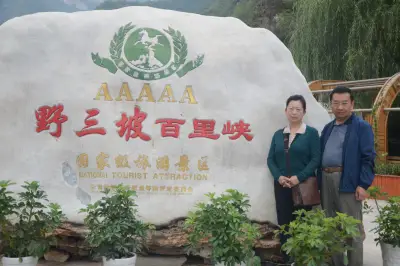
When it comes to Hushan in Baoding, Hebei, tourists from the Beijing-Tianjin-Hebei region all know it as a 'Gold Mountain.' Hushan has a long history. Over the ages, this ancient land has been home to many magical legends. It is the only gold-themed cultural tourism destination in Hebei Province and even in all of North China. Its pristine natural environment and rich gold resources have endowed Hushan with a profound gold-mining culture. The flowers blooming amid green mountains and clear waters lead us deeper into the hills. On this trip to Hushan, I stroll slowly along the rippling lakeshore, intoxicated by nature’s fresh and graceful charm.
Over the years, I have visited many scenic spots across the country, and I always yearn for more authentic, unspoiled natural landscapes. Hearing about Hushan in Baoding, I set off in this May season of blooming flowers and gentle breezes to explore the gold-prospecting stories hidden deep in the Taihang Mountains.
Hushan is located in the northernmost part of Quyang County. It gets its name from a huge rock on the summit that resembles a tiger ready to pounce. Here, rolling hills, deep forests, and secluded valleys hide breathtaking scenery that is rich in meaning and endlessly beautiful.
As you venture deeper into Hushan, many people are struck by curiosity. Whether on the winding mountain paths or at various scenic spots, the most prominent feature is the ancient millstones, steeped in history. This place is known as the No.1 Millstone Valley under Heaven.
Millstones held an important place in ancient China. People used pestles, mortars, and other tools to pound materials. On one hand, mulberry bark and bamboo hemp were crushed to obtain the needed pulp for paper. Another key function was grinding grain.
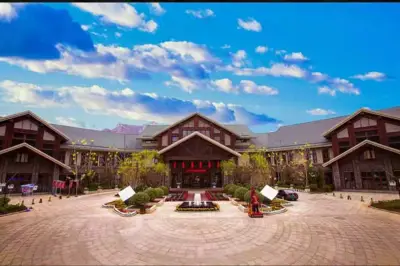
Hushan boasts a deeply rooted gold-prospecting culture. There are many must-see attractions: the thousand-meter Ancient Gold Mine Cave, the Old Gold Factory, the Gold Culture Expo Hall, the 'Ten-Li Gold Water Corridor' wellness trail, the Gold Smelting Experience Zone, the Folk Culture Exhibition Courtyard, the Gold Stone Mountain Inn, and more — all related to gold.
The unique geographical conditions gave rise to Hushan's age-old gold culture and to the gold-prospecting households at its foot. As the Chinese saying goes, 'Those living on a mountain live off the mountain, those by water live off the water.' The gold deposits on Hushan gave many mountain dwellers rich experience in gold prospecting since ancient times, and the abacus became a daily necessity in almost every home.
Inside Hushan’s Abacus Culture Museum, a collection of abacuses used by nearly 2,000 gold-prospecting households is displayed. Of every shape and form imaginable, they truly opened my eyes.
From primary school, we all learned the basics of using an abacus. Back then, every student used the same type. The abacuses we commonly see are basically rectangular, with a wooden frame, inside of which are vertical rods separated by a crossbeam. On the beam sit two beads, each counting as five; below the beam are five beads, each counting as one. But every abacus I saw in this museum was far beyond my expectations and truly eye-opening.
The unique local environment led to the establishment of the Abacus Culture Museum. Hushan is not only beautiful in scenery but also a place of stories and sentiment. The exhibition of all these abacuses in the museum is the result of a long period of accumulation, which is why we now see such a variety of ancient abacuses before our eyes.
Going back to the late 1990s, Mr. Tian, the founder of the Abacus Culture Museum, is a native of Hushan. Immersed in the local culture since childhood, he had a deep love for it. When he first saw an unusually shaped abacus, he fell in love with this old item that radiated the warmth of time.
The very first abacus Mr. Tian collected is displayed in the most prominent spot of the Abacus Culture Museum. In the late 1990s, this abacus cost over two thousand yuan—a huge sum for Mr. Tian, who earned a modest salary. But out of sheer love, he bought it.
From then on, he began paying attention to all kinds of abacuses in the homes of local gold prospectors. Whenever he found one he liked, he would get it no matter the cost. Over a long time, this accumulation led to the Abacus Culture Museum we see today.
Mr. Tian’s abacus passion stems from his innate love for Hushan. As a true local, being able to present something he loves to the world through culture is probably one of the most fulfilling things in his life.
I wonder how many people still know how to use an abacus today. Historical records show that the abacus has a history of over a thousand years. The Chinese abacus originated in the Northern Song Dynasty. It’s a simple calculating tool invented by our ancestors that played a vital role in ancient times. Whenever we think of ancient bookkeepers, the image that springs to mind is them clicking the abacus beads.
China is the birthplace of the abacus. Even in today’s era of advanced technology, some people still prefer to use it, which shows its irreplaceable value. Now, with UNESCO’s recognition in Baku, Azerbaijan, Chinese abacus calculation has officially become a part of humanity’s intangible cultural heritage. The nation will do its best to protect this heritage. As time goes by, abacuses are becoming rarer, and the significance of Hushan’s Abacus Culture Museum will only grow.
The abacus has already spread worldwide. As its birthplace, China’s ancestors passed this great invention on to other countries. Today, there are also Japanese and Russian abacuses internationally.
Inside Hushan’s Abacus Culture Museum, we can see many unusually shaped abacuses. These special designs probably arose from different uses and the identities of their users. Abacuses made of high-grade materials are highly valuable to collectors.
There, we saw abacuses made of special materials, such as one inlaid with silver dollars, and another whose beads are made of turquoise and agate. These were tools used only by wealthy families in ancient times.
High-end abacuses are worth collecting. Polished by time, they have a warm luster. According to experts, abacuses can be classified by the materials of their beads and frames: gold, silver, copper, iron, jade, bamboo, wood, ivory, crystal, marble, and more. Others are classified by the material of the vertical rods, including iron, wood, silver, copper, aluminum, bamboo, etc. The better the material, the higher the collection value and appreciation potential. The turquoise and agate abacuses in Hushan’s museum are worth a considerable fortune.
Seemingly ordinary abacuses gain different values because of their materials. These unusual abacuses have played important roles over long years. Now presented as exhibits, they have deep meaning to me. First, they represent the sediment of a bygone era. Second, they embody the knowledge and sentiment of the collector. Third, they give every viewer a deeper and broader understanding of the abacus.
Each abacus tells a story; each is a witness to the history of a gold-prospecting household. The days when the clacking of abacus beads resounded were times of hope and longing for these families.
Today’s primary school students are very familiar with π. Many can rattle off the seven digits after the decimal point. But how was such a complex number calculated? This brings us back to the abacus.
The Chinese mathematician Zu Chongzhi was the first person in the world to calculate the accurate value of π to seven decimal places. According to historical records, he achieved this feat using the predecessor of the abacus—counting rods.
Over the long river of time, the gold mines of Hushan shaped the gold-prospecting families in the mountains and made Hushan the only gold-themed cultural tourism destination in Hebei and even in North China.
Hushan has many fun attractions. In May, a gentle breeze carries the faint scent of flowers. Strolling among green mountains and clear waters, wandering in Hushan, I roam through the wonderful scenery nature has given us.
After enjoying Hushan’s scenery and visiting the culturally rich Abacus Culture Museum, a meal of local farmhouse food is deeply satisfying. When people mention Hebei cuisine, the first thing that comes to mind is Baoding cuisine. Hushan is in Quyang County, Baoding, where the dishes emphasize texture and taste. The ingredients come from Hushan itself—green and pollution-free.
Whether it’s the golden scrambled farm eggs or the large chunks of braised tofu, every bite is fragrant and full of the natural flavors of the ingredients.
The benevolent love mountains, the wise love water. When natural beauty meets profound abacus culture, Hushan’s charm is worth studying slowly and exploring in detail. Right now, by the rippling green lake, the locust flowers on Hushan are in full bloom. Perhaps, like me, you too would like to come and meet your own summer here.