Off to See the Dancing Girls at Yandu Ancient City in Yi County
Speaking of ancient towns, the 'ancient town tour' craze has been in full swing across China over the past decade. Besides the early-developed, well-known ones, the booming tourism industry has sparked ancient-town fever all over the country. Seasoned travelers, however, take greater pleasure in discovering and verifying off-the-beaten-path destinations. This spirit of exploration has steadily brought many history-buried old towns to light, turning them into prized assets for local governments and must-visit spots for travel lovers. The national push for characteristic towns since 2016 has seen newly built ancient towns mushrooming, their planning, layout, and craftsmanship no less exquisite, leaving visitors dazzled and often unable to tell the real from the replica.
Because of my work, I occasionally travel around, north and south, and have visited most of the ancient towns in China: Langzhong in Sichuan, Dali, Lijiang, and Chuxiong in Yunnan, Xi'an in Shaanxi, Pingyao and Datong in Shanxi, Qinhuangdao in Hebei, Zhenyuan and Qingyan in Guizhou, Enshi in Hubei, Fenghuang and Lingling in Hunan, the four commanderies of Hexi in Gansu, and so on. What I long for most now are the ancient towns and villages in the southeastern coastal provinces—who knows when I'll get my wish... Anyway, let's get back on track and talk about this time's destination.
Yandu Ancient City came to my ears by chance while I was on a business trip to Beijing. Rumor has it that it's the largest waterside ancient town in North China. Oh my, that's a lofty claim, so on a whim, I decided to go check it out.
Transportation wasn't complicated. There are direct minivans from the Liuliqiao subway station in Beijing for 50 yuan. Just tell the driver where you want to go, and they'll drop you right at the spot. The driver sped all the way—clearly an old hand. I was just about to doze off when we arrived; I checked the time, a little over an hour, pretty fast.
Stepping out of the vehicle, everywhere I looked were clusters of ancient-style buildings. Especially that huge watchtower on the square—isn't that something you only see in movies? So authentically Spring and Autumn and Warring States style. But the various snack stalls lining the roadside first caught my attention. Drawing closer, I saw grilled gluten, fried skewers, cold noodles, naengmyeon—quite the spread, actually. As for food, there's a saying: 'Food in China, flavor in Sichuan,' and a condensed version, 'Eat in Sichuan, savor in southern Sichuan.' If you ever get a chance to wander there, you'll understand. Sichuan cuisine has three styles, with Chengdu, Chongqing, and Zigong each claiming one. Zigong's salt merchant cuisine stands out. Oops—occupational hazard kicking in; consider it a little popularization.
Beside the square there's a stone archway inscribed with 'The Land of Loyalty and Righteousness,' which instantly stirred my heroic spirits. The culture of loyalty and righteousness is central to Chinese tradition, as the saying goes, 'Loyalty and righteousness pass through the ages, filial piety and chastity endure forever.' Yue Fei and Guan Yu are its representatives. Passing through the archway, I stepped into a small courtyard. I visited at the cusp of spring and summer; the courtyard was lush with greenery all around, red blossoms gradually unfolding, and a corridor peeking through the verdant trees.
I decided to bypass the courtyard and head to the square—after all, the square is the soul. Besides the huge watchtower, the square also boasts six totem poles carved with major historical events from the Spring and Autumn and Warring States periods related to the State of Yan. On the outer side stands a large stone inscribed with the name, the characters '燕都古城' (Yandu Ancient City) bold and vigorous. On the south side there's a small children's playground adjoining a small parking lot, presumably for tourists. But I saw many local private cars parked along the roadside, so parking shouldn't be an issue for those driving themselves (I utterly loathe parking difficulties at scenic spots—anyone who often drives on trips will know the pain).
By the visitor center side of the square, there's a tourist map of Yi County's all-for-one tourism. Let me first get familiar (the whole country is now promoting all-for-one tourism; kudos to Yi County for this). You don't know until you look, and once you look, it blows you away. It turns out Yi County is so rich in tourism resources. Nationally ranked attractions include Langya Mountain, the Western Qing Tombs, and Yesanpo—Yesanpo is a 5A scenic area, Langya Mountain and Western Qing Tombs are 4A. There are also Zijing Pass, Yunmeng Mountain, Yishui Lake, Qianfo Mountain, and more. (Don't laugh; it's not that I didn't do my pre-trip homework—I just never expected such a place hidden away southwest of Beijing, unassuming and quietly impressive. All I can say is this land is brimming with cultural depth, though the stars all revolve around Beijing.)
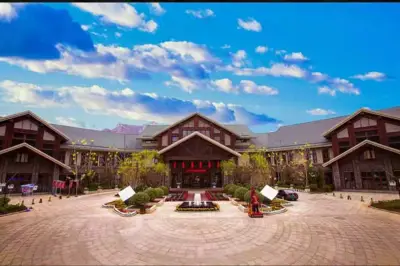
Speaking of the visitor center, I figured I should go inside and learn more (following domestic custom and industry standards, large scenic areas usually have a visitor center offering information, panoramic tours, guide services, public restrooms, emergency assistance, etc. Next time you visit a scenic spot, I suggest hitting the visitor center first to get an overview, so you don't wander aimlessly and waste time and energy). The visitor center is a large courtyard-style building, with a main gate of typical traditional design, complete with gate pillars and lintels. At the entranceway, there's a screen wall merging with the roof. Behind it is a courtyard holding a large diorama, where the layout of the scenic area is shown in minute detail under a glass dome. Flanking are wing rooms, now looking like offices (envy~ how lovely~). The wing rooms feature exquisite wooden carved doors and windows. Looking up, the ceilings are entirely painted (often overlooked by the casual observer, it's just stunning). The carvings and paintings make for a resplendent sight—sumptuous to the extreme. The main hall has no doors, forming an open, spacious foyer furnished with rows of chaise longues. As I was looking, a fragrant breeze wafted over—a receptionist lady was approaching. Being a socially awkward, seasoned homebody, I decided on a tactical retreat, leaving the lady fluttering alone in the wind… Exiting the visitor center, I took a deep breath: 'That's right, I am a traveler; loneliness is my calling.'
Leaving the visitor center, I turned a corner and came face to face with a cannon and a torii gate. The cannon was a Qing dynasty 'Divine Might General' cannon. As for the torii, it's that gate-like thing you see at the entrances of Japanese shrines, which actually evolved from the temple gate arches of China's Tang and Song dynasties. Seeing it here feels like a homecoming. A plaque on the torii reads: 'Antique Street.' Instantly, my blood surged—' Another one of my soft spots!' I practically saw my former self, running against the wind through an antique street under the setting sun—that was my lost youth!
Following Antique Street in, at its heart stands a statue of 'Lying on Ice to Fetch Carp for His Mother'—one of the representative tales of Chinese filial piety culture (Baidu explains it in more detail than I can; look it up yourself). On both sides, stalls are laid out with all manner of antiques. Readers, stay calm. Why use the phrase 'all manner'? Because there are just too many to describe, and I can't do a tongue-twisting spiel, can I? In fact, the Yi County area mainly produces cliff cypress, Dwarf Elm burls, walnut-shell carvings, and inkstones. As for everything else, the oldest item is probably that red cloth under the stall. But don't mind the details. The greatest joy of an antique market is browsing and bargaining—browsing means roaming everywhere, bargaining means haggling and sharpening your tongue. Haggling itself is a pleasure, nothing to do with stinginess, just life philosophy.
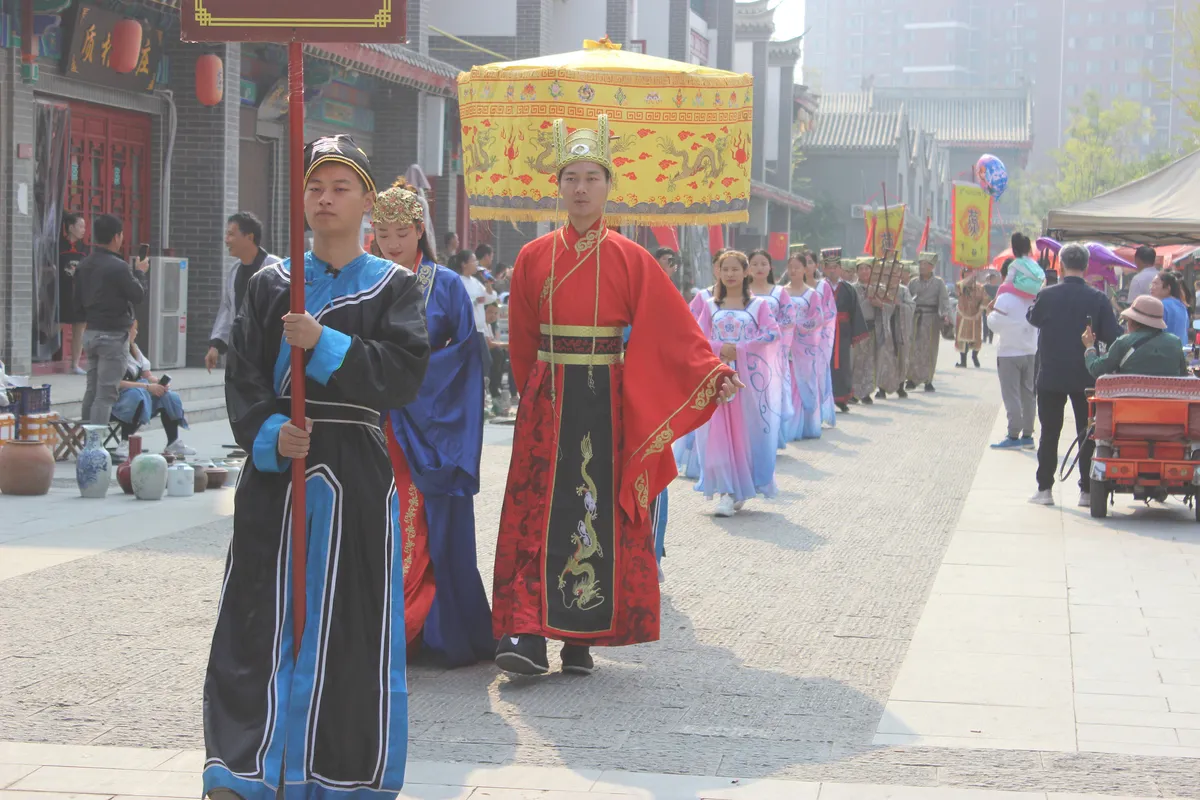
While I was strolling, a commotion stirred behind me. I turned back and my pupils suddenly dilated—Whoa! What a spectacle, are they shooting a movie? A fully arrayed procession of ancient-period honor guards approached. The one at the front cleared the way with a gong; two figures, likely the king and queen, led, followed by court musicians and dancers, and finally soldiers bearing halberds. No camera rigs in sight, no director shouting 'Cut!' What was going on? I asked around and learned that this was the ancient town's regular show called 'The King's Procession.' I also got word of a stage performance in the evening. For the first time, I eagerly anticipated nightfall…
(To be continued...)