Embrace the Tangible Sun at Hushan – Summer Vacation's Here! Bring Your Children to Play!
The car exits Baofu Expressway at Lingshan intersection, then creeps along a shiny black mountain road into the deep Taihang Mountains. As you enter the deep mountains, the most obvious change is how the hills become greener and the scenery more beautiful, with clusters of mountain villages nestled among lush trees.
After a while, my eyes suddenly lit up – there was a large stretch of water here! To be honest, I always thought the Taihang Mountains were full of bare rocks, so it's rare to see such green hills and clear waters. I asked my travel companion what this place was – maybe a small reservoir? My knowledgeable friend Yan Xiaoping told me it was Yangjiatai Reservoir, and not far ahead was the Hushan Scenic Area.
Starting from Shijiazhuang, it took just over an hour to arrive at the famous Hushan Scenic Area by 8 a.m. The mountain air was still a bit chilly, with a crisp breeze blowing away the travel dust. The fresh air, rich in negative oxygen ions, immediately refreshed everyone.
A ray of golden sunlight spilled over the entrance to Hushan Scenic Area, casting a golden glow over my 2020 journey. Yesterday, before setting off, I posted on social media: aging is inevitable, but as a modern senior, one shouldn't be afraid, especially with the ongoing epidemic prevention measures. While taking reasonable precautions, we should still boldly go out. Find a place surrounded by green hills and clear waters to stay – it's a reward for yourself and a contribution to the development of culture and tourism.
It was love at first sight. My first impression of Hushan Scenic Area was that it's really great. Located at the junction of three counties, it boasts deep mountains and dense forests, fresh air, green hills, and clear waters. The environment is excellent, and most importantly, this place isn't just fun – it's also full of 'culture.' Strolling among the lush scenery, you can't help but feel beautiful yourself.
The Chinese believe in 'harmony between man and nature.' I think 'nature' here means the natural environment, which has a huge impact on people. In different settings, one's mental state and physical signs change. Traditional Chinese medicine says this year is a year of fire and dryness; epidemic prevention forced people to stay indoors, and the environment often left them feeling unwell. The way to change this is to leave home and go to places with few people and good surroundings.
That's why rural trips, local getaways, and leisure travel have become the best choices recently. Especially for retirees like us, who have both time and money – as long as we can get away, we can enjoy the scenery, exercise our bodies, and even contribute to society a little.
When I saw people bringing their children to play here, I suddenly felt a bit selfish. The kids are on vacation – this holiday has stretched from last year's winter break to this summer break. Why keep them at home glued to their phones instead of taking them into nature, letting them grow healthily through interacting with the outdoors and learning more useful knowledge through practice?
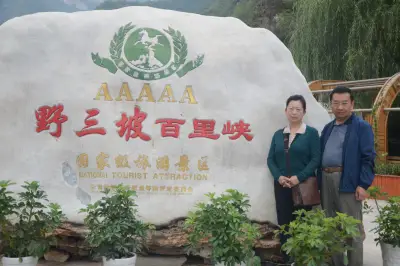
This is the Hushan Scenic Area in Quyang County, 38 kilometers from Quyang county seat, 75 km from Baoding, 120 km from Shijiazhuang, and 200 km each from Beijing and Tianjin. It's a national AAAA-level tourist attraction. Located in western Baoding, in the northernmost part of Quyang, it got its name from a giant rock atop the mountain that looks like a crouching tiger ready to pounce. Connected to the famous Northern Mount Heng, its highest peak, 'Sanjianliang,' rises over 1,100 meters above sea level. Bordering Tang County and Fuping, it forms a mountainous landscape where 'one foot steps on three counties,' with a total area of more than 20 square kilometers.
Hushan has long been hidden deep in the Taihang Mountains, with rolling peaks that saw few visitors for years, preserving its pristine natural ecology. The mountain climate is humid, the air incredibly fresh and pure, with fine mist rising like a light veil, earning it the reputation among travelers as a 'natural oxygen bar.'
Wild animals such as gazelles, squirrels, hares, and various birds often appear in the mountain ravines. Hushan has many scenic spots: 'Birdsong Gorge,' 'Qiu Shui Temple,' 'Jin Shui Spring,' 'Miners' Living Area,' 'Triple Cascade Waterfall,' 'Fairy Waterfall,' 'Wishing Tree,' 'Sky Meadow,' 'Sanjianliang,' and 'Gold Panning Cave.'
The tinkling 'Jin Shui Spring' in the mountains is like a musician playing a moving song of Hushan. Its lake-blue water is beautiful all year round, bubbling up clear and sweet, and the gurgling stream nourishes the heart of the mountain.
The most beautiful spot here is Millstone Valley, composed of countless millstones, and home to the Shouting Spring. When you come to Shouting Spring, you absolutely must give a shout.
It's said that a shout at Shouting Spring ensures you live to 99. I, an old man, also stepped up, grabbed the microphone, took a deep breath from my diaphragm, and exhaled slowly. A jet of clear spring water shot up into the sky in response. A fellow visitor exclaimed, 'Impressive, old man! That's the spirit of life!'
After leaving Millstone Valley, our group headed to the highlight of this trip: the 'Gold Panning Cave.' The ancient gold-panning caves consist of several tunnels reaching hundreds of meters deep. These gold mine caves are relics from gold mining in the late Qing Dynasty and early Republic of China era. A typical horizontal mine tunnel in the Taihang Mountains, it stretches over a kilometer, with caves within caves, all interconnected like a mysterious underground palace. These caves have also given rise to a unique gold panning culture here. Deep, long, and cool with gentle breezes, they evoke a sense of mystery.
This is also the famous 'Gold Culture Museum' of the scenic area. Gold panning culture is the theme of Hushan and one of its distinctive features. Entering the cave, I looked up and saw the words: 'The Sun You Can Touch.'
Haha, I got inspired: gold is the tangible sun, and our children are even more so – the sun you can touch. On November 17, 1957, Chairman Mao met Chinese students and interns in Moscow and said, 'The world is yours, as well as ours, but in the last analysis, it is yours. You young people, full of vigor and vitality, are in the prime of life, like the sun at eight or nine in the morning. Our hope is placed on you.'
Chairman Mao compared youth to the morning sun, placing the nation's hope on them. In fact, every child in a family is that family's 'sun,' and hopes are pinned on them. Thus, their studies and health are top concerns for all parents. During holidays, all sorts of cram schools spring up, and with epidemic prevention measures, 'online classes' take up most of kids' time. I actually think authorities should explicitly ban this – after more than half a year of kids being cooped up at home with computers and phones, isn't that also a kind of 'disaster'?
Learning is a lifelong goal; one should keep learning as long as one lives, only by continuous learning can we keep up with society's development. Learning to practice, learning to learn – that's what's most important. Only during holidays do we have the chance to enter the great school of society, to go into nature, and to learn and exercise through contact with the outdoors, acquiring the most genuine knowledge. Walking into the Gold Cave is like stepping into history, into a textbook on gold.
The Gold Culture Museum is connected to the Gold Cave, covering over 3,000 square meters, and is a mysterious gold culture visitor area. It uses the historical gold mining and smelting sites from various periods in Hushan to vividly display the history and legends of gold extraction here.
It blends the development of gold culture past and present, using sculptures, murals, artifacts, and interactive displays that visitors love to showcase ancient mining and smelting techniques and the culture of gold. Combining education with fun, this gold-themed culture park offers a unique experience for both science learning and sightseeing.
Before the old objects steeped in history, and the reconstructed scenes of laborers at work, we not only learned about the history of gold production but also appreciated the hardship and glory of labor.
The history of gold accompanies the development of human civilization. A display board here is inscribed with 'Legends of the Human Ages': humans of the Golden Age, the Silver Age, the Bronze Age, and the Iron Age.
In Greek mythology, humanity went through five ages. The first race was made of gold: food and fruits grew automatically on the earth, the sky was always clear. They had no worries about food or clothing, living carefree lives. They were naturally extremely long-lived, even immortal. They never suffered illness, and when their time came, they peacefully fell asleep. That was the Golden Age of humanity. After death they became angels, guardians of the earth, traveling through clouds and mists to uphold fairness and justice in the world.
Fairy tales give gold the most wonderful legends, making the whole world incredibly beautiful. Everyone hopes for a 'Golden God of Wealth' before them. But as the saying goes, only fake gold needs a real gold coating; true gold needs no plating.
Gold is a symbol of wealth, yellow the color of emperors. Gold itself is a kind of religion. The museum's various tributes to gold showcase its different glories.
As I left the Gold Cave, I recalled a quote from the great revolutionary leader Lenin: 'When we are victorious on a world scale, I think we shall use gold for the purpose of building public lavatories in the streets of some of the largest cities in the world.'
Recently, Hushan has undergone a butterfly transformation, gathering eight museums of different themes in a cluster: the Gold Culture Museum, the Chinese 'Double Happiness' Culture Museum, the Folk Blessing Culture Museum, the Chinese Abacus Culture Exhibition Hall, the Taihang Jinshan Oil Lamp Art Exhibition Hall, the Centennial Telephone History Exhibition Hall, the Republic Era Electrical Appliances History Exhibition Hall, and the Gold Miners' Living Museum.
Among these eight museums, we only visited the Gold Culture Museum. Next stop: the Chinese 'Double Happiness' Culture Museum, which is said to be even more fun.
A morning of sightseeing made time fly, and soon it was time for lunch. In the rush, I took a selfie – my shadow cast on the display board is me!
After the study tour, let's talk about food and lodging, since food is the paramount necessity of the people. The Stone Mountain Eatery and Our Family Courtyard can serve over 300 diners at once. The pristine mountains, waters, and ecology provide Hushan with top-quality ingredients, and visitors can savor local Hushan specialties. Famous local Chinese delicacies such as Black Daughter buns, knife-cut noodles, Zhang's hand-pulled noodles, rice cakes, pan-fried cakes, pancakes, and clay oven sesame cakes – over 30 traditional snacks in total – are sure to satisfy your taste buds.
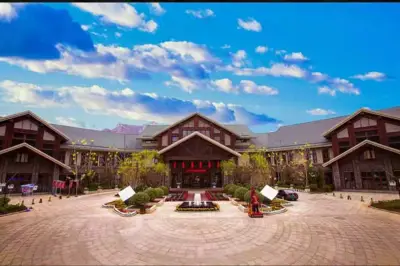
The Jinshitoushan Inn is located along the Jinshui River in the scenic area. Rooms are renovated to star-hotel standards, all in traditional courtyard style with elegant decor. There are suites, standard rooms, single rooms – over 60 in total – plus facilities like a chess and card room, meeting room, movie room, and night-view terrace.
This place at Hushan is known as the Immortal Mountain Ancient Path. Legend has it that Emperor Shun once walked this road during a ritual sacrifice. Verdant mountains, serene green paths, gurgling streams blend harmoniously with people. Like a painting, like a poem, it enters our holiday time, into our hearts.