This Mountain in Baoding Boasts Beautiful Scenery and a Gold Mine from a Thousand Years Ago
When we were young, our fathers were superheroes in our eyes. They seemed silent and stern, yet had a clumsy tenderness. It was only when we grew up that we realized our fathers were also ordinary people.
In the ocean of life, our fathers ride the waves, from high-spirited youth to their twilight years, all to keep that little boat called “family” sailing safely forward. That boat, with father, mother, and us, is the most steadfast anchor of our lives.
My parents’ love story began in the 1980s. Due to the times and family conditions, many of their happy moments could only be treasured in memory. Perhaps the only tangible keepsake that survived is their marriage certificate.
Over more than a century of change, marriage certificates have taken many forms. But no matter how they look, they all mark the happy beginning of a couple and a home.
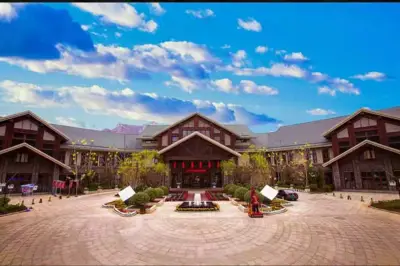
Yesterday, at a good friend’s invitation, I visited his hometown, Hushan Village. I had originally gone to escape the summer heat, but the trip brought an unexpected reward. In Hushan’s Happiness Culture Hall, a collection of marriage certificates from different eras is preserved. The oldest one dates back to the 19th year of the Guangxu reign (1893), and the most recent ones are from the 1970s and 80s. This hall practically spans all periods of modern Chinese marriage certificates.
Each marriage certificate here once witnessed a moment of happiness. Through the shifting times, the owners of these certificates may no longer be found, but the hope and pursuit of a happy life they left behind will remain forever in the Happiness Culture Hall, for later generations to see, and to draw strength for their own happiness.
Besides marriage certificates, the hall holds many items that evoke memories of my childhood. Enamel washbasins, old photo frames, tea sets—all these were what home looked like in those early memories. As the country has rapidly developed, such things have moved from our daily lives into our memories, never to be erased.
Walking around the Happiness Culture Hall stirred the same feelings I had at the start of this article. It was like being back in my parents’ youth, when my father was high-spirited, my mother young and full of life, their hands clasped together, standing under the morning sun, eyes filled with hope and longing for the future. After decades of braving the waves, my parents have grown old, and we have grown up. Now it’s our turn to stand in front of them and face the storms ahead.
The second floor of the Happiness Culture Hall is a space dedicated to folk deities. From Taoist immortals to patron gods of various trades, they are all introduced. No matter what profession, what we revere is not the spirits themselves, but the wisdom of our ancestors and the blessings they left us.
Speaking of Hushan, one cannot skip its gold mining history, which dates back a thousand years. The area still holds many mining sites and tunnels. Throughout human history, gold has held an indisputably important place, a symbol of wealth and status from ancient times to today.
Most people know little about gold mining. I only gained some basic understanding at the Hushan Gold Hall. It turns out that one ton of gold ore yields just a few grams of pure gold—no wonder it’s so precious. Yet that fits the universal pattern: the rarer something is, the more valuable it becomes. A 50th wedding anniversary is called the golden anniversary, fifty years of mutual care and support, half a century’s companionship that crystallizes into a bond as shining and precious as gold. Most of our parents’ marriages are approaching forty years now. I hope they can all hold each other on their golden anniversary.
The Gold Hall offers detailed displays on the history of gold, mining, and smelting, plus many fascinating legends and myths about gold. There are also relics from the mining era, ore specimens, and ancient metal artifacts. It’s an eye-opener for both adults and children. My only regret is that the gold mine tunnel was closed during my visit, so I couldn’t explore inside.
In ancient China, alchemy was basically the idea that gold, being durable and resistant to decay, could be transformed into an elixir of immortality, granting eternal life—a beautiful wish.
Due to limited time, we only visited these two exhibition halls. Aside from the halls, Hushan’s natural scenery is also breathtaking. There’s a place called Millstone Valley, where the paths are paved with millstones. In the valley, there’s a Shouting Spring: the louder you shout, the higher the water spouts. Those with trained lungs can take on the challenge—it’s great fun. On the way back, we happened upon people making zongzi by the roadside. With the Dragon Boat Festival near, some familiar flavors begin to linger in my mind.
Many say that the post-80s generation is the most nostalgic. But really, every generation has its cherished times—some kept in memory, while others need to be sparked by old objects. If you want to return to an era of riding the waves, go visit Hushan. There, many things are waiting to help you recall those beautiful moments.