Dreamlike Baishishan, Cool City Laiyuan
Laiyuan, tucked away in the northwest corner of Baoding, Hebei, is known as the 'Cool City' because its average summer temperature is only 21°C.
During the dog days of the pandemic, people are even more cautious about traveling. While staying at home and browsing Ctrip, I stumbled upon a travelogue about Laiyuan's Baishishan organized by Ctrip years ago. I was surprised to discover such a unique landscape near Beijing. I immediately called the scenic area to make a reservation (under the pandemic, Baishishan offered free tickets to Beijing tourists with a reservation), and quickly booked the Laiyuan Wanyue Hotel on Ctrip.
The main attractions of Laiyuan fall into two categories: one is the natural 5A-level Baishishan Scenic Area (15 km south of the county seat), and the other is the cultural sites in the county town, including the source of the Juma River, Taishan Temple, and Geyuan Temple. If time permits, you can also hike the rugged Wulonggou Great Wall in the county, walk along Feihu Pass—one of the Eight Passes of the Taihang Mountains—and enjoy the alpine meadow scenery on the mountaintop.
Accommodation in Laiyuan is mainly in two areas: one is the guesthouses near Baishishan (standard room around 100 yuan), and the other is hotels in the county town (standard room around 200 yuan).
There are two main driving routes from Beijing to Laiyuan: one is National Highway G108 (290 km/5 hours), and the other is the Beijing-Hong Kong-Macau Expressway transferring to the Zhangshi Expressway (210 km/2.5 hours).
A two-day trip is best for Laiyuan: Day 1: G108 National Highway + county attractions; Day 2: Zhangshi Expressway + Baishishan Scenic Area.
Laiyuan ticket prices: Baishishan World Geopark (ticket 135 yuan, sightseeing bus round trip 60 yuan or cable car round trip 140 yuan), Geyuan Temple (free), Juma River Source Park (free).
Baishishan Scenic Area tour routes: The area has two entrances, east and west (the west entrance was closed during the pandemic). Both require taking a cable car up the mountain, arriving at Xiangyun Gate on the east side and Cuiping Peak on the west side. Visitors then choose from three routes: the summit route is not suitable for average tourists and is only for climbing enthusiasts; the other two are the Feihu Gorge Line at 1,600 meters elevation and the Shuanggongshi Line at 1,900 meters. These two routes cover most of Baishishan's attractions. Visitors can either take one route round trip or combine both for a loop. Xiangyun Gate on the east side has branch boardwalks leading to the 1,600-meter and 1,900-meter lines, while Cuiping Peak on the west side is on the 1,900-meter line, with a hiking path and the Feiyunkou cable car connecting to the 1,600-meter line (the cable car was closed during the pandemic, so only hiking was possible).
On the day of Great Heat (Dashu), we came to the Cool City to see the great rivers and mountains of Laiyuan. The towering white boulder at the Beijing-Hebei border bears the guiding principle for the reconstruction of National Highway G108. Today, the Beijing-Laiyuan section of G108 has become a scenic highway, winding through the mountains southwest of Beijing. From Shidu and Shangfangshan in Fangshan to Baicaopan, Yesanpo, Juma River, and Baishishan in Laishui and Laiyuan, driving along it feels like traveling through a beautiful landscape gallery.
Crossing Fangshan and passing through Laishui, we entered Laiyuan amidst coolness and warmth.
About 30 km from Laiyuan county town, there is a Great Wall hotel reception center on the roadside. Nearby, a viewing platform has been built on the mountain. Climbing up, you can overlook the Wulonggou Great Wall on the opposite mountain. The Wulonggou Great Wall is an inner wall built under the supervision of Ming general Qi Jiguang. It connects to Pingxing Pass in Shanxi in the west and Zijing Pass in Yi County in the east. The watchtowers and walls are built along steep peaks and ridges, winding with the terrain, presenting a beautiful curve to travelers. Wulonggou is the most pristine 'wild Great Wall' today, having endured centuries of war and erosion, maintaining its original appearance, and is considered the most beautiful Great Wall in Hebei.
Following the Juma River to its source—Laiyuan county town—people have dammed the river 3 km southeast of the county to form a lake. Laiyuan Lake is also called 91st Ford, possibly numbered from the First Ford in Fangshan. The clear lake ripples gently, and four cultural sculpture squares along the shore proclaim that this small mountain town has depth. Historically, Laiyuan was rich in metal deposits. Since the Tang Dynasty, the imperial court set up furnaces here to mint coins. For centuries, caravans crossed the Laishui River, and strings of camel bells echoed through the valleys. Laiyuan once prospered because of imperial coinage.
When visiting Laiyuan, you must try its local cuisine. Laiyuan's food features northern noodle dishes. Near the county government, Tianyuan Coarse Grain King is a restaurant serving local snacks, famous for its refined coarse grain dishes. Corn porridge, oat noodles, steamed potatoes, yellow flour fried cakes, and various steamed dumplings—all are mouthwatering.
Laiyuan, the source of the Laishui River (the old name for the Juma River), means 'water large and swift like a galloping horse.' The Juma River flows for 500 li, cutting through mountains and walls, forming a hundred-mile gallery renowned in Beijing and Hebei at Yesanpo in Laishui and Shidu in Fangshan. It is hard to imagine that the surging Juma River does not come from mountain streams but instead emerges from underground at 102 springs in Laiyuan.
Laiyuan is truly a city of springs. Springs are densely clustered around the county, with clear water gushing. In some riverbanks and woodlands, digging a hole with your hand can create a spring, and the water pushes fine sand up and down—a remarkable sight. Many landscape experts praise the Juma River source, calling it 'not only China's but also the world's best spring landscape.' Laiyuan county has seven major spring groups, among which Beihaiquan, Nanguanquan, and Laolongtan are the most famous. The lake and pagoda reflection in front of Taishan Palace is a beautiful scene in Laiyuan city.
The Juma River source is a recreational area with towering trees and surging springs. Many historical sites complement it, forming seven great views: Maitreya's Four Gazes, Morning Coolness from Layered Towers, Pine Waves from the East Pagoda, Bell Sounds from Geyuan Temple, Sunset Glow at Zhenhai, Confluence of Lai and Yi Rivers, and Xiushan Reflection.
Taishan Temple, built in the Tang Dynasty, stands by the Juma River source on a high terrace by the lake. It is very conspicuous. The steps on both sides have white marble railings, and six of the panels are carved with exquisite reliefs of figures, flowers, and trees, lifelike. To protect them, people have covered them with glass.
Taishan Temple is a Taoist temple dedicated to 'Bixia Yuanjun, the Heavenly Immortal Holy Mother of Mount Tai'. It is said that Bixia Yuanjun is powerful, in charge of people's fortune, salary, wealth, and longevity, and has been revered by people since ancient times. Taishan Temple absorbs the essence of heaven and earth and the spirit of Bixia Yuanjun. Its halls are majestic, pines and cypresses are rugged, and it radiates spiritual light, illuminating Laiyuan. In the times when gods were not worshipped, Taishan Temple once served as classrooms for the county's No. 1 Middle School, damaging ancient buildings and trees. Today, Taishan Temple has resumed Taoist activities and has been opened as a scenic area for tourists.
Xingwen Pagoda in the temple is a landmark of Laiyuan. It has a history of over 1,200 years. Although repaired through the ages, it still maintains the architectural style of the Liao Dynasty. 'The mint cast millions of strings daily, with thousands of craftsmen like immortals. In the third year of Tianbao, this pagoda was built, imperishable and indestructible, connecting with the sky.' Xingwen Pagoda was built with donations from the craftsmen of the 'national mint' at that time, both to worship Buddha, promote culture, and improve feng shui. At the source of the Juma River, there were many springs. 'Spring' (quan) sounds like 'money' (quan). Building a pagoda over the spring, with the Water Mother Goddess enshrined inside, was meant to gather wealth and prevent it from flowing out.
Geyuan Temple is another ancient temple in Laiyuan city. The county town is not large, and with the help of navigation, it is easy to find this red-walled temple compound with tall ancient cypresses. Approaching it, there was no signboard, and the gate was tightly closed. It seemed difficult to get in today.
Opportunity comes to those who wait. Next door, the 'Wenzhongyuan' was decorated with red banners and seemed lively. Someone was locking the gate, so we hurried over to ask. We learned that Geyuan Temple is not open to the public; it is only occasionally opened for cultural exchanges under the guidance of cultural relics department staff. It seemed hopeless, but we didn't give up. After some effort, we were fortunate enough to enter Geyuan Temple—but definitely not by breaking in or climbing over the wall.
Seeing uninvited guests, a small dog ran over to inspect. Its eyes showed no hostility but rather a tacit monitoring expression.
Geyuan Temple is under archaeological excavation and restoration. Its value has only been gradually recognized in recent years. In the last century, it was also used for other purposes: the main hall became a classroom and warehouse for the Party school, the temple became a courtroom for the court, and the square in front of the temple was covered with residential houses. Geyuan Temple has a three-courtyard symmetrical layout. On the central axis, there are three main halls: the Heavenly King Hall, the Manjushri Hall, and the Sutra Depository. The Heavenly King Hall and the Sutra Depository are Ming Dynasty structures, not particularly distinctive. Only the Liao Dynasty Manjushri Hall in the middle is tall and majestic, appearing simple and dignified.
The Manjushri Hall is considered a national treasure by locals. It was built in the 16th year of the Liao Yingli era (966 AD) and is one of the nine known Liao Dynasty large-scale buildings. It is also the only timber-framed structure that has never undergone a full-scale dismantling and rebuilding.
The Manjushri Hall is precious for its three treasures: murals, dougong (bracket sets), and lattice windows. Admiring the murals was out of the question; we were content to peek through the locked door cracks. It is said that the murals were not the work of ordinary folk artisans but must have been created by court masters. The single figures in the murals are larger than life, using mineral pigments and techniques of li fen tie jin (raised gold paste and gold leaf), with as much as nine jin of gold leaf used. The murals, combined with the already destroyed sculpture groups inside the hall, created a grandeur rarely seen even in Dunhuang.
The second treasure, the lattice windows, are in the rhombus lattice style that emerged in the Liao and Song dynasties. The craftsmanship is rustic but exquisite. Especially a piece next to the left pillar, engraved with many patterns: some resemble ritual implements, some pagodas, some characters, and one strikingly similar to the dancing 'Jing' character from the Beijing Olympics. Windows are the weakest part of a building and easily damaged. It is a miracle that they have been preserved for a thousand years.
The third treasure, the dougong, is highly praised by architectural historians. The building has a high architectural standard, with large timbers, ingenious design, and perfectly matched mortise and tenon joints. The shape and decorative carvings of the dougong are exceptionally exquisite, rarely seen in contemporary architecture.
The mottled plaque and the smooth white jade stepping stone at the entrance of the Manjushri Hall indicate its great age.
On both sides of the hall stand sutra pillars and steles from the Ming Jiajing and Qing Kangxi eras. In a corner of the temple compound, broken ancient stele components are piled up. A stone Buddha with a missing head sits silently in a courtyard corner. Geyuan Temple has many stories worth exploring.
The bell tower of Geyuan Temple has long collapsed, and this Liao Dynasty Feihu bell with precise inscription and date has lain on the ground for many years. After enduring a thousand years of wind and rain and narrowly escaping the Great Steelmaking campaign, it can still ring loudly when struck. In the past, this bell hung in the bell tower and every morning its deep sound spread far, waking nearby residents. This gave rise to one of Laiyuan's twelve ancient scenic views—'Bell Sounds from Geyuan Temple'.
The dragon and phoenix pines in front of the hall are not thick. The dragon pine has died, while the phoenix pine remains green. The trunk and branches of the dragon pine are completely barkless, but people are still reluctant to remove it. Supported by external props, the dead crown stretches upward like two dragon horns, as if showing off something to the sky.
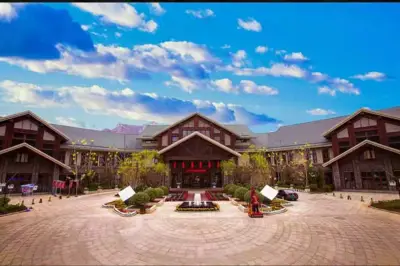
The Wanyue Hotel looks large in the county town. The rooms are clean and well-equipped. Groups of guests are checking in at the lobby, mostly tour groups. Opposite the hotel, Le Man Ju is labeled as a Laiyuan old store, but it mainly serves Sichuan cuisine. However, dishes made with Laiyuan sour tofu have a unique flavor. During the day, Laiyuan is also hot, but it is indeed cool after sunset. A restaurant waiter said it is even cooler on the mountain, and at night you need to wear a coat up there.
Baishishan stands majestically at the northern end of the eight-hundred-li Taihang Mountains. It is an important area in the China Fangshan National Geopark. 'The mountain is full of white stones, peaks rise vertically, beautifully arranged like a screen, with clear clouds drifting above.' It is a typical northern mountain with southern features. 'White Stone Clear Clouds' is the foremost of Laiyuan's twelve ancient scenic views. Baishishan is a place for spectacular photos: vast seas of clouds in red sunrise light, thousands of peaks shrouded in mist—each scene is breathtaking. However, to witness that ultimate beauty requires effort and luck.
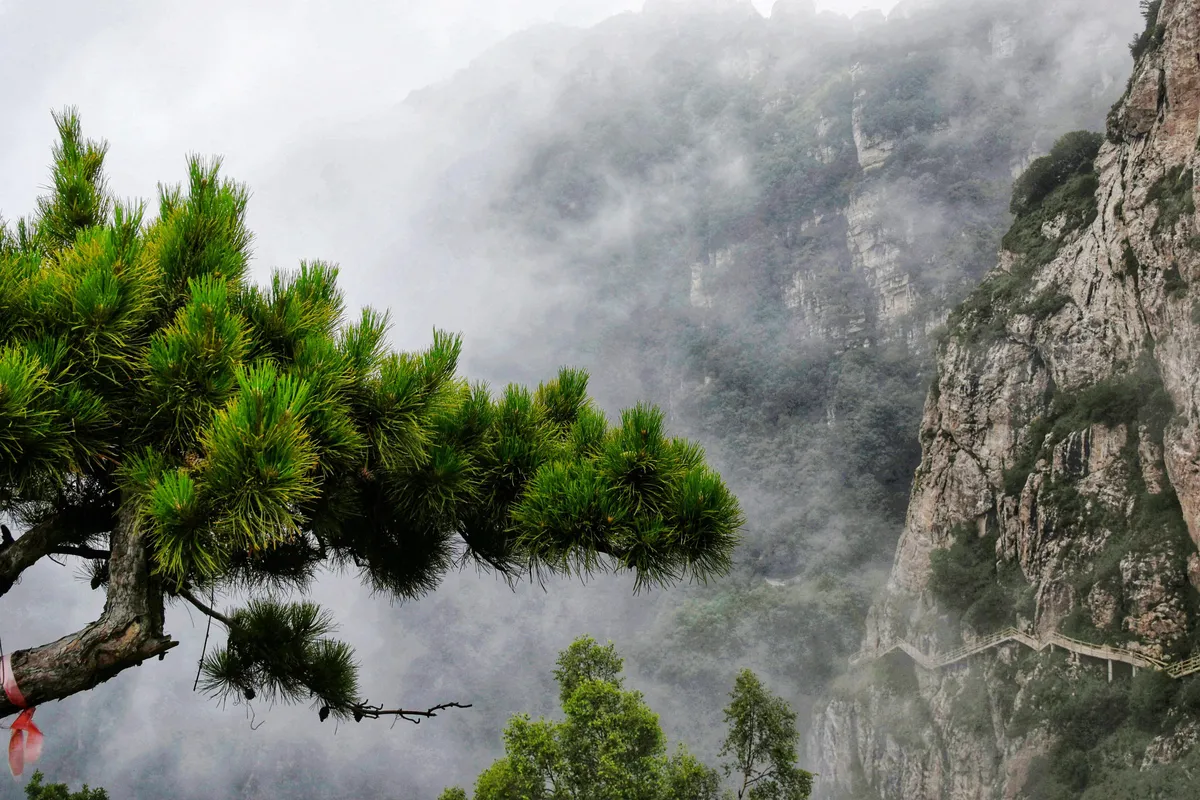
Baishishan has two entrances, east and west. Both require taking a cable car or scenic bus up the mountain, arriving at Xiangyun Gate on the east side and Cuiping Peak on the west side. Due to the pandemic, the west entrance was closed. Taking the cable car from the east entrance, we saw the white stone peaks shrouded in thick clouds and mist, revealing only parts of the mountain. This weather was changeable. If some wind came, we might see the beautiful scenery we hoped for.
Arriving at the mountain's Jiucaiyuan (Chives Garden) via cable car, we encountered wisps of white mist drifting through the valley. The fairy-tale sight delighted everyone. The sky seemed to brighten a bit, filling us with anticipation for the day's tour. But this didn't last long. Soon it began to rain, and throughout the tour, it was either drizzling or overcast.
At Jiucaiyuan, visitors face three route choices: the summit route is not suitable for average tourists, consuming energy and time without many sights; the remaining are the Feihu Gorge Line at 1,600 meters and the Shuanggongshi Line at 1,900 meters. Due to the pandemic, the west entrance was closed, so visitors could only take one route round trip or combine both in a loop.
The scenic area's route descriptions were clear enough, but tourists still couldn't figure out the routes at the map. No one knew the difficulty of each route, and no one informed that the cable car connecting the two lines on the west side was suspended. At this critical point, the scenic area did not arrange staff to guide.
We also didn't understand the route situation, so we simply chose the recommended A route: a big loop of Feihu Gorge + Shuanggongshi. Braving dark clouds and drizzle, we mustered our spirits and started our Baishishan tour. As the saying goes: 'Clear is not as good as rain, rain is not as good as fog, fog is not as good as clouds.' But today the clouds were thick enough to hide the sky, the fog was heavy enough to obscure the scenery, and the rain made climbing harder. This weather did not match the 'White Stone Clear Clouds' atmosphere.
The pandemic has indeed dampened people's courage to go out. In previous years, this northern fairy mountain and summer resort was bustling, but today there were very few tourists. The only people walking the entire route with us were a family of three generations from Baoding.
In this strange natural world where peaks touch the clouds and roots reach the earth, suspended plank roads hundreds of meters high on cliffs are amazing. They are both passages to the deep fairyland and spectacular sights themselves. Walking on the narrow plank roads in the winding U-shaped valleys, we felt extreme thrill and excitement.
The double-layer glass bridge spanning dangerous rocks between two mountains was a classic. Its unique design was a first in China, connected to a glass plank road on a lone peak, giving visitors more views. No one stepped onto the glass bridge or plank road. Unsure of safety, everyone chose to just look and pass.
'Immortal Drying Boots' is a major wonder of Baishishan. How could a hanging stone resembling a boot be so perfectly balanced on a lone peak? Could it be fixed with metal materials? The scenic area introduction shows this geological landscape is formed by many vertical joints in the rock layers. After hundreds of millions of years of weathering, the remaining rock's center of gravity still lies on the main cliff. The rock gradually eroded into a boot shape, eventually forming the 'Immortal Drying Boots' landscape on the lone peak. It is the most lifelike formation in the scenic area, but today the sky was overcast, so the boot might be filled with rain.
'Viewed horizontally as a ridge and sideways as a peak, each distance and height presents a different aspect.' Slightly changing position and angle, the Immortal Drying Boots peak and two adjacent peaks form another interesting landscape—'Three Saints Worshipping Buddha'. Three peaks standing together line up like three bodhisattvas in a standing posture, slightly leaning forward, humbly facing the Buddha, showing a devout attitude.
'Three Caves Overlapping'—three nearby peak walls have weathered into three connected caves. Through the caves, you can see different worlds, truly a hidden paradise. The three caves are endowed with beautiful symbolism: each cave is wider than the last, representing the three stages of meeting, knowing, and loving, finally sealed with a thousand-year kiss, entering the palace of happiness.
'God of Taihang'—a strangely weathered, slender, tall, and thin rock body standing alone among the peaks. Some say it looks like a kind old man telling people the history of Baishishan's changes; others say it looks like a spiritual cultivator absorbing the essence of Baishishan. After hundreds of millions of years of natural baptism, the God of Taihang still stands majestically, guarding Laiyuan, Baishishan, and the Taihang Mountains.
Baishishan is a geological museum. Here you can not only appreciate nature's extraordinary craftsmanship but also learn a lot about geology. 'Ten Thousand Volumes of Heavenly Books'—the strange rocks are layered like the pages of a book. This type of rock is called wavy stromatolite, a biological sedimentary structure formed by blue-green algae in ancient coastal zones binding lime mud and sand into alternating dark and light wavy layers.
'Pillar Peaks Clusters'—these connected stone cones with thick bases and thin tops form a spectacular cluster landscape. Actually, this landscape is not combined but formed by differentiation. They are the product of hundreds of millions of years of crustal movements and weathering. Mountains gradually change from peaks to walls to pillars, and eventually they will completely peel and collapse, disappearing.
This section from the 1,600-meter line to the 1,900-meter line should be completed by the Feiyunkou cable car, but since the cable car was suspended, we had to hike. This section, like a ladder to heaven, tested our physical strength and endurance. I never felt such difficulty. My whole body was wet, not knowing if it was sweat or rain.
'Oath of Union'—Baishishan is a place concentrated with love culture. The marble peak over the deep abyss was designed as a heart-shaped platform. Holding hands on the platform and touching the Heart Stone together, sincerely making vows and wishes, you will be protected and blessed by the Queen Mother of the West.
'Piggy Marrying a Bride'—Legend has it that Marshal Tianpeng got drunk and flirted with Chang'e, was banished to the mortal world, fell in love with Miss Gao, and they got married. Then he met Tang Seng and was forced to follow him on the journey to the West, eventually achieving enlightenment. Nature's wonder has created the peculiar landscape of Piggy carrying his wife on his back, also depicting Piggy as a model husband.
'Dolphin Leaping Out of Water'—this lone peak looks like a small dolphin about to leap out of the sea. But this scene needs a sea of clouds in the valley to match.
The big loop of Feihu Gorge Line and Shuanggongshi Line, due to the suspension of the Feiyunkou cable car, made the eight-hour hike of over ten kilometers extremely arduous. The drizzly, dark weather not only increased physical exertion but also deprived Baishishan of its ethereal beauty. However, even through the not-so-clear visibility, we could see that the forest of peaks in Baishishan is indeed a unique marvel in the Taihang Mountains.