China's Carving Capital: Discover How Gold is Refined—and Maybe Take a Gold Brick Home!
When you mention Quyang, stone carving is undoubtedly the first thing people think of. As early as 1995, the State Council officially designated Quyang County as 'China's Carving Capital'. Quyang boasts a long history; its name derives from its location on the sunny, curved side of the ancient Northern Sacred Mountain, Mount Heng (now Mount Damao). After Qin unified the six kingdoms, the empire was divided into 36 commanderies, and Quyang County was established, belonging to Julu Commandery, with a history spanning over 2,000 years. From the Yungang Grottoes, Leshan Giant Buddha, Dunhuang Caves, and Wutai Mountain Buddha statues to the Epang Palace, the Forbidden City, the Old Summer Palace, the Summer Palace, and the Golden Water Bridge in front of Tiananmen, as well as buildings like the Great Hall of the People, the Monument to the People's Heroes, and the Chairman Mao Memorial Hall, Quyang people's carving artistry has left its mark everywhere.
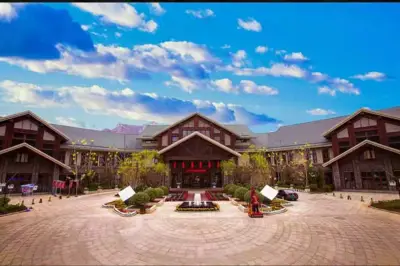
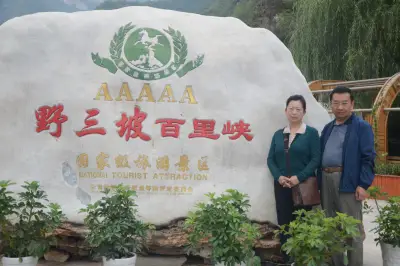
The Hushan Scenic Area we are heading to lies in the northwest of Quyang County, forming a continuous line with the ancient Northern Sacred Mountain, Mount Heng—one of the Five Great Mountains of China designated for imperial rituals. Its main peak, Sanjianliang, rises over 1,100 meters above sea level. Bordering Tang County and Fuping, it creates a mountain tourism landscape where you can stand in three counties at once. Hushan covers more than 30 square kilometers and is a national AAAA-level scenic spot, with vegetation coverage exceeding 90%. The area features a Gold Culture Museum, an Abacus Culture Exhibition Hall, a Folk Wedding Culture Hall, a Folk Blessing Culture Hall, a Folk Customs Exhibition Hall, and a Red Culture Exhibition Hall, housing over 30,000 artifacts. These collections bring together unique local historical and cultural relics from the Taihang Mountain region.
Gold panning culture is the thematic focus of Hushan Scenic Area and one of its distinctive features—it is the only scenic area in China that showcases a gold panning culture. According to the *Quyang County Annals*: 'Gold is distributed in the foothills of Sanjianliang at the northwestern end of the county, with a mineralized zone over 500 meters long. Mining occurred during the Yuan Dynasty.' Local folklore says that gold panning in Hushan can be traced back to the Tang and Song dynasties, and everyday utensils unearthed from scattered mountain dwelling sites confirm this. County officials once came to Hushan to supervise mining, indicating the existence of government-run gold mines historically. The gold mining sites in Hushan remained active until the mid-1990s, finally halted in 1996. The mysterious and deep 'Gold Panning Caves' are caves left by ancient gold diggers, with several extending hundreds of meters deep. Inside, vivid sculptures and murals—presented in forms that visitors love—illustrate ancient mining and gold smelting techniques. There is also a gold refining experience area where you can discover exactly how gold is made.
With the words 'Two families unite in marriage, a covenant is made, a happy union forever, a perfect match,' a small marriage contract carries the happiness of a family. In Hushan's Wedding Culture Hall, over 3,000 marriage certificates from different eras are on display. Red silk drapes paired with red lanterns in a deep lane create an atmosphere both mysterious and tender. Young visitors can't resist taking a photo with their sweetheart and silently making a vow in their hearts. 'While enjoying the mountain and water scenery, I also got to see so many old items from the 1940s and 1950s, which brought back memories of my childhood. It was a trip full of nostalgia and well worth it,' said Mr. Wang, a visitor, happily after touring the area.
From a new bride's dressing mirror to a 'crank-handle' telephone from the Republican era, to pagers from the 1990s... In the Folk Culture Museum complex, vintage objects from various decades tell the story of changing times. A sewing machine, a Forever brand bicycle, even a porcelain teacup or a kerosene lantern—tens of thousands of precious folk artifacts spanning many periods—allow visitors to touch the memory of each era. Through these old items, you can understand the past, sense the present, gain inspiration for the future, and motivate yourself to walk the long march of the times.
Hushan is a magical land. In these deep mountains, rarely visited for many years, near-total vegetation cover conserves abundant water resources. As you walk through, you can enjoy the unspoiled gifts of nature and relax your body and mind completely. Quyang is a renowned carving capital, and the clever people of Hushan have applied traditional craftsmanship to the scenic area's decoration and services. Upon entering, you'll notice that all signs and directional markers are carved from stone. Even roadside resting seats are sculpted following the natural shape of existing rocks. The perfect marriage of traditional carving techniques with modern tourism has become a unique feature of Hushan.
Food is the paramount necessity of the people, and you haven't truly visited Hushan without savoring its culinary delights. The area offers many authentic Taihang countryside dishes that will make your mouth water: Hushan Golden Pancake, Hushan Golden Steamed Bread, Eight Big Bowls, and the nationally renowned local specialty, Black Daughter Dumplings. These dumplings were originally created by Mr. Su Qiaosheng, a master chef in the imperial court during the Chongzhen reign of the Ming Dynasty. From Emperor Chongzhen himself, through the Qing Dynasty's Kangxi and Qianlong emperors to Empress Dowager Cixi, all have tasted them. Around the founding of the People's Republic, party and state leaders like Nie Rongzhen and Yang Chengwu also ate Black Daughter Dumplings when they visited Quyang. Notably, when Premier Li Peng inspected Baoding City, he specifically asked for Quyang's Black Daughter Dumplings.
As we bid farewell to Hushan, the staff told us that the 8th Gold Culture Festival will be held from August 14 to 16. One highlight is the 'Gold Brick Lift' challenge: if you can lift a Hushan 'gold brick' with one hand, you'll walk away with a cash prize of 6,666 yuan! If you can't lift the gold brick, don't worry—there's also an 'Angry Birds' game for children. Participants simply use a slingshot to shoot and take home the corresponding prizes they hit.