Hibiscus Blooms
July has come again, and with it the season of blooming hibiscus.
As spring fades into early summer, the peach, apricot, pear, and plum blossoms have all taken their final bow. By summer, aside from the wild herbaceous flowers, the hibiscus takes center stage in Yandu Ancient City.
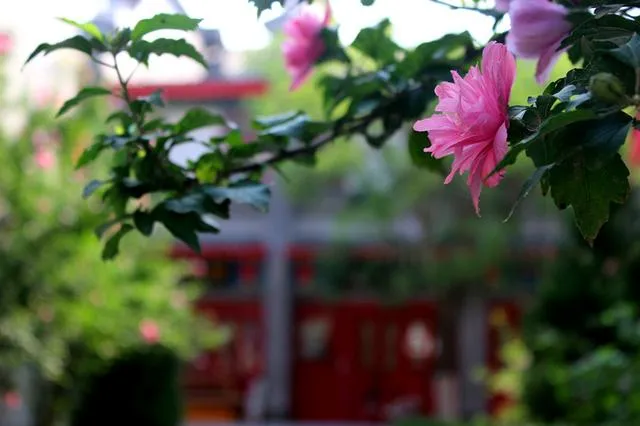
With their pink blossoms, glossy green leaves, and slender yet resilient branches, they sway and dance, peeping through everywhere; by houses, along the waterways, embraced by groves, they exude beauty, waft their fragrance, and stand quietly as a scene all their own.
The beauty of the hibiscus has been celebrated since ancient times. The Book of Songs says: ‘A lady rides with me, her face like the hibiscus bloom. She flits and soars, her jade pendants tinkling… A lady walks with me, her face like the hibiscus flower. She flits and soars, her jade pendants jingling…’ The ‘hibiscus bloom’ and ‘hibiscus flower’ in the poem refer to the hibiscus. Using flowers to describe people, the beauty in both is reflected: a beauty like a flower, a flower like a beauty, which fully shows the hibiscus’s charm.
Speaking of its name, there is a beautiful legend:
In remote antiquity, east of the ancient capital mound, there was a hill called Lishan. At its foot grew three clumps of hibiscus, reaching as high as two zhang (about six meters), lush and flourishing. In summer and autumn, the trees would burst into full bloom, splendid beyond words.
One year in early autumn, the ‘Four Evils’—Hundun, Qiongqi, Taowu, and Taotie—came to admire the flowers. Seeing such beauty, they each conceived the wicked idea of claiming them as their own. So on Lishan, they fought over the hibiscus. In the end, battered and bruised, they managed to uproot the three clumps. But the flowers and leaves quickly withered and fell. Then the Four Evils left in dejection.
Upon hearing this, Yu Shun hurried over and called on the farmers to prop up the hibiscus and water them. Then a miracle occurred: the hibiscus came back to life, blooming beautifully as before. He and the farmers all smiled with joy.
On the day the hibiscus revived, Yu Shun met three fairies in a dream and told them what had happened. In a haze, he saw the three fairies drifting over, so beautiful that he was entranced. The three lovely fairies told him they were the hibiscus spirits, deeply grateful for his rescue. Yu Shun was startled and immediately bowed, but the fairies laughed, saying that to repay his great kindness, they had taken his name, Shun, as their surname…
More admirable than the pleasure their beauty brings is the hibiscus’s character: unafraid of violence, valuing loyalty and righteousness, and persevering with resilience.
The Tang Dynasty poet Cui Daorong tenderly described the hibiscus: ‘The hibiscus flower never sees the evening; each day it renews. The east wind will blow peach and plum blossoms, but not until next spring.’ Blooming at dawn and fading at dusk, each withering is for an even more brilliant bloom next time. These delicate flowers possess an indomitable spirit, just like the sun setting and rising, the seasons cycling from spring to autumn, endlessly and everlastingly.
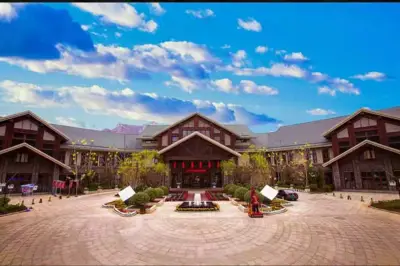
Tough flowers! Loyal and righteous flowers! Flowers that inspire reverence! Now, you have settled along the Yishui River, in the land of Yandu Ancient City. Together with the ancient-style architecture here, together with the deep cultural veins flowing through this place, you bloom with your own beauty, persisting in your own persistence.