A Journey to the Hometown of Tang Yao: The Millennia-Old Culture of Emperor Yao
Lanterns cast their first light on the ancient bluestone path, the love of Yao’s mother lingers, the night is still young.
Opening the WeChat Moments and short video accounts of travel enthusiasts from all over the country, photos and videos of “cultural tours” from every corner flood in, showing that “cultural tourism” has become a major trend in the current travel market. Especially in recent years, some emerging “ancient towns,” “landscapes,” “cultural parks,” and “hometowns of historical figures” backed by ancient culture have, with their novel models, sense of historical participation, and interesting cultural tourism projects, become popular destinations that travelers are eager to visit. Among them, a cultural tourism project centered on the “Tang Yao culture” has, with the charm of ancient culture spanning thousands of years, attracted visitors from all directions and local residents to come and check in, rising as a new internet-famous spot.
Emperor Yao, the ancestor of Chinese civilization and one of the “Three Sovereigns and Five Emperors” of ancient China, was the son of Emperor Ku (his father) and Empress Qingdu (his mother). In 2365 BC, at the age of fifteen, Yao was enfeoffed in the ancient Tang state, hence also known as “Tang Yao,” giving rise to the millennia-old “Tang Yao culture.”
Tang County, historically called “Tangdi,” was where Yao was enfeoffed as the Marquis of Tang and where he established the Tang state. Successive generations inherited the character “Tang,” and when the county was established in the early Han Dynasty, it was named Tang County, becoming the millennia-old hometown of Tang Yao, the birthplace of Tang Yao culture, and one of the origins of Chinese civilization. In 2014, it was named “Hometown of Chinese Tang Yao Culture” by the China Folk Literature and Art Association.
The “Third Baoding Tourism Industry Development Conference” is about to open. As the “Hometown of Chinese Tang Yao Culture,” Tang County’s achievements in the protection and inheritance of Tang Yao culture and the construction and development of the cultural industry have become a major focus of this conference. In recent years, the “Qingdu Mountain Health and Tourism Resort,” which uses Qingdu Mountain as its cultural scene carrier, has gradually formed a complex of cultural architectural entities. Among them, cultural tourism projects represented by Qingdu Mountain, Yaomu Lake, the ancient Lingyuan Temple site, the Tang Yao Museum, and the Tang Yao Ancient Town have become must-visit projects for tourists coming to Baoding from all directions.
Qingdu Mountain, as the name suggests, is named after “Qingdu,” the mother of Emperor Yao. It features undulating green peaks and beautiful scenery. The Qingdu Mountain Health and Tourism Resort, built along the mountain, covers an area of 16 square kilometers (about 24,200 mu) with a total investment of 5.4 billion yuan. Focusing on leisure vacation and cultural experience, it skillfully integrates historical humanities, natural landscapes, traditional folk customs, characteristic B&Bs, health hotels, and other formats, making it one of the largest tourism and vacation destinations in Baoding and North China.
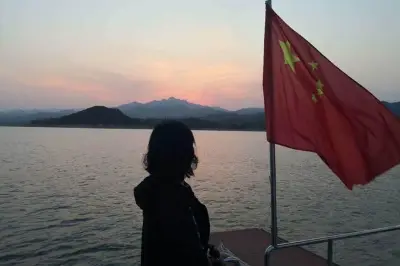
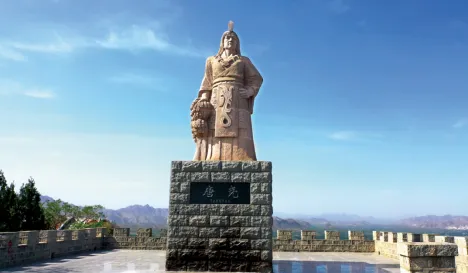
Standing on the summit of Qingdu Mountain and looking into the distance, you see mountains surrounding it like a green screen. Qingdu Mountain sits alone in the center, winding and coiling like a reclining dragon, exuding an imperial aura. On the flat top of the mountain, there is a summit square for worshipping Emperor Yao, with a statue of Emperor Yao placed there. The nine-square grid on the ground is inlaid with metal strips bearing the names of the nine ancient provinces: Ji, Yan, Qing, Xu, Yang, Jing, Yu, You, and Yong, representing the entire Chinese land. Mountains and waters complement each other. Yaomu Lake, nestled beside the mountain, is beautiful with rippling blue waves. Legend has it that Yao’s mother often came to this lake to wash clothes while raising Tang Yao in the Tang region.
On the western part of Qingdu Mountain lies the site of the ancient Lingyuan Temple, first built during the reign of Empress Wu Zetian. It was a famous imperial temple, evidenced by the existing temple base bearing the “Spirit Tablet of Empress Qingdu, Consort of Emperor Ku” and five blue marble Buddhist scripture steles inscribed with “Offering of the Great Tang Empress Dowager.” The temple is surrounded by soaring green cypresses, and there is an ancient stone well. The moon can be seen reflected in the well from night until dawn, a phenomenon known as “Lingyuan Dawn Moon,” one of the eight ancient scenic spots of Tang County.
Connecting the mountaintop to the foot of the mountain is a stone path totaling 350 meters in length with 711 steps. Throughout history, whether emperors, generals, or common people, they have regarded the statue of Emperor Yao as a sacred place to pray and make wishes, and this pilgrimage path is the staircase carrying those wishes and dreams.
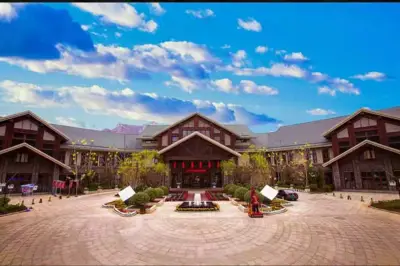
The Tang Yao Museum, located at the entrance of the Qingdu Mountain Health and Tourism Resort, is the most distinctive building of the Tang Yao culture exhibition area and the first large-scale pure wood structure in North China built with Tang-style mortise and tenon joints.
Based on Tang Yao culture, the Tang Yao Museum presents a strong image of a Tang-style imperial hall. The overall building is grand, magnificent, and elegant. Its facade features a double-eave hip roof with wooden pillars and beams as the main structure. The hall has a total height of 26 meters and a total floor area of 4,576 square meters. Among them, the wide lower platform covers an area of 3,317 square meters, and the wooden-framed hall covers 1,258 square meters. Inside the museum, three statues of Yao, Shun, and Yu are displayed, surrounded by murals that take the brilliant and legendary life of Tang Yao as a clue, showcasing the tales of his birth, growth, achievements, and the establishment of the era of Yao and Shun.
Tang Yao Ancient Town, imbued with strong nostalgic affection, is built as the “Hometown of Emperor Yao” based on the mother Yao’s love and longing for her son Tang Yao, and the praise of the Tang people for Emperor Yao’s virtuous governance, concern for the people, fairness, selflessness, and respect for talent over power. The ancient town sits in the gentle valley between Qingdu Mountain and Yu Mountain, adjacent to Yaomu Lake, covering an area of 182 mu. It is a charming ancient town featuring an ancient commercial street and northern-style residences. The town is a showcase of the folk customs of the Tang Yao cultural heritage. The streets are arranged in rows along the mountain and lake. The buildings are mostly one or two stories high, not exceeding 40 meters overall, with grey bricks and black tiles, exuding an ancient charm.
Horseshoe sesame cakes, Tang County bowl meat, Liuyang steamed dishes, one noodle, pulled noodles, river snail rice noodles, belt noodles, golden pumpkin cake, spicy rabbit head, Shanxi liangpi... The commercial street of the ancient town gathers the specialty cuisines of Shanxi, Shaanxi, Henan, Shandong, Sichuan, Tang County, and Baoding, allowing you to taste flavors from all over the country in one place. The traditional craft workshops along the street take you back in time to experience the spirit and charm of traditional artisans. Over the thousands of years of history, it is these artisans who have painstakingly preserved and passed down Chinese culture in their respective fields.
The inheritance and adherence to traditional culture inevitably require industrialized commercial operations. Only when economic returns and cultural development achieve a win-win situation can culture be truly activated. Tang County, precisely targeting its own cultural advantages, and inspired by the basic strategy of cultural construction in the new era of Xi Jinping Thought, is vigorously promoting the high-quality development of the cultural industry, improving the modern cultural industry system and market system, promoting the growth and development of various cultural market entities, cultivating new cultural formats and consumption patterns, and enhancing people’s cultural sense of gain and happiness through high-quality cultural supply. In recent years, driven by the national push for the construction of the “night economy” industry, Tang County has made significant investments in the night lighting upgrade and the construction and support of the night economy industry in the Qingdu Mountain Health and Tourism Resort. When night falls, looking down from a height at the ancient architectural complex of Tang Yao Ancient Town and the Tang Yao Culture Museum, the visual effect is dazzling and colorful. Visitors, wandering in the lights and shadows, travel through millennia and have a cross-time dialogue with their ancient ancestors. Under the starry and brilliant night sky, Qingdu Mountain appears dreamlike and surreal.
In the future, cultural industry projects with Tang Yao culture at the core will continue to take on more creative and magnificent forms, standing on this fertile cultural ground of Tang County, Baoding City, Hebei Province. Tang County opens its cultural door and warmly welcomes guests from all directions!