Visiting a Red Education Base – Tang County, Hebei
The Norman Bethune and Dwarkanath Kotnis Memorial Hall in Tang County
On March 3, 1890, in the small town of Gravenhurst in northern Ontario, Canada, a boy was born to an ordinary pastor’s family and given the name little Henry. More than 40 years later, in 1937, across the ocean from Canada, the people of China were straining with all their national might to resist the Japanese fascist invaders. It was also in that year that the man born in that small northern Canadian town on the other side of the Pacific made a sacred vow to aid China’s war of resistance, went to New York to sign up with the International China Aid Committee, and volunteered to form a medical team to work with guerrilla forces in northern China. In the spring of 1938, carrying enough medicines and equipment to outfit several medical teams, he arrived in Yan’an and met Mao Zedong, the leader of the Chinese Communist Party.
The foreigner personally received by Chairman Mao Zedong was the Canadian communist and renowned thoracic surgeon Dr. Henry Norman Bethune, a name engraved on the monument of honor in China’s war of resistance. Dr. Bethune spent his whole life tirelessly fighting against fascism. For the Chinese people’s cause, he proposed and helped establish health schools, trained large numbers of medical workers, and set up the first field hospital in the Jin-Cha-Ji (Shanxi-Chahar-Hebei) Anti-Japanese Base Area. On top of that, he worked relentlessly to race against death and save the wounded. What most deeply touched the Chinese people was that, in the effort to treat the injured, he gave his precious life to the liberation of the Chinese nation at the age of 49. To honor and remember this great international friend and communist fighter, Commander Nie Rongzhen issued an order naming the field hospital after him, later called the “Bethune International Peace Hospital.” Another great friend of the Chinese people became that hospital’s first director — Dwarkanath Kotnis. Kotnis, a member of the Indian medical aid team to China, broke through repeated obstructions by the Kuomintang authorities and arrived in Yan’an in February 1940, serving as a surgeon at the Eighth Route Army hospital. In June 1940, he came to Tang County in western Hebei, taking up the posts of first director of Bethune Hospital and surgical instructor at the Bethune School. In July 1942, he joined the Chinese Communist Party. He worked tirelessly, rescued the wounded, and trained medical personnel, earning praise from local soldiers and civilians as “the second Bethune.” On December 9, 1942, he died of overwork at Ge Gong Village in Tang County, Hebei, at only 32.
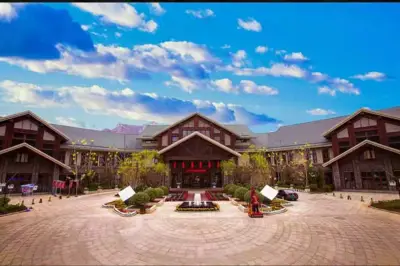
Passing on the glorious deeds of Dr. Bethune and Director Kotnis and carrying forward their spirit is the mission and responsibility of Baoding City’s “Red Culture” development project in Hebei Province. In November 1986, the new Bethune-Kotnis Memorial Hall complex was completed at the foot of Zhongming Mountain in Tang County and opened to the public. Covering 45,950 square meters with a floor area of 3,300 square meters, the entire architectural group is majestic and imposing. Its resplendent glazed-tile roofs complement the surrounding undulating pines and cypresses; the memorial halls with their dougong brackets and flying eaves, the granite slab steps rising from south to north, the entrance pailou with its cloud-ridge and green tiles, and the surrounding grey-brick walls form a harmonious whole. Through the pailou, you can see the main complex with a 22-meter height difference along the central axis. All buildings are in traditional Chinese style with modern structures and exquisite design. The south-facing main gate is a traditional Chinese pailou symbolizing merit and eternity. Entering the gate, you are greeted by a reclining stele of Indian red granite, with relief busts of Bethune and Kotnis carved above and their bilingual biographies (Chinese and English) inscribed below. The main complex consists of “two halls and one memorial hall”: the octagonal memorial hall lies in the center on the north side, flanked by the Bethune Memorial Hall to the west and the Kotnis Memorial Hall to the east. In the corridors linking them, four large copper relief panels depict the themes “Leading the Team Eastward,” “Deep Bond with the People,” “Battlefield Rescue,” and “Self-Reliance.”
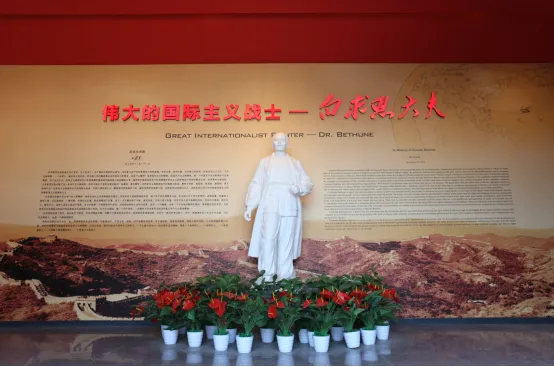
The Bethune Memorial Hall has a 450-square-meter exhibition space and a 110-meter exhibition route, featuring the permanent display “Great Internationalist Fighter — Dr. Bethune.” It covers six units: Unit 1: Childhood, Adolescence, and Youth; Unit 2: Advocating Socialized Medical Systems; Unit 3: Joining the International Anti-Fascist Front; Unit 4: Coming to China to Aid the Resistance; Unit 5: Fighting in Jin-Cha-Ji; Unit 6: Immortal Spirit, Enduring Friendship.
The Kotnis Memorial Hall also covers 450 square meters with a 90-meter route, presenting the permanent exhibition “Friendship Envoy of the Chinese and Indian Peoples.” Its six units are: Unit 1: Youth; Unit 2: Journey to China; Unit 3: First Days in Northern Shaanxi; Unit 4: Jin-Cha-Ji Years; Unit 5: Died at His Post; Unit 6: A Lasting Legacy.
Former Site of the Jin-Cha-Ji Military Area Command Headquarters
The Hundred Regiments Offensive was a large-scale offensive and counter-“mopping-up” campaign launched by the Eighth Route Army behind enemy lines in North China during the War of Resistance against Japan. Because the troops committed numbered 105 regiments, it was called the “Hundred Regiments Offensive.” The main theater of this massive campaign covered the whole of Hebei-Chahar and most of Shanxi-Suiyuan, and it was during this period that the Jin-Cha-Ji Military Area Command Headquarters became a monument in the history of the Chinese people’s resistance.
The former headquarters site is in Hejiazhuang Village, Juncheng Town, 47 kilometers from the county seat. The Jin-Cha-Ji Military Area was formed from part of the Eighth Route Army’s 115th Division. In March 1939, the command headquarters moved from Fuping to Zhanghezhuang Village in Tang County, then on May 21 of the same year to Hejiazhuang in Juncheng (codenamed Dali Village). During the Tang County period, Nie Rongzhen served as commander and political commissar, Nie Heting as chief of staff, and Shu Tong as director of the political department. In these years, the Jin-Cha-Ji Military Area took part in famous battles such as the Hundred Regiments Offensive, the Battle of Huangtuling, and the Battle of Yansuya, scoring brilliant victories and growing rapidly. In early August 1941, the command moved from Hejiazhuang to Fuping County, having been stationed in Tang County for two and a half years; afterward, the command of the 3rd Sub-Area of the Jin-Cha-Ji Military Area moved into Hejiazhuang Village. Departments including operations, cipher, military affairs, and medical services — as well as leaders like He Long, Guan Xiangying, Yang Chengwu, Lü Zhengcao, and Wang Zhen — were scattered in various locations around the village. Though more than 70 years have passed, most of the courtyards still retain their original appearance.
Cradle of New China’s Munitions and Chemical Industry
The flames of revolution burned with boundless passion on this red soil. Tang County was not only the command center of the Jin-Cha-Ji Military Area but also the seat and rear base for the party, government, and military organs of the Central Hebei Region and the cradle of New China’s munitions and chemical industry. Here, sulfuric acid, the key raw material for military chemicals, was first successfully developed, and a fairly complete ordnance industry system was established. Behind Qingxu Mountain in Tang County, Da’angou, surrounded by ridges with few inhabitants and thick vegetation offering excellent concealment, was an important base for ordnance production in the Shanxi-Chahar-Hebei revolutionary base area during the war. The Da’angou Chemical Plant, despite having no equipment, raw materials, or technical know-how, used indigenous methods to produce high-purity “sulfuric acid, the mother of military chemistry,” and a series of subsequent products such as smokeless powder, ammonium nitrate explosives, cartridge cases, and silver fulminate, thus enabling the Shanxi-Chahar-Hebei base area to form an independent and complete ordnance production system. This made an enormous contribution to the final defeat of the Japanese invaders and the founding of New China, and is why it is hailed as “the cradle of New China’s munitions and chemical industry.” Here burns the fervent aspiration of the Chinese people for a strong army and a strong nation.
Chairman Mao Zedong’s Residence “Going to the Capital to Take an Exam”
One day in 1949, the home of Li Chengrui in Shulü Village, Gaochang Town, Tang County, received a visitor who described himself as “going to the capital to take an exam,” speaking with considerable humor. The man who stayed at Li Chengrui’s home was Chairman Mao Zedong, who on October 1, 1949, would proclaim to all the people of China and the world, “The People’s Republic of China is founded!” After the peaceful liberation of Beiping, the CPC Central Committee decided to move from Xibaipo to Beiping. On the morning of March 23, 1949, the Central Committee set out from Xibaipo, passing through Lingshou, Xingtang, and Quyang, and arrived at Shulü Village in Tang County around 9 that evening. A motorcade of eleven cars and ten trucks slowly entered the village. Chairman Mao stayed in the north room of Li Chengrui’s house, while Zhou Enlai, Liu Shaoqi, Ren Bishi, and other central leaders lodged in other villagers’ homes. At 9 a.m. on March 24, the leaders departed from Shulü Village to continue their “journey to the exam” in the capital. On the 50th anniversary of the founding of the PRC, CCTV came here to film the large-scale documentary From Xibaipo to New China. Today, Chairman Mao’s “Going to the Capital to Take an Exam” residence is a key stop on the “Retracing the Exam Journey” red tourism route, attracting large numbers of visitors each year.
The 3rd Baoding Tourism Industry Development Conference is about to open. Baoding City, as the core of the Shanxi-Chahar-Hebei anti-Japanese base area, naturally makes red tourism a focal point, drawing the attention of leaders, distinguished guests, and tourists attending the conference. Looking back, the great friends of the Chinese people — Bethune and Kotnis — their dedication and loyalty to communism reflect an identification with the spirit of total resistance in the Shanxi-Chahar-Hebei border region and a profound respect for our great leader Chairman Mao Zedong. We share the same red mission and the same revolutionary ideals. Unlike other traditional cultural heritage, red culture signifies mission, responsibility, and the Chinese Dream! The revolutionary flame never dies; red culture endures forever. Tang County welcomes you!