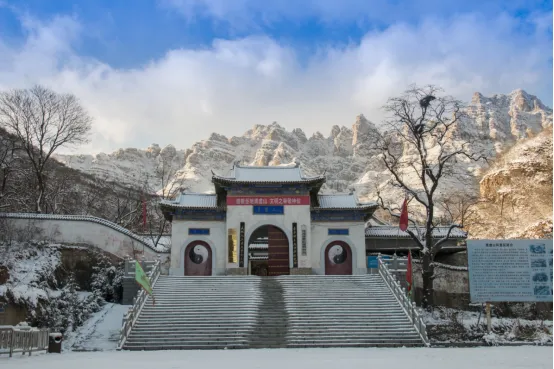
Taoist Mountain——Qingxu Mountain (Ge Hong Mountain)
Ge Hong, one of the founders of Taoism, an alchemist, and a medical scientist. Although he was a Taoist priest who practiced alchemy, he still has his own pharmaceutical group (in name only) to this day, which shows his accomplishments in medicine.
If Ge Hong were alive today, he would be the child that others envy—good at everything! First, he came from a good family, born into a literati clan in Jiangnan. Although his family later declined, he was still an excellent student. Second, his career advanced rapidly; he served as a consultant, general, and other positions. Later, for suppressing the peasant uprising led by Shi Bing and others, he was granted the title of Marquis of Guannei. Yet he resolutely resigned from his official post and devoted himself to Taoism. Finally, after studying under a master and joining Taoism, he not only married his master's daughter but also made achievements in Taoism and medicine.
Since he devoted himself to Taoism, his mind was set on immortality, alchemy, and cultivation. Thus, Ge Hong searched far and wide for immortal mountains. Finally, one day, "cutting through thorns and brambers, climbing vines and creepers," he arrived at Qingxu Mountain to practice. He left behind relics such as the Xixin Spring, Qingxu Palace, medicine mill, mugwort-drying platform, and the Immortal Chess Stone.
With so many famous mountains and great rivers, what made Qingxu Mountain special enough to attract this Taoist scholar? It turns out that Qingxu Mountain "has clear and warm air throughout the four seasons, bordering on nothingness, transcendent and detached." Moreover, the mountain is mostly composed of limestone, which, after long-term wind and rain erosion, has formed strange peaks like green bamboo shoots, wolf fangs, and arrowheads, piercing straight into the sky. Under the sunlight, smoke and mist swirl, and purple qi drifts ethereally. It sounds truly otherworldly.
Some natural caves are even deeper and more mysterious, adding infinite mystery to Qingxu Mountain. Since Ge Hong's arrival, Qingxu Mountain has become a must-visit destination for Taoist successors to preach scriptures. According to the "Stele of Chongxianzi Returning to Truth," the founder of Quanzhen Taoism, Qiu Chuji, sent his disciple Chen Daoyi (known as Chongxianzi) to Qingxu Mountain to preach, develop followers, and build temples and nunneries.
Emperor Qianlong, on his way to Mount Wutai for incense offering, passed by this area. Seeing the mountain's majestic grandeur, he sent his minister Dong Bangda to survey Qingxu Mountain twice. Dong painted a panoramic map and eight small scenes, which are still preserved in the Palace Museum. The emperor also wrote the characters "Ziyun Peak" (Purple Cloud Peak) and "Fenghuang Stone" (Phoenix Stone) on two jade tablets, which were inlaid on the cliffs.
With the endorsement of Quanzhen Taoism and the promotion by Emperor Qianlong, Qingxu Mountain became even more "spiritually" gathered, with incense thriving continuously. From the Liao Dynasty to the end of the Qing Dynasty, over 100 temples, monasteries, nunneries, and shrines were built on Qingxu Mountain. The annual temple fair on the 15th day of the third lunar month attracted believers from all over North China to come and worship, making it extremely lively.
The main reason Qingxu Mountain attracted so many Taoist scholars to come and check in was its beautiful and magnificent scenery. According to Chen Xiaoyuan's "Geshan Zhizhang Tu" (Guide Map of Ge Mountain) from the Qianlong period of the Qing Dynasty, Qingxu Mountain has over 40 natural landscapes, including four peaks such as Ziyun Peak, three cliffs, nine caves, four valleys, two gardens, two stockades, two precipices, and two tidal areas. Looking from afar, "thousands of peaks stand green, clear and dark at times, mist and clouds ever-changing, Qingxu stands green and towering." It is one of the eight ancient scenic spots of Tang County.
Behind Qingxu Mountain, there is Xisheng Gully, with flying springs and waterfalls, and streams flowing all year round. The two beautiful dragon pools appear full of spiritual energy. For over ten li, the gully is filled with jagged rocks and interlocking fangs, and the steep cliffs are covered with stalactites. Stone flowers, stalagmites, and stone nipples come in various poses and strange shapes. The entire gully is filled with azaleas and crabapple flowers, and the slopes are covered with kudzu vines and shrubs. Spring water splashes, presenting a scene reminiscent of the southern landscape.
The beautiful scenery and Taoist cultural connotations are not enough to describe Qingxu Mountain as it is now. Qingxu Mountain and Damao Mountain, located at the junction of Tang, Fuping, and Laiyuan counties, form a strategic pincer. It is also a place of military importance, controlling the Taihang Mountains to the west and the North China Plain to the east.
At the foot of Qingxu Mountain, the 4th Company of the 2nd Regiment of the 3rd Sub-area of the Jin-Cha-Ji Military Region of the Eighth Route Army successfully blocked the Japanese mopping-up operation. As a result, the "West Gully" behind Qingxu Mountain was renamed "Xisheng Gully," meaning "Victory Gully," to commemorate this historic battle. In addition, the lower Qingxu area of Qingxu Gully and the Hulu Pond (Gourd Pond) in Xisheng Gully are the former sites where the internationalist fighter Dr. Norman Bethune treated wounded Eighth Route Army soldiers and provided medical care for local villagers.
It seems that Qingxu Mountain, like Ge Hong, is a "scenic spot belonging to others" — it has beautiful scenery, cultural depth, and is a red landmark. Such a high-quality scenic spot is just a small part of Tang County. It is hoped that through the promotion of the third Baoding Tourism Development Conference, the tourism resources of Tang County will be fully tapped, bringing Tang County into the public eye, truly realizing all-for-one tourism, driving the development of cultural tourism industry, revitalizing Tang County's economy, and achieving poverty alleviation through cultural tourism.
Finally, this scenic spot that belongs to others — would you consider coming to see it?