Autumn Trip to Yesanpo and Yishui Lake (The Wind Blows Bleakly, the Yi River Chills---)
The eighth chapter of 'Zhuozhou Annals,' 'Sampo Branch Preface,' records: 'Sampo has long been under Zhuozhou's jurisdiction, but its origins remain untraceable.' However, it includes multiple poems by Yuan, Ming, and Qing poets singing about 'Panpo Snow' (one of the ancient eight scenic spots of Zhuozhou).
One: This place is a paradise, ignoring Han and Wei, let alone Jin and Yuan.
Fleeing fame in rocky valleys, hiding in forests and springs.
Magnificent rivers and mountains, how can one stand by with folded hands and let them be ungoverned?
The slopes covered with snow, mountains appear and disappear.
Regarding the historical origins of Yesanpo, though some traces can be captured, there is still no definitive evidence.
In 1984, the county government organized a tourism resource investigation team to study the name, region, and jurisdiction of Yesanpo. The following is only a brief introduction: Yesanpo borders Fangshan to the southeast, Wanping to the northeast, and is bounded by the Great Wall to the northwest, adjacent to Zhuozhou.
The terrain gradually rises from south to north, with significant differences, thus it is divided into upper, middle, and lower slopes.
According to 'Zhuozhou Annals': 'Due to the barrier of the mountains, the climate differs between the upper and lower slopes, with a temperature difference of about half a month.
Every spring, when walnuts on the lower slope already bear fruit, the upper slope is just flowering.
Rain comes later, so farming is correspondingly delayed.' Thus, the name Sampo originated from topographical changes and climatic differences.
Investigating the history of Yesanpo, a folk song circulates: 'Yesanpo, Yesanpo, Prince Yan's northern campaign didn't sweep it. Hair bundled like a wild bird's nest, shoes turned up at the toes. Not allowed into the examination hall, generations of blood and tears.' This song is a historical portrayal of Yesanpo.
According to 'Zhuozhou Annals,' 'In the early Ming, Prince Yan (Zhu Di) led a northern campaign and reached the boundary of Sampo (Nucai Ridge), where he saw a wild animal (squirrel) holding a pinecone as if bowing in salute. The prince thought it was paying homage, and said to his attendants, 'Even beasts submit, let alone the people!' He then issued an imperial edict exempting them from corvee and grain taxes.' To this day, the saying that they received imperial favor is still widely spread.
By the Qing Dynasty, because the people of Sampo revered the Ming, the Qing court pressured them, forbidding Sampo people from participating in the imperial examinations and depriving them of the right to seek 'merit and fame.' At that time, some bandits from outside colluded with local officials to extort Sampo. The people's lives were unsettled, so they elected 'elder officials' who were 'wealthy and of high prestige' to manage all affairs within the slopes, and were forced to organize armed protectors to defend their hometown. It is recorded: 'Once an alarm is raised, regardless of village boundaries...'
Original ecological small group tour - Yesanpo
In Yesanpo, a folk song circulates: 'Yesanpo, Yesanpo, Prince Yan's northern campaign didn't sweep it. Hair bundled like a wild bird's nest, shoes turned up at the toes. The Qing Dynasty forbade entry to examinations, generations of blood and tears.' This song tells: Yesanpo was originally called 'Sanpo.' During the Ming Dynasty, Prince Yan Zhu Di came here and saw a squirrel holding a pinecone bowing to him, so he said to his attendants, 'Even beasts submit, let alone the people!' He then issued an imperial edict exempting them from corvee and grain taxes. Therefore, the local residents have always cherished the favor of the Ming Dynasty. After the Qing army entered the pass, the Qing rulers discovered that the people of Sanpo still harbored sentiments for the previous dynasty, which made them angry and annoyed. They not only ordered that Sanpo residents be barred from taking the imperial examinations but also added the character 'Ye' (wild) before Sanpo, calling it 'Yesanpo.'
This trip took place in late autumn, and after brainstorming, we finally chose Laishui Yesanpo. Considering temperature, distance, and time, this was one of the rare outings after the company's restructuring. The interest was evident, and the cohesion was visible.
The director's motto for the trip was to strike a pose, both for fun and for memories. Smiling naturally.
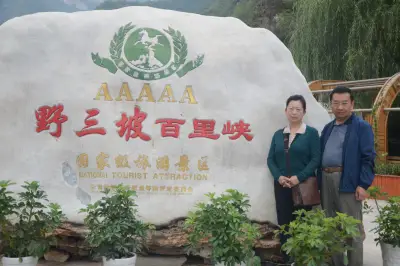
Yesanpo, with its 'majestic, perilous,奇特, and tranquil' natural landscapes, enjoys the reputation of a paradise. Baili Gorge, known as 'the world's first gorge,' features cliffs as if cut by knives and axes, strange rocks standing upright, crabapple flowers filling the ditch, and wildflowers covering the mountains. Strolling through it feels like stepping into a thickly colored gallery of a hundred miles.
The effect of posing was obvious—extremely happy, photos full of joy. Everyone was quite cheerful when not working.
Baili Gorge is rich in vegetation and full of wild charm. There is a special plant here, 'one root grows one stem, one stem holds one leaf,' called 'single-root grass.'
The timing was just right, entering the park around 3 pm. Walking opposite to most tourists, we could fully enjoy the quiet beauty given by nature without crowding or noise.
At the entrance of Baili Gorge, there was still some bustle, with endless posing. After taking a few group photos, we ventured deep into the gorge to explore.
The director's excitement was palpable. Truly a talented scholar from a prestigious university, full of character. Brother Kan just made a casual visit. Even the crutch of Iron Crutch Li couldn't help much. On the road, the sedan chair bearers heard someone wanted to ride, rushed over eagerly, offering a 20% discount. After bargaining, we found it not worthwhile. This load would probably exhaust the bearers halfway, so the deal fell through, and they parted ways.
Gorge route map - setting off
The expression says it all without words.
The continuous steps by the small waterfall made a few people hesitate for a while. Since we came, we had to climb. Choosing the right direction was the first thing to do, just like entering society in life. The first step on the right path leads to a bright future. Once you take the wrong path, you will undergo many hardships with unknown consequences, wasting precious time.
Old Cong had a strong drive to climb, without hesitation.
We had encountered this kind of climbing steps several times before, but in our younger days. Considering our knees and ankles, we were a bit intimidated. They say that at this age, we should climb less, but the joy of being out with everyone made us forget our original intention—it didn't quite match our real-life philosophy. We also talked about what medicine works—Move Free.
These steep steps, if not accompanied by the sound of the waterfall echoing in the stream, would probably have made us go straight down the mountain.
A good place for cultivation. Wugong once again confirmed the magical footwork in the cave. Many martial arts masters come from here (many martial arts films were shot in this gorge). When training is complete, you can move forward through the mountain and stroll in the martial world.
Typical posture of the gorge.
Somewhat of a tomboy flavor.
The vitality of plants on the rocks is strong, surviving in rock crevices.
The path in the Sky's Gate.
Spring water flows continuously under the Celestial Bridge.
The pinnacle of the mountain—joy from the heart.
The hardship of climbing—tired but happy.
In a flash, a small episode occurred: the weakest southern woman, who hates climbing most, surprisingly went downhill quickly but in the wrong direction.
Finally reunited, and the worry about the weak woman pacing back and forth on the cable car platform could be put down.
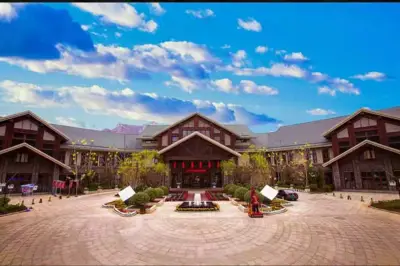
Dinner: The farmhouse stay was indeed 'all happy.' The restaurant owner's family was very kind. They pulled radishes from their own vegetable patch, picked eggplants, cut leeks (we experienced the feeling of cutting leeks ourselves—a bit different from stocks and futures), and even gave us some freshly pulled radishes before we left, to help us 'clear the air.' When the wine was flowing, everyone said drinking requires a certain amount, but controlling the amount is really difficult. We thought of the great poets Li Bai and Du Fu's life in wine, sighing deeply! We hadn't seen each other for many days, so we talked freely at the dinner, sharing all topics, very lively! A small episode: After returning to the room, everyone kept saying, 'We chose the wrong career.'
Leaving the gorge was nearly evening, and the time in the valley of visiting heroes was just right.
Seeing the railway tunnel deep in the mountains, and the well-equipped tourism facilities now, I recalled coming here 36 years ago—a world of difference. In those days, we stayed overnight in a mountain villager's home, eating up all their New Year's reserves: a big rooster (I guess the hen would have to wait a while for eggs—no rooster to tread), two jin of meat, and a basket of eggs. Sleeping on a large kang for one night gave many feelings—young people dare anything!
Leaving Laishui. The next stop was led by a history scholar. It was said to be 30 km to Zijingguan, but after 36 km we still hadn't arrived. An emergency general meeting was called to discuss whether the direction was correct. At a critical moment in history, a standing committee meeting was necessary to unify thoughts; otherwise, getting lost would be terrible!
The site of the Yeshanpo meeting, evidenced by the car.
One against six arguing with friends; the teacher was indeed a teacher, full of learning. There was still much material not yet revealed, so we continued to follow, nothing more to say.
A knowing smile, all hanging on the corners of the mouth—easy peasy!
Before Zijingguan, many emotions arose. It was once an impregnable pass and a famous gate of the Great Wall. Now, with broken walls and ruins, it appears slightly desolate and dilapidated. Passed by before without seeing it, looking back now, it fades away along the river with the historical mist.
This watchtower was badly damaged.
Retired people should have the spirit of retirement and live the life they can decide—healthy, happy, and often gathering.
'Commentary on the Water Classic' records: '(Middle) Yi River originates from the broad valley of the Western Mountains, passes through the south of Five Great Officers City. In the past, Wang Tan, Marquis of Beiping ( Mancheng), did not follow Wang Mang's regime (did not recognize Wang Mang's government). His son Wang Xing had five sons, all of whom avoided the turmoil of the time and lived in seclusion in this mountain, so their old residence was called Five Great Officers City.' 'The Yi River flows eastward, and on the left joins Zizhuang Brook, which originates south of Zizhuang Pass (Zijingguan), flows past the west of Five Dukes City, and bends through its south. The five dukes are the five sons of Wang Xing. When Emperor Guangwu of Eastern Han ascended the throne, he enfeoffed them as five marquises: Yuancai as Marquis of Beiping, Yicai as Marquis of Anxi (Dingzhou), Xiancai as Marquis of Puyin (Shunping), Zhongcai as Marquis of Xinshi (Xinle), and Jicai as Marquis of Tang (County), known as the five princes of Zhongshan. The common people also called it Five Dukes Residence. Both cities are about one li square, both on hilltops, slanted above and square below.' 'The Yi River flows eastward, then on the right meets Nüsi Brook, which comes from the southwest Nüsi Stream, flows northeast into the Yi River, at a place called Sanhuikou. The Yi River then flows eastward past the southwest of Guancheng City, which is the Great Wall gate of Yan.' 'The Yi River flows eastward past the Great Wall of Yan, then eastward past Jianli City, which is where Prince Dan of Yan housed Gao Jianli. The Yi River then flows eastward past the south of Wuyang City, as the Yi River comes from the broad valley west of Yanxiang through Wufu Pass and flows eastward; it is also called Wu River, so the lower capital of Yan bears the name Wuyang.' 'The southeast small city within the large city of Wuyang is the former city of Gu'an County (now in Yi County) of Han. Emperor Wen of Han enfeoffed Chancellor Shen Tu Jia as a marquis, with the city east-west two li and south-north one and a half li.' 'Wuyang City was built by King Zhao of Yan, east-west twenty li, south-north seventeen li. Therefore, Fu Dai in his 'You Fu' wrote: Leaving Ji north, passing Liangxiang, ascending Gold Terrace, viewing Wuyang, the two cities vast, old traces barely visible. This refers to that place.'
Yishui Lake is located 25 km southwest of Yi County, 150 km from Beijing, 80 km from Xiong'an New Area, connecting to 'Juma Surging Waves' upstream and starting 'Yishui Cold Current' downstream, facing 'Lang Mountain Majestic Beauty' to the south, and bordering 'Yunmeng Overlapping Green' to the north. The water area is about 27 square kilometers, with a capacity of 390 million cubic meters, and a maximum depth of 48.5 meters. Yishui Lake features majestic and perilous mountains, clean and dust-free air, and dense forests.
At Laozi Peak in Yishui Lake, the 3100-meter lakeside observation plank road winds like a 'dragon,' with a new view at every step, the essence of the Yishui Lake resort. It is full of rock formations with unique shapes, including 12 scenic spots such as the Source of the Great Way, Roots of Heaven and Earth, Non-action Screen, Heavenly Gate Cloud Ladder, and Watching Water.
According to Li Daoyuan's above description, Sanhuikou should be in the Anggezhuang Reservoir area, and the southern Great Wall of Yan should at least extend from here or further west. The lower capital of Yan has rich historical and cultural connotations, such as King Zhao of Yan recruiting talents, Le Yi conquering over 70 cities of Qi, Su Dai persuading the King of Zhao by citing the story of 'a snipe and a clam locking in combat, with the fisherman profiting' seen on the bank of the Yi River, which made the King of Zhao not attack Yan. Also, the thrilling scenes of Jing Ke's assassination attempt on the King of Qin are deeply moving.
Love spread all around, all poses of this type. The director's heart embraces the world, universal love, world harmony.
Remember: breakfast is free, but don't overeat; otherwise, it will affect the subsequent pace. People with hypoglycemia know this well. The lesson is profound!
The dock for the lake heart island, first berth.
Ready to charge in—the chaos of the martial world begins here. The instigator was originally here.
Second dock—Fish King.
The small wooden house on the island has a quiet environment.
Everything in sight, calm and unruffled.
Finally on a boat.
This old brother doubts life.
Yishui Lake shore—the 'Little Lijiang River of the North.' Worth a visit.
The director's scholarly and poetic nature fully displayed—eloquent and brilliant, very enjoyable.
The cloud ladder goes straight into the mountain top, into the clouds.
Following the crowd mentality—we clapped once, and those sitting talking loudly and noisily also clapped, not knowing what they were clapping for, just raising their hands.
The difficulty of the cloud ladder can only be appreciated by climbing it.
The scenery of the 'Little Guilin of the North' combines beauty and grandeur.
A perfect journey, the important thing is to be happy.
Like the craftsmanship of the Hanging Temple in Shanxi, but that was 1500 years ago. Building this mountain ridge path is no easy task even now.
Discussing the market, each expressing their views—entering the market has risks, responsibility is one's own.
Everything under control; everyone is happy with this layout. What harm is there in walking an extra 800 li? That smile clearly hides ineffable meaning.
Walking down the mountain with 'space steps.'
The team did not scatter, orderly and following one after another.
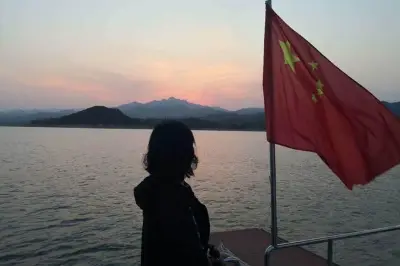
Riding the waves and breaking through the billows to return.
Finally found the main group, inner excitement arises spontaneously, full of joyful photos.
Life like this, smile at the world. The Bagua diagram has profound implications.
Returning to Beijing for another farmhouse meal, endless aftertaste.