Hebei Travel: Honoring the Five Heroes—Twice Climbing Langya Mountain (Photos)
In Yi County, Hebei Province, stands the famous Langya Mountain, widely known for the movie 'The Five Heroes of Langya Mountain.' It was this very film that had long endeared this place to the reporter, especially out of admiration for the five heroes who fought bravely against the Japanese invaders here during the War of Resistance Against Japan, and so the reporter had always wanted to visit and pay respects. Unexpectedly, on March 28 and June 3, 2007, the reporter had the good fortune to visit twice in the same year.
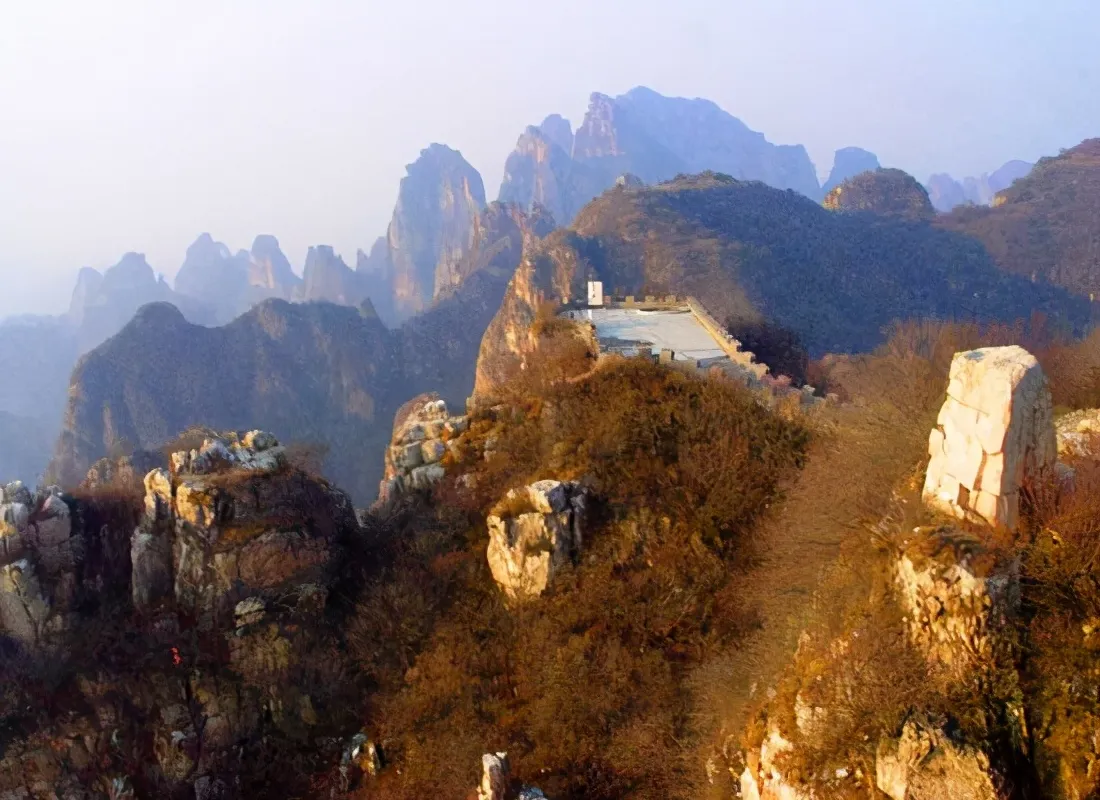
Majestic Langya Mountain (Photo: Feng Ganyong)
The first trip to Langya Mountain was to survey a Red Tourism self-driving route in Yi County with Mr. Cao Qun, president of Beijing Aiche Global Group, accompanied by Liu Xuejun, then director of the Yi County Tourism Bureau, who led the first ascent of Langya Mountain. Along the climb, Director Liu Xuejun gave a detailed account of the county's tourism resources.
Photo with Liu Xuejun on the climb (Photo: Cao Qun)
Yi County has a long history, profound cultural heritage, a sound ecological environment, and abundant tourism resources. There are as many as 57 cultural relic protection sites at the national, provincial, and county levels. Its main tourist attractions include: Langya Mountain, Western Qing Tombs, Yanxiadu (the lower capital of the Yan State), Jing Ke Tower, Nanhu Lake, Zijingguan Pass, Daodejing Pillar, Longhu Lake, Hongya Mountain, Yunmeng Mountain, Manchu Ethnic Village, and the Warring States Culture City, among others.
Rolling mountain ridges (Photo: Feng Ganyong)
Among them, the Western Qing Tombs, Yanxiadu, Zijingguan Pass, and the Laozi Daodejing Pillar are four key national cultural relic protection sites. In addition to the above, there are the Twin Pagodas at Shuangta'an, the uniquely designed Thousand Buddha Pagoda, the Prince's Pagoda built for Crown Prince Dan of Yan, the lush Yunmeng Mountain, the Moon-Viewing Peak of Kongshan, and more.
Opening ceremony of the mountain climbing competition (Photo: Feng Ganyong)
The second visit to Langya Mountain was to attend the 'National Fitness and the Olympics — 2007 National Mountaineering & Fitness Conference Langya Mountain Climbing Competition and Hebei Province Series Tourism Mountaineering Opening Ceremony.'
Photo with Wang Xiaguang (Photo: Liang Yanhong)
At that time, the lively and jubilant opening ceremony scene and the reunion with Wang Xiaguang, a sports journalist from the People's Daily, ten years after a trip to Tibet in August 1997, left a deep impression. Although the two visits to Langya Mountain were not far apart, each one left different fond memories.
Overlooking the mountain trail of Langya Mountain (Photo: Feng Ganyong)
To ascend Langya Mountain, visitors can either hike along the mountain path or take the cable car up the mountain, then walk a short trail to reach the summit. With an elevation of 1,105 meters, Langya Mountain is one of China's 100 classic Red Tourism sites, one of the country's 30 premium Red Tourism routes, and a patriotic education base in Hebei Province. In 2006, it was named one of China's top ten tourist routes by CCTV's 'Perfect Holiday' program, together with Baiyangdian and Ranzhuang. It is now a national 4A-level scenic area.
Cable car at Langya Mountain (Photo: Feng Ganyong)
Langya Mountain was originally named Langshan (Lang Mountain). It gained its name when the son of Crown Prince Liu Ju, during the reign of Emperor Wu of the Han Dynasty, took refuge here to escape the 'Witchcraft Scandal.' In his later years, Emperor Wu was frequently ill and suspected witchcraft (burying wooden puppets to curse people) among his attendants, implicating the empress, crown prince, princesses, and other relatives. Crown Prince Liu Ju committed suicide, and his son fled far away to this mountain, hence the name. At the foot of Langshan, there were once the Imperial Edict Stele of Langshan Jun (the grandson of Emperor Wu) and his son, General Chufeng, jointly worshipped, as well as the Langshan Jun Shrine and the Chufeng General Temple, dating from the first year of the Taikang era of the Western Jin Dynasty (AD 280).
Scenery of Langya Mountain (Photo: Feng Ganyong)
Since 'Lang' is a homophone for 'wolf,' it was also called Wolf Mountain. Because its towering peaks rise jaggedly like wolf teeth, it became known as Langya Mountain (Wolf Fang Mountain). It is one of the ten scenic wonders of ancient Yizhou and one of the eight sights of the ancient city of Baoding, known as the 'Elegant Beauty of Langshan.' On the mountain, there are not only natural wonders like the Wind-Moving Stone, Immortal's Bridge, and Southern Heavenly Gate, but also numerous cultural relics and historic sites such as the Laojun Hall, the Three Religions Hall, and the Silkworm Maiden Temple.
Anti-Japanese War scenario display (Photo: Feng Ganyong)
On September 25, 1941, to cover the retreat of the main force, the five heroes faced the advancing Japanese and puppet troops, preferring death to surrender. They smashed their weapons and, without hesitation, jumped off a cliff dozens of meters deep, composing a heroic and stirring chapter that made Langya Mountain renowned both at home and abroad.
A millennium-old cypress (Photo: Feng Ganyong)
Langya Mountain is not only a mountain of heroes but also a famous historical and cultural mountain and a green ecological mountain. With many cultural sites, its five ridges and thirty-six peaks resemble wolf teeth—magnificent, steep, and perilous. The vegetation is thick, and the forest coverage rate exceeds 70%. It is now a national forest park, a patriotic education base, and a national Red Tourism hotline scenic area.
Photo at the spot where the five heroes jumped off the cliff (Photo: Zhang Jingping)
During the Anti-Japanese War, Langya Mountain was a famous resistance base. After the five heroes jumped, Ma Baoyu, Hu Delin, and Hu Fucai died martyrs for the country, sacrificing their lives gloriously, while Ge Zhenlin and Song Xueyi were caught on tree branches on the cliff and survived. To commemorate the martyrs, remember history, and love our China, the Langya Mountain scenic area opens the Langya Mountain Five Heroes Exhibition Hall (Ma Baoyu, Ge Zhenlin, Song Xueyi, Hu Delin, Hu Fucai) free of charge to visitors each year on September 25, the anniversary of their jump. 'High lofty Yanshan, Chill the Yi River flows. Five heroes mighty, Their fame shakes Langya Mountain.'
Langya Mountain climbing competition (Photo: Feng Ganyong)
The main peak of Langya Mountain, Lotus Peak (Great Lotus Petal), stands at 1,105 meters above sea level and is located in the western part of the mountain. To the east is Cangutu (Silkworm Maiden Ridge), and north of the area between Qipantuo (Chessboard Ridge) and Cangutu is Laojun Hall. These three peaks form three narrow passes leading to the summit of the Langya mountain range. The Prince of Yan's Immortal Platform is in the northeast. Southwest of Qipantuo are Zhongjun Mountain and Emei Mountain (also called Qimei Mountain according to Yi County Annals). At dawn or dusk, from the tower of Baoding City, the majestic sight of Langya Mountain can be seen from nearly a hundred li away.
Qipantuo (Chessboard Ridge) ruins (Photo: Feng Ganyong)
Qipantuo (Chessboard Ridge) is precisely where the five heroes fought against the Japanese invaders. It is one of the main peaks of Langya Mountain. According to the Yi County Annals of the Republic of China era: 'Qipantuo lies 95 li southwest of Yi County, west of Langshan (where Laojun Hall is located on Dalian Peak). It is several li high, surrounded by tall peaks, accessible by a single path, and features a stone chessboard and three pools with never-ending clear spring water.' At the foot of the ridge is Xishuizhai, and to its southwest are Emei Mountain and Zhongjun Mountain, all ancient battlefields. Climbing from Xishuizhai leads to the Western Heavenly Gate, where the path is flanked by sheer cliffs as if cut by knives or axes, with stalagmites shaped like precious vases. Near the Western Heavenly Gate, there is a red agate karst cave originally called 'Tianjing' (Sky Well), with chambers within chambers, a variety of stalactite formations, and an underground river that runs continuously.
Sheer peaks as if cut by knives and axes (Photo: Feng Ganyong)
Beyond the Western Heavenly Gate are numerous strange peaks, oddly shaped rocks, and caves, such as the Wooden Club Cliff, the Yellow Silk Umbrella, Tiger Cave, Tiger's Mouth, Tiger Drinking Pool, Lovesick Valley, Fairy Spring, Bottomless Cave, Demon-Suppressing Stone, and the peculiar Yin-Yang Stone—its sunny side resembles a warrior, its shady side a maiden, locally called 'Wife's Head.' Following 2,900 steps of the Stairway to Heaven, one reaches Qipantuo. Atop the ridge stands the Pagoda of the Five Heroes of Langya Mountain. To the west of the pagoda is Small Lotus Peak (Small Lotus Petal), the very spot where the five heroes jumped.
A view of Langya Mountain (Photo: Feng Ganyong)
Lotus Peak is adjacent to natural features such as the Little Stone Forest and Red Cloud Cliff. To the west of the ridge lies Rouge Lake. According to the Yi County Annals, beneath Zhongjun Mountain to the southwest of the ridge is the Malan Gully, which is inaccessible. To its south is Huang Boyang Cave, and there is also the Hanging Lotus Cave, where Prince Zhu Di of Yan stationed his troops in the third year of the Jianwen era of the Ming Dynasty (1401). To the north of the ridge are the perilous King Yama's Nose and Little Devil's Face cliffs.
Five Heroes Exhibition Hall (Photo: Feng Ganyong)
In May 1993, the Langya Mountain tourism area was designated a provincial-level patriotic education base by the People's Government of Hebei Province. Each year, a steady stream of Party members, Youth League members, soldiers, students, and others come to receive patriotic education. Especially around July 1 and October 1, special lectures given by elderly Party members and veterans of the Eighth Route Army draw visitors to stop and listen. In 2001, the Langya Mountain Five Heroes Exhibition Hall, with an inscription handwritten by General Yang Chengwu, was completed.
Tourist map of Langya Mountain (Photo: Feng Ganyong)
Covering an area of 816 square meters with a floor space of 300 square meters, the hall houses four exhibition rooms displaying photos, historical documents, Anti-Japanese War relics, and battle scenes. These exhibits recreate the valiant deeds and history of the anti-Japanese soldiers and civilians under the Party's leadership, defending the homeland against the Japanese invaders, and further expose the heinous crimes committed by the Japanese aggressors in our base areas. The exhibition hall began trial operation in May 2001, thus becoming another site for revolutionary and traditional education at the Langya Mountain patriotic education base.
Five Heroes Memorial Pagoda (Photo: Feng Ganyong)
When visiting Langya Mountain, looking up from the foot of the mountain, the Five Heroes Memorial Pagoda standing atop the peak is spectacular and very eye-catching. The history of the memorial pagoda dates back to January 1942, when the First Division of the Shanxi-Chahar-Hebei Military Region decided to build a memorial tower at the spot on Qipantuo Peak where the five heroes jumped. With strong support from the border region government and the arduous efforts of construction workers, the three-story 'Three Martyrs Memorial Pagoda' was basically completed by the end of September that year.
Photo under the memorial pagoda (Photo: Wang Jue)
After its completion, although the 'Three Martyrs Memorial Pagoda' inspired the revolutionary people's determination to resist Japan, it also drew the hatred of the Japanese imperialists, who sought to destroy it. In September 1943, during another large-scale mopping-up operation by the Japanese imperialists, the pagoda was bombarded by enemy mountain guns and destroyed.
Close-up of the memorial pagoda (Photo: Feng Ganyong)
To inherit and carry forward the heroic deeds of the five heroes, the people of Yi County rebuilt the memorial pagoda in 1959, and Nie Rongzhen personally inscribed the name 'Langya Mountain Five Heroes Memorial Pagoda.' However, due to the Cultural Revolution and earthquake damage, the pagoda was destroyed again by the end of the 1960s. The memorial pagoda was built and destroyed twice, but the damage could not erase the people's remembrance of the five heroes.
Relief sculpture on the memorial pagoda (Photo: Feng Ganyong)
With the care of the Party and government, the 'Langya Mountain Five Heroes Memorial Pagoda' was rebuilt for the third time in 1986. The new pagoda is cream-yellow, entirely of reinforced concrete, covering 69 square meters, with a base diameter of 3.06 meters and a height of 21.5 meters. The five-story tower is in the shape of a regular pentagon, topped with a pavilion-style yellow glazed-tile cap. On the front (south face) of the pagoda are embedded nine large golden characters reading 'Langya Mountain Five Heroes Memorial Pagoda,' inscribed by Nie Rongzhen.
Looking up at the memorial pagoda (Photo: Feng Ganyong)
The embossed images of the five heroes are set on a white marble flag surface level with the base of the pagoda, connected to the ground floor. To the east is a covered stele corridor, at the eastern end of which is a stele pavilion. Inside the pavilion is a hexagonal marble stele inscribed with the inscriptions of 12 leaders, including Peng Zhen, Nie Rongzhen, Yang Chengwu, Liu Lantao, Chen Zhengxiang, and Shi Jinqian. Around the memorial pagoda are also cast-in-place balustrades, archways, and enclosing walls.
A photo taken at Langya Mountain (Photo: Wang Jue)
Today, a visit to Langya Mountain in Yi County not only offers magnificent mountain scenery but also allows people, through the real experience of climbing Langya Mountain and following in the heroes' footsteps, to once again appreciate the awe-inspiring national integrity and lofty spirit of patriotism, thus receiving a vivid patriotic education. (Text and Photos: Feng Ganyong)