Still Crowded in Beijing? This Weekend, Baoding Awaits to Unearth History
Have you been to Yuyuantan Park?
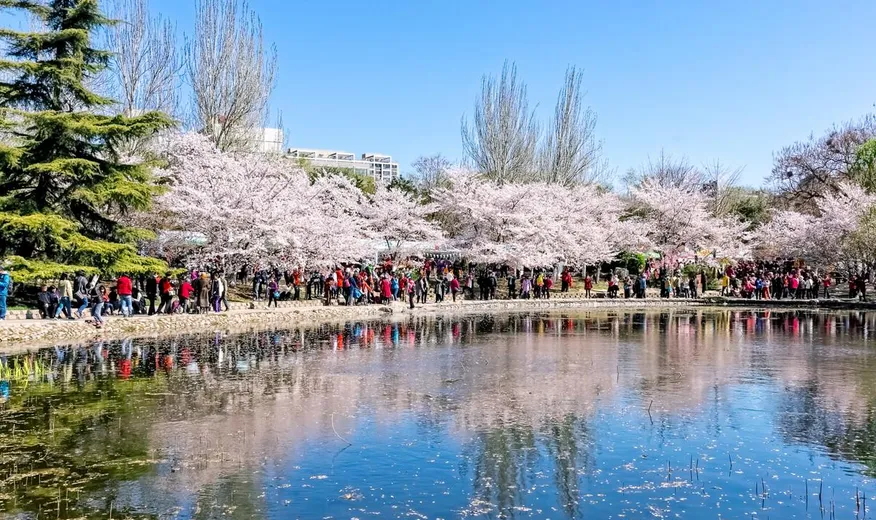
Going to Yuyuantan Park to see cherry blossoms in spring is probably the most popular thing to do in Beijing.
Is Yuyuantan beautiful? Of course it is!
Is Yuyuantan expensive? With a 10-yuan entry ticket, what do you think?!
Is Yuyuantan crowded? Absolutely! Shoulder to shoulder, bustling with people, packed to the brim—it even made trending topics during the Qingming Festival!
Although Beijing has many attractions and low entrance fees, it can't withstand its over 21 million permanent residents plus people from all over the country who want to see the capital.
So why stay here and jostle? There are so many fun cities around Beijing. Today, Earth Explorer recommends a city near Beijing—Baoding.
From Beijing, a regular green train takes just 1–2 hours; a high-speed train takes only a few dozen minutes—blink and you're there. Even by bus, from Liuliqiao Bus Terminal it’s no more than two and a half hours.
Of course, Earth Explorer still recommends the train. Let’s go, hop on the train to Baoding.
Baoding's name means 'defend the capital, stabilize the realm.' Historically it has been a strategic area near the capital and the 'southern gate of the capital.' You could say it's Beijing's most loyal little brother—if it claims second place, no one dares claim first.
Baoding has a long history. Historical figures like Jing Ke, Liu Bei, Zhao Kuangyin, Zu Chongzhi, and Li Daoyuan were all born here. Compared to its past glory, Baoding has faded somewhat. After the founding of New China, Baoding even served twice as the capital of Hebei Province:
In 1949, when the Hebei Provincial People's Government was established, Baoding was the capital, and Baoding city was a provincial municipality;
In 1958, the provincial capital moved to Tianjin; in 1966, it moved back to Baoding. Two years later, the previously obscure Shijiazhuang snatched the title. Considering Hebei's stable development, Premier Zhou Enlai instructed, 'No more moving from now on!' This set the pattern we see today.
However, Baoding’s most glorious period was during the Qing Dynasty, when it was the capital of Zhili Province and the seat of the Viceroy of Zhili. From 1669 to 1968—a whopping 301 years! That’s why our first stop is the Zhili Viceroy’s Office, after all, we’ve got to pay homage to the boss!
Attention! Attention! Attention!
For scenic spot reservations and some ticket purchases in Hebei, you must use the mini-program 'Le Xiang Ji'. The Zhili Viceroy’s Office is the same: first reserve via 'Le Xiang Ji', then buy a ticket at the counter, 30 yuan per person.
The name Zhili means 'directly under the capital' (that’s how straightforward it is). Since the Qing Dynasty implemented a provincial system, it was also called Zhili Province. The viceroy was an official dispatched by the imperial court, the highest military and administrative chief locally. Due to its unique location, Zhili Province wielded immense power, and the Viceroy of Zhili ranked first among the eight viceroys of the empire. The jurisdiction went far beyond today’s Hebei, covering parts of present-day Hebei, Beijing, Tianjin, Shandong, Shanxi, Henan, Liaoning, and Inner Mongolia. The viceroy's responsibilities expanded over time, for instance, the Viceroy of Zhili concurrently served as the Northern Trade Minister, and Viceroy Li Hongzhang was in charge of building the modern navy.
The Baoding Zhili Viceroy’s Office hosted a total of 59 viceroys serving 66 terms, including well-known names like Zeng Guofan, Li Hongzhang, and Yuan Shikai.
(Yan Family Donkey Meat Old Shop)
(Yan Family Donkey Meat Old Shop – Donkey Meat Huoshao)
After walking around the Viceroy’s Office, you must be hungry! You’ve surely heard of donkey meat huoshao, a hugely popular traditional snack in North China. Coincidentally, it was born right here in Baoding.
According to historical records, donkey meat huoshao dates back to the second year of the Jianwen era in the Ming Dynasty (1400 AD). There are several origin stories; here’s one:
The founding emperor of the Ming Dynasty, Zhu Yuanzhang, before his death, appointed his heir Zhu Yunwen, the Ming Huizong. However, Zhu Yuanzhang's fourth son, the Prince of Yan, Zhu Di (later Emperor Yongle who moved the capital to Beijing), was unwilling to accept this. After Zhu Yuanzhang’s death, Zhu Di raised an army, and Zhu Yunwen sent General Li Jinglong to fight Zhu Di in the area of Baigou River. Li Jinglong suffered a heavy defeat and retreated to Caohe Town in Xushui. With no grain supplies, he had to order the slaughter of horses for food. Thus, cooking horse meat became a local custom in Caohe Town, and the cooking skills grew more refined. Combined with the local crispy-on-the-outside-tender-on-the-inside huoshao (baked buns), and braised donkey meat with rich broth stuffed into the crispy huoshao, the taste is simply out of this world!
I asked many Baoding locals, and they all agree that Yan Family Donkey Meat Old Shop opposite the North China Electric Power University is the most authentic. Though it’s also said to be the 'most expensive donkey meat huoshao' in Baoding. Earth Explorer bought a premium one for 12 yuan. Two of these down the hatch, and energy levels fully recharged.
Next, let’s visit the place that contributed most to modern Chinese history in Baoding. Nearly 10,000 officers were trained here, of whom over 1,600 achieved general rank, including Bai Chongxi, Zhang Zhizhong, Ye Ting, Fu Zuoyi, and more. You’ve probably guessed it—this is the Baoding Military Academy.
The Baoding Military Academy, formally the Baoding Army Officer School, was named after the founding of the Republic of China. Its origins trace back to Yuan Shikai. In November 1901, Yuan Shikai arrived in Baoding to take over as Viceroy of Zhili and Beiyang Minister. He was also in charge of training troops at Xiaozhan, and under the Boxer Protocol, military instructors from Xiaozhan were not allowed to be stationed near Tianjin. So, these key military personnel were moved to Baoding.
As everyone knows, Yuan Shikai placed great emphasis on education. He repeatedly petitioned to open military schools. According to archives from the late Qing Army Department, from 1902 to 1912, a total of 16 military schools were established in Baoding, including the Beiyang Mobile Officer Academy and the Training Officers Camp. That's why Baoding Prefecture in Zhili Province is hailed as the cradle of modern Chinese military academies.
In 1912, after Yuan Shikai became President of the Republic of China, he appointed Duan Qirui as Minister of the Army. He moved the Army Preparatory College to Beijing and renamed it the Army University, while on the original site in Baoding, the Army Officer School was established.
Generally, students who entered in 1912 are considered the first class of the Baoding Military Academy, and those who entered in 1921 the ninth and final class.
Counting from 1912, the academy produced 6,553 graduates; if you count from the Beiyang Military Academy period, nearly 10,000 officers were trained here, with over 1,600 attaining general rank. The military influence of the Baoding Military Academy is plain to see. When Dr. Sun Yat-sen founded the Whampoa Military Academy, he also relied on Baoding graduates as the backbone of military education.
When we visit the Baoding Military Academy, we’re actually visiting the Baoding Military Academy Memorial Hall. No ticket is needed; you just need to reserve through the mini-program 'Le Xiang Ji'.
The Baoding Military Academy is undoubtedly the pride of Baoding people. That’s why, next to the memorial hall, there’s the largest Baoding Military Academy Square in northern China. Built in 2002 with an investment of 140 million yuan, the square is filled with birdsong and flowers, spacious, and has become a great place for locals to relax and have fun.
After all that history, let’s enjoy some nature! Baiyangdian and Yesanpo are both great, but they’re a bit far, beyond Earth Explorer’s range. Right in downtown Baoding, there’s the Ancient Lotus Pond. At first glance, it might not look like much, but it was once ranked one of China's ten most beautiful classical gardens.
However, unlike other gardens like the Humble Administrator’s Garden, the Ancient Lotus Pond has suffered a great deal.
The Ancient Lotus Pond was built in the 22nd year of Emperor Taizu of Yuan (1227) as the residence of Zhang Rou, who was then the Grand Marshal of Baozhou (today’s Baoding) and surrounding areas.
In the 26th year of the Zhiyuan era of the Yuan Dynasty (1289), a major earthquake struck Baoding, damaging the pond. Fortunately, the water didn’t dry up, but no one repaired it until the 44th year of the Jiajing era of the Ming Dynasty (1565). After that, it gradually gained attention. The 'Zhili Academy' was built here. During the Qianlong reign, the Ancient Lotus Pond Guesthouse was expanded into an imperial palace, and the restless Qianlong Emperor visited it six times. Emperors Jiaqing and Guangxu also stopped by. The pond’s prestige soared, and all sorts of antiques and treasures poured in.
Until 1900, when the Eight-Nation Alliance invaded China. It was a nightmare for the central government—and for the Ancient Lotus Pond.
At that time, troops from four of the nations—Britain, France, Germany, and Italy—surrounded Baoding, looting and burning. The Ancient Lotus Pond, with its large collection of antiques and treasures, couldn't escape the disaster. According to the Qingyuan County Annals, 'the garden was left with only broken bricks and tiles.'
This time, however, restoration came much faster. The then Viceroy of Zhili, Yuan Shikai, ordered it rebuilt as an imperial garden. During the Republican period, the Zhili Army Commander Cao Kun stationed troops in Baoding, and the Ancient Lotus Pond became the private property of the Cao brothers, used as a warehouse to display their rare treasures. After the Zhili clique lost the war, the Cao brothers fled, emptying the pond once more.
After that, the pond saw both damage and repairs, but it never regained its former glory. In 2000, the Baoding municipal government decided to restore the Ancient Lotus Pond to its Qing Dynasty scale. That led to what we see today.
By the way, you also need to reserve through the mini-program 'Le Xiang Ji' for the Ancient Lotus Pond, then buy a ticket for 10 yuan per person.
It’s right in the city center. Stroll, eat, play—a full day comes to an end.
So, how does this little weekend trip sound to you?!