Journey Through the Zhongshan Kingdom: Discovering Timeless Dingzhou
The 5-day Labor Day holiday in May—how could I miss the chance to travel? But everywhere was mobbed. Based on past experience, the only option was to pick a lesser-known city not too far away—basically a two-day round trip. Daddy Pig suggested Dingzhou. I asked for a reason. He said, for one, it's close to Beijing, off the beaten path, and it's a historic city.
Preview ----
【Itinerary】
Day 1: Self-drive 4 hours from Beijing to Dingzhou. Dingzhou Museum, exterior of Yan Yangchu's Former Residence, lunch: Youjian Xinhuaijiu Restaurant. Afternoon: Dingzhou Examination Hall (Gongyuan), Dingzhou Prefectural Office. Evening: Kaiyuan Temple Avenue and Chongwen Street. Dinner: street snacks on Chongwen Street. Overnight at GreenTree Inn Railway Station Branch.
Day 2: White Fruit Tree (Ancient Ginkgo). Dingzhou Old City. Dingzhou Tower (Kaifeng Temple Pagoda). Lunch: Yanyu Shiguo Restaurant. Afternoon: drive back to our cozy home in Beijing.
【Food】
Dingzhou: Zhongshan Banquet, Yanyu Shiguo Restaurant, Youjian Xinhuaijiu Restaurant, Menzi (stewed meat jelly), hand-pulled sausages, donkey meat, and more.
【Accommodation】
GreenTree Inn Railway Station Branch, family room for four, 238 CNY per night.
【Attractions】
Kaifeng Temple Pagoda, Dingzhou Museum, Dingzhou Old City, Examination Hall, Dingzhou Prefectural Office, Chongwen Street, etc.
I go by the online name Happy Pet, known as Big Soup Sister. Started working as a tour guide in 1997, and I speak Indonesian. My sister runs a pet shop. I love making healthy treats for pets. Based in Beijing long-term, I adore food, travel, animals, and sharing.
Terima Kasih—for giving me a job in tourism that lets me roam the world and share the joys and sorrows of my work. And for those who read my travelogs, listen to my stories, and even like my clumsy photos.
Terima Kasih—for my inborn love for animals; my life is inseparable from furry kids, and I’m happy to make healthy snacks for them. Every time I read comments saying someone has carefully read my words and felt the emotions in them, it moves me.
Terima Kasih—to my family and friends, for letting travel become a way I express love for my family. Warmth, even if brief. Every comment inspires me to keep going.
Here comes the main story—
Day 1: Self-drive 4 hours from Beijing to Dingzhou. Dingzhou Museum, exterior of Yan Yangchu's Former Residence, lunch: Youjian Xinhuaijiu Restaurant. Afternoon: Dingzhou Examination Hall, Dingzhou Prefectural Office. Evening: Kaiyuan Temple Avenue, Chongwen Street. Dinner: snacks on Chongwen Street. Overnight at GreenTree Inn Railway Station Branch.
Beijing to Dingzhou is about 250 km, and the drive takes a little over three hours via the G4 Beijing-Hong Kong-Macau Expressway. I used around half a tank of gas. With holiday toll-free travel, we set off early at 6 a.m. There was only a small jam on the South Sixth Ring Road, then smooth sailing all the way. After a quick rest stop, we arrived in Dingzhou.
First, to the hotel. I’d originally booked a place near Kaiyuan Temple Pagoda, but holiday prices had doubled. Then I stumbled upon this hotel. It’s not right next to Kaiyuan Temple, but with our own car, it didn’t matter—driving downtown took just 10 minutes. Plenty of parking in the front and back yards, and the service was good. Even though we arrived before 10 a.m., they let us check in early and the front desk recommended lots of places to eat. The hotel is a 10-minute walk from the train station.
We booked a family room that can sleep four: two single beds in the outer room, a big 2-meter bed in the inner room, each with its own TV. The room was clean and tidy; the only downside was that Wi-Fi was slow when the hotel was full. But the price was unbeatable—just 238 CNY. Highly recommended.
Dingzhou lies between Baoding and Shijiazhuang, a key transport hub in North China. It was the capital of the ancient Zhongshan Kingdom, with a history as long as Chinese civilization itself. In antiquity, Dingzhou was called the Zhongshan Kingdom. During the Spring and Autumn and Warring States periods, a branch of the White Di people, the Xianyu, modeled on the Eastern Zhou states, established their kingdom in 507 BC in the eastern foothills of the Taihang Mountains in central Hebei. The Zhongshan Kingdom was sandwiched between the Zhao and Yan states, with its capital at Gu (today’s Dingzhou), later moving to Lingshou (now Lingshou County, Hebei), gaining its name from hills within the city. Although the capital moved to Lingshou, and Lingshou plays an important role in Zhongshan culture, these cities today are relatively less developed, struggling to spread the Zhongshan legacy. All things considered, Dingzhou is the city best positioned to revive and radiate Zhongshan culture. As the capital of the Warring States Zhongshan Kingdom and the seat of successive Zhongshan Han Dynasty princes, Dingzhou is unquestionably the cultural heart of Zhongshan heritage. And Dingzhou’s Kaiyuan Temple Pagoda, built in 1001, has weathered the city’s storms, witnessed the deep-rooted Zhongshan Kingdom, and stands in the bustling modern Dingzhou. So let all our stories, the Dingzhou journey, begin with this pagoda.
Dingzhou isn’t large, and its sights are concentrated. But even a small place needs a plan. Landmarks along Zhongshan Road are basically opposite each other. It’s best to explore one side, then cross via the underpass to the other; otherwise, the ups and downs of the underpass will wear you out. Roughly: Museum, Yan Yangchu’s Former Residence, Dingzhou Pagoda and Kaiyuan Temple Avenue, and the South City Wall are on one side. Across the road: Examination Hall, Chongwen Street, Dingzhou Prefectural Office. Most restaurants are near Chongwen Street. Park near Kaiyuan Temple Avenue. First sight: Yan Yangchu’s Former Residence. The exterior is unassuming—if you haven’t done your homework, you might not know much about it. But travel is learning. Dingzhou has many notable figures who played bridging roles in its long history.
Yan Yangchu (James Yen), known as the “Father of the World Mass Education Movement,” together with Tao Xingzhi, forms the pair “Southern Tao, Northern Yan.” His bond with Dingzhou spanned over a decade, leaving many tales. In his early mass education work, Yen believed China’s great ailment lay in the people’s poverty, ignorance, weakness, and selfishness—the “Four Sicknesses.” He advocated running civilian schools to first teach literacy to farmers, then implementing livelihood, literary, health, and citizenship education—the “Four Great Educations”—to cultivate knowledge, productivity, strength, and solidarity, thus creating “New Citizens.” He promoted holistic rural construction spanning politics, education, economy, self-defense, health, and rites to achieve national salvation. Among his works are *The True Meaning of Mass Education* and *The Mission of the Rural Movement*.
Unfortunately, Yan Yangchu’s Former Residence was closed. From other travelogues, I knew it sometimes opens. It’s a typical northern-style courtyard dwelling. Inside a small quadrangle, there are five main rooms with four beams and eight pillars, tiled roof, and east and west wing rooms, three on each side. Photos and texts chronicle his deeds. A bit of a letdown.
Right next to the residence is Dingzhou Museum, a must-see. Entry is free but with timed tickets; closed on Mondays. You can reserve in advance via the “Changyou Ji” mini-program or on-site if it’s not full. The museum covers about 3.7 hectares, with a total floor area of 25,600 square meters. Its design draws on Zhongshan Kingdom culture, incorporating terraces, sloped roofs, and dougong brackets, lending it grandeur and historical weight.
The museum building has five levels (underground and above), but only the two aboveground floors are open. It holds over 50,000 artifacts, including three national treasures and 965 precious items. The collection spans pottery, porcelain, jade, stone, gold, silver, bronze, bone, wood—mainly from the Han and Song dynasties, rich in local and period character. The first floor: “Han Imperial Tombs and Palaces” and “Buddhas of the Northern Dynasties.” Second floor: “Grandeur of White Porcelain,” “Millennial Treasures Beyond the Dust,” and “Starry Sky of Hometown Masters.”
“Han Imperial Tombs and Palaces” displays excavated artifacts from kings of Zhongshan and other Han-era relics, with multimedia showing disassembled coffin chambers, a 360° hologram of a gold-threaded jade burial suit, and Han tomb interpretations.
“Buddhas of the Northern Dynasties” features stone statues from the Northern Wei, Eastern Wei, and Northern Qi dynasties, along with the story of the “Self-Come Buddha.”
“Grandeur of White Porcelain” showcases masterpieces from the Ding kiln, one of the Five Great Kilns of the Northern Song, tracing kiln’s origin, development, peak, and aftermath across four sections.
“Millennial Treasures Beyond the Dust” brings out relics from the underground palace of Jingzhi and Jingzhong Monastery pagodas: sarira, Buddhist statues, incense burners, ritual vessels, offerings, and ancient coins.
“Starry Sky of Hometown Masters” uses texts, images, paintings, sculptures, and multimedia to feature Dingzhou’s historical luminaries, creating a cultural shrine to local greats.
Inside, the lobby is bright and orderly. Three must-see treasures: a large green jade heng (disc) with twin dragons holding rings and grain pattern, an openwork jade screen with immortal tales, and a white-glazed ewer with dragon-head spout and lotus design. A relief at the entrance shows these three treasures amid ancient porcelain, Buddhist figures, jade discs, and more—all tied intimately to Dingzhou’s history.
Behind the relief, text narrates Dingzhou’s historical evolution.
First, I visited the “Han Imperial Tombs and Palaces” gallery, centered on the Han-era Zhongshan Kingdom’s culture. The Han, China’s first golden age, was a mighty empire. With Dingzhou as its capital, the Zhongshan Kingdom was one of the larger vassal states. Most Western and Eastern Han princes were buried in Dingzhou, unearthing a trove of treasures.
Dingzhou has over a hundred Han tombs, and photos from excavations were on display. From Liu Chang’s tomb came a Western Han gilt-bronze ram-shaped lamp with double flue pipes, its body fluidly lined, exquisitely patterned, and studded with colored gems—tiny and delicate.
Dingzhou Museum’s three national treasures, its three crown jewels, all from here. Two are from Liu Chang’s tomb: the “green jade double-dragon ring heng with grain pattern,” 30.5 cm high, 24.4 cm diameter, 1.1 cm thick, bluish, translucent jade, with a broad outer band and neat grain pattern inside. Above protrudes an openwork pair of dragons biting a ring, their bodies coiling, with fine-line facial features and claws, amid cloud scrolls, flanked by differently shaped dragon-shaped ears.
The second treasure is the “openwork jade seat screen with immortal tales,” 16.9 cm high, 15.6 cm long, 6.5 cm wide, made of four green jade pieces. Two pieces serve as side supports, two flat pieces one above the other in the middle, with tenons fitting into mortises. The side pieces are double-disc shapes, each disc with an openwork dragon wound around a central rectangular hole. On the two horizontal screens, upper and lower, figures and beasts are all openwork. The upper middle is the Queen Mother of the West, with kneeling attendants below and around, surrounded by phoenixes, birds, ducks, and beasts. The lower middle is the King Father of the East, with kneeling attendants to the sides, and turtles, snakes, bears all around. The carving is delicate, rich in content, vividly expressive—a Han dynasty masterpiece.
The next gallery, “Buddhas of the Northern Dynasties,” shows stone statues from the Northern Wei, Eastern Wei, and Northern Qi, plus the origins of the “Self-Come Buddha.” “Grandeur of White Porcelain” later.
Entering, the first thing you see is the colossal head of the Self-Come Buddha. Serene and awe-inspiring. Just as I was searching the web about its history, a guide explained that among Dingzhou’s “Eight Oddities,” one is “The Self-Come Buddha has no head.” During the Cultural Revolution, the statue was smashed, body and head separated. The torso remained at the ruined Stone Buddha Temple in the northeast corner of town, but the head was luckily safeguarded by cultural heritage authorities. The millennia-old torso? The temple site later caught fire, scorching the torso beyond recognition and repair, so reassembly was impossible. But a blessing in disguise: if the head hadn’t been knocked off, it would have burned too.
Moving upstairs, “Grandeur of White Porcelain”: Ding kiln was one of the Five Great Kilns of the Northern Song. The exhibition traces its story from origin through development, peak, and legacy.
The star of the room is the third national treasure: a white-glazed ewer with dragon-head spout and lotus design. It stands 60.5 cm tall, mouth diameter 2 cm, maximum belly diameter 19.1 cm, foot diameter 10.1 cm. Ultra-thin, creamy white glaze, crafted with appliqué, carving, and incising, set off by graceful curves—it exudes a solemn dignity. The ewer has a small mouth, long neck, with a light tray mid-neck; sloped shoulders, drum belly, elongated lower body, and a flat foot. On one shoulder, a dragon is carved—short thick neck, raised forehead, horns fused and swept up, glaring eyes, bared teeth, tongue appearing to spray mist. The whole vessel is carved with lotus petals. It’s a Northern Song early Ding ware treasure, the tallest Ding porcelain piece found in China, and was designated a national treasure by the National Cultural Heritage Appraisal Committee.
Nearby, models depict Song Dynasty street scenes of porcelain trading and literati banquets with porcelain wares—lively and prosperous.
My little rascal loved a certain piece: a plump, round little turtle, very uncommon.
“Millennial Treasures Beyond the Dust” displays sarira, Buddhist statues, incense implements, offerings, and coins from the Jingzhi and Jingzhong Monastery pagoda underground palaces.
A recreation of the Jingzhong Monastery crypt scene was presented.
“Starry Sky of Hometown Masters” uses text, images, paintings, sculptures, and multimedia to present Dingzhou’s historical celebrities, a hall of local heroes. I was stunned—Dingzhou has produced so many talents! Featured figures include Li Kui of Wei who served in Zhongshan during the Spring and Autumn period, Tang poet Liu Yuxi, and Northern Song statesman Han Qi.
Finally, a statue of Zhang Hanhui, who composed “On the Songhua River” in Xi’an on July 12, 1937, both lyrics and music his own.
Dingzhou Museum deserves a slow visit; many artifacts are profound. Taking your time takes about two-plus hours. Stepping out, the sky was wide and cloudless. The fountain on the square glistened in the sunlight. In the distance, the Examination Hall’s memorial arch was visible. Noon neared, and my stomach rumbled. So off to Chongwen Street across the way!
On the way through the underpass, there were many displays introducing Dingzhou, giving new visitors a handy overview.
Emerging from the underpass near the museum, you’re on Chongwen Street. Most eateries are near here. Over two days, we passed through Chongwen Street many times. At night it’s worlds apart from daytime—so lively later. So we didn’t explore much now, just headed straight to Youjian Xinhuaijiu Restaurant right at the street’s entrance for lunch.
Chongwen Street was built as part of the prefectural office reconstruction, circling the office and forming a cultural core with Kaiyuan Pagoda, the Confucian Temple, and the Examination Hall. It’s the first commercial pedestrian street entirely mimicking Ming-Qing style, blending Zhongshan culture with a marketplace atmosphere, combining shopping, leisure, dining, and tourism.
Daytime Chongwen Street was quiet, few visitors, and many roadside stalls closed. But the snacks were indeed affordable. On the right just after entering stands Youjian Xinhuaijiu Restaurant. I’d wanted to try the online-recommended Zhongshan Banquet, but it was booked for a wedding. So we ended up here. I was still grumbling about missing out on Dingzhou’s signature menzi when—surprise!—
We ordered Dingzhou’s special big mixed stew. It didn’t look like much, but it was packed with local specialties: menzi, tofu, crispy meatballs, and more. Anyway, I got my menzi and was content.
The service was warm; noticing we weren’t locals, they explained various ways to eat menzi. Dishes came quickly. Dingzhou isn’t expensive—three dishes, drinks, and rice cost 130 CNY.
After eating, just a few steps further, we saw the memorial arch that marks the entrance to the Examination Hall. It looked newly built but still conveyed the solemnity of imperial exams. Behind the square lies a small garden.
Flanking the arch are statues of two historical figures: Wang Zhonghuai, who once encouraged public donations to expand and renovate the venue, creating the grand examination site preserved through the ages.
In the third year of Qianlong’s reign (1738), Prefect Wang Danian established Dingzhou Examination Hall, assembling civil and military candidates from the jurisdiction for exams to earn the Xiucai (licentiate) or Gongsheng (tribute student) degree.
Before even reaching the gate, a towering screen wall (yingbi) commands attention. In ancient times, it was where results were posted—overnight fame or crushing defeat. The wall is two zhang high and six zhang long (approx. 6.6m x 20m).
My little rascal and Daddy Pig played at checking results, mimicking ancient examinees. I wonder if they felt the weight those scholars carried. Isn’t it much the same today? From babbling infancy through years of schooling, every step is fraught. Keep it up, rascal.
Admission: 20 CNY. Dingzhou Examination Hall is the best-preserved Qing dynasty exam venue in China. In 1738, Prefect Wang Danian built it. In 1834, Prefect Wang Zhonghuai raised public donations to enlarge and renovate it into a sprawling exam complex.
The hall is square, covering 2.21 hectares with 1,547 square meters of buildings. Facing south on a central axis, the surviving structures include the screen wall, main gate, Kuixing Pavilion Exam Cells, grand hall, and rear building on the axial line, with symmetrical east-west layout. The civil exam area thus has five main structures. The eastern military exam area once housed the Martial Hall, Wenchang Palace, rear palace, etc. Each group forms its own courtyard, connected as needed. The layout balances tension and variation.
Couplets on the front columns: the outer ones by contemporary calligrapher Ouyang Zhongshi exhort examiners: “Select the outstanding for country and people, promote virtue and talent.” The inner ones bless candidates: “With soaring writing talent, storms roll and phoenixes spread wings; the star of literature tips its brush, talent crests the sea to clinch the top.”
Passing the three-bay gate, two ancient locust trees with gnarled branches greet you. Legend says Emperor Qianlong planted them when he stopped in Dingzhou on his southern tour.
Straight ahead is the main structure: Kuixing Pavilion Exam Cells, seven bays wide, nine deep—the actual exam hall, once seating over a hundred. The southernmost part, Kuixing Pavilion, is a half-four-corner pointed roof, with layered corbeling and upturned eaves like birds in flight, connected to the triple-eaved roll-shed roof of the exam cells—an ingenious blend.
Here on the second floor is enshrined Kuixing, the god of exams—red hair, blue face, fierce eyes, bared teeth. He stands on one leg atop an ao (giant turtle), the other leg kicked up like a hook; one hand holds a dipper, the other a brush, symbolizing “Kuixing dots the dipper” to mark the top scholar with his red brush—the very image drawn from the character 魁. Gazing up at this imperious deity, you can almost see candidates trembling below.
More couplets front the exam cells.
Walking through this door leads into the “roll-shed roof” exam cells, once holding desks and stools for a hundred candidates. Nearly three centuries ago, every exam season, a hundred scholars would race their brushes here. From Tong Sheng (trainee) to Sheng Yuan, then Gong Sheng, Jin Shi, and only the top Jin Shi became Zhuangyuan (first place), then Bangyan, Tanhua… the imperial exam ladder stretched endlessly. Only after many steps could one reach the top.
The exams followed principles of “free registration, open exams, fair competition, merit-based selection,” reflecting fairness. Originating in Han, founded in Sui, established in Tang, perfected in Song, flourishing in Ming and Qing, it lasted 1,300 years. It replaced the earlier systems of recommendation and nine-rank meritocracy, giving ordinary landlords and commoners a ladder to officialdom.
I was stunned that little Dingzhou produced so many Zhuangyuan—truly eye-opening. Over its 1,300 years, the exams yielded over 700 Zhuangyuan, nearly 110,000 Jin Shi, and millions of Ju Ren. Dingzhou Examination Hall hosted rural and metropolitan exams, and featured both civil and military tracks. By the end of the Qing, Dingzhou had produced 227 civil and military Ju Ren.
Where there are exams, there’s cheating—with mind-boggling tricks. Some methods: collusion, advance submissions, hidden notes, proxies, hand signals, extra candles, carrier pigeons. Here, only a vest covered in tiny calligraphy of the classics and food with hidden questions were on display.
Out the back, the coiled-dragon stone pillars still look magnificent.
The last structure is the highest in the hall: Lanyue Tower (“Embrace the Scenery”). Back then, literati from different places gathered here to climb, enjoy the view, compose poetry, and make friends. Ascending, you can overlook the whole exam compound, and truly grasp the joy of successful candidates: “On spring wind, proud hooves gallop, in one day seeing all the flowers of Chang’an.”
To the west of the tower stands a stone tablet inscribed on all four sides.
Looking up at the tower’s mottled walls, you almost travel back in time. Ancient examinees might have sold property or left home; truly, “ten years of hardship in a cold study, one exam decides a lifetime.” The examination hall, as the exam site, was perhaps a relatively fair place. At least it rewarded diligence.
After the hall, we drifted back past the statue to the next sight.
Every Dingzhou local knows this imposing statue: Han Qi, Northern Song prime minister and poet. He’s honored because, beyond his legendary life, he once served in Dingzhou and contributed greatly. In Dingzhou, he reorganized the garrison. Long neglected, the troops had grown arrogant. Han Qi used both grace and severity. He reaffirmed military law, purged troublemakers, and had unruly soldiers tied up and executed outside the camp gates—no hesitation. The soldiers found this new official stern and never dared flout discipline again.
Behind the statue lies the Dingzhou Prefectural Office. I found scant information online. Built in the Tang Dynasty, following the principles of ancestral temple left, altar right, and central symmetry, after centuries only the Dingwu Academy survived; other buildings were lost. That’s why data is sparse. The government painstakingly restored it to its former glory. Admission: 20 CNY (normally 30, but a discount due to a holiday activity).
The restoration based on Daoguang-era county annals recreated the entire Ming-Qing style prefectural seat: gate tower, Yongding Post Station, east and west offices, Zhongshan Rear Garden, etc. It features five halls and six courtyards, roughly three lines (central, east, west), three features (south-facing, front offices rear residence, civil east military west), and three functions (administration, military, post station).
First, a tall arch inscribed “The World Is for All,” with stone steles flanking: “Your salary, your fortune, come from the people’s flesh and blood” and “The common folk are easy to abuse, but heaven is hard to deceive.” Along both sides are the six departments: personnel, revenue, rites, war, justice, works—each with matching couplets.
Dingzhou Prefectural Office is quite large, and the layout a bit confusing. Check the guide map to avoid going in circles.
A lofty plaque: “Righteousness of Heaven and Earth.” The main hall is the heart of the office, where verdicts were given and grand ceremonies held, like a new official receiving his seal.
During the holidays, a cherry blossom festival was on, blending real and fake flowers, a delight to the spirit.
Next, the second hall, named “Sibu Hall” (Hall of Reflection), used for preliminary hearings, civil cases, or as a rest area after main hall trials. Its couplet: “Nurture heaven-and-earth rectitude, emulate ancient and modern worthies.”
On the dais, the usual “Upright and Open” banner, flanked by plaques reading “Temper Punishment” and “Benevolent Forgiveness.” As a prefect governing a region, cultivating integrity and emulating worthies was essential, but these plaques deserve scrutiny. “Temper Punishment” means applying laws moderately, using punishment sparingly—excessive or wrongful killing invites heavenly and popular wrath. “Benevolent Forgiveness” means judging with compassion, exercising the “way of forgiveness,” opposing harsh punishments—reflecting Confucian ideas of benevolence and cautious penalty. Placed in the second hall, it’s apt: this was where officials rested after main trials; after hearing facts, a brief pause to ponder sentencing. With these words as self-warning, they were to overcome harsh impulses and, through rational reflection, arrive at a punishment aligning with reason, feeling, and law.
Then into the inner residence. What of the prefect’s wife?
“Yuhu Hall” (Jade Pot Hall). Main room couplet: “Honest officials please the people, just law keeps them secure.” Inner courtyard: “Outside, four seasons of spring and gentle rain; on the desk, three-foot law like scorching sun, harsh frost.” The inner residence has its own courtyard where the official and family lived, normally closed. The main couplet highlights the importance of integrity and impartial justice—only thus can people feel safe and the region tranquil. The inner couplet contrasts spring’s mildness with the law’s severity. Even in the private quarters, officials couldn’t simply enjoy spring; they must reflect on governance and justice.
Traditional Chinese culture valued rites over law, especially cautious with criminal law, believing “penal law is not esteemed in a flourishing age,” used only as last resort, because applying it is like “scorching sun, harsh frost.” Rooted in yin-yang and cosmic harmony, this cautious approach still has practical merit. Today, some fields show a tendency toward “over-criminalization,” trying to control crime and enforce morality through criminal law alone. But excessive criminalization has limited effect on prevention or order; it may even dilute condemnation. The traditional “temper punishment” view calls for legislative restraint, lighter penalties, and judicial economy, emphasizing social harmony and educating offenders. Only then can the “four seasons of spring” outside truly be shared.
Guixiang Room is a courtyard for the official’s female family members. In an age without phones or computers, I wonder if they got bored. But probably composing poetry, painting, and drinking wine offered their own charm.
Jingye Pavilion—inner womenfolk’s area. Empty now, door shut, a bit eerie.
Next to Jingye Pavilion is Shizhu Pavilion—quarters of the private secretaries (shìyé), whom the official hired personally to handle matters. Most were failed exam candidates, trained in law, finance, and documents, paid handsomely.
Finally, Yongding Post Station, an ancient hotel—exclusive to the yamen. Here, flying horses and urgent dispatches took place. An interesting building—see below.
When my rascal and Daddy Pig went upstairs and opened a door to look outside, they discovered that the second floor, five meters up, had no railing. You could walk out in three steps. A bit dicey yet amusing.
The academy on the guide map wasn’t open, and several buildings eluded us—the signage wasn’t clear, maybe because it’s newly rebuilt. My advice: follow the central axis first, cover the west line, then the east line. Exit via the post station. Takes about 1.5 hours. Though I didn’t see everything, the painstaking reconstruction still offers great insight into the top-level prefectural office of the era.
By the time we finished, it was 4:30 p.m. We returned to the hotel and rested two hours. As lights came on, it was time to visit Dingzhou’s liveliest night spots: Kaiyuan Temple Avenue and Chongwen Street.
We parked near the museum. Right there, you step onto Song Street, which adjoins Kaiyuan Temple Avenue. One step away, it’s dead quiet—many eateries shut.
Reaching Kaiyuan Temple, the scene instantly transformed: thick crowds, every kind of amusement. The ring-toss game drew a huge crowd, everyone vying for prizes.
At the avenue’s end stands Dingzhou’s landmark, Kaiyuan Temple Pagoda. Earlier in the day, we’d passed by; a few people were flying kites, and the square held barely a dozen souls. But at night, day and night are worlds apart.
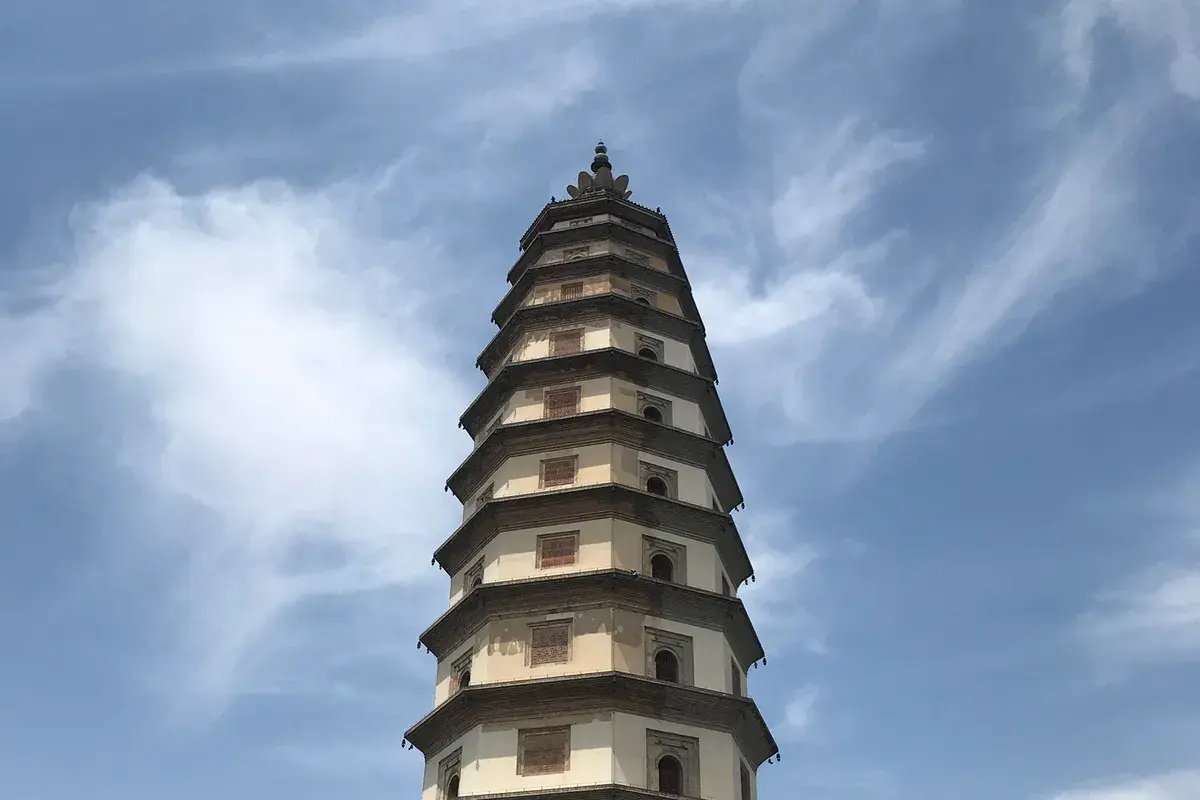
The pagoda, originally called Kaiyuan Temple Pagoda, is China’s tallest surviving brick-and-wood ancient pagoda, known as the “First Pagoda of Cathay.”
According to records, Dingzhou had Kaiyuan Temple first, then the pagoda. The temple’s precursor was Qidi Temple, built in 491 AD during the Northern Wei Taihe period. In the 16th year of Kaihuang (Sui Dynasty), it became Zhengjie Temple. During the Tang Tianyou era (904–907), it was renamed Kaiyuan Temple. Hebei folklore groups “Cangzhou’s Iron Lion, Dingzhou’s Kaiyuan Pagoda, and Zhengding Longxing Temple’s Great Bodhisattva” as the “Three Treasures of Hebei.” There’s also the “Four North China Treasures”: “Cangzhou Lion, Dingzhou Pagoda, Zhengding Bodhisattva, Zhaozhou Bridge.”
At night, with the fountain before the pagoda in full swing, the spot grew even more festive, the spray dancing to music in shifting colors—a perfect evening stroll.
We lingered half an hour, but it stayed crowded. We’d return in daylight anyway, so we headed across the road to Chongwen Street for dinner.
At night, Chongwen Street is Dingzhou’s most vibrant, snack-filled night market, especially swelling during holidays. Everything from mala tang, skewers, to stinky tofu—prices not high. Tonight’s dinner was here, sampling a bit of everything.
Stall after stall, we tasted our way through, quickly filling up. Eating and playing, 10 p.m. rolled around, but the crowd’s enthusiasm didn’t wane. Back at the hotel, exhaustion hit. Sleep. Tomorrow: ancient tree, pagoda.
Day 2: White Fruit Tree (Ancient Ginkgo). Dingzhou Old City. Kaiyuan Temple Pagoda. Lunch: Yanyu Shiguo Restaurant. Afternoon: drive home to cozy Beijing.
In the morning, near the hotel, I went to buy menzi. Stumbled on the train station—so small and close!
Local legend: “First there was the White Fruit Tree, then Dingzhou City.” Impossible to verify now, but many tales survive. Today, the tree stands inside a kindergarten, so we could only snap a photo from outside.
The ancient tree is 8.2 meters tall, trunk girth 4.3 meters, crown diameter 31.8 meters. No one knows when it grew. The Daoguang-era county annals call it a white fruit tree (ginkgo), already withered and leafless then. Locals call it Ancient Tree or White Fruit Tree. Its bark resembles cypress. The name “white fruit tree” might be a mishearing of “ancient cypress.” The common saying goes, “First the White Fruit Tree, then Dingzhou City.” It’s over 2,600 years old—a true ancient sentinel of Zhongshan, with a poem praising: “Ginkgo leaves long fallen, only bare branches remain; gazing proudly at heaven’s will, Zhongshan’s heroic bearing sustains.”
Then a 10-minute drive to Dingzhou’s South City Gate. Knowing it lacked the might of Xi’an’s walls, I still felt a pang of disappointment. The gate sits amid a jumble of homes on a narrow street where two cars barely pass. The walls are utterly unvarnished, and street vendors’ calls echo.
Dingzhou South Gate, also called “Yintai Gate,” was built in early Ming Hongwu years (14th century), over 600 years ago. Back then, Dingzhou’s military commander Ping An expanded the old citadel against northern intrusions, dismantling temples, building walls, melting bells for weapons, erecting 13 km of new walls with four gates (east, west, south, north) and barbicans, each topped by a gate tower for observation and command. The inner gate was imposing: wall 12 m high, tower 8 m, width 22 m. Repairs were made under Wanli (Ming), Kangxi, Yongzheng, Daoguang (Qing). Now only parts of the wall and three gates remain.
The gates are connected by a flagstone path that looks aged, with motorbikes and pedestrians hurrying through.
The moat outside is dry. Who knows if it once surged?
Yintai Gate has three successive gateways. Originally Dingzhou South Gate had four portals and three barbicans forming a “目” (eye) structure. Outermost: a moat 10 zhang wide, 2 deep, spanned by a drawbridge lowered for daily passage, raised in war. Between outer and middle gate lay the first barbican: entering, the wall turns east in a J-shape, with a side door into the inner barbican—attackers trapped inside would be attacked from all sides, as if entering a jar. The innermost main gate boasted a double-eaved tower for observation and command. Inside the top, a protective wall faced the ramparts; outside were crenellations with arrow slits for shooting—bowmen lined up to repel foes.
The earliest Dingzhou city wall was built by Guan Zhong. In the Spring and Autumn period, Duke Huan of Qi, aiming for hegemony, rallied to “respect the king and repel barbarians.” In 648 BC, Guan Zhong campaigned to Dingzhou and built a city for military use. In 154 BC, Liu Sheng became the first Western Han Prince of Zhongshan, making his capital at Lunu (today’s Dingzhou). He built a palace in the northeast with terraces, halls, pavilions mirroring Chang’an. In AD 54, Prince Jian (Liu Yan) built two palaces, opened four gates, cut a stone tunnel under the north wall to channel the Tang River and run a stream into the palace, adding fishponds, fishing terraces, and horse-viewing platforms. In 348, under Later Zhao, Zhonglang Jiang built a small city south of the original palace, adding halls. In 386, Later Yan’s Murong Chui restored palaces and made it his capital, then built another layer south. In 397, Northern Wei’s Tuoba Gui conquered Zhongshan and rebuilt the city on Han foundations. Early Ming, for defense, Dingzhou Commander Ping An expanded it: circumference 26 li plus 13 bu, height 3 zhang, four gates with moon-shaped barbicans, towers, and heavy doors. Successive prefects repaired it. In 1619 (Ming Wanli 44), Prefect Shen Tingying rebuilt the four gates, naming them: north—Zhanchen (Gazing at the Imperial Court), south—Yingtai (Greeting Good Fortune), east—Guanhai (Viewing the Sea), west—Wangheng (Looking toward Mount Heng).
Passing the second gate, you can see protected bridge remnants—stone pillars that once supported the bridge deck.
The walls can no longer be climbed. Standing at the end, gazing inside, a sense of melancholy mixed with awe: a testament to history, utterly uncommercialized and raw, yet sad that it isn’t properly protected, nibbled away by daily life. How much longer can these ancient walls endure?
A ten-minute walk from the South Gate brings you to Dingzhou Pagoda. I’d passed it many times yesterday without pausing to appreciate it. Located inside the South Gate on the east side, Kaiyuan Temple Pagoda is the world’s tallest surviving brick-wood ancient pagoda, completed in 1055, over 900 years old. It has survived more than ten earthquakes. In the 10th year of Guangxu (1884), the northeast section collapsed from top to bottom, marring its perfection, yet it still stands proudly.
The pagoda is all brick and wood, octagonal, 13 stories, 84.2 meters tall, formed by two overlapping squares. Elegantly proportioned, gracefully shaped. On the four main sides are arched doors, the other four have blind windows with geometric latticework. Inside, stairs go up each level, forming octagonal corridors. There are Buddhist niches and color paintings. Back then, with Song-Liao confrontation, Dingzhou sat on the northern frontier, so the pagoda was used to watch for enemy movements.
The spire consists of five symbolic layers: the first, a hemispherical bowl representing water; the second, square for earth, with four painted eyes called “wisdom eyes”; the third, triangular for fire, divided into thirteen diminishing steps; the fourth, umbrella-shaped for air; the top, spiral-shaped for “essence of life.”
The pagoda rises majestically. Ming Xuande-era (1426–1435) Prefect Yuan Xuan wrote a poem: “South of the prefecture, a brahma king’s palace; a lofty stupa leans on the sky. In the calm Hu River, it reflects; from Mount Heng, green ridges kiss the peak. On top, a jeweled spire catches dawn sun; under eaves, golden bells ring in evening breeze. Each time I climb the utmost top, I feel I’ve reached the azure void.” Another poem by censor Gong Fanxian: “Slow steps within the hundred-zhang stupa, heart floating like willow fluff, apricot blossoms in wind. Passing by twelve towers, my eyes encompass three thousand worlds empty. Where can worldly dust reach this Buddha? Here my heart merges with the great void. Some day I’ll ride a crane back, to climb even higher, the first layer of blue heaven.”
For lunch, across to Chongwen Street’s internet-famous Yanyu Shiguo Restaurant. Prices still down-to-earth.
The food was tasty, just 35 CNY per person. After filling up and a short stroll, worried about holiday traffic back to Beijing, we hit the road early. The highway was clear, and we were home before 4 p.m. Our Dingzhou trip was short—barely two days—but this historic city left a deep impression. Pity the Confucian Temple was closed. Maybe next time.