Romantic 520: Love at Baishi Mountain
"The wise delight in water, the benevolent delight in mountains." We who love both mountains and water meet at Baishi Mountain on May 20th, and how can we not say "love" after long dwelling in the noisy city!
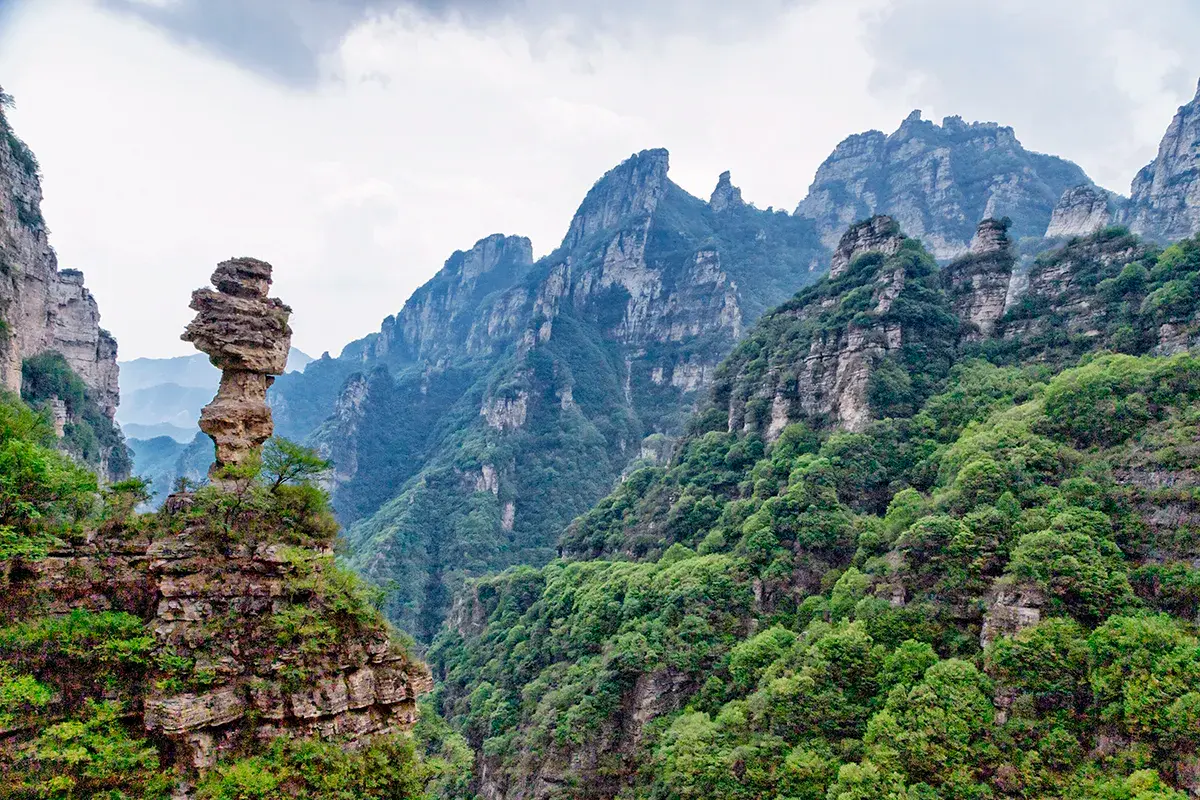
I'd long heard that Baishi Mountain's scenery combines grandeur, uniqueness, peril, illusion, and beauty—reputed as the "Little Huangshan of the North" and an outstanding representative of China's spectacular and precipitous mountain landscapes. Its steep terrain, forest of strange peaks, jagged rocks, green waves of forests, and rosy clouds glow with magnificence, beauty, mystery, and ethereal charm, hailed as the "Number One Marvelous Mountain in Northern China."
On China Tourism Day (May 19th), we drove to Baishi Mountain, located 15 kilometers south of Laiyuan County town. Only after listening to General Manager Bi of Baishi Mountain did we learn that it gets its name from the white marble that covers the mountain, and it's China's only scenic area with a white marble peak forest landform.
Baishi Mountain lies at the intersection of the Taihang, Hengshan, and Yanshan ranges, commanding the northernmost tip of the 800-li Taihang Mountains. Known as the "Head of the Taihang," its main ridge stretches 7,000 meters. It is a national 5A geological park.
The unique geological and geographical structure creates the dreamlike wonders of sea of clouds and Buddha's light at Baishi Mountain. It is home to the largest larch and red birch forests in North China.
Baishi Mountain is the birthplace of China's frontier culture, the Hope Project, and fox fairy culture. It is among the best spots to view Buddha's light and sunrise. A famous mountain that combines natural scenery with history and culture.
Baishi Mountain's north resembles mountains, while its south resembles elephants—unusualness found in plainness, beauty in majesty. Since ancient times, it's been said of Baishi's scenery: sunshine is less enchanting than rain, rain less than mist, and mist less than clouds.
Early on May 20th, we entered Baishi Mountain to see the sea of clouds and sunrise, wandering along the cliff-hanging boardwalks. Along the way, peaks clustered like forests, sheer cliffs and deep valleys presented a spectacular and precipitous sight. Strange rocks in myriad shapes, bizarre and dazzling, formed bewildering mazes of peaks that are beyond counting. The multitude of peaks, steep cliffs, unusual shapes, and perilous terrain all highlight Baishi Mountain's extraordinary character.
Two cliff boardwalks, at 1,600 meters and 1,900 meters altitude, with drops of hundreds of meters, form a ring connected by cable cars. This circular route links the "Twelve Scenes of Baishi," requiring no backtracking. The cliff boardwalk is like a streamlined grandstand, allowing you to stroll and capture all of Baishi Mountain's beauty in one sweep.
Scenes like "Clear Clouds over Baishi," "Jiang Taigong Fishing," "Pigsy Gets Married," "Two Heroes Guarding the Mountain," "Gliding on Glass," "Vows of Eternal Love," "Rime Charm of Baishi," "Mist Veils the Scenery," "God of the Taihang," "Three Sages Worshipping Buddha," "Immortal Drying Boots," and "Auspicious Clouds & Buddha's Light" came vividly to life one by one, letting us enjoy a different view with every step in relaxed delight.
The "Twelve Scenes of Baishi" tower up from the ground, soaring into the sky, majestic and unyielding like iron bones, standing guard over the Head of the Taihang for hundreds of millions of years. Everywhere they evoke a sense of powerful strength, each an irreplicable natural heritage.
Walking along the cliff boardwalk, you can reach out to touch floating clouds and look down upon eons of time. Majestic and grand, precipitous and spectacular, it not only lets you fully appreciate the bold beauty of Baishi Mountain's ink-wash landscape but also experience "clouds floating beneath your feet and the wind frolicking beside you," as if in a fairyland among the clouds, utterly carefree.
Baishi Mountain's most delightful spot is the Cloud Café, the warmest is the Sky Restaurant, and the most romantic is the oath-taking sanctuary "Shanmeng Tai" (Mountain Vow Terrace)... These Instagram-worthy spots are all my favorites.
Baishi Mountain's thousand peaks and ten-thousand-foot cliffs, as if carved by knives and axes, are crisscrossed with perilous gorges like bottomless abysses, with sheer drops almost insurmountable. Yet who would have thought that this majestic and resolute Baishi Mountain is also a mountain of love? It hides the romantic legend of the Taihang Ancestor and a fox fairy. Baishi Mountain is the birthplace of fox fairy culture. As the saying goes, "In the south, there's the Legend of the White Snake; in the north, the Legend of the Fox Fairy." Come to Baishi Mountain to hear the Taihang Ancestor tell love stories and experience a romantic love journey.
Here, there's the Kissing Stone left by the Taihang Ancestor, the heaven-made Mountain Vow Terrace, the red birch forest symbolizing love, and the romantic Cloud Café. Make a wish under the Kissing Stone, swear a vow on the Mountain Vow Terrace, hold hands in the red birch forest, and sit a while in the café. Until seas dry up and rocks crumble, romance will last a lifetime, love for all eternity.
On 520, come to Baishi Mountain for a feast of landscapes, a cultural banquet, to see the white rocks of the world, roam an earthly paradise, and experience a romantic journey. The towering Taihang stretches thousands of miles with boundless vastness; the timeless white rocks have witnessed the end of time. This fairy mountain is a realm of transcendence, combining northern mountain grandeur with southern landscape charm. I can't help but say, I love the country, but I love Baishi Mountain even more. Love must be declared out loud. Standing on the Mountain Vow Terrace, we cheered loudly: Baishi Mountain, I love you.