15-Day Self-Drive Tour of Hebei
When planning a self-drive tour of Hebei, I had two options at the time: one was to drive the entire route, and the other was to join a tour group first, then fill in the gaps by renting a car to cover the scenic spots I missed. I contacted several travel agencies, but apart from one that couldn't start on time due to too few registrations, there was almost no group tour covering the whole of Hebei. Therefore, I had to design my own route. I set the duration at fifteen days and tried my best to include all the major scenic spots in Hebei. After gaining the approval of three other travel companions, we officially started our full Hebei self-drive tour on May 13.
(May 14) After a 17-hour ride on train K234, we arrived at Handan Station at 4:17 a.m. sharp. After securing accommodation, the car rental company delivered the car to the hotel on time. Today's first scenic spot was Congtai Park, but the air quality in Handan was concerning, always feeling hazy. However, when I checked the air quality index, it showed excellent. I'm not sure if the forecast was wrong or if it was just morning fog.
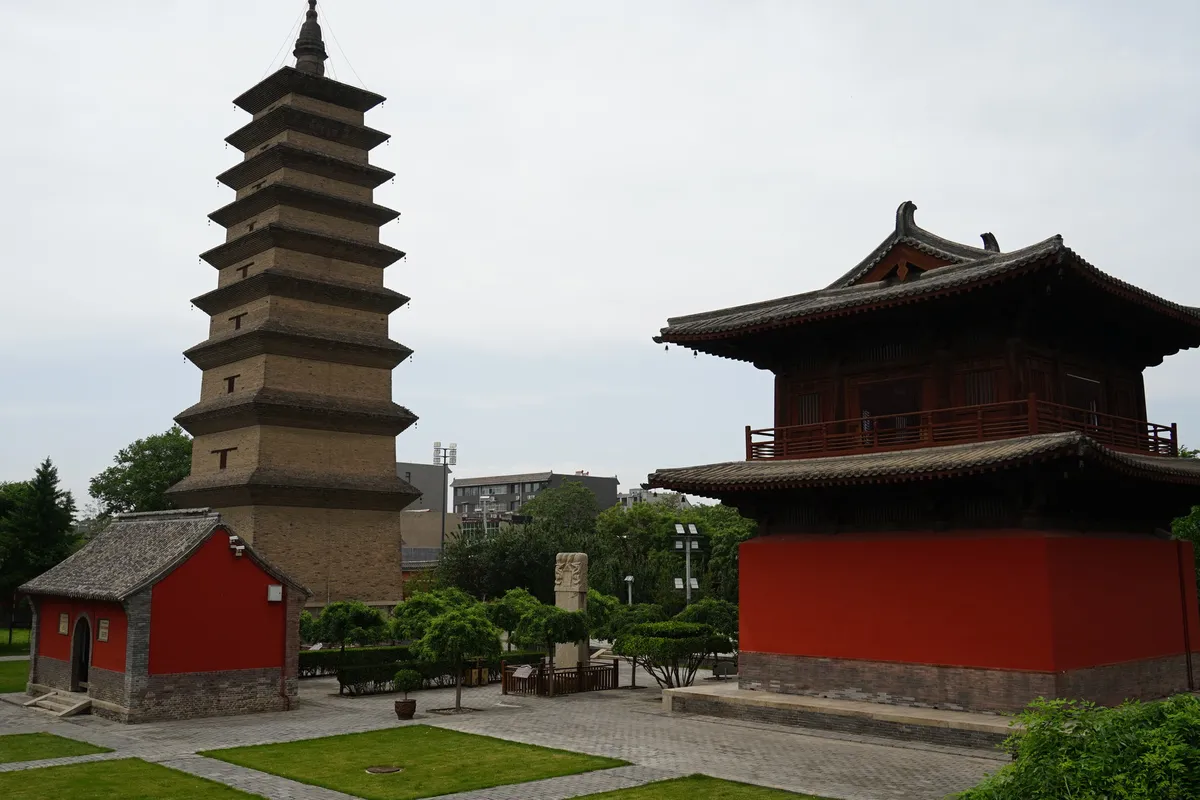
The main attraction of Congtai Park is the Wuling Congtai, built during the reign of King Wuling of Zhao in the Warring States period. It was originally a high platform used to review troops and enjoy song-and-dance performances. After more than two thousand years, it has remained a historical and cultural site and is one of Handan's landmarks.
Across from Congtai, the Handan Stele Forest is most memorable for its massive epitaph, which can be considered the largest of its kind. It was originally created by a military governor of the late Tang Dynasty, illustrating the power of warlords at that time.
Congtai is now a comprehensive park and a leisure and entertainment venue for Handan residents. May is the season when a hundred flowers are in full bloom.
Not far from the park is the Xuebu Bridge (Learning to Walk Bridge). As an ancient city with 3,100 years of history, Handan has given rise to many idioms, such as 'Learning to Walk in Handan,' 'The Golden Millet Dream,' and 'Returning the Jade Intact to Zhao.'
After lunch, we drove 26 kilometers out of the city to Guangfu Ancient City, located in Yongnian County, Handan. It is a 5A-level scenic area. The ancient city was first built in the late Sui and early Tang dynasties. It served as the capital of the Xia Kingdom when Dou Jiande proclaimed himself emperor, and later declined. However, it remained a prefecture during the Ming and Qing dynasties, lasting for 545 years.
The ancient city is surrounded by water on all sides (actually in a low-lying area), making it the only water city on dry land in northern China.
The city is large and still under renovation. We took a sightseeing car to the first attraction, Guangping Prefectural Office. It was rebuilt on the original site, covering an area of 53,000 square meters, with buildings totaling 5,600 square meters, 19 courtyards of various sizes, and over 160 rooms. When we arrived, a film crew was shooting a scene there.
The second attraction we visited was Guangjun Sanwu (Three Martial Arts of Guangjun), which is the best-preserved Qing dynasty architectural complex in the city, with three entrances and four courtyards. 'One prefecture produced three scholars; inside and outside, two Hanlin scholars.' The exquisite architecture, precious exhibits, and profound cultural connotations left a deep impression on us.
After touring the ancient city, we went to the nearby Hongji Bridge. Built during the Sui dynasty, it is contemporary with the famous Zhaozhou Bridge. It is now protected, and admission is required.
(May 15) We stayed overnight in Handan. The next morning, we drove 90 kilometers to the Memorial Hall of the 129th Division of the Eighth Route Army in Shexian County, located at the eastern foot of the Taihang Mountains. After the visit, we followed the General Ridge to the former site of the 129th Division Headquarters to continue our visit. Unfortunately, the weather was not cooperative; it started pouring rain when we arrived at the scenic area, so we could only take photos with our phones.
From 1937, when Liu Bocheng and Deng Xiaoping established the Taihang Mountain Anti-Japanese Base, until 1947 when they advanced into the Dabie Mountains, they lived and fought here for nearly ten years—a considerable time. Coinciding with the 100th anniversary of the founding of the Communist Party, there were many visitors coming to study here. We managed to avoid the crowds by timing our visit carefully.
After lunch in the small town near the former site, we visited another 5A-level scenic area not far away: the Wahuang Palace (Goddess Palace), a place of beautiful legends. According to legend, in ancient times, the goddess Nüwa 'molded clay to create humans and smelted stones to repair the sky' here. Over 8,000 years, Nüwa culture was born and flourished here, leaving behind stone carvings from the Northern Qi dynasty, inscriptions from the Tang dynasty, brick walls from the Song dynasty, and Ming and Qing dynasty architecture. It has become one of the five major ancestral worship sites in China.
At the foot of the mountain, a giant statue of Nüwa stands in the square.
Xiao Yang and I gave up the cable car and climbed up the Eighteen Bends trail to the top.
There were many temples at the foot of the mountain and pavilions on the summit.
Northern Qi dynasty stone-carved Buddhist scriptures.
This building is called the 'Living Building Hanging Temple,' secured by nine iron chains. When you reach the highest level, the building sways.
We descended via the 'Buthole Valley Ecological Scenic Area,' which was beautiful.
(May 16) We stayed overnight in Shexian County. In the early morning, the small city had fresh air and the first rays of sunlight. After breakfast at the hotel, we drove to Dongtaihang Scenic Area in Wu'an.
Dongtaihang Scenic Area is a new Taihang Mountain tourism project invested by CITIC Group with over ten billion yuan. Online hype focused only on the glass walkway, but 'if you don't see it, you won't know; once you see it, you'll be amazed.' The beauty of the Taihang Mountains and the completeness of the tourism facilities rival the 'Five Finger Peaks' in the north. We took the cable car up and down and spent a full four hours in the scenic area, yet we were still not fully satisfied.
The glass walkway on the mountain was temporarily closed due to an order from the Provincial Department of Culture and Tourism.
The mountain body here is composed of red quartz sandstone from 1.4 to 1.8 billion years ago, characterized by Zhangshiyan landform features, making it a mountain-type natural scenic area that combines grandeur, uniqueness, danger, and steepness. Walking here was thrilling and immensely satisfying.
The mountain body shows feather-like cross-bedding patterns.
There are three route options for touring Dongtaihang: Route A takes 3 hours, Route B 4 hours, and Route C 5 hours. We chose Route A.
Red cliffs and danxia landscapes were incredibly beautiful.
Cloud-covered plank roads with elevators for assistance.
Small setups brought big surprises.
'Riding the Ridge to Enjoy the Scenery' was only viewed from a distance; we didn't set foot on it (Route C).
Around 3 p.m., we gathered at the visitor center and then drove to the nearby Jingniang Lake Scenic Area. After playing in the mountains, it was time to play in the water!
The name Jingniang Lake comes from the story of Song Taizu Zhao Kuangyin escorting Zhao Jingniang a thousand miles. Actually, the scenic area was formed by building a dam in a canyon, creating a reservoir like the Three Gorges. Here, steep cliffs, deep valleys, high gorges, and flat lakes with clear water and red cliffs created an extraordinary landscape.
The scenic area can be divided into water tours, island tours, and dock leisure tours. Due to time constraints, we chose to first take a boat, then go ashore, and return to the dock along the lakeside plank road.
(May 17) Since we had to return to Handan tonight to change cars (air conditioning malfunction), we had to leave Jingniang Lake early. In the morning, we drove another 150 kilometers to the Zhaozhou Bridge Scenic Area in Zhaoxian County, Shijiazhuang. With this, the Handan area tour came to an end.
My longing to visit Zhaozhou Bridge originated from elementary school textbooks. It was always on my mind, so I naturally included it in the itinerary. However, it was disappointing that the current Zhaozhou Bridge is a rebuilt one.
There are many inscriptions from past dynasties recording and praising it.
After seeing Zhaozhou Bridge, we went to Baodu Stockade in Luquan District, Shijiazhuang, about 65 kilometers away. It is a famous mountain and ancient stockade that integrates historical culture and natural scenery, rising abruptly from the North China Plain and extending westward to the continuous Taihang Mountains. The mountaintop is flat, with over 600 mu of fertile land, known as 'the world's extraordinary stockade' and 'Baodu Blessed Land.'
We first took a gondola lift for 40 yuan to the Southern Heavenly Gate, then walked along the long city wall to the Golden Que Palace, then to the Cowherd and Weaver Girl's Home, through the woods, and back to the Southern Heavenly Gate.
The main scenery of Baodu Stockade is the stockade wall winding along the cliffs, about 2 kilometers long. From above, you can see the entire land of Yan and Zhao.
The stockade wall wound along the cliffs, looking very steep from a distance.
According to records, in 204 BC, Han Xin defeated the Zhao army here, and the idiom 'burning one's bridges' originated from this battle. Zhang Sanfeng, the founder of Taoism, also stayed here.
After this visit, we originally planned to go to Cangyan Mountain Scenic Area today and then stay in Shijiazhuang so that we could go to Xibaipo the next day. However, it was getting late, so we decided on the spot to stay nearby (Luquan District) and go to Cangyan Mountain early tomorrow, then to Xibaipo, and finally to Zhengding to see the night view. So, Deming Ancient Town came into the picture from behind the scenes.
Deming Ancient Town is not ancient! The government aimed to create a new model and new format that can reflect Yan-Zhao culture, attract high-end artistic talent, and foster innovation. Therefore, its architecture draws from various sources, concentrating the essence of different periods, forming a new place for eating, dressing, living, shopping, and entertainment. Located in Changqing Tourist Area of Shijiazhuang, Deming Ancient Town naturally attracts a lot of visitors.
(May 18) Cangyan Mountain Scenic Area is located in Jingjing County, 50 kilometers southwest of Shijiazhuang. It is a national scenic spot. There are temples, academies, stele pavilions, and other buildings on the mountain, all built on dangerous rocks, deep valleys, and steep cliffs, blending with the surrounding mountains, pines, and ancient cypresses. The scenery is very beautiful, and many film and television programs have been shot here.
We set off from Luquan, passing through the eastern section of the 'Taihang Sky Road,' and drove for over an hour. First, we took a cable car to the top, then hiked down. After a full round, everyone was very happy and gained a lot.
After exiting Cangyan Mountain, we drove another hundred kilometers to the red education holy land Xibaipo. The expressway was very helpful all the way. Xibaipo was the last location of Chairman Mao and the Party Central Committee before the nationwide liberation. Although they stayed here for only a little over ten months, it was a time of surging waves in the Chinese revolution. Every event that happened here holds historical value.
We first visited the Xibaipo Memorial Hall, then the former site of the Party Central Committee, Mao's former residence, the former site of the Seventh Plenary Session of the Second Central Committee, etc. We paid tribute to the great achievements of our predecessors and received a red revolutionary re-education.
The site of the Second Plenary Session of the Seventh Central Committee.
That day, we arrived in Zhengding. We took a taxi to the Hutuo River (Zhengding has regional traffic restrictions), and then to the South Gate. At this time, the sun was setting in the west, and the lights on the city towers were just coming on. We finally got to see Zhengding's beautiful night view as we had wished.
Compared to 12 years ago, Zhengding has truly undergone a rebirth. That evening, we had dinner at the night market and stayed at Hanting Hotel on Hengshan West Road.
(May 19) Today we entered the third stop of our Hebei self-drive tour—Baoding. In the morning, we drove 103 kilometers from Zhengding to the Ranzhuang Tunnel Warfare Memorial Hall in Baoding.
Ranzhuang is located in the central Hebei plain. Starting in 1938, the villagers dug tunnels, eventually forming a network with 4 main lines and 24 branch lines, totaling 16 kilometers in length, crisscrossing and interlocking up and down. They used the tunnels to fight against the enemy 157 times, killing or capturing over 2,100 enemy soldiers, earning the title 'Model Village for Tunnel Warfare.'
From the memorial hall, we entered the tunnels directly and then came out in the village. The visiting route was well arranged.
The old locust tree at the head of the village was the best witness to the battles.
The crossfire network once caused the enemy regiment commander to die.
Tunnels underground, watchtowers above.
Shooting holes everywhere.
We took a photo with the son of the old anti-Japanese village head. Ranzhuang is also the filming location for many film and television works, such as 'Tunnel Warfare,' 'Plain Guerrilla Unit,' and 'Burning Hell.'
Traveling from Ranzhuang to Baiyangdian Lake covers 76 kilometers, and we had to take this route. Baiyangdian consists of many lakes, islands, and waterways, forming a dense water network and reed marshes, and is also a land of fish and rice. During the Anti-Japanese War, there was the Yanling Detachment, which grew from over 30 people to over 100, fighting over 70 battles, with only 8 casualties, while killing or capturing nearly 1,000 Japanese and puppet soldiers, composing a moving and magnificent epic.
Online information showed that Baiyangdian Scenic Area was closed, but in fact, there are always ways around it. We paid 100 yuan each to charter a boat and entered the scenic area (two islands), then took a tour of the lake and entered the reed marsh. In the end, the trip was not in vain, fulfilling a long-cherished wish.
From Baiyangdian, Xiong'an New Area was not far away (a driving tour of the new area to see the construction was also planned), but the new area is very large, so we set our target on the newly opened Xiong'an High-Speed Rail Station. That night, we stayed at the Pasiton Business Hotel in Zangang Town, Xiong County.
(May 20) The Baoding area has very rich tourism resources. Considering factors such as license plate restrictions, we adjusted our itinerary. Today, we would go directly to the Western Qing Tombs. Yesanpo and the Zhili Governor's Mansion would be visited on the return trip.
The Western Qing Tombs are located in Yi County, northwest of Baoding, about 87 kilometers away. They contain the tombs of four Qing dynasty emperors and form a complementary pair with the Eastern Qing Tombs in Zunhua. The scenic area is very large, and the distance between tombs is considerable. Although there are shuttle buses connecting them, affected by the departure interval and off-peak season timing, we chose to drive within the scenic area ourselves.
Tailing (Yongzheng)
Muling (Daoguang)
Chongling (Guangxu)
Changxiling (Jiaqing)
After touring the Western Qing Tombs, it was already noon. We encountered a traffic jam on the Jinghuan Road in Xiong'an, which wasted nearly an hour. To save time, we simply grabbed a quick bite. From the Western Qing Tombs to Baishi Mountain was about 79 kilometers. We arrived around 2:30 p.m., but because of hailstones on the mountain, the cable car was suspended, and we had to take a bus instead, which wasted more time.
Baishi Mountain is located 15 kilometers south of Laiyuan County, Baoding City, Hebei Province. It stands at the northernmost end of the 800-li Taihang Mountains, with the highest peak, Foguangding, at an altitude of 2,096 meters. The scenic area integrates peak forests, strange rocks, sheer cliffs, canyons, forests, sea of clouds, Buddhist light, and the Great Wall, making it the number one famous mountain in northern China.
It is also a world geopark, with many geological wonders.
Fortunately, in the evening, the weather cleared up, allowing us to finally see the震撼 (shock) brought by the number one mountain in northern China!
Baishi Mountain is actually very large and very beautiful, with two entrances and three cable car lines. Due to time constraints, we only saw a part of it.
(May 21) That day, we hurried to stay in Yu County (GreenTree Inn Bus Station Branch). Yu County was called Yuzhou in ancient times, first built in the second year of the Daxiang era of the Northern Zhou dynasty. The current ancient city was rebuilt in the tenth year of Hongwu in the Ming dynasty. The ancient city contains numerous cultural relics and historical sites, and it is now a famous historical and cultural city in Hebei Province.
Prefectural Office (rebuilt in 2011)
Yuzhou Ancient Castle is 10 kilometers from the ancient city. It was preserved as a former military garrison and requires no ticket to enter. The newly built Nuanquan Ancient Town is speculated to be used for performing 'Dahushu (beating molten iron into sparks).'
From Yu County, we drove for 2 hours to reach the Dajingmen Scenic Area in Zhangjiakou. This is a pass of the Great Wall and a gateway to protect Beijing, ranking with Shanhai Pass, Jiayu Pass, and Yulin. With high mountains on both sides and the Great Wall winding along them, it truly has the strategic advantage of 'one man can hold off ten thousand.' We did not stay in Zhangjiakou but directly headed north to the important fortress beyond the Great Wall—Zhangbei County (Hanting Hotel Zhangbei Branch).
The landmark of Zhangbei County—Lansheng Gate.
(May 22) Zhangbei County is one of the first new-type urbanization pilot cities in China. The streets are clean, traffic is smooth, and the cityscape has a new look. In conversations with restaurant owners, they all had high hopes for Zhangbei's future. The eastern entrance of the 'Grassland Sky Road,' which rivals Route 66, is at Yehu Ridge in Zhangbei, and the exit is at Huapi Ridge in Chongli, with a total length of about 89 kilometers. This road was built in 2011, with an average altitude of 1,400 meters. The road twists and turns, rising and falling, displaying northern grassland scenery, highly favored by self-driving enthusiasts.
Wind power everywhere.
Not far from Huapi Ridge is Chongli County town, and a short drive later is Taizicheng, the host of the 2022 Winter Olympics skiing events. Now, the high-speed rail station and expressway have been completed and opened. The Olympic Village and some venues are also under interior decoration.
For tomorrow's Jinshanling Great Wall, we moved our planned accommodation forward to Changping District in Beijing. Along the spacious and brand-new Jing-Chong Expressway, we arrived at the 7 Days Inn Changping Subway Station in about an hour and enjoyed lamb soup and meat pies on the street.
(May 23) It took about 2 hours and 150 kilometers to drive from Changping to Jinshanling Great Wall. After parking and buying tickets, we took an electric car to the cable car station. We agreed that at the top, we would first go left, then turn back, making a 'T' shape, and finally meet at the central hub at the bottom.
The weather was not good—moderate pollution!
Jinshanling Great Wall connects to Gubeikou Great Wall in the west and Simatai Great Wall in the east. It is over ten kilometers long, with 5 passes, 67 watchtowers, and 3 beacon towers. The entire scenic area has undulating mountains. Climbing high and looking far, the Great Wall twists like a giant dragon on the mountain peaks, very grand and desolate.
Jinshanling Great Wall is located in Luanping County, Hebei Province. It was first built in the first year of Hongwu in the Ming dynasty under the supervision of General Xu Da. In 1567, the famous anti-Japanese general Qi Jiguang, as the commander of Ji Town, further built and renovated it. It is now a well-preserved Ming dynasty Great Wall.
Descending from the Jinshanling Great Wall was already 2 p.m. We drove to the nearby Gubeikou intending to stay there. We happened to meet a lady recommending accommodation. It turned out that Gubeikou had been transformed into the Gubei Water Town, with an admission fee of 180 yuan. We went to the place the government had relocated her to, a relatively large accommodation with meals, and the conditions were really good.
According to the lady, the nearby 'Ancient Imperial Road' was worth a visit, and the night view of Gubei Water Town was beautiful, so we could go there at night. So, after a short rest, we went to the Ancient Imperial Road Village and the Great Wall Anti-Japanese War Memorial Hall.