Great Wall Pass Trip Part 2 - Bethune Memorial Hall, Longxing Temple, Xibaipo
As mentioned at the beginning, this self-driving trip along the Great Wall passes, besides visiting the strategic passes and dangerous fortifications on the Great Wall, also plans to stop by some places of interest that are not far away, making the journey more fulfilling, colorful, and interesting. This principle was followed not only in the pre-trip planning and itinerary but also throughout the journey, with adjustments and modifications according to actual conditions as needed. This is because self-driving travel has the inherent advantage of being adjustable and flexible at any time and place.
Tang County, established as a county in the early Western Han Dynasty, was the fief of Tang Yao, one of the "Three Sovereigns and Five Emperors" of ancient times, and is one of the birthplaces of the Chinese nation, known as the "Millennium Ancient County." Located in the western part of the Haihe River Basin, at the northern section of the eastern foot of the Taihang Mountains, the county features a variety of landscapes including mountains, hills, plains, and rivers, summarized as "70% mountains, 10% water, and 20% farmland."
During the War of Resistance against Japan, Tang County was the headquarters of the Jin-Cha-Ji Military Region and the Third Subdistrict, where veteran revolutionaries such as Nie Rongzhen, Yang Chengwu, and Lü Zhengcao lived and fought for a long time. It was named a "Model Anti-Japanese County" for raising more than 50,000 Eighth Route Army soldiers with its population of 180,000. The great internationalist warriors Norman Bethune and Dwarkanath Kotnis lived, worked, fought, and died here.
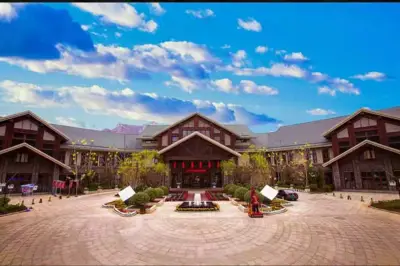
Longchang Holiday Hotel, claiming to be a four-diamond level, was unexpected for Tang County, which was still a poverty-stricken county until two years ago (exited in 2019), to have such a high-class hotel. The lobby, corridors, and rooms were all very good, and staying one night felt worth the money.
For dinner, we found a restaurant near the hotel called "Menguo Tribe" (闷锅部落), a trendy and fashionable name with a unique and innovative way of eating.
Waking up early, I took my usual walk outside. To get a feel for a county town I had never visited, strolling along the streets was the most direct way.
The streets were neat and clean, with no very tall buildings. The roads were wide, and the sprinkler truck had just sprayed the pavement. There were few pedestrians and occasional vehicles, without the hustle and bustle of a big city, presenting the unique relaxation and comfort of a small city.
I carefully looked at the bus stop signs; this street had more than one bus route.
Turning a corner, there were rows of restaurants with clean and tidy storefronts, all looking quite pleasant.
Longchang Steamed Bun Shop, many parents were bringing their children for breakfast, seemingly serving a special function for student breakfasts.
The hotel breakfast had a nice dining environment, and the food was satisfactory.
In the hotel lobby, there was a "Tang County Consumption Poverty Alleviation Counter" selling local specialties. I bought corn grits and date wine. Tang County is famous for its large dates, with a long cultivation history, known for being "big, thin-skinned, with small pits and thick flesh."
Another sunny day.
April 13th, the second day of the trip, covering over 260 kilometers.
Tang County - Zhengding Longxing Temple - Xibaipo - Pingshan County
I knew that Bethune died in Tang County but didn't know that the Bethune and Kotnis Memorial Hall was located right in Tang County town. Our generation is very familiar with Bethune's deeds and full of respect for this internationalist warrior. Since the Bethune Memorial Hall was nearby, how could we miss it? Everyone unanimously agreed to add it to the itinerary and visit.
The Bethune and Kotnis Memorial Hall is located at the foot of Zhongming Mountain, 2 kilometers north of Tang County town. The memorial was first built in 1971, and in 1985, with the approval of the Hebei Provincial People's Government, the site was moved north to build a new hall. The new hall was completed in November 1986.
Mao Zedong's famous saying in "Learn from Bethune" is still recited from memory: "What kind of spirit is this that a foreigner, with no selfish motives, regards the liberation cause of the Chinese people as his own? This is the spirit of internationalism, the spirit of communism, and every Chinese Communist Party member must learn this spirit."
The memorial is built in traditional Chinese ethnic architectural style, facing south, covering an area of 45,950 square meters with a building area of 3,250 square meters. The main building complex is divided into "two halls and one memorial hall." In the north center is an octagonal memorial hall used for temporary exhibitions and various commemorative activities. On the west side is the Bethune Memorial Hall, and on the east side is the Kotnis Memorial Hall.
Bethune Memorial Hall
Bethune, full name Henry Norman Bethune (March 4, 1890 – November 12, 1939), was a Canadian Communist, an internationalist warrior, and a famous thoracic surgeon. He joined the Communist Party of Canada in 1935 and came to China in 1938 to participate in the War of Resistance against Japan. He died of sepsis caused by infection during surgery on the early morning of November 12, 1939.
On the evening of April 1, 1938, the day after arriving in Yan'an, Bethune was invited to meet with the leader of the Chinese Communist Party, Mao Zedong. Under the flickering candlelight, listening to the soft and low voice and those sharp questions, he gained a very strong impression: that this Communist leader was a man of high cultural cultivation and could express his thoughts with sharp political remarks.
A newly discovered precious photo, the only one ever seen of Mao Zedong and Bethune together.
Although this photo has long been known, it is equally precious. It was taken by Bethune in April 1938, a photo of Mao Zedong.
Bethune did not agree to stay in Yan'an; he insisted on going to the front line. In April 1938, he went from Yan'an to the Jin-Cha-Ji border region, where he worked for nearly two years. The red dots on the map below indicate the places where Bethune fought; he died in Tang County.
Bethune's residence in Tang County.
An unforgettable image, from a real-time photo taken that year: Bethune performing field surgery in a small village temple. His spirit of sacrifice, work enthusiasm, and sense of responsibility were exemplary, until he died at his post. Mao Zedong praised him as "a noble person, a pure person, a moral person, a person free from vulgar tastes, and a person beneficial to the people."
During the War of Resistance, Tang County, located at the eastern foot of the Taihang Mountains in Hebei, was a "model base area." Bethune risked his life, moving along the banks of the Tang River, through bullets and artillery fire, serving the anti-Japanese military and civilians with great enthusiasm. He was a person who never seemed tired. If his work was delayed or he saw others working inefficiently, he would rage, scaring those around him. But for the soldiers he treated, his eyes showed kindness. He always said to the wounded: "My child..."
On the east side of the memorial hall is the Kotnis Memorial Hall.
Dwarkanath Kotnis, an Indian, famous doctor, and great internationalist warrior, came to China in 1938 with the Indian medical team to assist in the war against Japan. He served in Yan'an and the North China anti-Japanese base areas, as the chief surgeon of the Eighth Route Army hospital and the first director of the Bethune International Peace Hospital. On the early morning of December 9, 1942, Kotnis died of epilepsy in Tang County, Hebei, at the age of 32.
In the corridor connecting the "two halls and one memorial hall," there are four large bronze reliefs, themed "Leading the Eastward Expedition," "Deep Bond with the People," "Field Rescue," and "Self-reliance."
Leaving Tang County, we headed to Longxing Temple, about 100 kilometers away.
Longxing Temple in Zhengding County, as a famous temple in the Heshuo region, has witnessed the development and changes of Buddhist culture in northern China from the Tang and Song dynasties to the Republic of China. Longxing Temple is one of the existing temples in China with the most Song dynasty architecture, statues, and stone carvings. It includes the Mani Hall, praised by Liang Sicheng as a unique example of ancient architecture in the world; the "Guanyin in Reverse Sitting," praised by Lu Xun as the "Oriental Beauty God"; and the tallest bronze Buddha in China, the "Thousand-handed Guanyin"...
Longxing Temple, also known as Big Buddha Temple, is located in Zhengding County. It was originally the Longteng Garden of Murong Xi of the Later Yan during the Sixteen Kingdoms period of the Eastern Jin Dynasty. In 586 AD (the sixth year of Kaihuang, Sui Dynasty), a temple was built in the garden, then called Longcang Temple, changed to Longxing Temple in the Tang Dynasty, and to Longxing Temple in the Qing Dynasty. It is one of the earliest, largest, and best-preserved Buddhist temple complexes in China.
The temple covers an area of 82,500 square meters, with more than ten halls and pavilions distributed along the central north-south axis and on both sides, with varying heights and clear priorities. It is an important example for studying the layout of Buddhist temple architecture in the Song Dynasty.
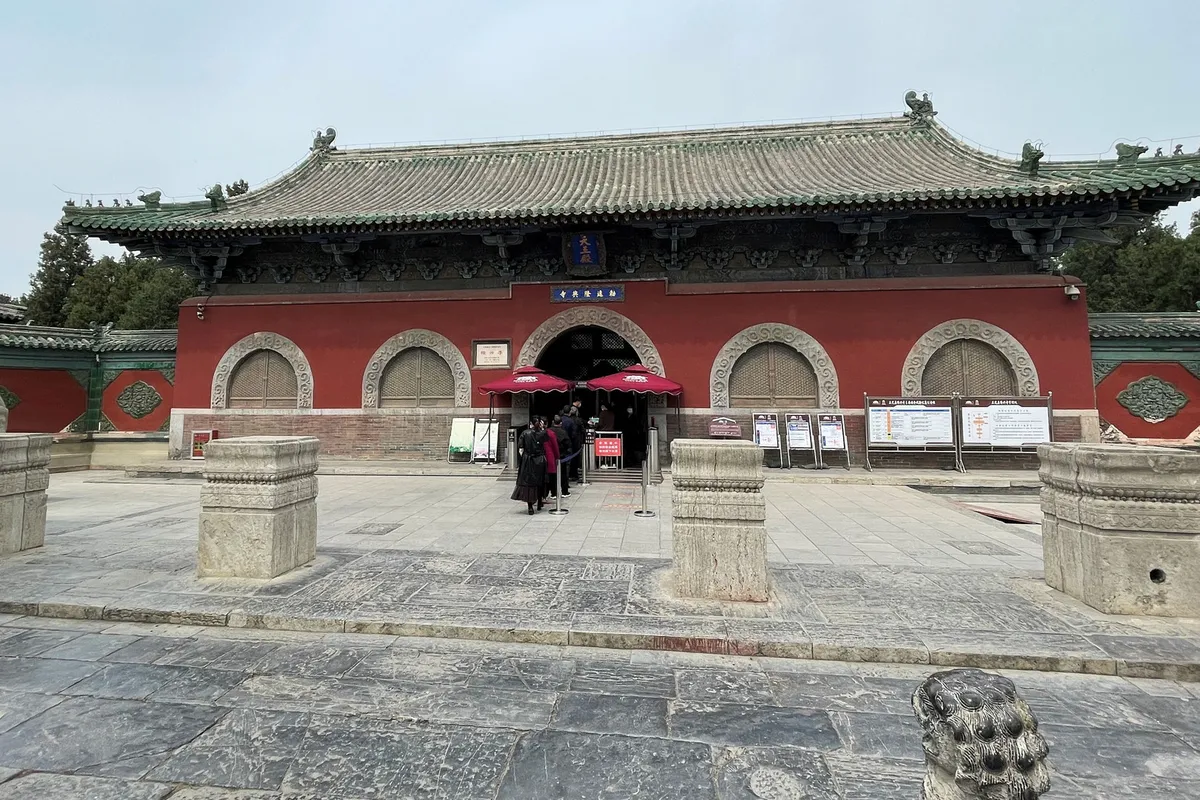
Tianwang Hall (Heavenly King Hall) is the first hall of Longxing Temple, also serving as the mountain gate. Built in the early Northern Song, it is a building with five bays in width, two bays in depth, a single-eave hip-and-gable roof, and a seven-purlin central column structure. During a major renovation in the Qianlong period of the Qing Dynasty, Qing architectural style was incorporated. Above the door is a horizontal plaque inscribed by Emperor Kangxi with the golden characters "敕建隆兴寺" (Imperial Construction of Longxing Temple).
Inside the hall, on both sides, are the Four Heavenly Kings, the guardian deities of Buddhism, commonly known as the "Four Vajras." After being introduced to China, they were completely sinicized, their image resembling ancient Chinese warriors. Due to the different instruments in their hands, they were given auspicious Chinese meanings. Together, the Four Heavenly Kings symbolize "wind, harmony, rain, and smoothness," implying "abundant harvests and peace for the country and people."
Inside the hall is a wooden statue of the Laughing Maitreya Buddha, a wooden carving from the Jin Dynasty, over 800 years old. The statue is 1.9 meters tall, plump, with a cheerful smile, holding a cloth bag in his left hand. This is a completely sinicized Maitreya Buddha, whose image originated from the monk Qieci of Yuelin Temple in Fenghua, Zhejiang, during the Five Dynasties. Some temples have a couplet: "A big belly can hold things that are hard to hold in the world; open your mouth and laugh at the laughable people in the world."
The site of Dajue Liushi Hall, originally built during the Yuanfeng period of Emperor Shenzong of Song, covers an area of about 1,800 square meters. It was renovated in the Jin, Yuan, and Qing dynasties but collapsed in the early Republic of China due to disrepair, leaving only the platform. According to the "Longxing Temple Records," the Buddhist altar in the hall originally had seven Buddha statues: in the center was Shakyamuni, flanked by his six predecessors, collectively known as the "Seven Buddhas of the Past."
Mani Hall has a very unique structure. On each of the four sides of the square hall body, there is a hipped-gable porch facing outward, forming a cross-shaped plan. The brackets under the eaves are large and sparsely distributed; the pillars are thick with obvious entasis, lateral inclination, and rising; the roof ridge and flying eaves curve like waves, natural and smooth; the four corners are slightly upturned, like a bird about to take flight.
The exterior of Mani Hall is majestic and imposing, layered and magnificent, full of variation and quite special in form. It is a model of ancient architecture according to the Song "Yingzao Fashi" (Building Standards) and is praised by Mr. Liang Sicheng as a unique example of ancient architecture in the world, with extremely high historical, scientific, and artistic value.
The stone incense burner in front of the hall, carved in the Song Dynasty, consists of two parts: the burner body and the base, stacked together, with a total height of 1.4 meters. On the front of the burner body is a relief of the Medicine Buddha, the master of the Eastern Pure Lapis Lazuli World, surrounded by the Twelve Divine Generals of the Medicine Buddha, holding weapons like vajras, swords, and clubs, giving a sense of power and lifelikeness. This Song Dynasty stone incense burner with Buddhist motifs is extremely rare to have survived to this day.
On the north wall of the inner chamber of Mani Hall is a Song Dynasty clay sculpture of a five-colored hanging mountain, with more than 30 Buddha statues on it. The most striking is the five-colored Guanyin statue sitting in the middle, commonly known as "Guanyin in Reverse Sitting." The Guanyin statue is 3.4 meters tall, with its left foot on a lotus, right leg raised, both hands holding the knees, body slightly leaning forward, with a serene and beautiful face and elegant and dignified posture. Beneath the willow-leaf eyebrows, the wise and deep eyes slightly look down, forming an emotional exchange with the worshipers looking up. This humanized Buddha statue is called the "Oriental Beauty God" by Mr. Lu Xun.
North of Mani Hall. "Mani" is a Sanskrit term meaning pearl or treasure. Buddhist scriptures say: "The Mani pearl, when thrown into muddy water, makes the water clear." Mani Hall takes this name, meaning to remove turbidity and achieve clarity, to leave the mundane world and attain purity.
To the north of Mani Hall is an exquisite wooden archway gate, which, due to the deep north-south depth and overlapping courtyards of Longxing Temple, likely served as an entry gate between the front and back courtyards.
Dragon and Phoenix Locust Trees: Inside the courtyard, on both sides of the central path, there are two locust trees over 1,600 years old, one a Dragon Locust and the other a Phoenix Locust. Their canopies intertwine in the air, and their roots intertwine underground. When the country's fortune is weak, the leaves are sparse; when the country's fortune is strong, the leaves are lush. People feel the spirituality of the Dragon and Phoenix Locust Trees and believe that walking around the tree three times will bring blessings.
The Ordination Altar at Longxing Temple is a very beautiful pavilion-style building, rebuilt in the Qing Dynasty. Inside, there is a Ming Dynasty bronze double-sided Buddha statue, with Amitabha Buddha on one side and Medicine Buddha on the other. This is one of the three major ordination platforms in northern China, the other two being at Jietai Temple in Beijing and Qingliang Temple on Mount Wutai in Shanxi.
The Ordination Altar is three stories with four sides. On the first floor, each side has six corridor pillars, above which are dougong brackets supporting the large eaves of the altar. The roof is a pointed roof with four ridges, each ridge having six mythical beasts.
Longxing Temple has many towering ancient trees. This ancient locust tree is honored as "Longevity Locust," over 1,300 years old. Legend has it that Song Taizu Zhao Kuangyin once stopped under this tree and saw auspicious cranes and clouds lingering above the tree for a long time, which he regarded as a sign of good fortune. As a longevity tree, it naturally provides protection. Piously walking around the tree three times can bring wealth, honor, and long life.
Dabei Pavilion (Hall of Great Compassion) is the main building of Longxing Temple, located at the rear of the central axis. It was formerly known as "Foxin Pavilion" and "Tianning Guanyin Pavilion." According to records, it was first built in 971 AD (the fourth year of Kaibao, Northern Song). It was repaired in the Yuan, Ming, and Qing dynasties. The existing building was rebuilt from August 1997 to September 1999 according to the Song "Yingzao Fashi." It is the largest single cultural relic renovation project after the Potala Palace. The rebuilt Dabei Pavilion is a three-story, hipped-gable-roofed pavilion-style building with seven bays in width and six bays in depth. The main hall is 35.5 meters high, with a total area of 1,643.5 square meters. The adjacent Yushu Tower and Jiqing Pavilion are connected by rainbow bridges, with the three pavilions standing side by side, magnificent and imposing.
Yushu Tower: In 1944 (the 33rd year of the Republic of China), when Dabei Pavilion was renovated, the adjacent Yushu Tower and Jiqing Pavilion were dismantled, reducing the building area by one-third compared to the original.
Inside Dabei Pavilion is a Song Dynasty bronze statue of "Thousand-handed, Thousand-eyed Guanyin Bodhisattva," commonly known as the "Zhengding Grand Bodhisattva." It was cast by order of Song Taizu Zhao Kuangyin in 971 AD (the fourth year of Kaibao, Northern Song). The statue is 21.3 meters tall, with 42 arms. Besides its own two hands and eyes, it has 20 hands on each side of the body, holding the sun, moon, pure vase, vajra, sword, and other ritual implements. The bronze statue is tall and well-proportioned, with rare scale and fine craftsmanship. It is the tallest and oldest thousand-handed, thousand-eyed Guanyin Bodhisattva among ancient bronze Buddha statues in the world.
The Thousand-handed, Thousand-eyed Guanyin Bodhisattva has a calm demeanor, even proportions, smooth clothing lines, and delicate details, reflecting the artistic style of the Song Dynasty.
Inside Dabei Pavilion, there are wooden stairs leading to the top floor, where you can lean on the railing and enjoy the view of the ancient city of Zhengding.
This stone Sumeru base is an original artifact from the Northern Song Dynasty, 2.25 meters high, with vivid shapes and exquisite craftsmanship, making it a rare treasure of Song Dynasty stone carving art.
Pilu Hall is located at the very end of the central axis of Longxing Temple. It was originally the main hall of Chongyin Temple, one of the eight major temples in Zhengding, built during the Wanli period of the Ming Dynasty. In 1959, due to the temple's dilapidation, it was moved to Longxing Temple for preservation. The Pilu Buddha inside the hall is a national treasure, one of the six greatest treasures of Longxing Temple.
The bronze Pilu Buddha is uniquely designed, exquisitely crafted, and was made by order of Emperor Wanli Zhu Yijun as a birthday gift for his mother, Empress Dowager Cisheng. This Pilu Buddha is entirely made of bronze, 6.72 meters tall, consisting of three layers of seated Pilu Buddha and three layers of round drum-shaped lotus pedestals stacked together. On the thousand lotus petals of the three layers of lotus pedestals, a small seated Buddha is cast, with appropriate proportions, fine workmanship, varied expressions, and meticulously carved decorations on the robe edges. The entire statue has a total of 1,072 large and small Buddha figures.
The stone pillar of Mengtang Master: Mengtang was a prominent monk of Longxing Temple in the Ming Dynasty, the twenty-fifth generation dharma heir of the Linji sect, who passed away in 1516 AD (the 11th year of Zhengde, Ming). The stone pillar of Mengtang Master was erected in 1557 AD (the 36th year of Jiajing, Ming). It is an octagonal, seven-story, stone imitation wooden pagoda-style structure, 9.13 meters high.
In the northeast part of the temple complex, there is a temple garden named Longteng Garden, combining cultural relic exhibition, leisure, and tourism.
When planning the itinerary before departure, we only considered Zhengding Longxing Temple as an optional target (it was not on the direct route, requiring a detour). During dinner in Tang County the first day, after discussion, we decided to visit anyway. Although it was a bit of a detour, we had enough time. In retrospect, it was a wise decision; Longxing Temple was well worth a visit.
From Longxing Temple to Xibaipo is over 90 kilometers.
Xibaipo is a revolutionary sacred site in China, was once the location of the Central Committee of the Communist Party of China. The Central Committee and Chairman Mao commanded from here the three major campaigns that decided the outcome of the War of Liberation: the Liaoshen, Huaihai, and Pingjin campaigns, and held the historically significant Second Plenary Session of the Seventh Central Committee and the National Land Conference, leading to the liberation of all China. Hence, it is praised as "New China came from here" and "China's destiny was decided in this village."
On March 23, 1949, the Central Committee of the Communist Party of China, the Central Military Commission, and the General Headquarters of the People's Liberation Army moved from Xibaipo to Beiping.
Central Organs Primary School
Former residence of Liu Shaoqi.
In March 1947, the Central Committee of the Communist Party of China evacuated Yan'an. On March 26, a Central Committee meeting was held in Zaolin Gully, Qingjian County, deciding that Mao Zedong, Zhou Enlai, and Ren Bishi would lead the central organs and the General Headquarters of the People's Liberation Army to stay in northern Shaanxi. Meanwhile, for work convenience, the Central Working Committee was established. On July 12, 1947, the Central Working Committee was established in Xibaipo, with Liu Shaoqi, Zhu De, and Dong Biwu as its standing committee members, and Liu Shaoqi as secretary.
Former residence of Dong Biwu.
Former residence of Comrade Mao Zedong.
In 1948, the Central Committee and Chairman Mao moved to Xibaipo, where they commanded the three major campaigns that shook China and the world, and in 1949, held the Second Plenary Session of the Seventh Central Committee, a historic turning point.
The air-raid shelters built by the central organs at that time.
Site of the Second Plenary Session of the Seventh Central Committee: From March 5 to 13, 1949, the Second Plenary Session of the Seventh Central Committee of the Communist Party of China was held here, attended by 34 full members, 19 alternate members, and 11 observers. Mao Zedong presided over the meeting and delivered the "Report to the Second Plenary Session of the Seventh Central Committee of the Communist Party of China."
"We must make comrades continue to maintain the style of modesty, prudence, and not being arrogant or rash; we must make comrades continue to maintain the style of hard struggle." The core of the two "musts" is to educate the whole party to withstand the tests of the new historical stage, showing Chairman Mao's far-sighted political vision.
On the high steps is the Xibaipo Memorial Hall. Behind the memorial hall, on the mountaintop, stands the Xibaipo Monument, with a total height of 20.5 meters. On the front of the monument are engraved the characters "Revolutionary Sacred Site Xibaipo."
The bronze statues of the five secretaries of the Central Committee of the Communist Party of China are located in the center of the square in front of the Xibaipo Memorial Hall, artistically recreating the scene of the first generation of collective leadership of the Communist Party of China filled with victory joy and infinite longing for the future.
Inside the Xibaipo Memorial Hall.
Gangnan Reservoir, with its lake and mountains reflecting clear waves, adds brightness to the revolutionary sacred site of Xibaipo.
From Xibaipo to Pingshan County town is nearly 50 kilometers. I had booked Jingye Hotel. It was a four-star hotel in the county town, and the price seemed a bit high, but the facilities and service were satisfactory.
Dinner was in the hotel restaurant. The cooking was good, all home-style dishes, and tasted great. However, the bill seemed a bit expensive.
Waking up early, I went out for a walk to experience the local customs. Pingshan County is located in western Hebei Province, at the eastern foot of the Taihang Mountains, upstream of the Hutuo River.
Nowadays, many county towns are built quite nicely, and Pingshan County is no exception. Quiet, neat, and tidy, it is a city that evokes affection, strikingly similar to the impression of Tang County from the previous day. However, a few matchbox-like high-rise residential buildings ahead on the road were somewhat displeasing.
Pingshan County is also an old revolutionary base area. Since the War of Resistance against Japan, it has been embraced by two major base areas: the Jin-Cha-Ji and Jin-Ji-Lu-Yu border regions. Pingshan County was the location of the leadership organs of the Fourth Military Subdistrict and the Second Military Subdistrict of the Jin-Cha-Ji Border Region. The Central Bureau of the Northern Bureau of the Communist Party of China, the Jin-Cha-Ji Border Region Government, and the Jin-Cha-Ji Military Region also lived here for up to three and a half years.
The yellow electric bikes should be shared vehicles. Despite the small city, it has everything it needs.
I deliberately turned into a small alley off the main street. Although its appearance was somewhat simple, it was very clean.
The hotel breakfast had a wide variety.
View of the county from the hotel room.
Travel Notes Contents:
1. Tang County
2. Bethune and Kotnis Memorial Hall
3. Longxing Temple
4. Xibaipo
5. Pingshan County Town
Tourism Information:
Hotel Index
Strategy Index
Ticket Index
Website Navigation
Tourism Index
Cruise Index
Corporate Travel Index
Join & Cooperate
Distribution Alliance
Friendship Links
Corporate Gift Card Purchase
Insurance Agency
Agency Cooperation
Hotel Franchise
Destination & Scenic Spot Cooperation
More Cooperations
About Ctrip
About Ctrip
Ctrip Hot Topics
Contact Us
Careers
User Agreement
Privacy Policy
Business License
Security Center
Ctrip Content Center
Intellectual Property
Trip.com Group Algorithm Publicity