3-Day Tour: Hebei Baoding, Xushui, Xiong'an New Area, and Beijing
Shanghai Hongqiao Railway Station → Overnight Train
18:00 Arrive at Shanghai Hongqiao Railway Station, wait for the train.
19:00 Depart from Shanghai Hongqiao Railway Station on an overnight train to Beijing South Railway Station, with stops at Nanjing and other stations.
Beijing South Railway Station → Xushui Station, Baoding, Hebei → Xiaoyu's Wedding Feast → Baiyangdian AAAAA Scenic Area → Xiong'an New Area Citizen Service Center → Beijing → Weiming Courtyard Hotel (Beijing Nanluoguxiang Branch / Check-in) → Nanluoguxiang → Weiming Courtyard Hotel (Beijing Nanluoguxiang Branch)
07:30 Arrive at Beijing South Railway Station. After exiting, walk to the waiting hall at Beijing South Railway Station.
07:45 Arrive at the waiting hall at Beijing South Railway Station, wait for the train.
08:20 Depart from Beijing South Railway Station on a train to Xushui Station, Baoding City, Hebei Province.
09:50 Arrive at Xushui Station, Baoding City, Hebei Province.
Xushui Railway Station, originally named Ansu County Station, is located in Xushui District, Baoding City, Hebei Province. It is a second-class station under the jurisdiction of China Railway Beijing Group Co., Ltd., first built in the 25th year of the Guangxu reign of the Qing Dynasty (1899).
10:00 Depart from Xushui Station, meet up with Xiaoyu and his wife, and take their self-driving car to Xiaoyu's home.
10:15 Arrive at Xiaoyu's home.
11:00 Depart from Xiaoyu's home by self-driving car to Xiaoyu's wedding venue.
11:20 Arrive at Xiaoyu's wedding venue for lunch.
13:00 Depart from the wedding venue, accompanied by Xiaoyu and his wife, by self-driving car to Baiyangdian AAAAA Scenic Area. Distance: 29.4–40.1 km, travel time: 50 minutes to 1 hour, expressway toll: 7 yuan.
14:00 Arrive at Baiyangdian AAAAA Scenic Area for sightseeing.
Baiyangdian AAAAA Scenic Area is located in the central part of Hebei Province, about 140 km by car from both downtown Beijing and downtown Tianjin, making it an ideal destination for weekend short trips from the Beijing-Tianjin region. It features endless reed marshes with crisscrossing waterways and a beautiful environment. Each July, large expanses of lotus flowers bloom, adding to the scenic beauty. Several major attractions have been developed within the area, including natural landscapes centered on lotus flowers and water, cultural buildings set against the backdrop of the Anti-Japanese War history, as well as performances and other activities, offering rich experiences. In addition, there are many farmhouses in the area where visitors can taste river delicacies, eat lotus roots, watch fishing, and experience a leisurely waterside lifestyle.
Baiyangdian Scenic Area covers a large area, extending dozens of kilometers inland. Within the lake are several small islands developed into major scenic zones. There are no bridges connecting the islands to the land, so visitors must travel by boat to enter Baiyangdian Scenic Area. The journey starts at Baiyangdian Anxin Pier, which is also the main entrance of the scenic area. Here you need to pay the entrance fee (equivalent to the main ticket) and rent a boat. Renting a boat is very convenient, with various sizes and types available, from speedboats to small wooden boats. Generally, renting a hand-rowed boat for four people for a day costs about 150 yuan, allowing unlimited time to visit various attractions. Speedboats cost about 40–60 yuan per hour. If staying at a local farmhouse, you may not need to rent a boat, as the farmhouse owner can pick you up by boat and guide you to the attractions. The boat fee is usually included in the accommodation cost and may sometimes help you save on the entrance fee, making it more affordable than renting separately.
Lotus Grand View Garden, Exotic Customs Garden, and Baiyangdian Cultural Garden are among the most famous attractions in the area, and visitors can choose based on their interests. The Lotus Grand View Garden is the most famous attraction in Baiyangdian, featuring hundreds of varieties of Chinese and foreign lotus flowers. It is the largest lotus garden in the country with the most lotus flowers. Coming here in July, the lotus ponds are in full bloom, making it an excellent spot for photography. In recent years, the garden has introduced the world's largest lotus, the Victoria Amazonica, whose leaves are like giant jade plates, reaching over one meter in diameter and capable of supporting a small child standing on them—a very special sight.
The Exotic Customs Garden is a zone focused on performances and entertainment, where visitors can watch crocodile fights, lion feeding, Thai dance, tightrope walking, and other shows, as well as amusement activities like haunted houses and exotic carnivals (some may charge separately). It is suitable for tourists who enjoy entertainment.
Baiyangdian Cultural Garden is mainly known for its cultural attractions. Here you can find a palace built for Emperor Kangxi when he stayed in the area, a memorial hall commemorating the story of the Yanling Team during the Anti-Japanese War, as well as temples and other structures worth visiting. Additionally, on an island near Baiyangdian Cultural Garden, there is a sitcom performance titled "Impression of Gazi" that is humorous and attracts many tourists.
【Accommodation and Dining】
Tourists visiting Baiyangdian usually stay overnight within the lake area. There are some hotels on Leisure Island, Fisherman's Island, and other attractions, but these hotels have limited facilities and are not cheap. A recommended accommodation is Wangjiazhai Folk Village, which has many farmhouses that are generally clean and tidy and reasonably priced. After booking a room, you can ask the owner to pick you up by boat and guide you to the attractions. You can also watch fishing, drink lotus leaf tea, and enjoy authentic local river fish, shrimp, and crab, as well as the famous Baiyangdian salted duck eggs from North China, experiencing genuine waterside life. The accommodation price here is usually about 100 yuan per person for a 3–4 person room (including three meals and boat transfer fees).
15:30 Depart from Baiyangdian AAAAA Scenic Area by self-driving car to Xiong'an New Area Citizen Service Center. Distance: 17.0 km, travel time: 25 minutes.
16:00 Arrive at Xiong'an New Area Citizen Service Center for a visit.
The Xiong'an New Area Citizen Service Center is the administrative body of Xiong'an New Area, Hebei Province. It is located within the boundaries of Xiaobaita Village and Mazhuang Village in the eastern part of Rongcheng, Xiong'an New Area. It covers a total building area of 99,600 square meters, with a planned total land area of 24.24 hectares. The total project investment is approximately 800 million yuan.
The construction of the Xiong'an Citizen Service Center mainly includes a planning exhibition center, a conference and training center, a government service center, office buildings, temporary housing, and living services. The site is located in eastern Rongcheng, within the boundaries of Xiaobaita and Mazhuang villages. The project is implemented in three phases and was completed before February 23, 2018.
During construction, the Xiong'an Citizen Service Center introduced the concept of a "sponge city." Permeable bricks are used in green spaces and sidewalks, permeable asphalt on roads, and grass planting bricks in parking spaces. This allows rainwater to filter through shallow grass ditches during flow before entering the rainwater collection system. Tree ponds and sunken green spaces enhance the landscape, adding nearly 8,000 cubic meters of rainwater storage capacity, achieving zero discharge of rainwater and sewage in the park. Through facilities such as rain gardens, sunken green spaces, and ecological wetlands, the Xiong'an New Area Citizen Service Center can collect rainwater, treat sewage naturally, and fully utilize renewable energy.
On April 28, 2018, the Xiong'an Citizen Service Center park banned fuel-powered vehicles from entering. People driving fuel-powered cars to the service center can park in a parking lot near Ronghe Tower in Rongcheng County and then take a shuttle bus. Alternatively, they can choose green transportation such as smart buses, cycling, or walking to reach the service center.
16:45 Depart from Xiong'an New Area Citizen Service Center by self-driving car to Beijing. Distance: 141.2–153.3 km, travel time: 2 hours 32 minutes to 38 minutes, expressway toll: 49–52 yuan.
20:00 Arrive in Beijing.
Beijing, abbreviated as "Jing," formerly known as Yanjing and Beiping, is the capital of the People's Republic of China, a provincial-level administrative region, a municipality directly under the central government, a national central city, and a megacity. It is designated by the State Council as China's political center, cultural center, international exchange center, and science and technology innovation center.
Beijing served as the capital of six dynasties in history. Over more than 2,000 years since the Yan Kingdom, many imperial palaces were built, making Beijing the city with the largest number of imperial palaces, gardens, temples, and mausoleums in China.
Beijing has the most world heritage sites (7) of any city globally and is the first capital city in the world to have a UNESCO Global Geopark. Beijing has over 200 tourist attractions open to the public, including the Forbidden City (the world's largest imperial palace), the Temple of Heaven for worshipping heaven, the Beihai Park (a royal garden), the Summer Palace, the Old Summer Palace, the Badaling Great Wall, the Mutianyu Great Wall, and the Prince Gong's Mansion (the largest siheyuan in the world). Beijing has a total of 7,309 cultural relics and historic sites, including 99 national key cultural relics protection units (including the Great Wall and the Beijing section of the Beijing-Hangzhou Grand Canal), 326 municipal-level cultural relics protection units, 5 national geoparks, and 15 national forest parks.
Beijing is the only inland city in China selected as one of the world's top 15 shopping destinations, with over 100 large and medium-sized shopping malls. Wangfujing Street, Qianmen Dashilan, and Xidan Commercial Street are traditional commercial areas in Beijing; China World Mall, Oriental Plaza, and Zhongguancun Plaza are modern shopping centers. Liulichang or Panjiayuan antiques market offers various antiques. Xiushui Street and Yaxiu clothing wholesale market sell all kinds of clothing. Cloisonné, jade articles, silk embroidery, etc., have a long history; folk handicrafts such as clay figurines, Beijing opera masks, kites, paper-cuttings, etc., are inexpensive and can be given as gifts to friends and relatives.
20:45 Arrive at Weiming Courtyard Hotel (Beijing Nanluoguxiang Branch) and check in.
Weiming Courtyard Hotel is located at No. 38 Baochao Hutong, a hutong with a history of nearly a thousand years. It was once the mansion of Ren Zan, a third-rank military official of the mid-Qing Dynasty, with a history of nearly 300 years. The hotel is near the famous Bell and Drum Towers, with attractions such as Nanluoguxiang, Houhai, Prince Chun's Mansion, Prince Gong's Mansion, Beihai Park, Guozijian (Imperial College), Jingshan Park, and Yonghe Temple (Lama Temple) in the vicinity. It has rich tourism and commercial resources and is close to subway stations and bus stops.
The old courtyard is a typical two-courtyard siheyuan of old Beijing and is a must-see on the old Beijing hutong tour route. There is a century-old wisteria and a 300-year-old jujube tree in the courtyard. In autumn, you can taste the sweet golden-thread jujubes. Staying here, you can appreciate the green bricks and glazed tiles of siheyuan architecture and feel like you are walking into Beijing's history.
As a folk music-themed hotel in China, the guest rooms are named after 18 traditional Chinese folk instruments, with corresponding instruments displayed inside. Free folk music performances are held every Friday evening. Activities such as tea ceremonies, calligraphy and painting, and making dumplings are often organized in the courtyard, allowing guests to fully experience the charm of traditional Chinese culture.
21:00 Depart from the hotel, walk 750 meters to Nanluoguxiang.
21:15 Arrive at Nanluoguxiang for dinner.
Nanluoguxiang is a hutong located in the Jiaodaokou area on the east side of Beijing's central axis. It runs north from Gulou East Street to south Ping'an Street, is 8 meters wide, and has a total length of 787 meters. It was built at the same time as Yuan Dadu (the Yuan Dynasty capital). It is one of the oldest neighborhoods in Beijing, with a history of more than 740 years. It is also part of the planned 25 old city protection areas. Because its terrain is higher in the middle and lower in the north and south, resembling a hunchback, it was originally called Luoguo Hutong (Hunchback Hutong). In the Qing Dynasty, during the 15th year of Qianlong's reign (1750), the "Complete Map of the Capital" renamed it Nanluoguxiang.
It is one of the oldest neighborhoods in Beijing and the only chessboard-shaped traditional residential area in China that completely preserves the texture of Yuan Dynasty hutong courtyards, with the largest scale, highest grade, and richest resources. It is also the most representative street of old Beijing culture. The surrounding hutongs contain various forms of mansions and residences, diverse and profound. Nanluoguxiang and its surrounding area were once the center of Yuan Dadu and during the Ming and Qing dynasties were places where the wealthy and powerful lived. The streets and alleys were filled with high-ranking officials and nobles, with countless mansions and palaces. After the fall of the Qing Dynasty, the prosperity of Nanluoguxiang gradually declined. It has now been fully transformed into a pedestrian street, with no vehicle access.
Nanluoguxiang is very lively. If you want to quietly experience old Beijing culture, you can explore several side hutongs, where many former residences of celebrities and historical buildings will definitely make your visit worthwhile.
22:15 Depart from Nanluoguxiang and walk back to the hotel.
22:40 Arrive at the hotel.
Weiming Courtyard Hotel (Beijing Nanluoguxiang Branch) → Zhengyangmen Gate → Tiananmen Square → Beijing Palace Museum (Forbidden City) AAAAA Scenic Area → Beijing South Railway Station (Qingfeng Baozi Shop) → Beijing South Railway Station (waiting) → Shanghai Hongqiao Railway Station
08:30 Check out from the hotel.
08:45 Depart from the hotel, walk 1.2 km to Gulou Street Station on Metro Line 2 (outer loop / Xizhimen 05:32–Xizhimen 22:53).
09:10 Arrive at Gulou Street Station on Metro Line 2 (outer loop / Xizhimen 05:32–Xizhimen 22:53).
09:20 Board the train at Gulou Street Station on Metro Line 2 (outer loop / Xizhimen 05:32–Xizhimen 22:53), travel 9 stops, and get off at Qianmen Station.
09:45 Arrive at Qianmen Station on Metro Line 2 (outer loop / Xizhimen 05:32–Xizhimen 22:53), exit via Exit A, walk 470 meters to Zhengyangmen Gate.
10:00 Arrive at Zhengyangmen Gate for sightseeing and photos.
Zhengyangmen Gate is located at No. 2 Qianmen Street, Dongcheng District, Beijing. It was first built in the 17th year of Yongle's reign in the Ming Dynasty and was originally named Lizhengmen. Because it is directly in front of the Forbidden City, it is also called "Qianmen" (Front Gate).
Zhengyangmen Gate is one of the "Nine Gates of the Capital" in old Beijing and is affectionately called "Qianmen Tower" by Beijingers. It is also the only old city gate in Beijing that is relatively well preserved.
Zhengyangmen Gate consists of three parts: the gate tower, the arrow tower, and the barbican. The barbican has been demolished, and the gate tower and arrow tower are separated on both sides of Qianmen Street. The one near Tiananmen Square is the gate tower. Climbing the gate tower, you can learn about Beijing's history and customs in various exhibition halls. On February 3, 1949, the People's Liberation Army held a grand entry ceremony here.
10:20 Depart from Zhengyangmen Gate and walk to Tiananmen Square.
10:30 Arrive at Tiananmen Square for sightseeing and photos.
Tiananmen Square is located on Chang'an Avenue (between Tiananmen and Zhengyangmen) in Dongcheng District, Beijing. It is open from one hour before the flag-raising ceremony (summer one hour, winter half an hour) to one hour after the flag-lowering ceremony (summer one hour, winter half an hour). At other times it is cleared. The public security department may make temporary adjustments based on seasons and actual visitor flow.
Tiananmen Square is located on the central axis of Beijing's city center, stretching from Tiananmen in the north to Zhengyangmen in the south, from the National Museum in the east to the Great Hall of the People in the west, covering an area of 440,000 square meters. The daily flag-raising ceremony at dawn and the flag-lowering ceremony at dusk are the most solemn ceremonies in Tiananmen Square. Every day, countless tourists gather here, watching the five-star red flag flying in the sky with excitement.
10:45 Depart from Tiananmen Square and walk to the Palace Museum AAAAA Scenic Area.
11:15 Arrive at the Palace Museum AAAAA Scenic Area for sightseeing.
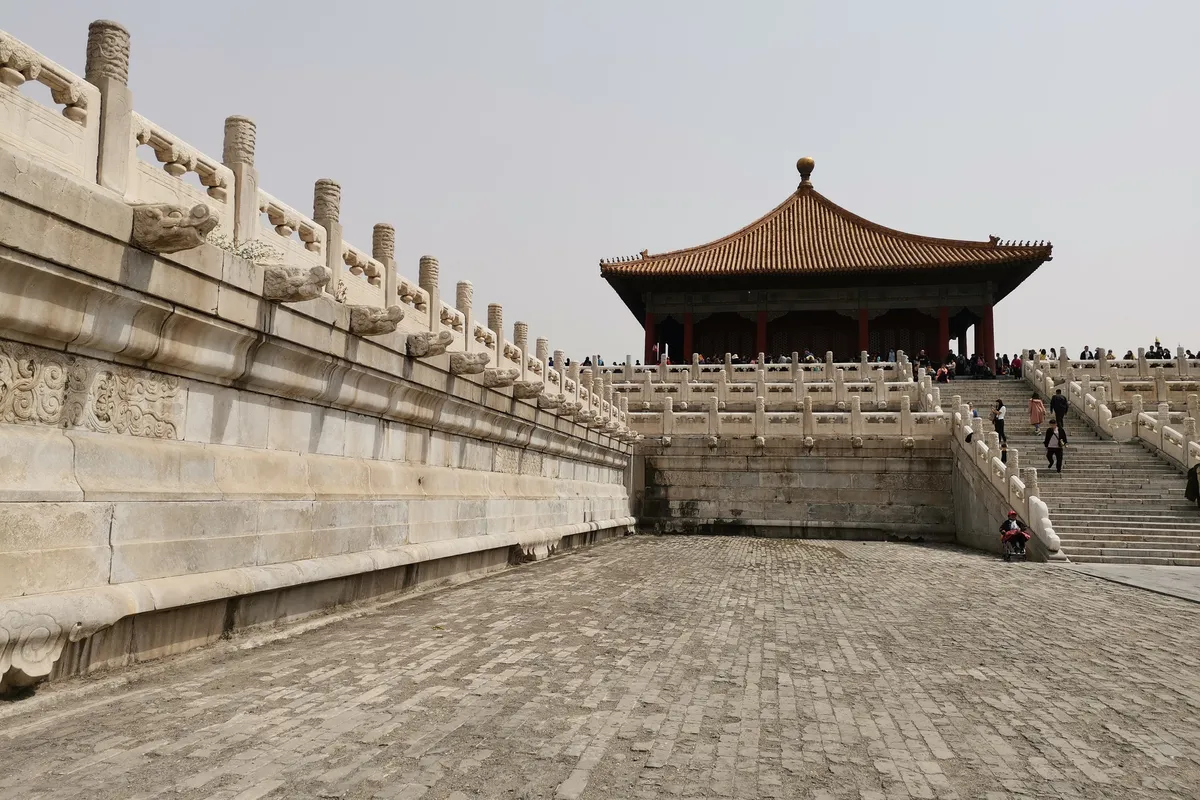
The Palace Museum in Beijing, established on October 10, 1925, is located within the Forbidden City in Beijing. It is a comprehensive museum built on the foundations of the Ming and Qing imperial palaces and their collections. It is also the largest museum of ancient art and culture in China. Its collection mainly comes from the former imperial collections of the Qing Dynasty and is one of the first batch of national patriotic education demonstration bases. It is one of the three great palaces in the world.
Since January 1, 2014, the Palace Museum has been closed almost every Monday. The Forbidden City is one of the first batch of national key cultural relics protection units, one of the first batch of national 5A-level tourist attractions, and a national advanced unit for ideological and moral construction among minors. In 1987, it was inscribed on the UNESCO World Heritage List.
The Palace Museum is located in the center of Beijing, 753 meters wide from east to west, 961 meters long from north to south, covering an area of more than 723,600 square meters. It is surrounded by a 10-meter-high city wall and a 52-meter-wide moat (Tongzi River). There are four gates on each side of the city wall: the Meridian Gate (Wumen) in the south, the Gate of Divine Might (Shenwumen) in the north, the Donghuamen and Xihuamen on the east and west. The Meridian Gate is the entrance for visitors, and the Gate of Divine Might is the exit. The total area of ancient buildings within the city is about 160,000 square meters (163,000 square meters according to some sources). The entire complex of palace buildings is laid out with strict adherence to feudal ritual and the yin-yang and five elements, reflecting the supreme authority of the emperor.
Although some of the Qing imperial collection were moved to the Taipei National Palace Museum between 1948 and 1949, the Palace Museum further enriched its collection after 1949 by retrieving treasures taken out of the palace by Puyi, accepting donations, and participating in archaeological excavations. The total number of artifacts has reached 1,807,558 items, including 1,684,490 precious cultural relics, 115,491 general cultural relics, and 7,577 specimens, covering almost the entire development history of ancient Chinese civilization and almost all categories of cultural relics.
【Other Notes】
Important reminder: All visitors in the same order must enter together and cannot enter separately. If entering at different times, please place separate orders with different ID numbers.
This ticket type does not allow more than 10 people per order. If the group exceeds 10, please place multiple orders, and provide the ID of each traveler when booking! One ID can only book one ticket per attraction per day (including the main ticket, Treasure Gallery, and Clock and Watch Gallery) on all online platforms. If you want to book the same ticket type for the same entry date again, please use a different ID. Otherwise, the order may fail. If the last digit of the ID number is X, please use uppercase X when entering the information, otherwise, the reservation cannot be made successfully.
If you do not bring your ID when entering, you can tell the staff your correct ID number for verification, but if the scenic area conducts a spot check, there is no guarantee of smooth entry. Therefore, please bring the relevant documents.
For multi-person orders, after verification of any one person, all visitors in the order are considered to have been verified (once verified, refunds cannot be applied), but others must still present their documents for secondary verification.
【Booking Restrictions】
Once the visit date is confirmed and submitted, it cannot be changed. Please choose the visit date carefully. After the ticket is successfully booked, please enter the scenic area on the date you selected for inspection. The pre-sale period is currently 10 days (excluding the current day).
An order cannot exceed 10 people. If exceeding 10, please place separate orders, and provide the ID of each traveler for booking. Different orders on the same travel date cannot use the same ID number.
【Tips】
During the period before and after legal holidays, Tiananmen Square has strict security checks, and there may be queues. It is recommended that you leave early to avoid delays.
If small children do not have an ID card, they must bring their household registration booklet. When booking, fill in the child's ID number. When entering, besides swiping the ID card, they can also verify by entering the ID number. However, if the scenic area conducts a spot check, smooth entry is not guaranteed, so please bring the relevant documents.
All visitors who book online can pass quickly through the dedicated entrance at the Meridian Gate (South Gate).
If the scenic area's e-ticket verification channel is under maintenance, guests must cooperate to exchange for a verified ticket at the designated window for entry. We apologize for any inconvenience.
Opening and closing times: The Palace Museum is open all year round. Opening times vary according to peak and off-peak seasons, and may be extended or shortened during legal holidays. Please pay attention to the announcement on the Palace Museum website.
Please avoid the peak period of 11:00 to 14:00 for visiting the Palace Museum. It is more comfortable to visit at the beginning or end of the day.
It is recommended to avoid the crowded central axis and pay attention to the various exhibitions held by the Palace Museum, such as the Ceramics Hall at Wenhua Hall, the Donated Cultural Relics Exhibition at Jingren Palace, and the Bronze Ware Hall at Chengqian Palace and Yonghe Palace.
Since July 2, 2011, the Palace Museum has implemented a one-way route from south to north: the Meridian Gate (South Gate) is used only as an entrance, and all visitors must enter the Palace Museum through the Meridian Gate; the Gate of Divine Might (North Gate) is used only as an exit. After the visit, visitors can leave through the Gate of Divine Might or the East Gate (Donghuamen).
13:30 Depart from the Palace Museum (Gate of Divine Might) and take a bus to Beijing South Railway Station.
14:10 Arrive at Beijing South Railway Station for lunch, shopping, and waiting. For lunch, we chose Qingfeng Baozi Shop.
15:30 Depart from Beijing South Railway Station by high-speed train back to Shanghai.
21:15 Arrive in Shanghai, ending the pleasant trip.