A Tour of Baoding Zhili Governor's Mansion During the 2021 National Day Holiday
Geographically, Baoding, Beijing, and Tianjin form an equilateral triangle, creating the so-called 'Golden Triangle' of the Beijing-Tianjin-Baoding region. Baoding also serves as the central point between Shijiazhuang and Beijing, as well as the center of the entire Hebei Province, so its importance to Hebei and even the Beijing-Tianjin-Hebei region is self-evident. Although Baoding's political status among Hebei's many cities has been relatively declining, there is one point on which there is broad consensus: Baoding has a rich historical and cultural tradition, and its status was once indeed prominent. It is said that during the evaluation of historical and cultural cities, Hebei initially submitted Handan, Xuanhua, and Shanhaiguan, with Baoding added later. After multiple rounds of review, only Baoding was unanimously approved by the numerous experts.
**The Origin of 'Baoding'**
Baoding is said to be the hometown of the legendary Emperor Yao. During the Spring and Autumn and Warring States periods, the states of Yan and Zhongshan both established capitals here, giving it a history of over three thousand years. According to the Ming Dynasty Hongzhi edition of the *Baoding Prefecture Annals*, King Zhao of Yan once built Guangyang City five li east of present-day Baoding, commonly known as 'Empty City', used for grazing war horses, earning Baoding the title 'South of Yan, North of Zhao'. This shows that Baoding initially emerged as a town for the defense of the State of Yan. Baoding is backed by the Taihang Mountains to the west, faces the Central Hebei Plain to the east, controls three passes to the north, and connects nine provinces to the south, often called the 'Thoroughfare of the Empire', 'Key Area of the Capital Region', and 'Southern Gateway of the Capital'. Due to its strategic location, it has always been a place of military contention. During the Song and Liao dynasties, Shi Jingtang ceded the Sixteen Prefectures of Youyun. After the Northern Song was established, Emperor Taizu and Taizong always regarded the recovery of Youyan as their strategic goal and paid close attention to military defense in Hebei. The Northern Song government established the 'Baosai Army' in Qingyuan County, meaning to guard the border. In 981 AD, it was upgraded to Baozhou, implying eternal peace and stability. Thus, Baozhou, along with Xiongzhou (present-day Xiong County) and Bazhou (present-day Bazhou City), formed a military defense line from southwest to northeast. The Song Dynasty often stationed troops here, making Baozhou a northern border fortress. Famous generals such as Hu Yanzan and Yang Si were once stationed in Baozhou.
During the Jin and Yuan dynasties, with the capital established in Beijing, Baoding was upgraded to Shuntian Military Commissioner, becoming an important town protecting the capital. Since then, Baoding 'guarded the capital region for seven hundred years and controlled the provincial government for two hundred years', earning the reputation 'Southern Shield of the Capital, Northern Fortress of Hebei'. In 1275, the Yuan Dynasty changed Baozhou to Baoding Circuit, meaning to protect the capital and stabilize the world, which is the origin of the name 'Baoding'.
**The Origin of 'Zhili'**
'Zhili' means directly subordinate to the capital. The term 'Zhili' first appeared in the Song Dynasty, where prefectures directly under the capital were called 'Zhili'. In the early Hongwu period of the Ming Dynasty, the capital was Nanjing (called Yingtianfu), so the area near Yingtianfu was designated as Zhili. After Prince Yan Zhu Di became emperor and changed the reign to Yongle, he moved the capital to Beijing, calling the area near Beijing 'North Zhili', which included present-day Beijing, Tianjin, all of Hebei Province, and small parts of Henan and Shandong. The original Zhili area near Nanjing was called 'South Zhili', including present-day Jiangsu, Anhui, Shanghai and other provinces and cities. After the Qing Dynasty entered the pass, the country was divided into 18 provinces (later 23 at the end of the Qing), plus special administrative regions such as Inner and Outer Mongolia, Qinghai, and Tibet. Therefore, South Zhili was renamed Jiangnan Province, and North Zhili, being near the capital Beijing, was renamed Zhili Province, with its jurisdiction remaining the same. After the establishment of Zhili Province, the Qing government took a series of political and economic measures in northern Zhili to maintain and consolidate its rule. First, to rectify the Qing army's military preparedness, unite the Mongol tribes, and strengthen northern border defense, they established the 'Mulan Hunting Ground' and the 'Chengde Mountain Resort', making Chengde the second political center of the Qing Dynasty. Second, to strengthen management of the Khalkha Mongols, they held a covenant meeting at Dolon Nor in the north, encouraged farmers to reclaim land outside the passes, develop livestock, and conduct market trade, promoting economic ties between Inner and Outer Mongolia. After the reigns of Yongzheng and Qianlong, the jurisdiction expanded daily, making it a key province of the capital region. As Zhili Province's political, military, and economic status rose and its territory expanded, by the end of Guangxu's reign, it had become a large province with 12 prefectures, 7 directly governed departments, 3 directly governed subprefectures, and 146 counties. Zhili's borders extended north to the border of the Abaga Right Wing Banner of Inner Mongolia, east to the border of Ningyuan Prefecture in Fengtian, south to the border of Lanfeng County in Henan, and west to the border of Guangning County in Shanxi, stretching 1,230 li east-west and 2,630 li north-south. According to statistics from the third year of Xuantong's reign (1911), the province had a total of 4,995,495 households with a population of 23,613,171. On February 18, 1928 (the 17th year of the Republic of China), Zhili Province was renamed Hebei Province.
**The Importance of the Zhili Governor**
The term 'Governor' (Zongdu) first appeared in the *Book of Han*, meaning 'general supervision and management', and was fixed as an official title starting from the Ming Dynasty. In the Ming Dynasty, governors were temporary posts established for specific matters, not a permanent system. The Qing followed the Ming system, initially appointing governors as special envoys, but gradually each province had one, becoming permanent.
Qing Dynasty governors were of two types: one specialized in important affairs, such as the River Governor and the Grain Transport Governor; the other governed local military and civil affairs. After the mid-Qing period, nine local governors were established nationwide: Zhili Governor (governing one province of Zhili, stationed in Baoding), Liangjiang Governor (governing Jiangsu, Jiangxi, and Anhui, stationed in Jiangning), Fujian-Zhejiang Governor (governing Zhejiang, Fujian, and Taiwan, stationed in Fuzhou), Huguang Governor (governing Hubei and Hunan, stationed in Wuchang), Shaanxi-Gansu Governor (governing Shaanxi, Gansu, and Xinjiang, stationed in Lanzhou), Sichuan Governor (governing one province of Sichuan, stationed in Chengdu), Liangguang Governor (governing Guangdong and Guangxi, stationed in Guangzhou), and Yunnan-Guizhou Governor (governing Yunnan and Guizhou, stationed in Yunnan). In the thirty-first year of Guangxu (1905), the Qing government added the Three Eastern Provinces Governor, governing Fengtian, Jilin, and Heilongjiang, with headquarters moving among the three provinces.
Both governors and provincial governors were the highest local officials. If a governor and a provincial governor were stationed in the same city, the provincial governor was under the governor's command. Their responsibilities also differed: governors focused on military affairs, while provincial governors focused on civil affairs. However, later, concurrent titles increased; in some provinces like Zhili and Sichuan, governors also acted as provincial governors, while in many provinces like Shanxi and Shandong, only provincial governors were appointed without governors, making it difficult to distinguish their duties. By the mid-to-late Qing, governors' powers expanded continuously. According to the *General Institutions of the Qing Dynasty*, the governor's duties were: 'to govern the military and civilians, command civil and military officials, assess officials, and maintain the borderlands.' This indicates that governors managed all military and civil affairs within their jurisdiction.
Governors were rank-2 officials; those granted the title of Minister of a Board were rank-1b. According to the Yongzheng system, governors granted the title of Minister of War also concurrently held the title of Right Censor-in-Chief of the Censorate. The title of Minister of War was to command local troops, and the title of Right Censor-in-Chief was to supervise local officials. Governors were respectfully addressed as 'Bureau Minister' (Bùyuàn) due to these concurrent titles. They were also called 'Zhitai', 'Dashuai', or 'Zhijun'. Initially, because governors were temporarily dispatched officials from the central ministries, their appointments were not part of the ancestral system, so they used a long seal for official documents called 'Guanfang' instead of a square seal. The governor's seal was made of silver, 3.2 inches long and 2 inches wide, with Manchu and Chinese seal script. When traveling, governors rode in an eight-man green sedan chair.
The full title of the Zhili Governor was 'Governor of Zhili and Surrounding Areas, Commander of Military Affairs and Grain Supplies, Manager of River Affairs, and Acting Provincial Governor of Zhili'. After the Xianfeng period, concurrent titles increased, and the title expanded accordingly, with a single incumbent system. In the early Qing, Zhili had both a governor and a provincial governor, each with their own jurisdictions and no hierarchical relationship. After several abolitions and establishments, and alternating governors and provincial governors with changing jurisdictions, it was not until the second year of Yongzheng (1724) that the system was fixed, with a dedicated Zhili Governor stationed in Baoding, appointed to Li Weijun. In the seventh year of Yongzheng (1729), the Qing court specially ordered the establishment of a governor's yamen in Baoding. In the fourteenth year of Qianlong (1749), the Qing court ordered the Zhili Governor to concurrently manage River Governor affairs. In the twenty-eighth year of Qianlong, the Qing court abolished the post of Zhili Provincial Governor, with the governor concurrently handling provincial governor affairs. In fact, after the second year of Yongzheng, the Qing court never appointed another Zhili Provincial Governor. In the tenth year of Xianfeng (1860), the Zhili Governor also took charge of the Changlu Salt Administration. At that time, the coastal area of Zhili, from Shanhaiguan in the north to the Huanghua salt fields in the south, was known as the Changlu Salt District. The Salt Transport Commission was originally stationed in Cangzhou (Changlu) and later moved to Tianjin. In the ninth year of Tongzhi (1870), the Qing government changed the Minister of Three Ports Trade to the Minister of Beiyang, and all foreign and coastal defense affairs under his charge were unified under the Zhili Governor. Thus, the Zhili Governor also concurrently served as the Minister of Beiyang. Because the original Minister of Three Ports Trade was stationed in Tianjin, the Qing government stipulated: 'Convert the Trade Minister's yamen into the temporary residence of the Zhili Governor. Every year, after the ice melts in spring, move to Tianjin; in winter, when the river freezes, return to the provincial capital Baoding. If there are important matters in Tianjin, do not strictly adhere to the schedule of returning after the river freezes.'
Because Zhili guarded the capital and its location was critical, the position of governor was reserved for significant ministers. Especially in the late Qing, the Zhili Governor also concurrently served as the Beiyang Minister of Trade, wielding great power. For example, Li Hongzhang served as Zhili Governor for 25 years. He represented the Qing government in signing the *Sino-French New Treaty* with France, the *Chefoo Convention* with Britain, the *Treaty of Shimonoseki* with Japan, the *Sino-Russian Secret Treaty* with Russia, and finally the *Boxer Protocol* with multiple countries. It can be said that after serving as Zhili Governor, Li Hongzhang reached the peak of his power, dominating both the court and the public, and became a prominent figure on the international stage. Hence, the Zhili Governor was known as the first among the nation's governors and the leader of regional officials.
Where there are officials, there are offices. With the establishment of the Zhili Governor as a regular post, the governor's yamen was built accordingly. The predecessor of the Zhili Governor's yamen can be traced back to the Yuan Dynasty. In the seventh year of Zhiyuan (1270) under Kublai Khan, Zhou Mengkan, a prefectural official of Shuntian Circuit (later renamed Baoding Circuit), built the 'Xuanhua Hall', which was the earliest predecessor of the Zhili Governor's yamen. In the Ming Dynasty, the original Xuanhua Hall served as the Baoding Prefecture yamen and later as the Daning Regional Military Commission yamen. In the early Qing, it was the office of a brigade commander. In the seventh year of Yongzheng, this site was selected for the Zhili Governor's yamen. Subsequently, acting Governor Yang Kun 'gathered materials and workers, and allocated public funds' for a major expansion, completed a year later. The renovated yamen featured 'high surrounding walls, spacious halls and steps', and complete facilities including halls, living quarters, stables, and kitchens. From then until the fall of the Qing Dynasty, through the reigns of Yongzheng, Qianlong, Jiaqing, Daoguang, Xianfeng, Tongzhi, Guangxu, and Xuantong—eight emperors over more than 180 years—it always served as the military and political hub of Zhili Province. A total of 59 governors (66 terms) served here, including notable figures such as Li Wei, Fang Guancheng, Liu Yong, Na Yancheng, Zeng Guofan, Li Hongzhang, and Yuan Shikai. The yamen repeatedly suppressed peasant uprisings, such as the Ci County peasant uprising under Qianlong, the Tianli Sect rebellion under Jiaqing, the Taiping Heavenly Kingdom Northern Expedition under Xianfeng, the Western Nian Army under Tongzhi, the Boxer Movement under Guangxu, and the Xinhai Revolution under Xuantong. Besides these, there were also many examples of promoting agriculture, managing water, inspecting officials, and redressing grievances. Its historical connotations are very rich, earning it the saying, 'One governor's yamen, half a history of the Qing Dynasty.'
After the Qing Dynasty fell, the provincial capital moved to Tianjin. In 1916, the former Zhili Governor's yamen became the Zhili Military Governor's office. In August 1920, it became the Zhili-Shandong-Henan Pacification Commissioner's office, turning into the stronghold of the Zhili clique warlord Cao Kun. The Zhili-Anhui War and the First Zhili-Fengtian War were planned here. In early 1933, it was converted into the Baoding Field Headquarters. In June 1935, the provincial capital returned from Tianjin to Baoding, and the Hebei Provincial Government was stationed here. In 1939, the Japanese puppet Hebei Provincial Government moved from Tianjin to Baoding and was also stationed here. During the Liberation War, the Kuomintang's 11th War Zone Command Headquarters, the Kuomintang Hebei Provincial Government, and the Kuomintang Baoding Garrison Command all successively used this office. After liberation, this yamen served as the Hebei Provincial Government Baoding Special Office and the Baoding Municipal Party Committee office. In January 1988, it was approved by the State Council as a National Key Cultural Relic Protection Unit. In November 1990, the municipal party committee moved out, and it was opened as a museum to the public.
The Zhili Governor's yamen is located at Yuhua Road, Lianchi District, Baoding City, Hebei Province.
In the urban area of Baoding, you can take buses No. 1, 4, 6, 8, 12, 26, 35, or 39 and get off at the Gulianguangzhi (Old Lotus Pond) Station.
Adult ticket: 30 RMB/person
Minors (under 18) are free.
The Zhili Governor's yamen faces south, is built in a small-style flush-gabled roof structure, and has a typical northern yamen architectural style. Its layout strictly follows the Qing Dynasty regulations for provincial yamens. The entire complex spans approximately 130 meters from east to west and 220 meters from north to south, with a total area of nearly 30,000 square meters. Divided by two north-south patrol paths, it consists of three parts: east, central, and west, known as the east road, central road, and west road. Each section forms a multi-courtyard quadrangle layout. The main buildings are located on the city's central axis. Outside the main gate are structures like the Y-shaped gate and flagpoles. Inside the main gate, the buildings in order are the ceremonial gate, main hall, second hall, official residence, and upper house. On the east and west sides are the money and grain offices and the criminal law offices, where private secretaries lived. Additionally, there are guard rooms, flower halls, clerical offices, and administrative offices. In the northwest corner of the complex is a back garden. This architectural form is closely related to the Forbidden City in Beijing, clearly influenced by its layout.
Baoding has three treasures: the Great Flagpoles, the Lotus Pond, and the Dabei Pavilion. The Lotus Pond refers to the Lianchi Academy, one of the four great academies of the Qing Dynasty. The Dabei Pavilion refers to the Zhenjue Temple, also known as Daci Pavilion. The Great Flagpoles refer to the two concrete flagpoles originally standing in front of the Qing Dynasty Zhili Governor's yamen. From afar, people coming to Baoding would first see the tips of these flagpoles and say, 'Baoding has arrived.' The most impressive sight for out-of-towners visiting Baoding is these flagpoles, which have become a symbol of the city.
According to the *Baoding City Map* in the Guangxu edition of the *Baoding Prefecture Annals*, the two flagpoles in front of the Zhili Governor's yamen were the tallest among all government offices in Baoding. Originally made of wood, each was six zhang high and painted red.
Flagpoles were important symbols of government authority. In September of the fifth year of the Republic of China (1916), Cao Kun served as the Zhili Military Governor and took up residence in the former Zhili Governor's yamen in Baoding. In December 1919, after the death of Feng Guozhang, leader of the Zhili clique, Cao Kun became its leader. In April 1920, Cao Kun convened a conference of representatives from eight provinces—Zhili, Jiangsu, Jiangxi, Hubei, Henan, Fengtian, Heilongjiang, and Jilin—in Baoding, forming an alliance against Duan Qirui, the leader of the Anhui clique then controlling the Beijing government. On July 14, Cao Kun held a military meeting at the military governor's office, appointing himself commander-in-chief and Wu Peifu as front-line commander, deciding to engage the Anhui army. After fierce battles at Gaobeidian, Zhuozhou, Songlindian, Liangxiang, and Gu'an, the Zhili army won a decisive victory. From then on, Cao Kun essentially controlled the central government in Beijing, making Baoding the stronghold of the Zhili clique. To display his power, Cao Kun decided to build two larger flagpoles in front of his yamen. To make the Great Flagpoles more impressive and showcase his authority, he ordered the removal of the original wooden ones and the construction of new concrete ones. At that time, concrete was still rare and had to be transported from Tianjin, reportedly from the first batch of German-imported cement. After the original wooden flagpoles were pulled down, they were cut into sections and removed. The new flagpoles were cast in reinforced concrete sections that were then connected and poured together, with an additional layer of concrete applied on the outside. Each of these concrete flagpoles was 10 zhang and 5 chi high, surpassing the 9 zhang 9 chi height of Tiananmen. The base was the size of a room, octagonal in shape. The flag compartments, square-shaped, were located at three-fifths of the height, with a two-foot-square opening for flag handlers to enter and exit. The section between the flag compartment and the base was hexagonal, roughly as thick as two men embracing. Above the flag compartment, the top part was conical, with a lightning rod at the tip.
Many historical events took place under these Great Flagpoles. In October 1922, Cao Kun bribed delegates to secure his election as President of the Republic of China, spending 13.56 million yuan in total, including 5,000 yuan per vote, with special votes reaching 10,000 yuan or more, buying 480 votes. On October 9, a grand ceremony platform was erected under the flagpoles. Cao Kun accepted the presidential election certificate from House Speaker Wu Jinglian on the platform, then took a special train to Beijing to assume office.
There are many fascinating legends about the Great Flagpoles. It is said that the famous Republican-era bandit Yanzi Li San (Li the Swallow) hid in the flag compartment during the day and came out at night. A folk rhyme from Baoding goes: 'Baoding's great flagpoles, piercing the nine heavens. At the base, sharp tips, where Hebei heroes hide.' After the founding of the People's Republic of China, the former Zhili Governor's yamen became the seat of the Hebei Provincial Government. On National Day, bright five-star red flags fluttered from the flagpoles, and a viewing platform was set up beneath them. Colorful archways and flags were erected to the east and west of the flagpoles. People from all walks of life in Baoding, dressed in festive attire, paraded and celebrated under the Great Flagpoles. This became a central gathering place for public events. On festive nights, strings of colorful lights hanging from the flagpoles seemed to connect with the stars, creating a magnificent sight. During the Cultural Revolution, the area under the flagpoles became a venue for the 'Four Bigs' (big-character posters, great debates, etc.). Layers of big-character posters were pasted on the bases of the flagpoles, and debating crowds circled endlessly...
Under specific historical conditions, these two flagpoles, symbolizing the ancient city of Baoding, were enveloped in a tragic hue. In 1971, the flagpoles that had stood in Baoding for over 500 years were pulled down. First, holes were drilled at the joints between the poles and bases, then ropes were tied to the poles, and bulldozers pulled them down. The bases were demolished with explosives. Before their destruction, the visionary photographer Cui Ying captured a last photo of the Great Flagpoles during their final moments, preserving the vanishing relics of history through the lens.
Seasons passed, days and nights changed. Twenty-three years went by, and Baoding underwent tremendous changes. The people of Baoding still often recall the towering image of the Great Flagpoles. The spring breeze of reform blew through every street and alley of Baoding. Baoding was listed as a National Historical and Cultural City, and the Zhili Governor's yamen was designated a National Key Cultural Relic Protection Unit. Rebuilding the Great Flagpoles became a popular wish, supported by experts and the government. After multiple discussions, and based on the opinions of relevant experts and citizens, the Baoding Municipal Government decided to rebuild the flagpoles at their original location, modeled after the reinforced concrete ones built in 1920. Now, the Great Flagpoles once again stand majestically in the ancient city of Baoding, resuming their magnificent form.
Outside the main gate, there was originally a set of buildings: the east and west guard rooms, the east and west Y-shaped gates, the spirit screen, the flagpoles, stone lions, and bell and drum towers. These formed a closed courtyard. The east and west Y-shaped gates were wooden structures with two pillars and a single roof. On the east gate was inscribed 'Southern Shield of the Capital' (Dōu Nán Píng Hàn), and on the west gate 'Northern Fortress of Hebei' (Jì Běi Qián Chéng). The gates were usually guarded by soldiers, and ordinary people were not allowed to enter casually. The south side of the Y-shaped gates connected to a gourd-shaped spirit screen. On the north side of the tall brick spirit screen, facing the main gate, was carved a pattern of sea waves, river cliffs, and a rising sun, with a gluttonous beast (tāo tiè) in the center. In ancient mythology, this beast was a greedy creature said to swallow gold and silver without end, even wanting to devour the sun, symbolizing insatiable greed. In old government offices, such images were used to warn officials not to take bribes or break the law. On the inside, at the east and west ends of the spirit screen, stood the two great flagpoles. In front of the main gate, to the east and west, were a bell tower, a drum tower, and a pair of stone lions. The bell and drum towers were demolished in the early Republic due to disuse. Additionally, to the southwest of the Y-shaped gates, there was originally a cannon platform, and to the east, parallel to the main gate, was the Temple of King Wu Cheng. Most of these buildings no longer exist. I only learned about them from relevant materials about the Governor's yamen, so I can only appreciate them through text.
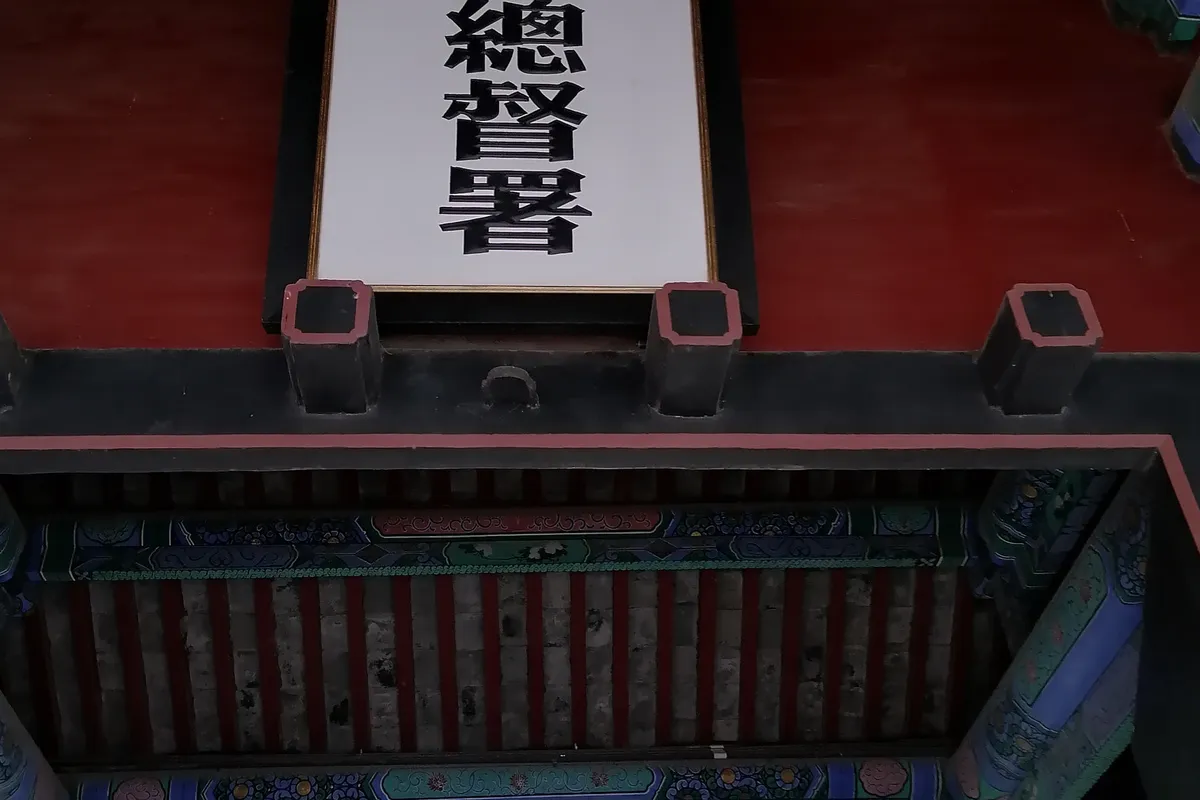
The main gate of the Governor's yamen is a black three-bay gate facing south, situated on a platform over three chi high. In the center above the gate hangs a plaque with the inscription 'Zhili Governor's Department' (or 'Zhili Governor's Bureau' in some materials), white characters on a black background, appearing solemn and dignified. On both sides is a pair of black-background gold-character column couplets. The first line reads: 'Absorbing the great desert to the north, stretching to the Yellow River to the south, with nine rivers converging in the middle, dominating the five states, a barrier between the western peaks and the eastern islands.' The second line: 'Cultivating internal governance, practicing military outside, concurrently managing the three-port trade, a generation of famous ministers, two masters and disciples before Zeng and after Li.' This couplet outlines the vast territory under the jurisdiction of the Zhili Governor, from the Mongolian desert in the north to the winding Yellow River in the south, and its extremely important strategic position, openly declaring the governor's all-encompassing power over internal affairs, diplomacy, military command, and administration.
**Inside the Main Gate**
Upon entering the main gate, the area is relatively open, with a wall door on each side leading to the east and west courtyards. From the main gate, a brick path leads north to the Ceremonial Gate.
Here is the couplet personally composed by Li Hongzhang for the Ceremonial Gate. The first line: 'Formerly the capital region, now controlling the strategic border, observing governance with leisure, personally arranging every hill and valley.' The second line: 'Near the Taihang Mountains to the west, far from the Bohai Sea to the east, retaining heroic sentiments and great scenes, following closely step by step.'
The first two phrases of the first line describe Zhili Province's important status: in the past (before the Opium Wars), Zhili was the capital region surrounding the national capital; today (after the Opium Wars), Zhili is controlled as a strategic border defense area. The following two phrases describe Li Hongzhang's own military actions after coming to Zhili. In the fifth year of Tongzhi (June 1870), the Tianjin Massacre occurred in Zhili Province, where the French consul Fontanier was beaten to death by an angry crowd, and the Wanghailou Church was set on fire. Warships from France, Britain, and seven other countries gathered at the Tianjin port and Yantai in Shandong. Zeng Guofan, the Zhili Governor, handled the case 'timidly and humiliated the nation, severely damaging his reputation.' At this critical moment, Li Hongzhang received a secret decree to 'lead all troops and march rapidly to the vicinity of the capital for stationed defense' and came from Xi'an to Zhili. He was then appointed Zhili Governor. He was fully aware of the weight of his responsibilities. In his memorial of thanks for the transfer, he clearly stated to the Qing court: 'Now I am appointed to transfer to the capital region at a time when coastal defense is critical, which is precisely when my official duties cannot be relaxed. But the capital region is a key area guarding the imperial capital. The fundamental plan involves the national framework; if I harbor any hesitation, I would betray loyalty and justice.' Based on this understanding of national defense, he deployed the Huai Army he brought along to various coastal ports, while also rectifying the provincial garrison troops, ordering them to guard the interior strategic points. This is what the couplet means by 'personally arranging every hill and valley.' 'Guanzheng' means observing political conditions, and it is said that these military deployments were made during the 'leisure time of political observation,' which is a pretense of ease but also reveals some of his self-confidence.
The first two phrases of the second line describe the natural features of Zhili Province: connected to Taihang in the west and facing the Bohai Sea in the east, which is the topographical characteristic of Zhili Province. The third phrase refers to Zeng Guofan, the previous Zhili Governor. Zeng came to Zhili with the 'heroic sentiments' of victory in suppressing the Taiping Heavenly Kingdom and did many beneficial things for the country and people: clearing up litigation, rectifying official administration, disciplining the army, managing rivers, relieving disasters, and reforming salt affairs—leaving behind 'great scenes.' The fourth phrase is about Li Hongzhang himself, indicating that he will follow closely in Zeng's footsteps, carrying on his policies like Xiao He following Cao Can's rules.
Above the Ceremonial Gate is a horizontal plaque reading 'Weifu Jijiang' (Awe-inspiring Protection of the Capital Region), meaning to pacify the territories near the capital with prestige.
The Ceremonial Gate was the place where the host welcomed and saw off guests. In feudal times, there were complex ceremonial protocols for meetings between officials of different ranks. Generally, civilian and military officials of equal rank would enter through the Ceremonial Gate and proceed together to the main hall. Officials of lower rank could only enter through the side doors of the Ceremonial Gate.
After entering the Ceremonial Gate, one first sees two rows of thick junipers, tall and vigorous, with ancient trees reaching to the sky. They are over 460 years old, living witnesses to history. Every winter, hundreds of owls roost among the leaves of the junipers, making the ancient trees and owls a scenic spot in the yamen.
A short distance north along the brick path is a wooden four-pillar, three-roofed stele pavilion, known as the 'Jiegong Stele Pavilion.' On the south side of the pavilion is engraved the three characters 'Gong Sheng Ming' (Impartiality Brings Clarity) in the calligraphy of the Song Dynasty scholar Huang Tingjian. On the north side, facing the main hall, are sixteen characters: 'Your salary and provisions come from the people's toil. The common people are easy to oppress, but Heaven is not to be deceived.' 'Gong Sheng Ming' is a maxim for officialdom, meaning that impartiality enables one to see the full truth of matters. When the governor sits in the main hall handling affairs, he can see this pavilion, serving as a reminder to be humble, diligent, fair, and honest.
In front of the main hall is a brick-built platform about 13 meters square. This platform is where officials held ceremonial events.
On both sides of the platform, to the east and west, are nine office rooms each. The east side houses the Civil Office, Revenue Office, and Rites Office; the west side houses the War Office, Punishments Office, and Works Office. These six offices correspond to the six central ministries. Adjacent to the south of the east offices is the Archives Repository for storing case files; adjacent to the south of the west offices is the Document Receiving and Dispatch Office for receiving incoming documents and issuing official notices. These areas now house exhibition halls displaying historical facts and background materials related to the Zhili Governor's yamen, helping visitors better appreciate the site.
The central building of the Zhili Governor's yamen is the Main Hall, also called the Public Hall. It was the venue for important political activities such as ceremonies, receiving imperial edicts, and issuing government decrees, and was the core place where the Zhili Governor exercised his authority. The main building rests on a platform 0.4 meters high, 22 meters wide with five bays, 9 meters deep with nine beams, a single-eave flush-gabled roof, and a three-bay front porch with a round ridge roof. The entire building is constructed of grey bricks, without brackets. Under the eaves, there are green and blue painted beams, giving it a simple and dignified style.
Inside the main hall, behind the screen at the main door, hangs a plaque reading 'Ke Gong Shou Mu' (Diligent and Respectful Chief Shepherd), which was personally written by Emperor Yongzheng and bestowed upon Tang Zhuyu, the Zhili Governor, as a reward for his diligent administration. The plaque has cloud and dragon reliefs on its four sides, with a blue background and gold characters, appearing solemn and majestic. According to legend, shortly after receiving the plaque, Tang Zhuyu was promoted to Minister of War. The plaque 'Ke Gong Shou Mu' is a true reflection of the incorruptible official Tang Zhuyu's life. Its important moral warning function is self-evident; each year, he used only thirty to forty percent of the 'nourishing honesty' silver granted by the Qing government, returning the rest to the provincial treasury. He wore simple clothes, ate plain food, avoided luxury, and taught his children to be thrifty and not greedy for money. After Tang Zhuyu died of illness, the acting Governor Gu Cong and his subordinates went to pay respects and sort out his belongings, finding 'nothing in his chests' to prepare his burial. They and other officials donated money to prepare his coffin and sent him back to Beijing for burial. Thereafter, each successive governor hung this plaque in the center of the main hall, and Tang Zhuyu's way of official conduct remains the best interpretation and confirmation of 'Diligent and Respectful Chief Shepherd.'
The main hall is decorated with black oil as the base tone, creating a solemn and majestic atmosphere. Inside is a screen with a painting of a red-crowned crane facing the sea tide and the rising sun, symbolizing a first-rank official; only a governor with the rank of first-rank official was qualified to use such an image. In front of the screen is a square wooden platform about one chi high. On the platform are placed a grand armchair and an official desk. To the right of the desk is a wooden frame for holding imperial rescripts, displaying the emperor's edicts and the seal box wrapped in yellow silk, symbolizing authority (the edicts and seal are not displayed). On the desk are placed arrow quivers, a sign tube, a brush rest, and other official tools.
On both sides of the hall are placed 'Avoidance' and 'Silence' signs and rank nameplates. The 'Avoidance' and 'Silence' signs are carved with tiger head patterns, commonly found in yamen halls. 'Avoidance' means that during court sessions or official business, any involved persons or relatives of officials should not approach and must not interfere. 'Silence' warns that the hall must remain quiet and no loud noise is allowed. The rank nameplates, also called 'cloud plaque racks,' vary in number depending on each governor's concurrent titles (including honorary titles). The nameplates have red backgrounds and black characters, one for each title. When the governor inspected, they were carried in front of his sedan to display his fame; normally, they were placed on both sides of the hall.
The main hall of the Zhili Governor's yamen is restored to the late Tongzhi period when Li Hongzhang served as governor. After becoming Zhili Governor, Li Hongzhang had many concurrent titles, reaching the pinnacle of his power and becoming a prominent figure in the late Qing. His titles numbered as many as eighteen, known as the 'eighteen cloud plaques of the imperial chariot.' His titles included: Imperial Appointed Minister of War, Right Censor-in-Chief of the Censorate, Governor of Zhili Military Affairs and Grain Supplies, Concurrent Acting Provincial Governor of Zhili, Ordered to Manage River Affairs, Manager of Changlu Salt Administration, Imperial Commissioner Beiyang Minister of Trade, Grand Secretary of the Wenhua Hall; Enfeoffed as Crown Prince's Grand Tutor, President of the Wuying Hall, First Rank Official with a Single-Eyed Peacock Feather, First Class Viscount Suyi, Granted the Right to Wear Three-Eyed Peacock Feathers, Granted the Right to Wear Dragon Square Embroidered Robe, Granted the Right to Ride a Horse in the Forbidden City, Granted the Use of a Purple Reign. On both sides of the nameplates are placed two 'Umbrellas of the People' presented to Li Hongzhang in the thirteenth year of Tongzhi (1874) by local gentry and wealthy families when he managed Baiyangdian Lake and the Daqing River. The umbrellas are cylindrical, made of silk, inscribed with names and phrases like 'The People Bear Virtue.'
During the Qing Dynasty, on the 60th and subsequent major birthdays of high-ranking civil and military officials, the emperor would often bestow gifts called 'cishou' (bestowed longevity), typically including fine silks, curios, imperial calligraphy of 'fu' and 'shou' characters, plaques, and couplets.
The main hall of the Zhili Governor's yamen has a front porch of three bays with four parallel pillars hung with prominent couplets. On the beams between the two central pillars are embedded bracket trays supporting plaques praising the governor's achievements.
On the central pillars of the main hall hang two column couplets presented by Emperor Guangxu and Empress Dowager Cixi on Li Hongzhang's 70th birthday. The couplet from Emperor Guangxu reads: 'Gui You En Rong Fang Shao Wang, Ding Zhong Xun Yi Fu Wen Nian' (You enjoy the glory of imperial gifts, your fame matches that of King Zhao's minister; your achievements are inscribed on bells and tripods, and you will enjoy a long and prosperous life). The horizontal scroll reads 'Jun Heng Du Hu' (Prime Minister's Blessings). The couplet from Empress Dowager Cixi reads: 'Dong Liang Hua Xia Zi Liang Fu, Dai Li Shan He Xi Da Nian' (You are the pillar supporting China, a gifted minister to the court; you are blessed with eternal imperial favor, and Heaven grants you a long life). The horizontal scroll reads 'Tiao Ding Ning Li' (Prime Minister's Good Fortune).
'Qi Zhen Ji Men' (Banner Town of Hebei Gate) was an imperial plaque given by Emperor Qianlong to the 23rd Zhili Governor, Fang Guancheng.
In the fifth year of Daoguang, Emperor Daoguang bestowed upon Zhili Governor Jiang Youtang a 60-minute hand warmer and an imperial plaque reading 'Xuan Qin Du Hu' (Promote Diligence and Blessings), praising his loyalty, integrity, and diligent administration.
On the occasion of Li Hongzhang's 70th birthday, Emperor Guangxu's couplet and plaque were as above. The horizontal scroll 'Jun Heng Du Hu' means 'Blessings to the Grand Secretary.' The first line roughly means: 'You enjoy the honor of imperial gifts like the jade wine vessel and fragrant wine, and your fame rivals that of the Zhou dynasty's minister Zhao Hu.' The second line roughly means: 'You have established brilliant achievements inscribed on bells and tripods, and you will have a bright future with many years.'
In the first year of Jiaqing (1796), on the 80th birthday of Liang Kentang, Emperor Jiaqing specially bestowed the imperial plaque 'Qi Shou Xuan Qin' (Longevity and Diligence) and a couplet: 'Feng Qi Zhu Ji Zheng Jia Rui, Jie Yue Sheng You Yin Da Nian' (Your achievements in the border region are auspicious; your authority leads to long life). This reflected the new emperor's concern and expectations for this veteran official of Zhili.
On Li Hongzhang's 70th birthday, the couplet and plaque from Empress Dowager Cixi were as above. The horizontal scroll 'Tiao Ding Ning Li' also means 'Blessings to the Prime Minister.' The first line means 'You serve as the pillar supporting China, a gifted minister sent to the court.' The second line means 'You are blessed with eternal imperial favor, and Heaven grants you longevity.'
The beams and columns of the main hall are connected using mortise and tenon joints, with few iron nails used.
From the east and west sides of the main hall, side doors lead north to the Second Hall Courtyard. The layout of the Second Hall Courtyard is compact, with surrounding corridors connecting. The ceiling beams, eaves, and door frames are made in the Jiangnan style, with exquisite carving. They were built during Li Hongzhang's tenure as Zhili Governor in the early Guangxu period, when he constructed the Huai Army Memorial Hall in Baoding and brought skilled craftsmen from Anhui to make these repairs, which are still well preserved. The east and west wing rooms each have three bays, with drum-shaped doorstones in front and rear doors, serving as passageways to the east and west patrol paths and the east and west flower halls. The main building of the Second Hall is five bays wide (22 meters) and 10 meters deep, with a layout of one bright room in the center and two dark rooms on each side. This hall evolved from the Yuan Dynasty 'Xuanhua Hall,' with broad platforms and many wooden elements retaining Song and Yuan styles. The Second Hall is also known as 'Tuisi Hall' (Retreat and Reflection Hall), 'Qinzhi Hall' (Good Governance Hall), or 'Sibu Hall' (Reflect and Supplement Hall), implying careful contemplation and assistance for shortcomings. It was where the regional official handled official business or discussed matters. In the Governor's yamen, the Second Hall was where the Governor received officials from other regions or retried cases. Generally, official business was conducted every five days (on the 5th and 10th of each month), called 'Yamen Day.' In the center of the Second Hall stands a three-panel screen with a carved unicorn pattern, representing a first-rank military official. In front of the screen are placed an official desk, grand armchair, and writing instruments. On both sides of the desk are three chairs each for the Provincial Treasurer, Provincial Judge, and other officials during joint trials. The east side of the Second Hall is the Discussion Room, where the Governor rested, changed clothes, or discussed matters with his staff before court. The west side is the Report Room, where clerks organized or searched for cases for the Governor.
As the location for daily government affairs, the Second Hall has a plaque reading 'Zheng Su Feng Qing' (Politically Dignified and Wind Clean). This content also comes from Yongzheng's saying: 'The capital region is the leading area; it must be politically dignified and wind clean to serve as an example for the four directions. Only those who are upright, incorruptible, and clear-sighted are competent!' This was Yongzheng's instruction to Shuntian Prefecture. Used here, it reflects respect for the emperor and signifies the important political significance of the Zhili region.
Passing through the Second Hall, one enters an open courtyard with interconnected gateways to the east and west patrol paths on each side. Further north is a brick wall with a hanging flower gate leading to the inner residence. The hanging flower gate was usually guarded by the Governor's trusted personnel. This gatekeeper had considerable power, commonly known as 'Gate Master Er.' Generally, visitors had to present money (called 'gate fee') to him for permission to enter. Beyond the hanging flower gate is the inner residence courtyard, consisting of the official residence and the upper house, two courtyards. Each has five main rooms, two side ear rooms on each side, and three wing rooms on each side, all connected by corridors. Pomegranate, lilac, crabapple, and wisteria fill the courtyard. With winding paths, sparse flowers and trees, and a strong living atmosphere, it feels like a different world compared to the front hall. The central room of the official residence is a passage hall. The east side room is the 'Inner Signature Room,' where the Governor usually reviewed documents and handled official business. The west side room is the study, where the Governor studied classics, practiced calligraphy, and cultivated his mind. Each Governor gave his study a refined name, such as Tang Zhuyu's 'Zhuo Shu Zhai' (Washing and Cleansing Studio) during the Yongzheng period.
A straight corridor connects the Second Hall to the official residence. Finally, through the official residence, one reaches the Upper House Courtyard, also called the 'Fourth Hall.' This was where the Governor's family lived and moved about, and outsiders were generally not allowed to enter freely.
**Office Building**
**East and West Flower Halls**
On the east and west roads of the Governor's yamen, there are also 'Flower Halls,' named 'East Flower Hall' and 'West Flower Hall,' where the Governor invited his friends to reminisce and discuss politics or held large banquets. The east and west roads also contain one or two courtyards, mostly where private secretaries worked and lived, called 'Mufu' (Private Secretariat), such as the criminal law secretariat and the fiscal secretariat. Although these buildings are lower in rank than the central road, they still have corridors and paintings, maintaining dignity.
**Imperial Poems on Cotton Drawings**
On the two sides behind the main hall are the 'Imperial Poems on Cotton Drawings' and the 'Military Skills Illustrations.' The 'Imperial Poems on Cotton Drawings' promoted local agricultural development and benefited the people. The 'Military Skills Illustrations' vividly depict the training of the Qing Green Standard Army. Speaking of the 'Imperial Poems on Cotton Drawings,' one must mention Fang Guancheng, one of the 'Five Qianlong Governors.' It is understood that Fang Guancheng served as Zhili Governor for nearly 20 years, second only to Li Hongzhong in tenure. During his term, he promoted agriculture, managed water, relieved famine victims, and handled litigation, doing everything methodically, effectively safeguarding the capital region.
Fang Guancheng's life was quite tumultuous. Originally from a scholarly family, his family declined when he was young, and his relatives were exiled, subjecting him to many hardships and strengthening his will. According to records, Fang Guancheng walked to Heilongjiang every year to visit his exiled grandfather and father, learning poetry and essays during the visits and understanding the sufferings of the people. Despite the hardships of going through summer and winter, these experiences tempered his resolve. At age 32, Fang officially began his career. In the early Qianlong period, much of Zhili Province suffered severe drought, forcing tens of thousands of people to flee their homes. After Fang Guancheng was transferred to Zhejiang as its governor, he did not forget the plight of Zhili's people. He sent people to Zhejiang to purchase sweet potato seedlings and brought back more than 20 workers to Zhili to teach planting. Later, when Fang became Zhili Governor, he continued to vigorously promote sweet potato cultivation, alleviating the hardships caused by the disaster. The saying, 'If an official doesn't act for the people, he might as well go home and sell sweet potatoes,' likely originated from this. Because of his diligent and benevolent governance in promoting sweet potato planting, the people in the capital region called sweet potatoes 'Fang's sweet potatoes.'
In addition, Fang Guancheng vigorously promoted cotton planting techniques during his tenure, benefiting the local population. He believed that planting cotton 'had the same merit as grains' and that only by enabling farmers to plant and weave cotton could 'clothing and bedding cover the world.' In the 30th year of Qianlong, Emperor Qianlong made a southern tour, and Fang Guancheng welcomed him and took him to inspect local cotton production, earning high praise from the Emperor. Later, based on his long-term experience in promoting cotton cultivation, Fang drew 16 pieces of 'Cotton Drawings,' detailing the entire process from planting cotton to weaving cloth in northern China. After each drawing, text explanations were attached. Fang then presented these drawings to the court. The Emperor Qianlong, upon seeing them, attached great importance and composed a poem for each drawing, creating the 'Imperial Poems on Cotton Drawings.' That same year, Fang supervised the carving of these drawings onto 12 pieces of duan stone. The 'Imperial Poems on Cotton Drawings' are clear and concise, with incised line engravings. The houses and people in the drawings are depicted vividly. 'Even illiterate commoners could understand the specific process of planting cotton through this set of drawings. The practical significance of the 'Imperial Poems on Cotton Drawings' surpasses that of other agricultural books.'
The Zhili Governor's yamen, having weathered many changes, embodies the merits and demerits of successive governors, accumulating rich historical connotations. It serves as a microcosm of the Qing Dynasty's politics, economy, military, and culture. Indeed, as the saying goes, 'One governor's yamen, half a history of the Qing Dynasty.'
I have written a lot here. Through writing, I have also learned a great deal. Without understanding this knowledge and background, just taking a walk through the Governor's mansion would be meaningless.
Travel Directory: 1. Baoding's Geographical Location and Importance 2. Baoding's History and Culture 3. Zhili Governor's Mansion 4. Location and Transportation 5. Tickets 6. Overall Layout of the Governor's Mansion
Travel Information Hotel Index Strategy Index Ticket Index Website Navigation Travel Index Cruise Index Business Travel Index Cooperation Alliance Distribution Alliance Friendship Links Enterprise Gift Card Procurement Insurance Agent Agent Cooperation Hotel Cooperation Destination and Scenic Area Cooperation More Cooperation Information About Ctrip Ctrip Hotspots Contact Us Recruitment User Agreement Privacy Policy Business License Security Center Ctrip Content Center Intellectual Property Trip.com Group Algorithm Disclosure