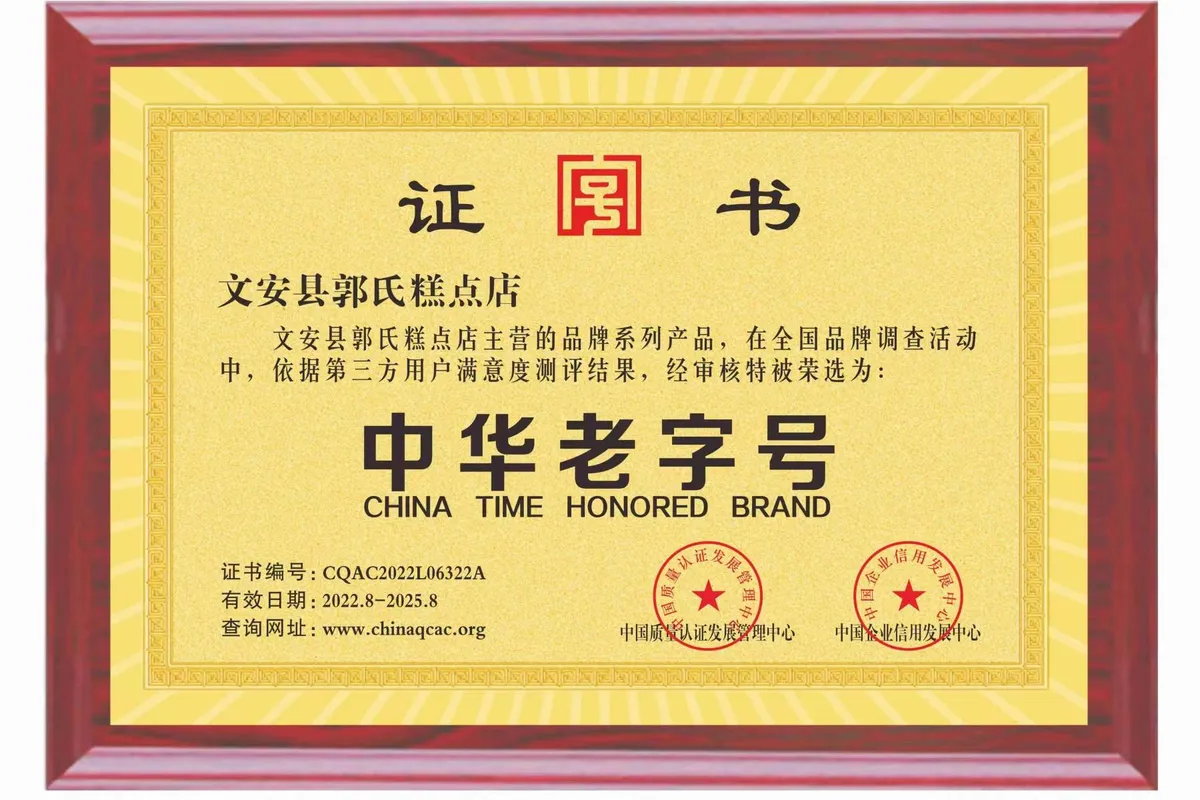
Zuogezhuang’s Century-Old Guo’s Gao Gan Named a China Time-Honored Brand
Zuogezhuang is a veritable ancient town with a history spanning over two thousand years. Founded in the Han Dynasty, it thrived in the Song and Ming dynasties and reached its zenith in the early Qing. A land of outstanding people and abundant resources, its culture shines brightly. Historical records show: in the third year of the Qian Yuan era of the Han Dynasty (177 BC), a man surnamed Zuo moved here, and the place was named Zuo Jia Zhuang after his surname; in the Tang Dynasty, it was renamed Zuo Shi Zhuang, later evolving into Zuogezhuang.
Zuogezhuang has a long history and numerous historical sites. Emperor Qianlong, in high spirits, crossed the Daqing River and toured scenic spots such as the Sanguan Temple, Haichao Monastery, Zhenwu Temple, and Beiji Temple, finally resting at the imperial lodge.
Guo's Gao Gan is a sight to behold on the streets of Zuogezhuang! It embodies the humanistic and historical culture of the town.
The two old houses of the Guo family are located south of the Gan River in Zuogezhuang. Originally, there were no houses to the east. According to my fifth uncle, Guo Yunwu, my three grandfathers, four grandaunts, my eldest uncle, my father, my fifth uncle, and my two aunts were all born here.
As far back as I can remember, our courtyard had two separate rooms. My blind third granduncle lived in the west room, while the east room, slightly taller and newer, housed my family of five: my parents, my older brother, me, and my younger brother. We lived there until 1977, when we renovated it into its current form. The land rights: the east room belonged to my eldest uncle and my grandfather, the west room to my third granduncle. We were in the same production team as my third granduncle. He passed away in the last lunar month of 1976—on the same day as our great Premier Zhou Enlai—and my father handled the funeral and cared for him in his old age.
The old house we see now is the ancestral home of the Guo family since they moved from Xiaopuli to Zuogezhuang. From the Guangxu period of the Qing Dynasty until today, it has witnessed the family's development and history. A modest business nourished an entire clan, persisting for over a hundred years—no easy feat. Integrity first, conscience in business—that's how it endures! Over the years, it has also fostered many university graduates and pillars of the nation, as well as entrepreneurs. The Guo family takes pride in their ancestors being small-time traders, not because of the wealth they left behind, but for the lessons on how to conduct oneself and earn a living.
The century-old house still exudes the delicate aroma of Gao Gan, drawing neighbors from all around with its fragrance. An elderly neighbor in her eighties tastes the Gao Gan, exclaiming how delicious it is—still that same old flavor—and doesn't forget to take a few pieces when leaving. To the east, 60-something old Mr. Liang savors the snack and praises it between bites. To the west, the elderly lady from the Dong family says after eating, 'It still has that same taste, but it's even better than before.' The warmth and affection among neighbors remain as genuine and close as ever, like one big family.
The descendants of the Guo family uphold the ancestral precepts: be honest and trustworthy, and lead a life of conscience. The fifth-generation successor, Guo Tongtong, carries forward the family's spirit of hard work and diligent study, crafting with meticulous care, and carrying on the century-old tradition with even greater brilliance.