Hebei Travel: Yishui Lake, Linked to Three Kingdoms’ Red Cliff (Photos)
Yi County in Hebei is a region with plentiful tourism resources. It is home to the renowned Western Qing Tombs, Langya Mountain where the five heroes of the Eighth Route Army bravely jumped off a cliff to block the Japanese invaders during the War of Resistance, Jingke Pagoda, Zijing Pass Great Wall ruins, and Yishui Lake, which gained fame after the filming of the movie 'Red Cliff'.
Scenery of Yishui Lake (Photo: Feng Ganyong)
I visited Yi County twice, on March 29 and May 6, 2007, together with Mr. Cao Qun, president of Beijing Aiche Yangguang, and others, to survey self-driving routes. Both times we went to the shimmering and exquisitely beautiful Yishui Lake, leaving me with a very deep impression.
Pier by Yishui Lake (Photo: Feng Ganyong)
Yishui Lake is located 25 kilometers southwest of Yi County town, 150 kilometers from Beijing, and 80 kilometers from Xiong'an New Area. It links the 'Juma's surging waves' above, leads to the 'Yishui's cold current' below, overlooks 'Langshan's scenic peaks' to the south, and borders 'Yunmeng's layered greenery' to the north.
Taking a speedboat on the lake (Photo: Feng Ganyong)
Yishui Lake covers a water area of about 27 square kilometers, with a storage capacity of 390 million cubic meters and a maximum depth of 48.5 meters. Its water quality meets the national Grade II drinking water standard. The surrounding mountains are majestic and steep, the air is clean and dust-free, and the forests are lush and dense.
Lake and mountain scenery (Photo: Feng Ganyong)
The name Yishui Lake carries a sense of historical gravity and tragic heroism. In 277 BC, during the chaos of the Warring States period, Jing Ke bid farewell to the Crown Prince of Yan by the Yishui River, setting off alone to assassinate the King of Qin. As he departed, he recited the timeless verse: 'The wind howls, the Yishui is cold; the hero leaves, never to return.' The 'Yishui' mentioned here is today's Yishui Lake in Yi County, Baoding.
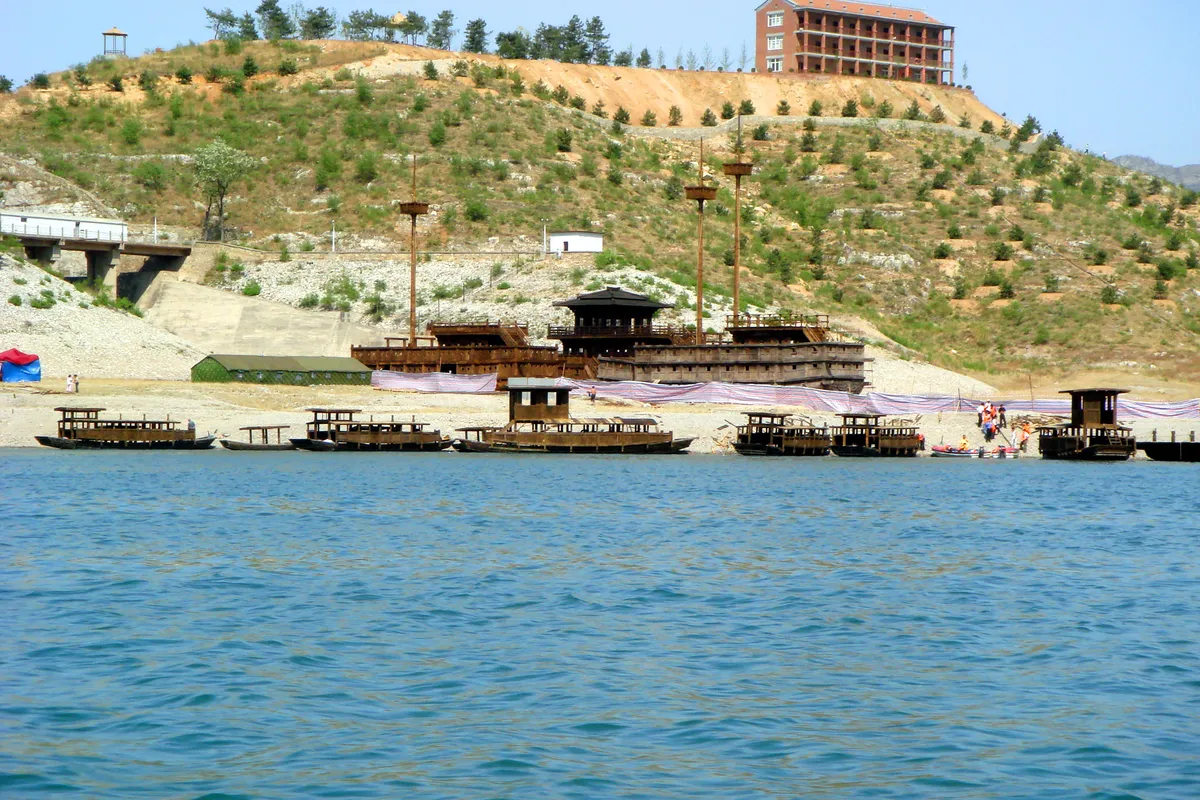
Distant view of the Red Cliff film set (Photo: Feng Ganyong)
It is Yishui Lake's beautiful mountains and waters that have attracted many film directors. It became especially famous after John Woo shot 'Red Cliff' here in 2007. Additionally, productions like 'Journey to the West,' 'A Battle of Wits,' and 'The Legend of Chu and Han' have all chosen this scenic locale for filming. Overlooking Yishui Lake from above, the clear water reflects the sky’s hues, making it feel like Qiandao Lake.
Cliffs and precipices in the lake (Photo: Feng Ganyong)
Notably, there is a spot called 'Little Guilin' by the lakeside, where vines drape over cliffs, sketching a scene reminiscent of the southern Guilin landscape. On the mountain, there are sights like Immortal's Cave, Immortal's Bridge, Immortal's Canal, and Prince's Hat, along with the beautiful legend of the Seven Immortals ferrying the Imperial Brother-in-law.
Sparkling lake surface (Photo: Feng Ganyong)
Visitors have composed verses: 'Seven immortals ferried the imperial brother-in-law here; Yishui Lake's little Guilin scenery. To see such beauty, why travel a thousand miles to Jiangnan?'
A corner of the Red Cliff film set (Photo: Feng Ganyong)
Visitors can appreciate Yishui Lake’s beauty from different angles. Looking down, the rolling mountains and ethereal mist create a fairyland illusion. From a boat, the lake and mountain scenery unfolds like a picturesque southern Chinese landscape painting.
Landing and arriving at the film set (Photo: Feng Ganyong)
Both times I visited Yishui Lake, we took speedboats to enjoy the lake and mountain beauty. At that time, the film 'Red Cliff' was in its preparation phase, so we rode speedboats to the film set by the lake and saw that they were busily constructing ancient warships.
Close-up of the warships (Photo: Feng Ganyong)
We saw rows of completed ancient warships and tents by the lake. The ships, made from real materials, looked authentically antique and imposing.
Photo at the film set (Photo: Wang Jue)
There is a mountain in Yishui Lake named Phoenix Mountain because its shape resembles a phoenix. After landing from the speedboat, our group climbed the path up. The mountain was thick with pines and cypresses, and vines covered the area, a genuine feng shui treasure. In about ten minutes we reached the summit, and the view of Yishui Lake from above was breathtaking.
Heading to the top of Phoenix Mountain (Photo: Feng Ganyong)
On Phoenix Mountain stands a Guanyin Temple, built by Liu Xiu. According to legend, when Wang Mang pursued Liu Xiu, Liu Xiu fled to Wugong City, where Wang Tan escorted him south. Wang Mang's army arrived at the foot of the mountain, about to capture Liu Xiu, who knelt and prayed to Guanyin for protection. The vines on the mountain ensnared Wang Mang’s troops, preventing their advance, and Liu Xiu escaped safely.
Viewing the mountain from the lake (Photo: Feng Ganyong)
After Liu Xiu ascended the throne, he built this Guanyin Temple on the mountain to repay the goddess for saving his life. The temple has enjoyed prosperous incense offerings, and worshippers' prayers are said to be answered.
Even more miraculously, a thousand-year-old cypress grows from a crack in the rock in front of the temple. Its trunk has been split in two by lightning, yet it remains luxuriant, which is also attributed to Guanyin's protection.
Enjoying the view on the mountain (Photo: Feng Ganyong)
When Emperor Kangxi of the Qing Dynasty visited and saw this tenacious tree, he immediately named it the 'Undying Cypress.' This mountain has since become a landmark tourist attraction.
Photo at the film set (Photo: Feng Ganyong)
On my second visit to Yishui Lake, after finishing the survey, Mr. Liu Xuejun, then director of the Yi County Tourism Bureau, suggested we visit Zijing Pass along the way. He led us to the Zijing Pass Great Wall, located 45 kilometers northwest of Yi County. This section is named after Zijing Ridge, on which it sits.
Zijing Pass Great Wall cultural relic stele (Photo: Feng Ganyong)
Zijing Pass is flanked by Wanren Mountain to the east and Xiniu Mountain to the west, with the wide Juma River bed stretching north of the Wall, making its position extremely strategic. Located 45 kilometers west of Yi County, the pass is guarded by the Eighteen Bends to the south and the Futu Pass gateway to the north nearby, with Xuanhua and Datong as distant outposts. The pass dominates the center, surrounded by perilous terrain on all sides, with peaks stacked like screens, making it one of the three key inner Great Wall passes.
Photo at Zijing Pass (Photo: Cao Qun)
Zijing Pass is one of the most ancient among the many formidable passes of the Great Wall and holds an important place in ancient Chinese military history. The earliest record of the pass appears in 'Lv's Spring and Autumn Annals,' where it was called 'Wuruan Pass' and listed among the renowned Nine Fortresses of the realm.
Overlooking from the Great Wall (Photo: Feng Ganyong)
During the Qin and Han dynasties, it was called Shanggu Pass; in the Northern Wei, Zizhuang Pass; and in the Sui and Tang, Baibi Pass. It was later renamed 'Puyin Pass,' the seventh of the Eight Passes of Taihang. In the early Song Dynasty, it was known as 'Jinpo Pass,' and by the mid-Song, it gained its current name. Legend has it that the area inside and outside the pass was once covered with bauhinia trees, and in midsummer, the blossoms filled the air with fragrance for miles. Thus, 'Purple Mist over Jing Pass' was designated one of the Ten Great Scenic Spots of ancient Yizhou.
Photo at Zijing Pass (Photo: Lin Lan)
In the Qin and Han periods, Zijing Pass was merely a small fortress of mixed earth and stone. Later dynasties carried out renovations but largely followed the original layout without significant expansion. After the Ming dynasty replaced the Yuan, in the early Hongwu reign, Emperor Zhu Yuanzhang approved the proposal of the famous general Hua Yunlong to rebuild the old city and construct a new Zijing Pass. Both the old and new walls were built with granite blocks, topped with grey bricks and battlements.
After the Hongwu era, through the Yongle, Zhengtong, Jingtai, Hongzhi, Jiajing, Wanli, and finally Chongzhen reigns, Zijing Pass was continuously reinforced. By the final days of the Ming dynasty, it had reached its current scale, becoming a relatively complete military defense system.
Great Wall walking path (Photo: Feng Ganyong)
Our group climbed onto the Zijing Pass Great Wall and looked down; both inside and outside the pass, the view was spectacular. After visiting Zijing Pass, our survey trip to Yishui Lake and Zijing Pass came to a successful end. (Text and photos: Feng Ganyong)