Hebei Travel: Notes on a Day Trip to Baiyangdian (with Photos)
Baiyangdian in Hebei is situated not far southwest of Beijing, the largest freshwater lake on the North China Plain and a renowned tourist attraction. Over the years, this reporter has visited many times; counting them up, including the most recent trip, I've been here at least five times. Even that last visit to Baiyangdian was already eight years ago. Yet this one-day trip to Baiyangdian, though brief, remains vivid in my memory.
Entrance to Jingkai Expressway (Photo: Feng Ganyong)
It was July 25, 2014, when our group went to Baiyangdian to take part in an activity themed 'Tracing the Footsteps of Anti-Japanese Heroes, Receiving Red Tradition Education.' To avoid the crowds typical of open tourist areas, we asked a friend whose hometown is near Baiyangdian—Si Zhenbo, general manager of Beijing Shidai Longxiang Cultural Center—to guide us on this trip. At 7 a.m., we gathered at the Xihongmen toll gate on the Jingkai Expressway and set off by car.
Daguang Expressway (Photo: Feng Ganyong)
In the early morning, the Daguang Expressway had little traffic. Our two cars cruised at a steady speed, and over the walkie-talkies, cheerful chatter filled the air. After about an hour and a half, we arrived at the Xidawu Wharf by the lakeside in Renqiu City. Eight of us boarded two small wooden boats and rowed into the depths of Baiyangdian.
Xidawu Tourist Wharf (Photo: Feng Ganyong)
Baiyangdian is administered by five counties and cities in Hebei Province: Anxin, Xiongxian, Rongcheng, and Gaoyang under Baoding City, plus Renqiu in Cangzhou City. 85% of its waters lie within Anxin County. Among the many lakes, Baiyangdian is the largest, hence its name. Since ancient times, it has been praised as the 'Pearl of North China' and the 'West Lake of the North.' Today, it is a nationally renowned 5A scenic area.
Boating on Baiyangdian (Photo: Feng Ganyong)
The people of Baiyangdian have a proud revolutionary tradition. During the War of Resistance Against Japanese Aggression, this was the setting for the story of 'Little Soldier Zhang Ga.' In particular, the local waterborne guerrilla force known as the 'Yanlingdui' (Wild Goose Feather Team) used the network of rivers, lakes, and channels to wage guerrilla warfare, striking fear into the enemy. They played hide-and-seek with the Japanese invaders among the reed mazes and lotus ponds, often leaving them battered and panic-stricken. This era also gave birth to the 'Lotus Lake School' of Chinese literature, represented by writer Sun Li.
A lone boat on the lakeside (Photo: Feng Ganyong)
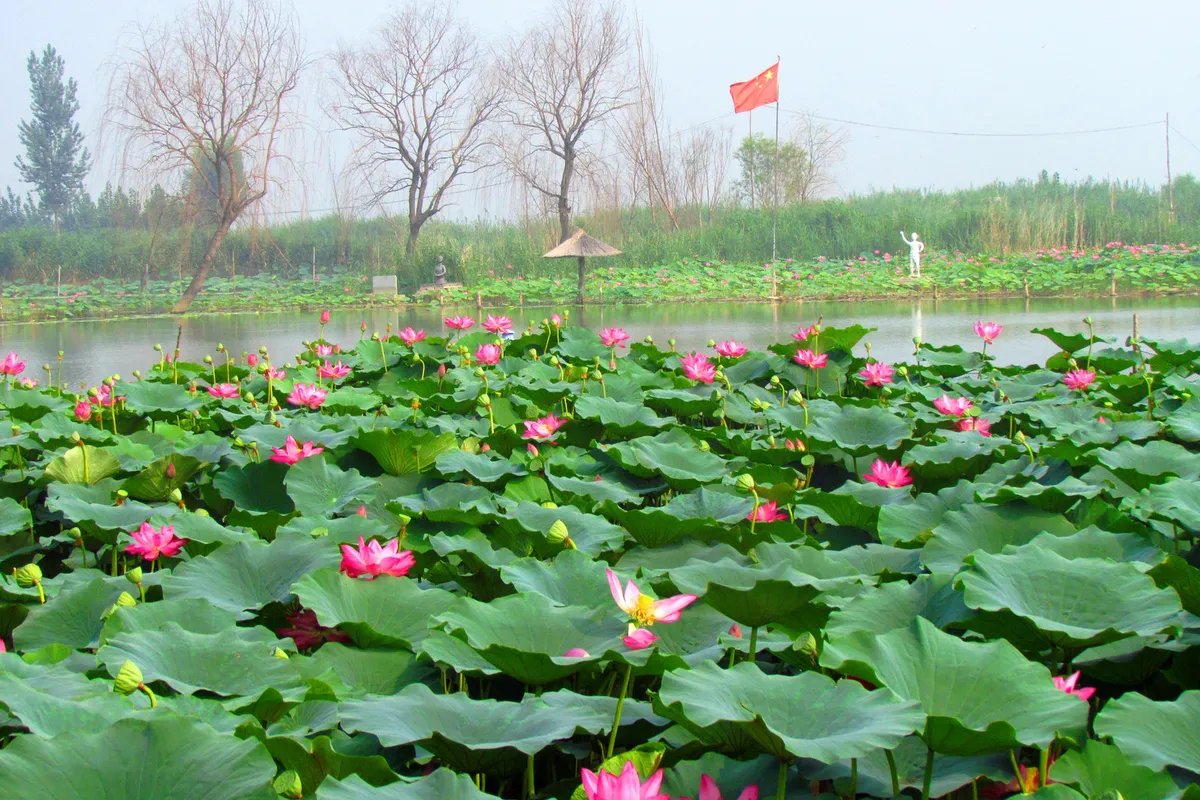
As our boat gradually entered deeper waters, Baiyangdian's beautiful lake scenery unfolded. A typical northern wetland, Baiyangdian has been famous since ancient times for its rich resources. It is a kingdom of birds, a paradise for fish, and a museum of aquatic plants. In midsummer, every reed, from stalk to leaf, is a fresh, gleaming green. By August, the lake is ablaze with blooming lotus flowers—red and white, graceful and upright, layer upon layer stretching endlessly, like a painting come to life.
Lotus pond scenery (Photo: Feng Ganyong)
Our boat first took us to a place called Xiaoyu Island. After going ashore, we followed a path along the embankment to a lotus pond. Lotuses are one of Baiyangdian's signature sights, and though this pond on Xiaoyu Island wasn't large, it offered a charming glimpse of the lake's lotus beauty. As we admired the blooming flowers, the enchanting melody of 'Moonlight over the Lotus Pond' by the group Phoenix Legend suddenly drifted over. With this scene—flowers, landscape, and music—the feeling of bliss was just right, a feast for the senses.
Capturing the beauty of Xiaoyu Island (Photo: Feng Ganyong)
General Manager Si told us that Baiyangdian boasts as many as 366 varieties of lotus, each with distinct forms and hues, making it the largest and most diverse lotus-growing area in northern China and beyond. The lake also has over 150,000 mu (about 10,000 hectares) of reeds, stretching as far as the eye can see. From any angle on the water, the endless reed beds resemble a long green Great Wall. They not only create a unique scenic backdrop but also provided effective natural cover for the elusive Yanlingdui guerrilla fighters during the war, who kept the Japanese troops howling in frustration. Today, these reeds remain a major source of income for the area.
Battle monument (Photo: Feng Ganyong)
Xiaoyu Island is not large, but its tranquil setting is pleasant. Here stands a memorial stone for the 'Caiputai Battle,' recording a guerrilla engagement against Japanese invaders that took place on the seventh day of the lunar calendar in 1942 in Caiputai Village.
Naval mines on the island (Photo: Feng Ganyong)
Also on the island are exhibits and replicas of wartime equipment used against the Japanese, such as floating mines ('water drifters') and resistance boats ('lifting poles').
Statue of Little Soldier Zhang Ga (Photo: Feng Ganyong)
At the far end of the island stands a rustic blockhouse and lifelike figures of militia fighters and the boy hero Zhang Ga. Though modest in scale, these traces vividly evoke the unforgettable history of Baiyangdian's struggle against the Japanese.
Blockhouse on the island (Photo: Feng Ganyong)
In the quiet setting of Xiaoyu Island, we held a serious democratic life meeting. Centered on the trip's theme, Party activists and members exchanged thoughts openly. Recalling the stirring stories of wartime resistance and learning about the local customs and natural environment gave everyone a valuable lesson in red tradition education.
A corner of the reed marsh (Photo: Feng Ganyong)
Blending the beauty of nature with a harmonious atmosphere, the meeting was lively and spirited. All agreed that this trip to Baiyangdian was profoundly meaningful.
Life meeting on the island (Photo: Si Zhenbo)
After the themed activity, it was close to noon. We boarded the boats and left Xiaoyu Island, heading toward Anxin County. After a boat ride of tens of minutes, we landed at a lakeside wharf in Quantou Village, about 45 kilometers east of Baoding City in Anxin County. Quantou Township lies at the heart of the Baiyangdian area, surrounded by water and comprising 29 lakes and ponds of various sizes.
Yacht by the water (Photo: Feng Ganyong)
It administers 11 village committees: Quantou East Street, Quantou West Street, Quantou Qiaonan, Quantou Qiao, Dongguangdian, Shaozhuangzi, Caiputai, Datianzhuang, Dongtianzhuang, and Beitianzhuang. The local economy thrives on reed mat weaving, aquaculture, and fishing. In the past, many emperors toured here; the Qing Dynasty's Qianlong Emperor came to hunt and even built a temporary palace.
A standout bloom (Photo: Feng Ganyong)
Walking through the village, narrow lanes crisscross like a maze, with old gates and courtyards here and there. Of course, many new houses have been built by the villagers. The tall gatehouses and intricately decorated screen walls featuring dragons and phoenixes reflect the comfortable life of local farmers. Winding through the alleys, we arrived at a supply-and-marketing cooperative restaurant, where we had our lunch that day in Baiyangdian.
Waterside scenery on Xiaoyu Island (Photo: Feng Ganyong)
Stepping into this outwardly modest eatery, I was surprised to enjoy a sumptuous local farmer-style feast of river shrimp, loach, sweet-and-sour fish fillets, fish-scale jelly, stewed mixed fish, wood ear mushroom fish slices, crispy fish slices, stir-fried lotus leaves, spiral-shell garlic shoots, and staples like shrimp pancakes and spiral pastries.
Boatman on Baiyangdian (Photo: Feng Ganyong)
Speaking of Baiyangdian's culinary culture, it's quite impressive. As a famous land of fish and rice, the area abounds in fish, shrimp, crabs, and turtles, cooked in countless ways. The nationally renowned 'stewed mixed fish' was originally a simple meal for fishermen making do. There's also the Lotus Banquet—dishes entirely made from lotus plants; the All-Fish Banquet is a masterpiece showcasing the full range of local fish preparation. The fish soup is so delicious you'd regret not tasting it for the rest of your life. And the staple of baked corn cakes served with braised small fish is just one of many such treats.
Scenic beauty of Baiyangdian (Photo: Feng Ganyong)
Also noteworthy is a local specialty: tea-patterned century eggs (pidan), one of Baiyangdian's famous products. The eggs come from free-range ducks and are made using traditional methods with modern scientific formulations. They are known for their bright color, savory taste, and distinct tea-like patterns. When cut, the egg reveals four rings of dark green, black, light brown, and deep brown. They can be used in cold dishes, century egg tofu, century egg congee, and more.
Fishing in Baiyangdian (Photo: Feng Ganyong)
The lavish lunch at the supply-and-marketing cooperative restaurant couldn't possibly cover every local delicacy, but the representative dishes we savored opened our eyes and palates, letting us fully appreciate and enjoy the flavors of Baiyangdian in an unforgettable way.
Sweet-and-sour fish fillets (Photo: Feng Ganyong)
After lunch, we returned to the wharf, boarded the boats again, and cruised to an open area of the lake. Those who could swim jumped into the water for a dip. The summer water temperature was just right—neither cool nor warm—perfect for swimming. Mr. Si told us that almost all children who grow up around Baiyangdian know how to swim.
Shrimp pancakes and spiral pastries (Photo: Feng Ganyong)
Nature is the best teacher; these kids, without any formal training, frolic in the water with ease and skill. It is this uniquely endowed natural water world that has made Baiyangdian famous. The day passed quickly in relaxation and joy, but the wonderful memories remain.
The reporter enjoying a swim in Baiyangdian (Photo: Si Zhenbo)
For a place less than 200 kilometers from Beijing, I believe that anyone who visits will, to some degree, find it truly enchanting—a place that makes you want to linger. (Text & photos: Feng Ganyong)
(Source: China News Network)