Step Inside the Zhili Governor-General's Office: Half the Story of the Qing Dynasty Unfolds
China is so vast, I want to see it. Let me take you to a place you may or may not have visited.
Step inside the Zhili Governor-General's Office and witness half of Qing Dynasty history.
The Zhili Governor-General's Office in Baoding, Hebei, served as the seat of the Viceroy of Zhili from the eighth year of the Yongzheng reign (1730) until the fall of the Qing Dynasty (1911), a span of 182 years. It is a microcosm of Qing history, and it is often said that 'one viceroy's office contains half the chronicle of the Qing Dynasty.'
After the Qing Dynasty conquered the Central Plains, it adopted the Ming system and continued to implement provincial administration. The area surrounding the capital, known as the metropolitan region, held greater importance than other provinces. Directly governed by the central government, it was called Zhili Province—literally 'Directly Ruled'—and is the forerunner of today's Hebei Province, though its jurisdiction was much larger, especially in the late Qing period.
The position of Governor-General originated in the Ming Dynasty as a temporary imperial envoy. The Qing gradually institutionalized it, and in the second year of the Yongzheng reign (1724), it became a permanent post. A Governor-General was the highest military and administrative head over one or more provinces, a substantive high-ranking official with a rank of Second Grade, Upper Level. The official title for the Viceroy of Zhili was 'Governor-General of Zhili and Other Regions, in Charge of Military Affairs, Provisions, Waterways, and Concurrently Overseeing the Governor's Duties.' Among the eight governors-general of the Qing, the Viceroy of Zhili was the most important, ranking first among provincial authority.
Where there is an official, there is an office. The Zhili Governor-General's Office, built in the seventh year of the Yongzheng reign (1729), is the only relatively well-preserved provincial-level government compound from the Qing Dynasty in China.
Since the Ming and Qing dynasties, government compounds from the imperial palace down to county yamens followed a fixed layout: south-facing, with offices in the front and living quarters in the back, divided into central, east and west paths, with civil offices on the left and military on the right, in a symmetrical, harmonious, and enclosed arrangement—a typical architectural group under the feudal hierarchy reflecting work and life.
The Zhili Governor-General's Office is a first-level feudal official compound, about 220 meters deep from north to south and 130 meters wide from east to west. Two north-south side corridors divide it into east, central, and west sections. Today, the west section no longer exists, and the east section is incomplete. The central section, with the main buildings, is the best preserved, including the main gate, ceremonial gate, great hall, second hall, official residence, and upper rooms. It now serves as the Zhili Governor-General's Office Museum.
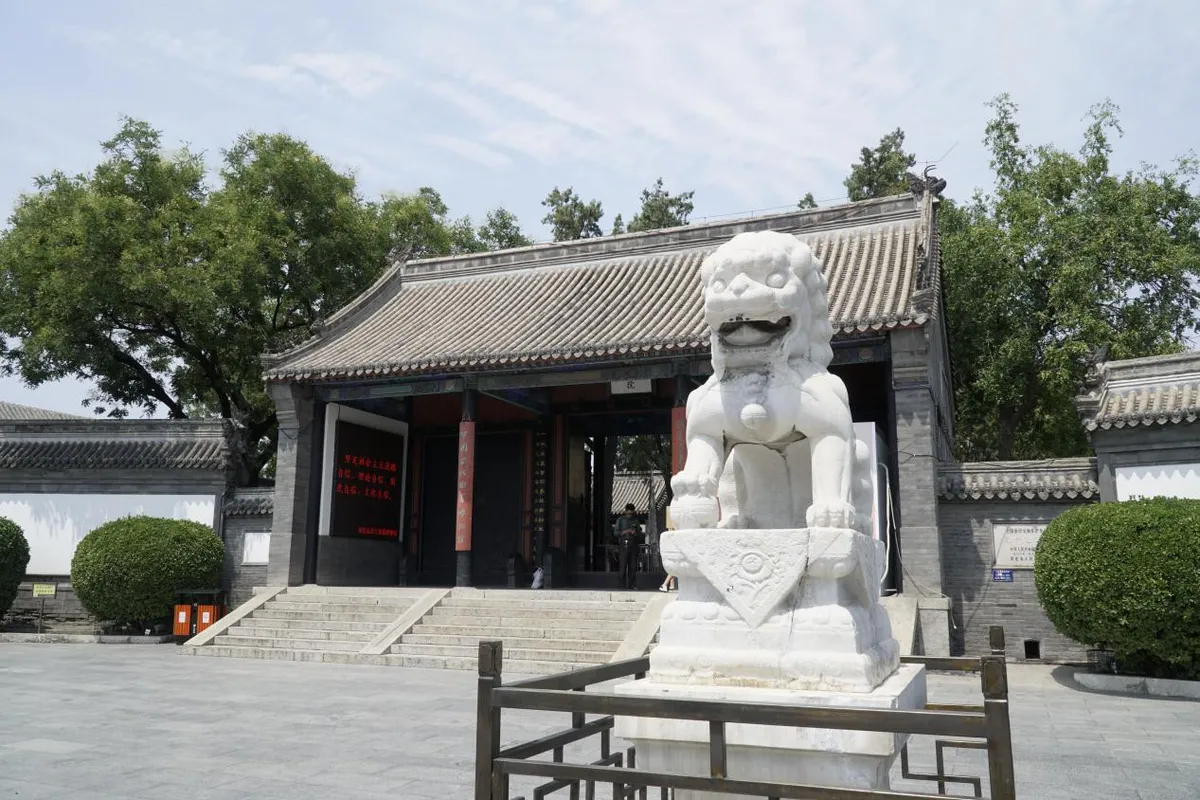
Outside the main gate, there was originally a semi-enclosed courtyard with flagpoles, stone lions, a spirit screen, east and west archways, duty rooms, a drum pavilion, and a music pavilion. The drum pavilion, music pavilion, and spirit screen are now gone.
The large flagpoles outside the archways were originally wooden. In the early Republican period, when Cao Kun served as the Inspector-General of Zhili, Shandong, and Henan, he ordered the wooden poles replaced with concrete ones, increasing their height from around ten meters to 33.6 meters, showcasing grandeur and becoming the tallest flagpoles in the country. The current flagpoles are reconstructions.
The main gate features a simple flush-gable roof and is three bays wide. The plaque above reads 'Headquarters of the Zhili Governor-General'. In the central government, the Viceroy of Zhili concurrently held the titles of Minister of War and Right Censor-in-Chief of the Censorate, making him a first-rank official, so the compound was respectfully referred to as a 'departmental headquarters'. For example, Li Hongzhang served twice as Viceroy of Zhili for nearly 30 years and held numerous concurrent titles. At the peak of his power, his full title was: Imperial Appointee as Minister of War, Right Censor-in-Chief of the Censorate, Governor-General of Zhili in Charge of Military Affairs and Provisions, Concurrently Overseeing the Governor of Zhili, By Imperial Order in Charge of Waterways, Administrator of the Changlu Salt Gabelle, Imperial Commissioner for Trade and the Northern Ports, Grand Secretary of the Wenhua Hall; Honored as Grand Tutor of the Heir Apparent, Director of the Wuying Palace, First-Rank Official, First-Class Earl of Suyi, Granted the Three-Eyed Peacock Feather, Granted the Square Dragon Robe, Permitted to Ride a Horse in the Forbidden City, Granted the Use of Purple Bridle Reins, and so on.
Entering the gate, you see the ceremonial gate. Above it hangs a plaque reading 'Awe-Inspiring Governance over the Imperial Domain', with couplets written by Li Hongzhang when he first took office as Viceroy hanging on the columns. Only officials of rank equivalent to the Governor-General were allowed to proceed through the ceremonial gate to the great hall; lower-ranking officials had to use the side doors.
Beyond the ceremonial gate stands a wooden admonition arch, also known as the 'Justice Breeds Clarity' arch. On the back is carved a sixteen-character official maxim written by Huang Tingjian: 'Your salary and emoluments are the fat and blood of the people. The common folk are easily oppressed, but Heaven is hard to deceive.' These words were originally part of a longer exhortation by Meng Chang, emperor of the Later Shu, to his ministers. Emperor Taizu of the Song Dynasty extracted these four lines, had Huang Tingjian inscribe them, and placed them in government offices throughout the Song, a practice largely continued by the Yuan, Ming, and Qing dynasties.
The great hall, also called the main hall, is the core building of the compound, where grand ceremonies and governmental activities took place. In the center of the hall, a screen depicts ocean waves, a rising sun, and red-crowned cranes, symbolizing a first-rank civil official. Hanging above is a plaque reading 'Reverently Serve as the Foremost Herdsman', handwritten by Emperor Yongzheng and bestowed upon Tang Zhiyu, the eighth Viceroy of Zhili, and preserved by his successors. Flanking the hall are two side buildings, each with nine rooms, housing the six departments: Civil Office, Revenue, Rites, War, Justice, and Works. Each department occupied three rooms to handle documents and affairs corresponding to the Six Ministries.
In ancient China, local administration and judiciary were not separated; the local chief executive also oversaw judicial proceedings and public security. From the Song Dynasty onward, local officials were even required to personally adjudicate cases, a practice that continued into the Ming and Qing. Governors-general generally did not directly try cases, but the only trial ever held in this great hall was one in which the defendant was the Governor-General himself.
In the 26th year of the Guangxu reign (1900), the Eight-Nation Alliance invaded China. British, French, German, and Italian troops moved south to Baoding, burning, killing, and looting. They set up an Allied headquarters and a so-called military tribunal, arresting Zhili Financial Commissioner Tingyong (acting Viceroy of Zhili), city garrison commander Kuiheng, Huai Army commander Wang Zhankui, and Judicial Commissioner Shen Jiaben. The four Allied commanders swaggered into the great hall, imitating Chinese officials trying criminals, and had Tingyong, Shen Jiaben, Kuiheng, and Wang Zhankui trussed up with ropes, forced to kneel and stand trial in a mock 'international tribunal'. Using Qing legal provisions for 'heinous criminals', they charged them with supporting the Boxers and took Tingyong and two others to Phoenix Tower in Baoding, where they were beheaded and their heads displayed. It was a deep humiliation for the government and the entire nation.
Passing through the side corridors of the great hall, you enter the second hall. Also known as the 'Retreat Hall', 'Mending Hall', or 'Governance by the Zither Hall', it suggests careful reflection and making up for deficiencies. This was where the Governor-General conducted daily work, received officials from other regions, and reviewed cases. In the center hangs a plaque reading 'Clean Government and Clear Morale'. Below it stands a three-panel screen; the middle panel features a qilin motif, which in Qing official robes represented a first-rank military official, while the side panels each show a crane symbolizing civil rank. The east side room was a council chamber, and the west side room was a reception hall, both used for discussions with advisors.
Beyond the second hall is a small courtyard about six meters wide. To the north, a decorative wall separates it, with a festooned gate in the middle, also called the inner residence gate. Behind it are two successive courtyards where the Governor-General lived with his family, collectively known as the inner residence.
Facing you is a row of five tiled rooms, the third hall, also called the official residence. Here the Governor-General worked and reviewed documents. The two rooms to the east were the inner office, where he routinely read incoming reports and handled official business.
Passing through the corridor from the third hall, you reach the fourth hall courtyard, the living quarters for the viceroy's family. The main building has five rooms, with two side rooms on each side. This was where the viceroy relaxed with his family during leisure hours.
After the Qing Dynasty fell, the east and west sections of the compound underwent extensive renovation or demolition.
It cannot be denied that the Viceroys of Zhili held immense power and high rank, yet the architectural style of their office is a branch of palatial architecture. The wooden structures avoided lavish bracket sets (dougong) and hipped-gable roofs, opting instead for modest flush-gable roofs. The compound reflects both hierarchical formalism and the down-to-earth character of traditional northern courtyard residences.
Compared with many grand private mansions and government offices, the scale of this compound is relatively modest; some even say it is 'only a little better than a village earth god temple.' In a traditional society where rulers valued frugality and moral governance, practicality was the ultimate goal of architecture.